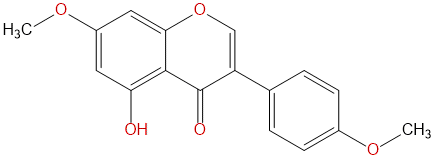


Product name: 7-O-Methylbiochanin A
Synonym name: 4',7-Dimethoxy-5-hydroxyisoflavone; Biochanin A 7-methyl ether; Genistein-4',7-dimethylether
Catalogue No.: BP4371
Cas No.: 34086-51-6
Formula: C17H14O5
Mol Weight: 298.294
Botanical Source:
Type of Compound:
Purity: 95%~99%
Analysis Method: HPLC-DAD or/and HPLC-ELSD
Identification Method: Mass, NMR
Packing: Brown vial or HDPE plastic bottle
Storage: Store in a well closed container, protected from air and light. Put into refrigerate or freeze for long term storage.
Whenever possible, you should prepare and use solutions on the same day. However, if you need to make up stock solutions in advance, we recommend that you store the solution as aliquots in tightly sealed vials at -20℃. Generally, these will be useable for up to two weeks.
The product could be supplied from milligrams to grams
Inquire for bulk scale.
For Reference Standard and R&D, Not for Human Use Directly.
Storage conditions:Short-term storage at 2~8℃, long-term storage at -20 ~ -80℃
68.9000
2.7044
2.6898
.0391
5.3455
64.6499
Low
92.1441
2.0989
Yes
No
Yes
No
Yes
Yes
2.1
No
No
No
No
7-Methylbiochanin A is a natural isoflavone derivative with the chemical name 4',7-dimethoxy-5-hydroxyisoflavone, CAS number 34086-51-6. This compound was originally obtained by isolation from the roots of the lotus plant Lotus polyphyllos, and due to its unique chemical structure and biological activity, it has attracted widespread attention in the field of natural product pharmacology in recent years. Isoflavones are plant secondary metabolites with various biological activities, including antioxidant, anti-inflammatory, anti-tumor, and anti-infective effects. Especially in antimalarial research, 7-methyl hawk-clawin A has shown significant potential, showing inhibitory activity against multiple key targets of the malaria parasite, making it an important candidate for new antimalarial drug development.
This review aims to systematically summarize the chemical structure and physicochemical properties, plant origin, and extraction methods of 7-methyl hawk-clawin A, with a focus on its pharmacological activity and mechanism of action. By combining druggability evaluation and pharmacokinetic characteristics, it explores its clinical application prospects in the field of malaria treatment, aiming to provide a theoretical foundation and practical guidance for related research.
The molecular formula of 7-methyl hawk-claw A is C17H14O5, with a molecular weight of 298.2940. Its structural core is the isoflavone backbone, characterized by methoxy substituents at positions 4' and 7, and a hydroxyl group at position 5, forming the 4',7-dimethoxy-5-hydroxyisoflavone structural unit. This structure imparts strong chemical stability and biological activity.
In terms of physicochemical properties, the LogP value of 7-methyl hawkclaw admirin A is 2.7044, indicating moderate lipid solubility, which is beneficial for cell membrane penetration and bioavailability. The polar surface area (TPSA) is 68.9 Ų, indicating that it possesses certain polarity and hydrogen bond formation capabilities, which facilitate binding to biological macromolecule targets. Low water solubility (0.0391 mg/mL) limits its solubility in the aqueous phase and may affect the bioavailability of oral formulations. The low permeability of the blood-brain barrier suggests that the compound has a limited distribution in the central nervous system, reducing the potential risk of CN toxicity. The hERG channel inhibition test was negative, indicating a low risk of cardiotoxicity. The Ames test value was 2.1, indicating a low genotoxicity risk and meeting safety requirements.
In summary, 7-methyl hawk-clawin A has moderate physicochemical properties and good drug development potential, especially balancing lipid solubility and polarity, providing a basis for its interaction with biological targets.
7-Methyl hawk-clawin A is mainly isolated from the roots of Lotus polyphyllos, a plant of the genus Lotus. Lotus polyphyllos, as a legume, is widely used in traditional medicine. Its roots are rich in various isoflavones, providing abundant resources for natural drug development.
The extraction process usually uses organic solvent extraction methods. The specific steps include:
In recent years, ultrasound-assisted extraction (UAE) and microwave-assisted extraction (MAE) technologies have gradually been applied to the extraction of 7-methyl hawk-clawin A, improving extraction efficiency and purity, reducing solvent dosage and extraction time, and aligning with green chemistry principles.
Pharmacological activity studies of 7-methyl hawk-clawin A have mainly focused on its antimalarial effects. Malaria is caused by the parasite Plasmodium spp., and remains a major public health challenge worldwide. Traditional antimalarial drugs face resistance issues and urgently need to develop new effective inhibitors.
In vitro experiments have shown that 7-methyl hawk-clawin A has a significant inhibitory effect on various malaria parasite strains, including drug-resistant strains. Its IC50 value ranges from low micromoles, indicating strong antimalarial activity. In vivo models, 7-methyl hawk-clawin A effectively reduces the load of malaria parasites, improving survival rates and symptom manifestations in infected mice.
Additionally, this compound demonstrated inhibitory capabilities against different developmental stages of Plasmodium, including erythrocytic schizonts and gametocyte stages, suggesting a multi-target, multi-stage antimalarial mechanism.
Although current research mainly focuses on malaria effects, 7-methyl hawk-to-amarin A, as an isoflavone compound, may possess multiple biological activities including antioxidant, anti-inflammatory, and immunomodulatory. Preliminary in vitro experiments have shown its regulatory effect on inflammatory mediators, and it is expected to expand into fields such as antitumor and neuroprotective treatment in the future.
The antimalarial mechanism of 7-methyl hawk-clawin A involves several key targets, mainly targeting the biosynthetic and metabolic pathways of the malaria parasite:
Molecular docking and kinetic simulations show that 7-methyl hawkmarin A can stably bind to the above targets, block their active sites, and exert multi-target synergistic inhibitory effects. This multi-target mechanism helps reduce the risk of resistance and improve treatment outcomes.
The druggability evaluation of 7-methyl hawk-clawin A is based on its physicochemical properties, biosafety, and in vivo behavior:
Pharmacokinetic research is still in its early stages, with a moderate in vivo half-life, mainly metabolized by the liver. The safety of these metabolites requires further evaluation. In the future, systematic research on absorption, distribution, metabolism, excretion (ADME), and toxicology is needed to provide data support for clinical development.
7-Methyl hawk-clawin A, as a natural isoflavone derivative, has the potential to become a novel antimalarial drug due to its remarkable antimalarial activity and good druggability. Its multi-target mechanism not only effectively inhibits the growth of malaria parasites but may also delay the development of drug resistance, meeting the current needs of antimalarial drug development.
Future research directions include:
Moreover, given its potential anti-inflammatory and immunomodulatory effects, the application of 7-methyl hawkclaw A in other infectious and inflammatory diseases is also worth exploring.
7-Methyl hawkclawin A, a natural isoflavone derivative derived from Lotus polyphyllos, demonstrated excellent antimalarial activity and promising prospects for drug development. Its unique chemical structure, multi-target mechanism of action, and favorable safety profile provide new ideas and candidate molecules for antimalarial drug development. With advances in extraction and purification technology and in-depth analysis of pharmacological mechanisms, 7-methyl hawk-clawin A is expected to become an important innovative drug in the field of malarial treatment. In the future, through multidisciplinary collaboration combined with modern medicinal chemistry, molecular biology, and clinical medical research, its clinical application will accelerate, benefiting malaria patients and advancing global malaria prevention and control.
