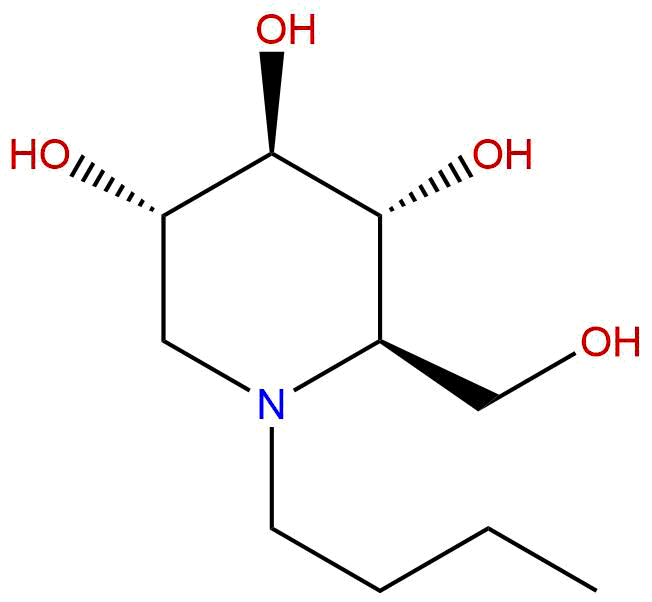


Product name: Miglustat
Synonym name: N-Butyldeoxynojirimycin
Catalogue No.: BP5229
Cas No.: 72599-27-0
Formula: C10H21NO4
Mol Weight: 219.281
Botanical Source:
Type of Compound: Alkaloids
Purity: 99%
Analysis Method: HPLC-DAD or/and HPLC-ELSD
Identification Method: Mass, NMR
Packing: Brown vial or HDPE plastic bottle
The product could be supplied from milligrams to grams, up to kilograms.
Inquire for bulk scale.
Miglustat, commonly marketed under the trade name Zavesca, is a drug used to treat Gaucher disease. It inhibits the enzyme glucosylceramide synthase, an essential enzyme for the synthesis of most glycosphingolipids. It is only used for patients who cannot be treated with enzyme replacement therapy with imiglucerase. Miglustat is now the first and only approved therapy for patients with Niemann-Pick disease type C (NP-C). It has recently been approved for treatment of progressive neurological symptoms in adult and pediatric patients in the European Union, Brazil, and South Korea.
Miglustat, an N-alkylated imino sugar, is a synthetic analogue of D-glucose. Miglustat is an inhibitor of the enzyme glucosylceramide synthase, which is a glucosyl transferase enzyme responsible for catalyzing the formation of glucosylceramide (glucocerebroside). Glucosylceramide is a substrate for the endogenous glucocerebrosidase, an enzyme that is deficient in Gaucher's disease. The accumulation of glucosylceramide due to the absence of glucocerebrosidase results in the storage of this material in the lysosomes of tissue macrophages, leading to widespread pathology due to infiltration of lipid-engorged macrophages in the viscera, lymph nodes, and bone marrow. This results in secondary hematologic consequences including sever anemia and thrombocytopenia, in addition to the characteristic progressive hepatosplenomegaly, as well as skeletal complications including osteonecrosis and osteopenia with secondary pathological fractures.
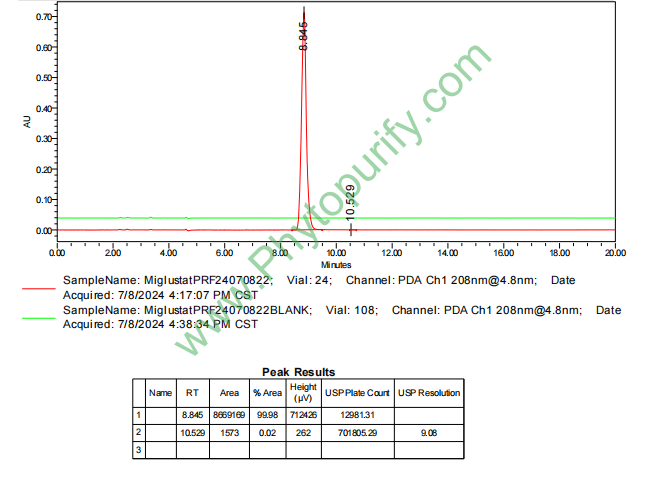
HPLC of Miglustat
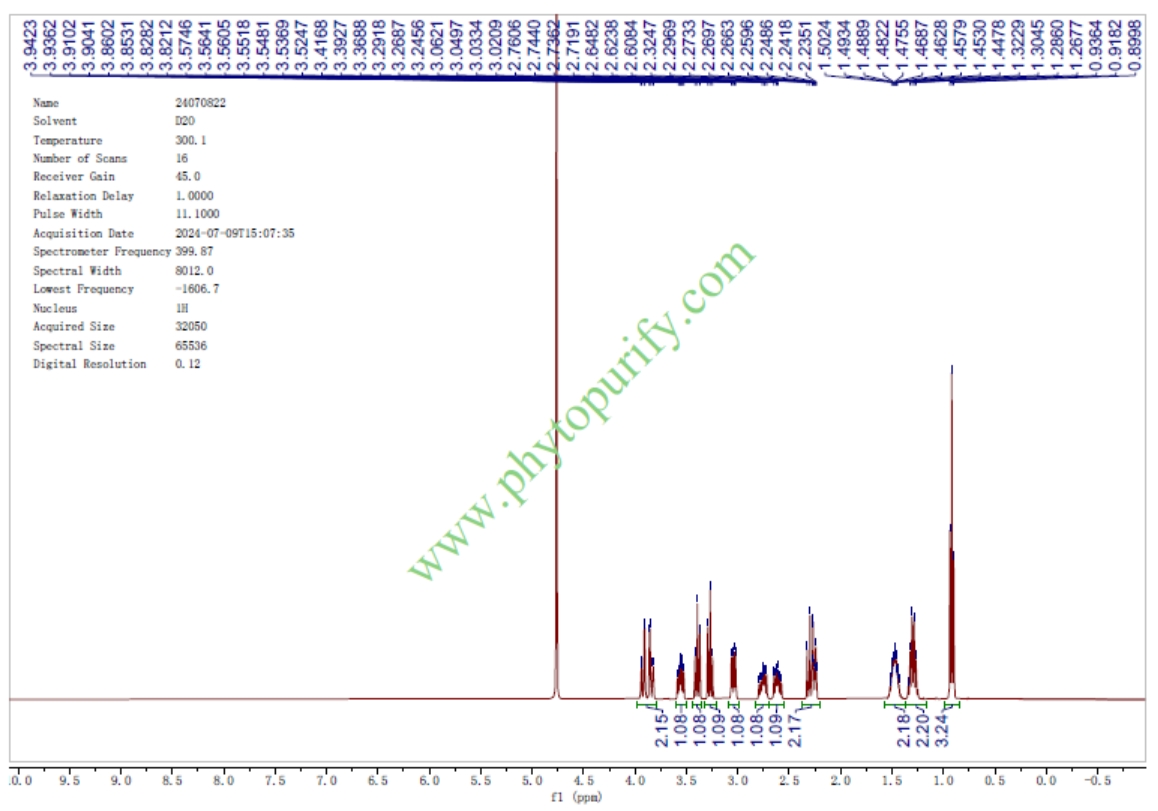
HNMR of Miglustat
Storage conditions:Short-term storage at 2~8℃, long-term storage at -20 ~ -80℃
84.1600
-.5330
-.7954
115.5476
.5672
.6199
Low
13.8637
3.6233
Yes
No
No
No
No
No
0.0
Yes
No
Yes
Yes
Lysosomal storage diseases (LSDs) are a type of genetic metabolic disorder caused by defects or functional abnormalities in lysosomal hydrolytic enzymes. Their pathological features are the abnormal accumulation of specific substrates (such as sphingolipids, glycosaminoglycans, glycoproteins, etc.) in lysosomes, leading to cellular dysfunction, tissue damage, and multiple clinical manifestations. The traditional LSDs treatment strategies mainly include Enzyme Replacement Therapy (ERT) and Substrate Reduction Therapy (SRT). Among them, SRT achieves therapeutic goals by inhibiting key enzymes involved in substrate synthesis and reducing the accumulation of substrates. Miglustat, trade name Zavesca ®), The chemical name is N-butyldeoxynojirimycin (NB-DNJ), which is an orally effective and reversible inhibitor of ceramide glucosyltransferase (GlcCer synthase). It is the first SRT drug approved for the treatment of Gaucher disease type I. Miguru's successful development not only provides non injectable treatment options for patients with Gaucher's disease, but also opens up new directions for SRT research in other lysosomal storage disorders such as Nieman Pick's disease type C, Pompe disease, etc. This article will provide a systematic review of metformin from the aspects of chemical structure, physicochemical properties, pharmacological activity, mechanism of action, drug properties, and clinical application prospects.
The chemical name of Miglustat is N-butyl-1-deoxynojirimycin, and its core structure is 1-Deoxynojirimycin (DNJ), a naturally occurring polyhydroxypyridine alkaloid that is structurally similar to D-glucose. The hydroxyl substituent configuration in DNJ molecules is consistent with the hydroxyl configuration at positions C-2, C-3, C-4, and C-5 of glucose. Therefore, DNJ and its derivatives can simulate the transition state structure of glucose and competitively inhibit glycoside hydrolases such as alpha glucosidase and beta glucosidase. Migluta introduced a butyl side chain on the N atom of DNJ, which significantly enhanced its inhibitory activity against ceramide glucosyltransferase (GlcCer synthase), while reducing its inhibitory effect on other glucosidase enzymes and improving selectivity.
The molecular formula of Migluta is C ₁₀ H ₂₁ NO ₄, with a molecular weight of 219.28 g/mol. Its structural formula is: a six membered pyridine ring with four hydroxyl groups (located at C-2, C-3, C-4, C-5 positions) on the ring, and a n-butyl chain connected to the N atom. This molecule contains multiple hydrogen bond donors (hydroxyl and secondary amine) and acceptors (hydroxyl oxygen and nitrogen atoms), thus exhibiting high polarity. Its calculated lipid water partition coefficient (LogP) is -0.533, indicating strong hydrophilicity and difficulty in crossing the blood-brain barrier (BBB). The topological polar surface area (TPSA) is 84.16 Å ², which meets the general requirements for oral medications (typically<140 Å ²). The high water solubility (115.55 mg/mL) is beneficial for the development of oral formulations. Migluta is a white or off white crystalline powder with no odor and a slightly bitter taste. It is stable in acidic aqueous solutions, but may degrade under alkaline conditions. Its pKa value is about 7.0 (secondary amine on the pyridine ring), partially protonated under physiological pH conditions, which facilitates its interaction with the target protein.
Migluta itself is not a natural product, but a semi synthetic compound obtained by structural modification based on the natural product 1-deoxynojirimycin (DNJ). DNJ is a naturally occurring alkaloid that mainly exists in the root bark, leaves, stems of mulberry plants (such as Morus alba) and fermentation products of some microorganisms (such as Streptomyces spp.). DNJ has a high content in traditional Chinese medicine mulberry leaves and significant hypoglycemic activity. Its mechanism of action is to competitively inhibit alpha glucosidase and delay carbohydrate absorption. However, natural DNJ has weak inhibitory activity against ceramide glucosyltransferase and poor selectivity. In order to obtain more selective and potent GlcCer synthase inhibitors, researchers alkylated the N-terminus of DNJ and ultimately screened for the N-butyl derivative - Migluta.
At present, the industrial production of Migluta mainly adopts chemical synthesis method, rather than direct extraction from plants. The synthetic route usually starts from DNJ and introduces the butyl side chain through reductive amination reaction. The specific steps include: reacting DNJ with n-butyraldehyde in the presence of a reducing agent (such as sodium cyanoborohydride) to generate N-butyl-1-deoxynojirimycin. This synthetic route is mature, with high yield and controllable cost. Although plant extraction methods (such as extracting DNJ from mulberry leaves and then chemically modifying it) are theoretically feasible, the low content of DNJ in plants (usually 0.1% -0.5% of dry weight) and the complex extraction and purification process make it difficult to meet the needs of large-scale production. Therefore, chemical synthesis is currently the mainstream method for the production of Migluta raw materials. In addition, there have been studies exploring the use of microbial fermentation to produce DNJ, which can then be converted into Miglutamide through enzymatic or chemical methods, but commercial applications have not yet been achieved.
Miglutamide, as a reversible inhibitor of GlcCer synthase, has the core pharmacological activity of reducing the synthesis of glucosylceramide (GlcCer). GlcCer is a precursor molecule for various sphingolipids, such as gangliosides, globulins, etc., and inhibition of its synthesis will lead to a decrease in downstream sphingolipid production. In patients with type I Gaucher's disease, due to defects in β - glucosidase (GBA), GlcCer cannot be degraded normally and accumulates in large amounts in the lysosomes of macrophages, forming typical "Gaucher cells". Migluta reduces intracellular GlcCer load by inhibiting de novo synthesis of GlcCer, thereby alleviating cell damage and organ enlargement.
In vitro studies have shown that Migluta can effectively inhibit the synthesis of GlcCer in various cell lines, such as human fibroblasts and macrophages, with an IC ₅₀ value at the micromolar level (approximately 1-10 μ M). In fibroblasts derived from patients with Gaucher's disease, treatment with myxostat significantly reduced the accumulation level of GlcCer in cells. In addition, Miglutamide has weak inhibitory effects on other glycosidases such as alpha glucosidase and beta glucosidase, demonstrating good selectivity. It is worth noting that Miglutamide can also inhibit the synthesis of glycosphingolipids (GSLs), which makes it potentially therapeutic in various diseases related to GSL accumulation, such as Niemann Pick disease type C, GM1 gangliosis, GM2 gangliosis, etc.
In vivo pharmacological studies were conducted in a mouse model of Gaucher's disease, such as GBA gene knockout or mutant mice. After oral administration of Migluta, a significant decrease in GlcCer levels was observed in the liver and spleen, improvement in hepatosplenomegaly, and a decrease in the number of Golgi cells in the bone marrow. In the Nieman Pick disease type C (NPC) mouse model, treatment with Miglutamide can delay the progression of neurodegenerative disease, improve motor function, and prolong survival. These results suggest that Miglutamide may regulate pathological processes such as intracellular signal transduction, autophagy, and inflammatory response by reducing the synthesis of GSL, affecting the composition and function of cell membrane lipid rafts.
The main molecular target of Migrutin is the ceramide glucosyltransferase (GlcCer synthase, encoded by the UGCG gene), which is located on the Golgi apparatus membrane and catalyzes the reaction of ceramide with UDP glucose to produce glucose ceramide (GlcCer). This is the first step and key rate limiting step in the de novo synthesis of glycosphingolipids (GSLs). Migluta, as an analog of GlcCer, reversibly inhibits the activity of the enzyme by competitively binding to its active site. Its inhibitory kinetics manifest as mixed inhibition, which can bind to both free enzymes and enzyme substrate complexes. The N-butyl side chain of Miglutamide enhances its interaction with the hydrophobic pocket of the enzyme, while the polyhydroxypyridine ring simulates the transition state structure of the glucose group, thereby improving the inhibitory efficacy.
In addition to directly inhibiting GlcCer synthesis, Miglutamide can also indirectly affect multiple molecular targets related to lysosomal function. For example, by reducing the synthesis of GSL, Migluta can alter the composition of cell membrane lipid rafts, affecting the localization and function of membrane proteins such as receptors, ion channels, and transporters. In the NPC disease model, treatment with Migluta can reduce the accumulation of cholesterol in lysosomes and partially restore lysosomal function. In addition, Migluta has been reported to regulate the autophagy pathway. Autophagy is an important mechanism for cells to clear damaged organelles and protein aggregates, and lysosomes are the terminal of the autophagy process. In GBA deficient cells, autophagic flow is impaired, and Miglutamide can promote the degradation of autophagic substrates by reducing GSL accumulation, restoring the fusion of autophagosomes and lysosomes. This effect may be related to the reduction of abnormal modifications of autophagy related proteins (such as ATG family members) by GSL.
The impact of Miguru on other targets is also worth paying attention to. For example, it can inhibit alpha glucosidase I and II, but with lower affinity. At clinical doses, this inhibitory effect is usually not significant. However, high concentrations or long-term use may affect the processing and maturation of glycoproteins. In addition, Miglutamide can also inhibit the activity of certain proteases (such as CTSB, CTSD), which may be related to its indirect effects on lysosomal pH or membrane stability. Overall, the main mechanism of action of Miglutamide is to reduce GSL synthesis by inhibiting GlcCer synthase, thereby alleviating substrate accumulation in LSDs and indirectly regulating autophagy, inflammation, and cellular signaling pathways.
Miglutamide has good drug properties and meets the basic requirements for oral medication. Its molecular weight (219.28 Da) is less than 500 Da, with a LogP of -0.533, indicating strong hydrophilicity and high water solubility (115.55 mg/mL), which is beneficial for oral absorption. The TPSA is 84.16 Å ², which is lower than 140 Å ², indicating good oral bioavailability. The hERG inhibition test result is negative, indicating a low risk of cardiac toxicity. The Ames test result is 0.0, indicating no mutagenicity. These data support the safety of metformin as an oral medication.
In terms of pharmacokinetics, Miglutamide is rapidly absorbed after oral administration, with a peak time (Tmax) of approximately 2-3 hours. The absolute bioavailability is about 70-80%, and food can slightly affect its absorption rate, but does not affect the total absorption. Miglutamide is widely distributed in the body, but due to its high polarity, it is not easily able to cross the blood-brain barrier (BBB), and the drug concentration in cerebrospinal fluid is only 10-20% of the plasma concentration. This characteristic limits its efficacy in central nervous system (CNS) - related LSDs such as NPC and GM2 gangliosis, but also reduces CNS related side effects. Migluta is almost not metabolized by the liver and is mainly excreted in its original form through the kidneys. Its plasma half-life (t ₁/₂) is about 6-7 hours, and it needs to be administered three times a day (100 mg/time). Patients with renal insufficiency need to adjust their dosage. The pharmacokinetics of Miglutamide are linear and there is no significant accumulation within the therapeutic dose range.
Common adverse reactions include gastrointestinal symptoms (such as diarrhea, bloating, abdominal pain, nausea) and weight loss, which are related to the inhibition of intestinal alpha glucosidase by metformin leading to poor carbohydrate absorption. In addition, some patients may experience neurological symptoms such as tremors and peripheral neuropathy, but the incidence is relatively low. Overall, Miglutamide has good safety and acceptable tolerability, but gastrointestinal reactions and neurological function need to be monitored.
Miglutamide was first approved in the European Union in 2002 for adult patients with type I Gaucher's disease (GD1) as an alternative or adjuvant therapy for ERT. For GD1 patients who are unable to accept ERT or have poor ERT outcomes, Migluta provides an oral treatment option. Clinical studies have shown that metformin can stabilize or improve symptoms such as hepatosplenomegaly, anemia, and thrombocytopenia in GD1 patients, and reduce plasma levels of chitotriosidase (a disease activity marker). However, its improvement effect on bone lesions is limited. At present, Miglutamide is mainly used for mild to moderate GD1 patients or as a combination therapy for ERT.
In addition to GD1, the application of Miglutamide in other LSDs has also received widespread attention. Miglutamide has been approved for the treatment of progressive neurological symptoms in Nieman Pick disease type C (NPC). Although its BBB permeability is low, some patients can still benefit from it, which may be related to the partial inhibition of GSL synthesis by the drug at low concentrations in the brain. In addition, Migluta has also explored preclinical or clinical studies of diseases such as Pompe disease, GM1/GM2 ganglioside storage, and Fabry disease. For example, in the Pompeian disease mouse model, the combination of Miglutamide and ERT can reduce autophagy disorders and improve muscle function. However, the clinical evidence for these indications is not yet sufficient and more randomized controlled trials are needed to validate them.
In the future, Miguru's research directions may include: 1) developing a new generation of GlcCer synthase inhibitors with higher CNS penetration to better treat LSDs with CNS involvement such as NPC; 2) Explore combination therapy options with other drugs such as ERT, molecular chaperones, and anti-inflammatory drugs to improve efficacy and reduce side effects; 3) Using Miglutamide as a tool molecule, we will conduct in-depth research on the functions of GSL in cellular signaling, autophagy, immune regulation, and other processes; 4) Evaluate the potential application of Miglutamide in non LSDs diseases such as cancer and neurodegenerative diseases, as GSL metabolic abnormalities are also closely related to these diseases. For example, some studies suggest that Miglutamide can inhibit the growth and metastasis of certain tumor cells, but its mechanism is not yet clear.
Migluta, as the first approved oral substrate reduction therapy drug, has a milestone significance in the treatment of lysosomal storage disorders. It effectively alleviates the clinical symptoms of type I Gaucher's disease and type C Nieman Pick's disease by reversibly inhibiting ceramide glucosyltransferase and reducing the synthesis of glycosphingolipids. Miguru's successful development not only validated the feasibility of the SRT strategy, but also provided important references for the drug development of other LSDs. Despite limitations such as gastrointestinal side effects and insufficient CNS penetration, Miglutamide remains an important treatment option. In the future, with a deeper understanding of the biological functions of glycosphingolipids and advances in new drug development technology, it is expected that more efficient and safer GlcCer synthase inhibitors will be developed, bringing good news to more LSDs patients. Miguru's research journey fully embodies the translational medicine approach from natural products to innovative drugs, and also provides valuable experience for the field of natural product pharmacology.
