Introduction/Overview
Cough is one of the most common symptoms of respiratory diseases and an important defensive reflex of the body. However, severe, frequent, or chronic coughing seriously affects the quality of life of patients and may indicate serious underlying diseases. At present, commonly used cough suppressants in clinical practice, such as central cough suppressant codeine, dexmedetomidine, and peripheral cough suppressant benzocaine, although have certain therapeutic effects, often accompany adverse reactions such as addiction, constipation, drowsiness, respiratory depression, and have limited effectiveness in treating some refractory coughs. Therefore, finding efficient and low toxicity lead compounds for novel cough suppressants from natural products has always been an important direction in drug development. Isopeimine (CAS number: 23496-43-7), as a steroid alkaloid isolated from traditional cough and phlegm reducing medicinal plants, has attracted much attention in recent years due to its significant cough suppressing activity and unique multi-target mechanism of action. This article aims to provide a systematic review of the chemical structure, plant origin, pharmacological activity, mechanism of action, pharmacological properties, and clinical application prospects of isoberberine, in order to provide comprehensive scientific references for the in-depth research and development of this compound.
Chemical structure and physicochemical properties
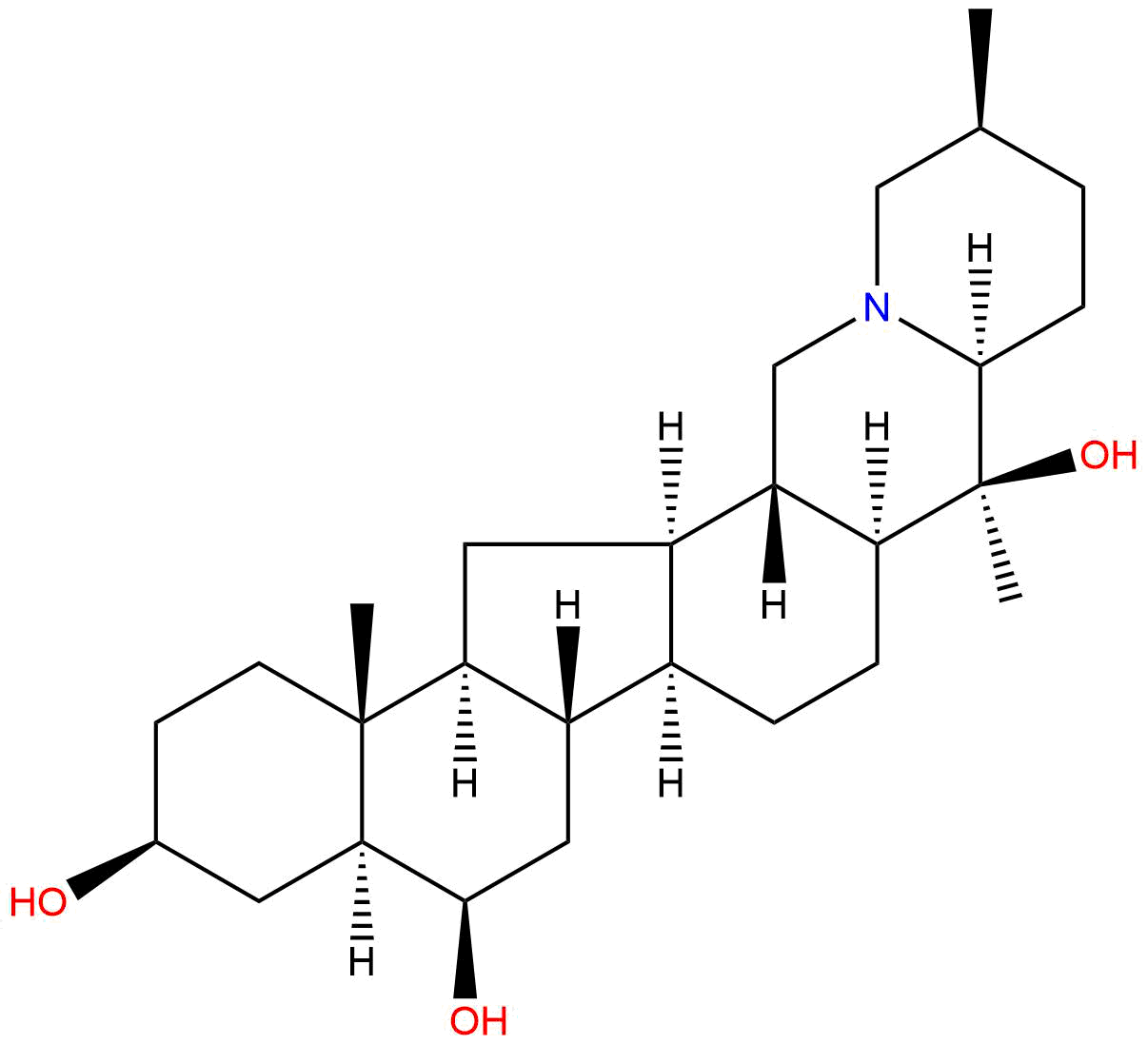
Isoberberine belongs to the class of steroid alkaloids, with a molecular formula of C27H45NO3 and a molecular weight of 431.6610. Its core structure is cyclopentane and a fully hydrogenated phenanthrene skeleton (steroid nucleus), which is isomeric with common Fritillaria alkaloids such as Peimine and Peimine. The main difference lies in the configuration or position of the nitrogen atom substituent on the D ring, as well as the stereochemistry of hydroxyl or carbonyl functional groups at C-3, C-6, and other positions. This subtle structural difference often leads to significant differences in its biological activity and pharmacological properties.
From the analysis of its physical and chemical properties, the lipid water partition coefficient (LogP) of isoberberine is 3.4860, indicating its moderate lipophilicity, which is beneficial for penetrating cell membranes, but also suggesting its poor water solubility (water solubility parameter is 0.0680). Its topological polar surface area (TPSA) is 63.9300 Å ², reflecting the presence of polar functional groups (such as hydroxyl groups) in the molecule, which have a certain hydrogen bonding ability. Based on its molecular weight, LogP, and TPSA values, this compound basically conforms to the Rule of Five and has the preliminary structural basis to become an oral drug. It is worth noting that its blood-brain barrier permeability is predicted to be "high", suggesting that it may act on central nervous system targets, which is of great significance for the development of central cough suppressants. In addition, preliminary pharmacological risk assessment shows that the hERG inhibition risk is "no", and the Ames test result is 0.0 (negative), indicating that its potential risk of arrhythmia and genetic toxicity is low, and its safety prospects are good.
Plant sources and extraction methods
Isoberberine is mainly derived from the genus Fritillaria in the family Liliaceae(Fritillaria L. Dry bulbs of various plants. These plants, such as Zhejiang Fritillaria(Fritillaria thunbergii)Chuan Beimu(Fritillaria cirrhosa)Pingbeimu(Fritillaria ussuriensis)In traditional Chinese medicine clinical practice, it is known as the "holy medicine for stopping cough" and is commonly used to treat symptoms such as lung heat cough, phlegm accumulation, and chest tightness. Isoberberine is one of the important active alkaloid components in medicinal Fritillaria, in addition to berberine and berberine.
Its extraction and separation usually follow the conventional process of natural product chemistry. Firstly, the dried Fritillaria bulb is crushed and subjected to reflux extraction or ultrasound assisted extraction using a suitable polar organic solvent (such as ethanol, methanol, or acidified alcohol water solution) to fully dissolve the alkaloid components. After concentration, the extract is dissolved in acidic water, and insoluble impurities are filtered out. The acidic water is then alkalized to alkaline (pH>10) to allow alkaloids to precipitate freely. Then, organic solvents (such as chloroform and ethyl acetate) are used for extraction to obtain crude total alkaloids. Further purification requires the use of various chromatographic techniques, including silica gel column chromatography, alumina column chromatography, reverse phase high performance liquid chromatography (RP-HPLC), and preparative thin-layer chromatography. By comparing elution systems of different polarities and monitoring with thin layer chromatography (TLC) or high performance liquid chromatography (HPLC), the monomer of isoberberine can be gradually separated. Modern separation techniques such as high-speed counter current chromatography (HSCCC) are increasingly being used for the large-scale preparation of such alkaloids due to their high efficiency and no loss of solid adsorbents. Structural identification relies on spectroscopic methods such as nuclear magnetic resonance (NMR, including 1H-NMR, 13C-NMR, 2D-NMR), mass spectrometry (MS), infrared spectroscopy (IR), and X-ray single crystal diffraction.
Pharmacological activity research
A large number of preclinical pharmacological studies have confirmed that the core pharmacological activity of isoproterenol is Cough suppression In various experimental cough models, such as the mouse/guinea pig cough model induced by ammonia or citric acid, the capsaicin induced cough model, and the chronic cough animal model, isobaric acid has shown a dose-dependent significant antitussive effect. Its cough suppression intensity is comparable or superior to the positive drugs codeine or dexmedetomidine, but it is worth noting that, at the same effective dose, no significant central inhibition (such as reduced spontaneous activity) or constipation side effects commonly observed with codeine were observed with isobaric acid, demonstrating a better safety window.
In addition to its direct cough suppressant effect, research has also found that isoberberine has a certain degree of anti-inflammatory and Expectorant Activity. Cough, especially chronic cough, is often closely related to airway inflammation. Isoberberine can inhibit the release of pro-inflammatory factors such as tumor necrosis factor - α (TNF - α) and interleukin-6 (IL-6) by macrophages stimulated by lipopolysaccharides (LPS) or inflammatory factors, reducing airway inflammatory infiltration. Its expectorant effect may be achieved by promoting ciliary movement of airway mucosa or regulating mucus secretion. These auxiliary activities together constitute the multidimensional pharmacological basis for its treatment of cough syndrome, which is in line with the holistic concept of "stopping cough and resolving phlegm" in traditional Chinese medicine.
In addition, sporadic reports have explored the activity of isoberberine in other fields, such as potential neuroprotection and anti fibrosis, but related research is still in its infancy, and its cough suppressing activity is still the absolute focus of current research.
Mechanism of action and molecular targets
The cough suppressant mechanism of isoproterenol is not through a single pathway, but involves the regulation of multiple molecular targets related to key links in the cough reflex arc, reflecting the synergistic effect of multiple targets and pathways. The cough reflex arc includes peripheral receptors, afferent nerves, medullary cough center, efferent nerves, and effectors (respiratory muscles). The targets of action of Isoberberine are widely distributed in the peripheral and central nervous systems.
-
Acting on transient receptor potential (TRP) channels This is the core of its peripheral cough suppression mechanism. Isoberberine has been confirmed to be TRPV1 and TRPA1 Effective modulators or antagonists of channels. TRPV1 and TRPA1 are key chemoreceptors expressed in the sensory nerve endings (mainly C fibers) of the airway. They can be activated by capsaicin, bradykinin, prostaglandins, and exogenous stimuli (such as citric acid and smoke), leading to calcium influx, neural depolarization, action potentials, and the transmission of "cough signals" to the central nervous system. Isoberberine can inhibit the activation of these channels, reduce the transmission of nociceptive signals, and thus exert peripheral cough suppressing effects.
-
Regulating the synthesis and release of neuropeptides After activation of airway sensory nerves, various neuropeptides such as calcitonin gene-related peptide are released(CALCA Gene products, substance P(TAC1 One of the fast acting peptides encoded by genes, etc. These neuropeptides have strong pro-inflammatory and cough inducing effects, which can lead to neurogenic inflammation and amplify cough reflex. Isoberberine can be downregulated CALCA and TAC1 Reduce the expression of related neuropeptides, cut off the vicious cycle of "neuroinflammation" in cough.
-
Affects sodium ion channels Voltage gated sodium channel Nav1.7 (composed of SCN9A Gene coding plays an important role in pain and cough signaling. Isoberberine may affect the generation and conduction of action potentials in sensory nerves by regulating the activity of Nav1.7 channels, similar to the effects of local anesthetics, but more selectively.
-
Acting on central and peripheral G protein coupled receptors (GPCRs):
- Opioid receptor Isoberberine may be partially excitedμ - opioid receptor (OPRM1)Traditional opioid cough suppressants, such as codeine, inhibit the cough center by activating the central μ receptor. The action of isoproterenol on this receptor may contribute to its central antitussive component, but its mode of action may be different from classical opioid drugs, which may be the reason why it has fewer central side effects.
- neuropeptide receptor Gastrin releasing peptide receptor(GRPR)And neuroregulatory peptide U receptor 1(NMUR1)It is a target closely related to cough, especially chronic cough and refractory cough, discovered in recent years. The antagonistic or regulatory effects of isoproterenol on these receptors may be a potential mechanism for its treatment of complex cough cases.
In summary, isoproterenol inhibits the initiation, conduction, and amplification of cough reflex from multiple levels by simultaneously antagonizing peripheral TRP channels, regulating neuropeptide systems, affecting ion channels, and acting on key GPCRs, forming the molecular basis for its highly efficient and broad-spectrum cough suppressing effect.
Evaluation of drug properties and pharmacokinetics
Based on its physicochemical properties and preliminary biological data, isobaric acid has shown good potential as a drug. As mentioned earlier, it complies with the five drug classification rules, and negative hERG and Ames results reduce the risk of early development.
In terms of pharmacokinetics, existing studies (mainly based on animal experiments) suggest that isoberberine can be absorbed in the gastrointestinal tract after oral administration, but its absolute bioavailability is limited by its low water solubility. It is widely distributed in the body, and its high blood-brain barrier permeability allows it to enter the central nervous system and act on targets such as the medullary cough center. The metabolic pathway may mainly involve oxidative metabolism of liver cytochrome P450 enzyme system, as well as possible glucuronidation or sulfation binding reactions. The main excretion pathways may be through the kidneys and bile. However, there is still a relative lack of systematic research on its detailed pharmacokinetic parameters (such as half-life, clearance rate, tissue distribution specificity), major metabolites and their activities, whether there are species differences, and potential drug drug interactions. This is a key data gap that must be filled before its clinical translation.
In the future, systematic preclinical ADMET (absorption, distribution, metabolism, excretion, and toxicity) research is needed, including the use of more advanced formulation technologies (such as nanocrystals, solid dispersions, liposomes) to improve their oral bioavailability; Using an in vitro liver microsomal model and in vivo experiments to elucidate its metabolic profile; Conduct long-term toxicological assessments (acute toxicity, long-term toxicity, reproductive toxicity, etc.) to comprehensively evaluate its safety.
Clinical application prospects and prospects
Isoberberine, as a natural cough suppressant lead compound derived from traditional Chinese medicine, has broad clinical application prospects but also faces challenges.
prospect:
1. Development of novel multi-target cough suppressants The multi-target mechanism of action of isoproterenol provides a new solution to the limitations of existing cough suppressants. It has particular potential for the treatment of poor response to conventional drugs Refractory chronic cough、Cough hypersensitivity syndrome And cough mediated by TRP channels (such as cough after a cold, asthma/eosinophilic bronchitis related cough).
2. Compound preparations and combination therapy Exploring the combination of Isoberberine with cough suppressants, expectorants, or anti-inflammatory drugs with other mechanisms of action can achieve synergistic effects, reduce single drug doses, and minimize side effects.
3. Structural optimization and derivative development Using it as the parent nucleus for structural modification, aiming to improve water solubility, enhance target selectivity, increase metabolic stability, or reduce potential toxicity, it is expected to obtain a new chemical entity with better activity and drug properties.
Challenges and Prospects:
1. Resources and Sustainable Supply Plants of the Fritillaria genus grow slowly, and wild resources are limited. Extracting large amounts of isoquercetin from plants is costly and unsustainable. We need to vigorously develop in the future Plant cell culture、Synthetic Biology(Constructing heterologous synthesis pathways in microorganisms) or Total chemical synthesis Strategy to achieve large-scale and green production of the compound.
2. Deep analysis of the mechanism of action Although multiple targets have been identified, the precise binding mode, affinity, whether it is excitatory or antagonistic, and whether there is allosteric regulation of isoproterenol to each target still need to be further elucidated through structural biology and molecular pharmacology methods such as molecular docking, site directed mutagenesis, and cryo electron microscopy.
3. Clinical translational research From laboratory to clinical practice is a long process. It is urgent to complete GLP (Good Laboratory Practice) toxicology research and GMP (Good Manufacturing Practice) process research for active pharmaceutical ingredients and formulations that comply with international standards, and then design rigorous clinical trials (phases I, II, III) to verify their safety, efficacy, and optimal drug use in humans.
4. Explore new indications Based on its anti-inflammatory and potential neuroregulatory activities, its application value in chronic obstructive pulmonary disease (COPD), pulmonary fibrosis, neuropathic pain, and other diseases can be explored.
Conclusion
Isoberberine is a steroid alkaloid with significant research value discovered from the traditional cough suppressant Chinese medicine Fritillaria. Its unique chemical structure, significant cough suppressant activity, and mechanism of synergistic action through multiple targets such as acting on TRPV1/TRPA1, regulating the neuropeptide system, and affecting opioid and neuropeptide receptors make it a highly promising lead compound for developing a new generation of highly efficient and low toxicity cough suppressants. Despite facing challenges in resource sustainability, in-depth pharmacokinetic research, and clinical translation, these challenges are expected to be gradually overcome with the development of modern separation technologies, synthetic biology, structural pharmacology, and formulation studies. The continuous in-depth research on Isoberberine not only helps to promote the birth of new cough suppressants, but also provides modern scientific basis for explaining the traditional efficacy of Fritillaria medicinal materials in relieving cough and resolving phlegm. It is a vivid example of the modernization and internationalization of traditional Chinese medicine. In the future, through interdisciplinary collaboration, isoberberine is expected to move from the laboratory to clinical practice, bringing new hope to patients worldwide who suffer from cough problems.