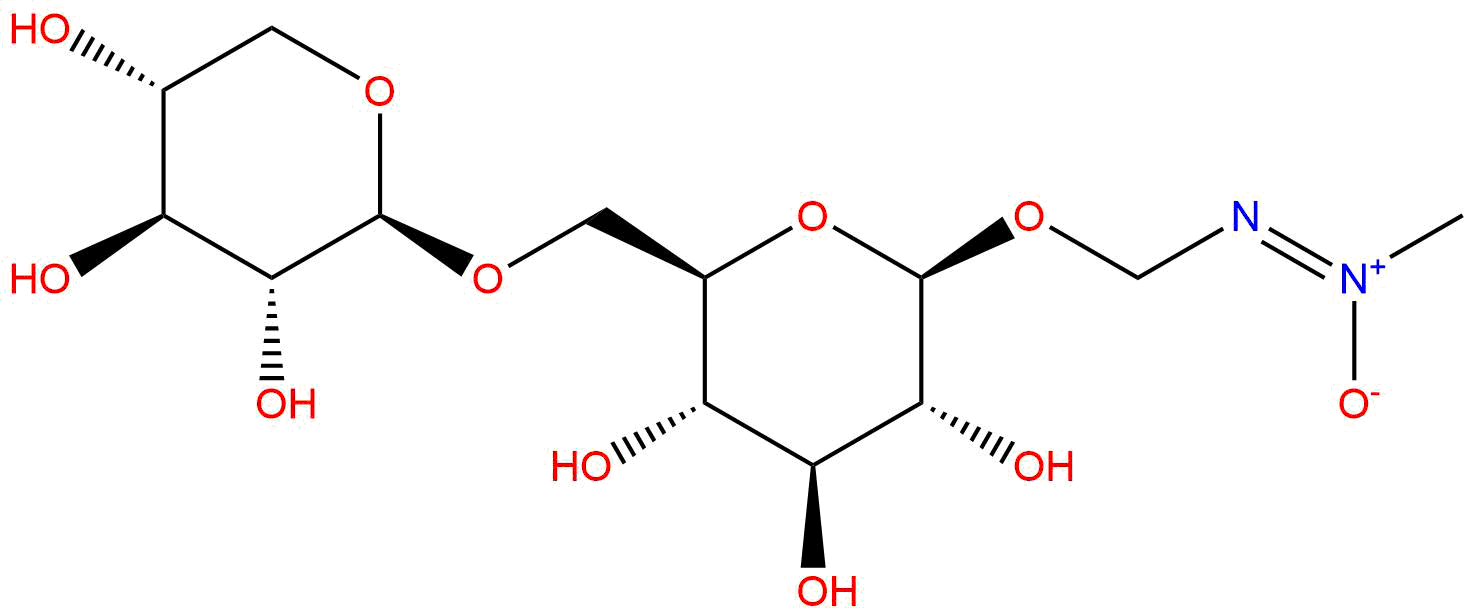


Product name: Macrozamin
Synonym name:
Catalogue No.: BP4206
Cas No.: 6327-93-1
Formula: C13H24N2O11
Mol Weight: 384.338
Botanical Source: Smilax glabra
Type of Compound:
Purity: 95%~99%
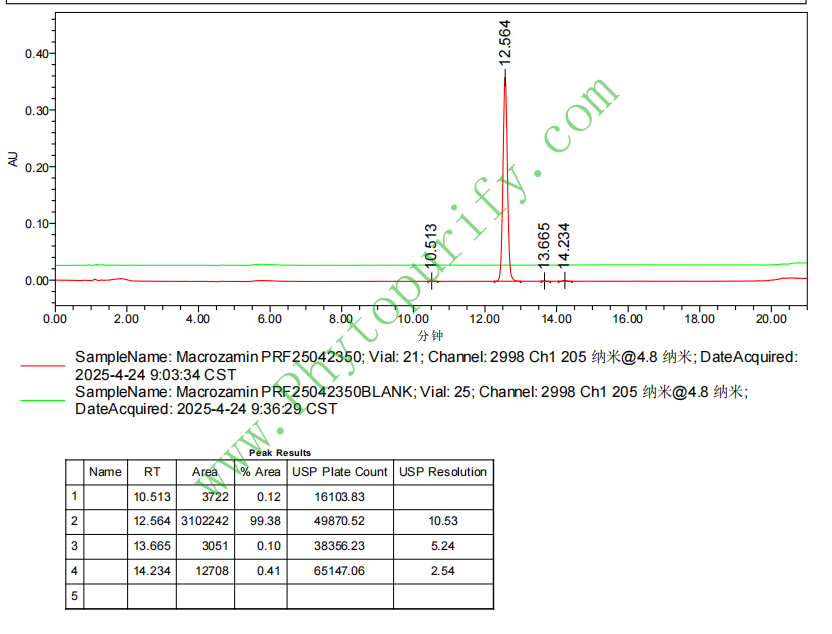
Analysis Method: HPLC-DAD or/and HPLC-ELSD
Identification Method: Mass, NMR
Packing: Brown vial or HDPE plastic bottle
Storage: Store in a well closed container, protected from air and light. Put into refrigerate or freeze for long term storage.
Whenever possible, you should prepare and use solutions on the same day. However, if you need to make up stock solutions in advance, we recommend that you store the solution as aliquots in tightly sealed vials at -20℃. Generally, these will be useable for up to two weeks.
The product could be supplied from milligrams to grams
Inquire for bulk scale.
For Reference Standard and R&D, Not for Human Use Directly.
HPLC of Macrozamin
Storage conditions:Short-term storage at 2~8℃, long-term storage at -20 ~ -80℃
196.7300
-2.2011
-2.2022
169.7307
.4653
.2261
Low
21.6477
4.9177
Yes
No
No
No
Yes
No
1.8
Yes
Yes
Yes
Yes
Macrozamin (CAS number: 6327-93-1) is a natural product mainly found in the seeds and leaves of Cycas spp. in the Cycas family of plants. As one of the main components of cycad, daidzein has attracted widespread attention in the fields of pharmacology and natural product chemistry due to its unique chemical structure and diverse biological activities. Although daidzein exhibits certain toxicological risks such as carcinogenicity, mutagenicity, teratogenicity, and neurotoxicity, its potential application value in various biological functions such as anti-inflammatory has aroused the interest of researchers. In recent years, with the deepening of molecular biology and pharmacological mechanism research, there has been a gradual increase in related studies on the targets, signaling pathways, and pharmacological evaluation of Daze Mingsu, providing a theoretical basis for its rational utilization in drug development.
This article aims to systematically review the chemical structure and physicochemical properties, plant sources, and extraction methods of daidzein. Combined with the latest pharmacological activity research, it explores its mechanism of action and related molecular targets, evaluates its pharmacological properties and pharmacokinetic characteristics, and looks forward to its potential and challenges in clinical applications. By comprehensively reviewing existing literature, it is expected to provide scientific basis and reference for the subsequent research and development of daidzein.
The chemical name of Daze Mingsu is (specific chemical name may vary slightly due to differences in literature), with a molecular formula of C17H24N2O9 and a molecular weight of 384.3380. Its structural characteristics are mainly manifested by the combination of a glycoside moiety and a nitrogen-containing heterocyclic structure, endowing it with high polarity and water solubility. The LogP value of Daze Mingsu is -2.2011, indicating its strong hydrophilicity and difficulty in freely diffusing through lipid membranes. Its topological polar surface area (TPSA) is as high as 196.7300 Å ², further confirming its polar molecular characteristics, which have important implications for its biofilm permeability and pharmacokinetic behavior.
The water solubility index is 169.7307, indicating good solubility in aqueous phase, which is beneficial for in vivo distribution and improved bioavailability. The low permeability of the blood-brain barrier suggests its limited ability to penetrate the central nervous system. The hERG channel inhibition experiment showed a negative result, indicating that daidzein has high electrophysiological safety for the heart. The Ames mutagenicity test value is 1.8, indicating that it has certain mutagenic potential and is consistent with its known carcinogenic mutagenic properties.
Structurally, the glycosidic bond connections and nitrogen-containing groups of daidzein provide the basis for its biological activity, especially playing an important role in binding to protein targets and signal transduction regulation. Its complex polar structure also provides diversity for its metabolism and excretion pathways in the body.
Da Ze Ming Su mainly comes from the seeds and leaves of Cycas spp. in the Cycas family of plants. As an ancient gymnosperm, the cycad plant has become an important object of natural product research due to its unique secondary metabolites. The content of daidzein in cycad seeds is relatively high, which is a typical characteristic component of this plant species.
Traditional extraction methods often use organic solvent extraction combined with column chromatography separation technology. Common extraction solvents include methanol, ethanol, and their aqueous solutions, which utilize their polarity characteristics to achieve effective dissolution. The extraction process generally includes the following steps:
In recent years, the application of ultrasound assisted extraction and microwave-assisted extraction technologies has improved extraction efficiency and purity, reduced solvent usage and time costs. In addition, molecular imprinting technology and immunoaffinity chromatography have also been attempted for highly selective separation of daidzein.
The pharmacological activity research of daidzein mainly focuses on its biological toxicity and anti-inflammatory effects. Although its carcinogenic, mutagenic, and neurotoxic properties limit its direct medicinal use, its potential value in regulating inflammatory responses has attracted attention from the academic community.
Numerous in vitro and in vivo experiments have shown that daidzein has significant carcinogenic and mutagenic effects. Its mutagenicity was verified through Ames test, which showed that it can induce gene mutations, leading to cellular malignancy. In animal experiments, Daze Mingsu can induce the occurrence of various tumors, especially in the liver and gastrointestinal system. Its carcinogenic mechanism is closely related to DNA adduct formation, oxidative stress, and abnormal cell cycle regulation.
Daze Mingsu has certain toxic effects on the nervous system, manifested as neuronal apoptosis, nerve conduction dysfunction, and behavioral abnormalities. Its teratogenic effect is mainly reflected in the embryonic development stage, which may lead to abnormal embryonic development and organ deformities by affecting cell division and differentiation processes.
Despite the risk of toxicity, Daze Mingsu has shown certain potential in the field of anti-inflammatory. Studies on in vitro cell models and animal inflammation models have shown that daidzein can significantly inhibit the expression and release of various inflammatory mediators, including IL-6, TNF - α, NOS2, and PTGS2. Its anti-inflammatory effect may be achieved by regulating the inflammatory signaling pathway, reducing inflammation and tissue damage.
In addition, the regulation of TRPV1 and TRPA1 plasma channels by Daze Mingsu suggests its potential role in pain and inflammation transmission. The inhibitory effect on CASP1 (caspase 1) suggests that it may intervene in inflammasome activation and reduce the release of pro-inflammatory cytokines.
In summary, the pharmacological activity of Daze Mingsu exhibits a dual nature, with obvious toxicological risks and certain pharmacological regulatory functions. Further exploration of its application value is needed within the safe dosage range.
The biological activity of daidzein is closely related to its regulation of multiple molecular targets, especially in the fields of anti-inflammatory and cellular signaling. The current research mainly focuses on the following key targets and signaling pathways:
In summary, Daze Mingsu exhibits complex pharmacological mechanisms by synergistically regulating inflammatory responses through multiple targets and pathways. The in-depth analysis of these mechanisms provides a theoretical basis for their secure applications and structural optimization.
The pharmacological evaluation of Daze Mingsu covers its physicochemical properties, pharmacokinetic characteristics, and safety indicators, comprehensively assessing its potential as a drug candidate molecule.
At present, research on the in vivo absorption, distribution, metabolism, and excretion (ADME) of daidzein is relatively limited. Its high polarity and low fat solubility may lead to lower oral bioavailability, and the metabolic pathways may be mainly liver hydrolysis and glycosidase mediated degradation. The excretion pathway may be mainly through renal excretion, which needs to be further validated through in vivo pharmacokinetic experiments.
The carcinogenic, mutagenic, and neurotoxic properties of daidzein are the main limiting factors for its medicinal properties. Although its hERG channel has no inhibitory effect and reduces the risk of cardiac toxicity, its mutagenicity and teratogenicity need to be controlled through rigorous toxicological evaluation and dose optimization. In addition, structural modification and derivative design may be effective strategies to reduce toxicity and enhance safety.
Given the multi-target anti-inflammatory activity of Daze Mingsu, its potential application value in inflammation related diseases cannot be ignored. Inflammation, as the core pathological process of various chronic diseases such as rheumatoid arthritis, inflammatory bowel disease, neuroinflammation, etc., provides a broad space for the action of daidzein.
However, its significant toxicological risks limit its direct application as a clinical drug. Future research directions can focus on:
In summary, as a natural product with potential pharmacological activity, Daze Mingsu faces safety challenges, but through modern drug development techniques and strategies, it is expected to achieve clinical translation.
As an important active ingredient in cycad plants, daidzein has complex biological activities and significant toxicological risks. Its unique chemical structure endows it with multi-target anti-inflammatory effects, but at the same time, it also brings safety hazards such as carcinogenesis, mutagenesis, and neurotoxicity. Through a systematic review of its chemical properties, pharmacological activity, and mechanism of action, this article reveals the potential value and pharmacological limitations of daidzein in inflammation regulation.
Future research should focus on structural optimization, safety improvement, and precise targeted delivery to maximize its medicinal value. The study of daidzein not only enriches the theoretical system of natural product pharmacology, but also provides valuable natural molecular templates for the development of new anti-inflammatory drugs. With the advancement of scientific research technology and the strengthening of interdisciplinary cooperation, Osamu Daze is expected to play a more important role in the field of natural medicine.
