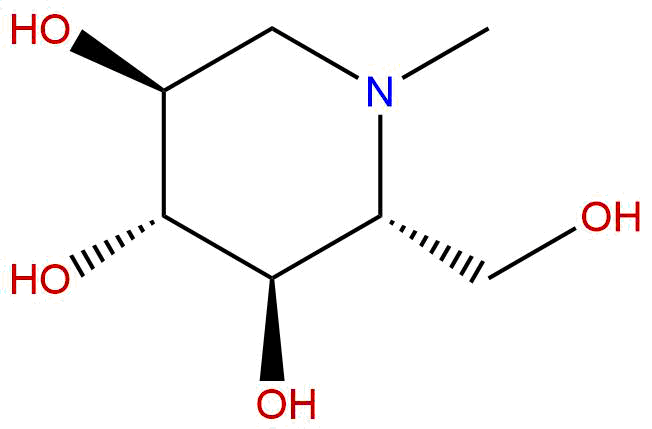


Product name: N-Methyl-1-deoxynojirimycin
Synonym name: N-Methylmoranolin; N-Methylmoranoline
Catalogue No.: BP2253
Cas No.: 69567-10-8
Formula: C7H15NO4
Mol Weight: 177.2
Botanical Source:
Type of Compound: Alkaloids
Purity: 95%~99%
Analysis Method: HPLC-DAD or/and HPLC-ELSD
Identification Method: Mass, NMR
Packing: Brown vial or HDPE plastic bottle
Storage: Store in a well closed container, protected from air and light. Put into refrigerate or freeze for long term storage.
Whenever possible, you should prepare and use solutions on the same day. However, if you need to make up stock solutions in advance, we recommend that you store the solution as aliquots in tightly sealed vials at -20℃. Generally, these will be useable for up to two weeks.
The product could be supplied from milligrams to grams
Inquire for bulk scale.
For Reference Standard and R&D, Not for Human Use Directly.
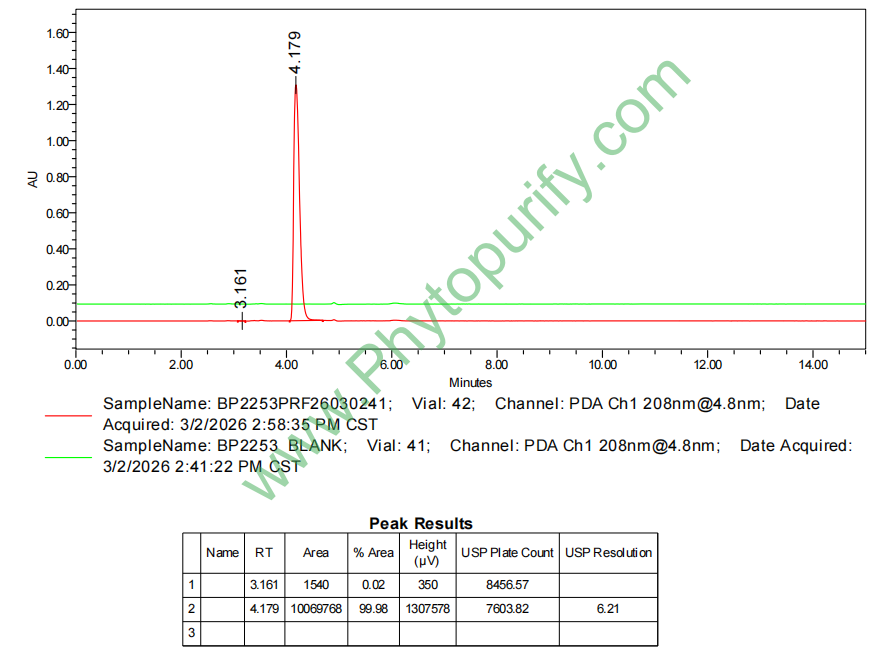
HPLC of N-Methyl-1-deoxynojirimycin
Storage conditions:Short-term storage at 2~8℃, long-term storage at -20 ~ -80℃
84.1600
-2.0310
-2.2092
654.6878
.5106
.5176
Low
4.4268
3.9694
Yes
No
No
No
No
No
0.3
Yes
No
Yes
Yes
Diabetes is a global chronic metabolic disease, its incidence rate continues to rise, has become a serious public health challenge. In the treatment strategy of diabetes, in addition to classic insulin and chemical synthetic drugs, it has always been an important direction of drug research and development to find new therapeutic molecules with high efficiency and low toxicity from natural products. Alpha glucosidase inhibitors, such as acarbose and miglitol, effectively control postprandial blood glucose by delaying the absorption of intestinal carbohydrates, and occupy a place in clinical practice. N-Methyl-1-deoxynojirimycin (N-Me-DNJ, CAS: 69567-10-8), as a naturally occurring class of polyhydroxyalkaloids, is an important representative and lead compound of this type of inhibitor. Deoxynojirimycin (DNJ), the parent nuclear structure, was initially isolated from plants such as mulberry bark, while N-methylated derivatives exhibit unique pharmacological properties. In recent years, with the deepening of research, the role of N-Me-DNJ has exceeded the simple inhibition of α - glucosidase, and has been revealed to play an anti diabetes effect through multiple target networks such as AMPK, SGLT2, PPAR γ, showing a broader therapeutic potential. The purpose of this paper is to systematically review the chemical characteristics, plant origin, pharmacological activity, multi target mechanism of action, pharmaceutical properties and clinical application prospects of N-Me-DNJ, in order to provide scientific reference for the in-depth development of this natural product and the exploration of new strategies for the treatment of diabetes.
N-Methyl-Deoxynojirimycin is a polyhydroxypyridine alkaloid. Its core structure is a pyridine ring, with multiple hydroxyl groups replacing the carbon atoms on the ring to form a three-dimensional configuration similar to glucose, which is the structural basis for its competitive inhibition of glycosidase. Compared with deoxynojirimycin (DNJ), its structural feature is that the nitrogen atom on the pyridine ring is replaced by a methyl group, forming a tertiary amine structure. This modification significantly altered its physicochemical properties and biological activity.
Its molecular formula is C7H15NO4 and its molecular weight is 177.2000. The molecule is rich in hydroxyl groups, making it highly hydrophilic. The calculated lipid water partition coefficient (LogP) is -2.0310, confirming its poor lipophilicity and strong hydrophilicity. The topologically polar surface area (TPSA) is as high as 84.1600 Å ², further confirming its high molecular polarity and easy formation of hydrogen bonds. These properties directly determine its excellent water solubility, with a calculated value of approximately 654.6878 mg/L, indicating that it is easy to dissolve and disperse in aqueous environments, which is beneficial for the development of oral formulations. However, high polarity and large TPSA also result in weaker ability to penetrate cell lipid membranes, predicting low penetration of the blood-brain barrier, which to some extent limits its potential applications related to the central nervous system, but may also reduce the risk of central side effects. In addition, preliminary pharmacological screening showed no significant inhibitory effect on hERG potassium channels (hERG inhibition: no), indicating a low potential risk of arrhythmia. The Ames test result is 0.3, indicating a low risk of mutagenicity under this testing system, providing preliminary support for its safety.
N-Methyl-Deoxynojirimycin and its precursor DNJ are widely present in mulberry plants, especially in the root bark, leaves, and branches of mulberry trees. In addition, such alkaloids have also been found in some leguminous plants and microorganisms. Mulberry tree, as a traditional Chinese medicine, is commonly used for clearing heat and lowering blood sugar through its leaves (mulberry leaves) and root bark (mulberry bark). One of its effective ingredients is this type of polyhydroxyalkaloids.
The extraction of N-Me-DNJ from plant materials typically involves solvent extraction combined with modern chromatographic separation techniques. The classic process is as follows: first, dry plant materials (such as mulberry leaves) are crushed, and water or alcohol water solutions (such as methanol water, ethanol water) are heated and refluxed or extracted with ultrasound assistance. Their good water solubility is utilized to extract them from plant cells. Subsequently, the crude extract was filtered and concentrated, and then enriched and purified through a cation exchange resin column. Due to N-Me-DNJ being an alkaline alkaloid, it can be specifically adsorbed by cation exchange resins under acidic conditions, while neutral or acidic impurities are eluted and then washed off from the resin using ammonia water or alkaline alcohol solution. Further refinement is often carried out using preparative high-performance liquid chromatography, using a reverse phase C18 column and gradient elution with water methanol or water acetonitrile (usually with a small amount of trifluoroacetic acid or ammonia water added to adjust pH to improve peak shape) as the mobile phase. The target components are collected based on retention time and UV detection (usually using an evaporative light scattering detector or mass spectrometry detector due to their lack of strong UV absorption). Finally, high-purity N-Me-DNJ was obtained through freeze-drying. In recent years, preparation techniques such as high-speed countercurrent chromatography have also been applied to the separation of such alkaloids, improving separation efficiency and yield.
The core pharmacological activity of N-Me-DNJ is its anti diabetes effect. Its research covers many aspects such as in vitro, in vitro organs and animal models.
1. Alpha glucosidase inhibitory activity: This is its earliest recognized and most direct mechanism for lowering blood sugar. N-Me-DNJ, as a glucose analogue, can competitively bind to the active centers of α - glucosidase (such as sucrase and maltase) on the brush like edge of the intestine, and due to its stronger binding affinity with the enzyme than natural substrates (oligosaccharides), it reversibly inhibits the enzyme activity. This delays the process of breaking down carbohydrates such as starch and disaccharides into absorbable monosaccharides (glucose), effectively suppressing the sharp increase in postprandial blood sugar. In vitro enzyme activity inhibition experiments showed that its half maximal inhibitory concentration against various α - glucosidase enzymes was at the micromolar level, and its activity was significant.
2. The effect of lowering blood sugar and improving glucose tolerance in the body: In the streptozotocin induced diabetes rat or mouse model, and db/db, ob/ob and other hereditary diabetes mouse models, oral administration of N-Me-DNJ can reduce fasting and postprandial blood glucose levels in a dose-dependent manner, and improve oral glucose tolerance. Its effect is equivalent to or better than the positive drug acarbose. Long term administration can significantly reduce glycated hemoglobin levels, indicating its ability to control blood sugar in the long term.
3. Improve insulin resistance and pancreatic function: Research shows that N-Me-DNJ can not only control blood sugar, but also improve insulin sensitivity. In an animal model of insulin resistance induced by a high-fat diet, it can reduce fasting insulin levels and increase insulin sensitivity index. The mechanism may be related to regulating fat metabolism, reducing inflammation, and oxidative stress. In addition, some studies suggest that it may have a protective effect on pancreatic beta cells, reducing glucose and lipid toxicity induced cell apoptosis.
4. Regulating lipid metabolism: N-Me-DNJ can also reduce serum total cholesterol, triglycerides, and low-density lipoprotein cholesterol levels in animal models, while increasing high-density lipoprotein cholesterol, exhibiting lipid-lowering effects. This is of synergistic therapeutic significance for the lipid metabolism disorder often associated with diabetes.
5. Other potential activities: In addition to anti diabetes, based on its glycosidase inhibitory properties, N-Me-DNJ has also been reported in the fields of anti-virus (such as inhibiting the processing of envelope glycoproteins such as HIV and HCV), anti-tumor metastasis (inhibiting glycosylation and affecting adhesion), but it is not the focus of this paper.
Modern pharmacological studies have revealed that the anti diabetes effect of N-Me-DNJ is a networked process involving multiple targets and pathways, far beyond the inhibition of intestinal α - glucosidase.
1. Core target: α - glucosidase and sodium glucose cotransporter protein 2
* Alpha glucosidase: As mentioned above, this is its direct and classic target, acting on the intestine to control the "entrance" of sugar absorption.
* SGLT2: Recent studies have found that N-Me-DNJ can also inhibit the activity of SGLT2 in the proximal tubules of the kidney. SGLT2 is responsible for the reabsorption of approximately 90% glucose in glomerular filtrate. Inhibiting SGLT2 can promote urinary glucose excretion and directly lower blood sugar, which is similar to the mechanism of the new hypoglycemic drug "Liejing". N-Me-DNJ thus possesses the hypoglycemic characteristics of a "dual approach" (reducing intestinal absorption and increasing renal excretion).
2. Core regulatory targets of energy metabolism and insulin signaling pathway
* AMPK: AMP activated protein kinase is the "master switch" of cellular energy metabolism. N-Me-DNJ has been shown to activate AMPK (composed of subunits such as PRKAA1). After AMPK activation, it promotes glucose uptake (by upregulating GLUT4) and fatty acid oxidation in skeletal muscle and liver, inhibiting gluconeogenesis and lipid synthesis; On the other hand, it improves systemic insulin sensitivity. This is one of the core mechanisms by which it improves insulin resistance.
* Key nodes of insulin signaling pathway: N-Me-DNJ can enhance tyrosine phosphorylation of insulin receptor substrate 1 and activate the downstream PI3K/AKT pathway. Specifically, it promotes the phosphorylation activation of AKT1, thereby regulating the formation of signal complexes involving regulatory subunits such as PIK3R1. Activated AKT promotes the translocation of GLUT4 from intracellular vesicles to the cell membrane, increasing glucose uptake by peripheral tissues such as muscle and fat (SLC2A4, also known as GLUT4 gene). Meanwhile, AKT can also inhibit the expression of key hepatic gluconeogenesis enzymes.
3. Nuclear receptors and transcriptional regulatory targets
* PPARγ: Peroxisome proliferator activated receptor gamma is a key nuclear receptor that regulates adipocyte differentiation, lipid metabolism, and insulin sensitization. N-Me-DNJ can act as a partial agonist or regulator of PPAR γ, promoting normal differentiation of adipocytes and increasing adiponectin secretion, thereby systematically improving insulin sensitivity.
4. Targets of the enteropancreatin system
* DPP-4: Dipeptidyl peptidase-4 is responsible for degrading enteropancreatin such as glucagon like peptide-1. There are studies suggesting that N-Me-DNJ may have a certain degree of DPP-4 inhibitory activity, thereby prolonging the action time of endogenous GLP-1, promoting glucose dependent insulin secretion, and inhibiting glucagon release.
5. Glucose sensing targets
* GCK: Glucokinase is the "glucose sensor" of the liver and pancreatic beta cells. N-Me-DNJ may affect the activity of GCK through indirect means (such as improving metabolic status) or direct allosteric regulation, thereby optimizing insulin secretion and liver glucose metabolism.
In summary, N-Me-DNJ works through a sophisticated network of targets: inhibiting glucose absorption in the intestine (α - glucosidase) and promoting glucose excretion in the kidneys (SGLT2); Activate energy receptors AMPK and insulin signaling pathway (AKT1/IRS1/PI3K/GLUT4) at the cellular level to improve insulin sensitivity; Regulating the expression of metabolism related genes (PPAR γ) at the transcriptional level; And it may assist in regulating the enteropancreatin system (DPP-4). This multi target synergy enables it to control blood sugar and more comprehensively correct the metabolic disorder of diabetes.
Based on its physicochemical properties and relevant data, a preliminary evaluation of the pharmacological properties of N-Me-DNJ is conducted
Advantage:
1. Good security potential: Natural source, clear structure. HERG inhibition negative and lower risk of Ames mutagenicity provide early positive signals for its safety.
2. Excellent water solubility: Beneficial for the production of oral solid preparations (tablets, capsules), with high solubility and no solubility limitations on bioavailability.
3. Multi target mechanism of action: May bring more comprehensive therapeutic effects and lower risk of drug resistance.
4. Clear pharmacological basis: Its α - glucosidase inhibitory activity has been successfully clinically validated by similar drugs (such as Miglitol, structurally similar to DNJ).
Challenges and unknowns:
1. Oral bioavailability: High polarity and hydrophilicity may lead to poor passive transmembrane absorption through the gastrointestinal tract after oral administration. Whether it is a substrate for intestinal epithelial cell transporters (such as through active transport and absorption) still needs to be clarified. Predict that its oral bioavailability may be moderate or low.
2. Lack of pharmacokinetic parameters: There is currently limited detailed systematic research data available on its absorption, distribution, metabolism, and excretion. It is necessary to clarify its peak time, half-life, protein binding rate, main metabolic pathways, and excretion mode.
3. Low blood-brain barrier penetration: Although it reduces the risk of central side effects, it also rules out the possibility of its use for central related diseases.
4. Possible gastrointestinal side effects: As a potent alpha glucosidase inhibitor, undigested carbohydrates entering the large intestine and undergoing bacterial fermentation may cause gastrointestinal adverse reactions such as bloating, bowel sounds, increased exhaust, and even diarrhea, similar to acarbose. This is the main issue that needs to be managed and tolerated in the clinical application of such drugs.
5. Formulation development: It may be helpful to improve its bioavailability or reduce gastrointestinal side effects through formulation techniques such as using absorption enhancers, developing prodrugs, and making sustained-release formulations.
N-Me-DNJ, as a multi target anti diabetes natural product, has broad clinical application prospects, but also faces challenges.
Potential application directions:
1. Development of new oral anti diabetes drugs: As a single component drug, its multi target characteristics may be applicable to type 2 diabetes, especially patients with significantly elevated postprandial blood glucose and mild insulin resistance. Compared with existing single target drugs, it may have more comprehensive advantages in blood glucose control and metabolic improvement.
2. The components of combination therapy: Due to its unique mechanism of action (mainly acting on the intestine and kidneys, with some acting on the periphery), combined use with drugs that act on other links (such as insulin, metformin, sulfonylureas) may produce synergistic effects, reducing the dosage of each drug and minimizing side effects.
3. Functional food/health supplement additives: Mulberry leaf extract itself has been widely used in hypoglycemic and health tea drinks. High purity N-Me-DNJ or standardized extract rich in this component can be used as functional food raw materials for blood glucose management in pre diabetes population or auxiliary treatment of diabetes patients.
4. Structural optimization and lead compounds: By using it as the parent nucleus for structural modifications (such as improving absorption, prolonging half-life, and enhancing specific target activity), it is expected to develop a new generation of derivatives with better performance.
Future research focus and prospects:
1. Systematic pharmacokinetic studies: It is urgent to conduct systematic ADME research in different animal models and in humans in the future to clarify the key parameters of its pharmacological properties.
2. Long term toxicology and safety evaluation: Conduct standardized GLP toxicology experiments to comprehensively evaluate its long-term safety.
3. Deep analysis of the mechanism of action: Using chemical biology, network pharmacology, and gene editing techniques, further clarify its direct/indirect relationship and weight with various targets, and identify its core pathways of action.
4. Preclinical and clinical studies: Design rigorous preclinical pharmacological experiments and gradually advance Phase I-III clinical trials to verify their effectiveness, safety, and optimal medication regimen in humans.
5. Pharmaceutical research: Develop new drug delivery systems to improve bioavailability, reduce gastrointestinal reactions, or achieve targeted delivery.
N-Methyl-Deoxynojirimycin is a valuable natural product discovered from the traditional medicinal plant mulberry. It transcends the single role of traditional α - glucosidase inhibitors, and shows multi-dimensional anti diabetes pharmacological activities that comprehensively regulate blood sugar, improve insulin resistance and lipid metabolism disorders by acting on multiple target networks such as AMPK, SGLT2, PPAR γ, and insulin signaling pathways. Its good water solubility, initially demonstrated safety characteristics and multi-target action mechanism have laid a solid scientific foundation for its development as a new type of anti diabetes drug or functional ingredient. Although further exploration is still needed in oral bioavailability, system pharmacokinetics and clinical validation, with the progress of modern pharmaceutical technology and the continuous declassification of its mechanism of action, N-Me-DNJ is expected to provide a new, natural multi-target treatment option for the treatment of diabetes, fully reflecting the value of transforming medicine from traditional medicine to modern innovative drug research and development. Future research should focus on promoting them from "potential lead compounds" to "applicable drug entities", and ultimately benefit the majority of diabetes patients.
