Introduction/Overview
Allergic diseases, such as allergic rhinitis, asthma and atopic dermatitis, have become a global public health problem. Their incidence rate is increasing year by year, which seriously affects the quality of life of patients. Traditional anti allergic drugs such as antihistamines and leukotriene receptor antagonists can alleviate symptoms, but they have limitations in efficacy, side effects, or are prone to developing drug resistance. Therefore, searching for efficient and low toxicity new anti allergic lead compounds from natural products has always been an important direction for drug development. Primin, a quinone natural product isolated from Primulaceae plants, has attracted widespread attention in the pharmacological community in recent years due to its unique chemical structure and significant biological activity. Initially, cherry blossom extract was known as a contact allergen, but in-depth research has found that under controlled doses and specific models, it exhibits multiple pharmacological activities including antibacterial, anticancer, and especially potential anti allergic effects. Its function involves regulating key enzymes in the arachidonic acid metabolism pathway, multiple inflammatory factors, and signaling pathways, suggesting that it may intervene in the complex network of allergic reactions through multi-target mechanisms. This article aims to systematically review the chemical characteristics, plant sources, pharmacological activities, especially the molecular mechanisms and targets of its anti allergic effects of primrose extract, and scientifically evaluate and prospect its pharmacological properties and clinical application prospects.
Chemical structure and physicochemical properties
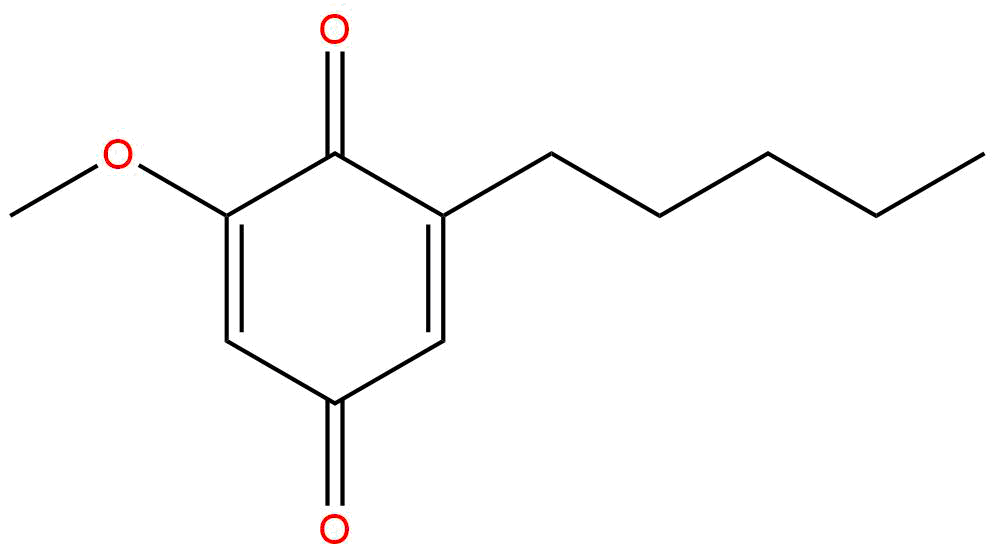
Sakura extract, chemical name 2-methoxy-6-pentyl-1,4-benzoquinone, CAS number 15121-94-5. Its molecular formula is C12H16O3 and its molecular weight is 208.2570 g/mol. Structurally, primrose is a derivative of benzoquinone, with a straight chain pentyl group attached to the 6th position of its benzoquinone nucleus and a methoxy group substituted at the 2nd position. This structure, which combines a lipophilic alkyl chain and an electrophilic quinone ring, is the chemical basis for its interaction with various biomolecules (such as enzymes and receptors) and the production of biological activity.
Its physical and chemical properties are closely related to its structure. The calculated coefficient of lipid water partition (LogP) is 2.4638, indicating that primrose has moderate to high lipophilicity, which is beneficial for its penetration into cell membranes. The topologically polar surface area (TPSA) is 43.3700 Å ², which is relatively small and further supports its good membrane permeability. The predicted value of water solubility is 0.1608 mg/mL, which belongs to slight solubility, indicating that solubilization strategies may need to be considered in formulation development. Pharmacokinetic predictions indicate that primrose has a high blood-brain barrier permeability potential, which provides a possibility for its potential central nervous system related applications (such as neuroinflammation), but also suggests the need to be vigilant about potential neurotoxic risks. Importantly, the preliminary pharmacological risk assessment showed that the hERG inhibition risk was "no" and the Ames test predicted a value of 0.0 (indicating no mutagenicity), providing relatively positive signals for its early safety as a candidate drug.
Plant sources and extraction methods
Sakuragenin was initially and mainly isolated from Primulaceae plants, especially Four Seasons Report Spring(Primula obconica Hance)。 This plant is widely distributed in the field of horticulture, and the glandular trichomes on the surface of its leaves and stems are the main sites for the synthesis and storage of anthocyanins. When the human skin comes into contact with these hair like bodies, cherry blossom extract, as a hapten, can cause contact allergic dermatitis, which is also its early recognized biological characteristic. In addition, other plants in the same family such as Primula mistassinica、Primula elatior And some Miconia There have also been reports of the presence of primrose or its analogues in the genus plants.
The extraction of cherry blossom extract from plant materials is usually carried out using organic solvent extraction method. The classic process includes: drying and crushing Primula obconica The aboveground parts (especially those rich in hairy bodies) are subjected to cold soaking or Soxhlet extraction using moderately polar organic solvents such as dichloromethane, ethyl acetate, or acetone. After vacuum concentration, the crude extract is separated and purified using a series of chromatographic techniques, such as silica gel column chromatography, thin layer chromatography (TLC), or high-performance liquid chromatography (HPLC). Due to its quinone like structure, attention should be paid to avoiding light and operating at low temperatures during the separation process to reduce its degradation. Modern technologies such as high-speed countercurrent chromatography (HSCCC) have also been applied to efficiently prepare high-purity primrose extract. The content of primrose in plants is influenced by factors such as variety, growth environment, and harvest season. Therefore, obtaining stable sources through plant cell culture or chemical synthesis is also one of the research directions.
Pharmacological activity research
The pharmacological activity research of cherry blossom extract has expanded from its initial allergenicity to multiple therapeutic fields, demonstrating the diverse biological effects of its chemical structure.
-
Antibacterial activity Early studies have confirmed that coumarin has significant inhibitory activity against various Gram positive bacteria (such as Staphylococcus aureus, Bacillus subtilis) and some fungi. The mechanism may be related to the interference of quinone ring structure on the electron transfer chain of microorganisms, or to the alkylation reaction of thiol groups in bacterial proteins. This provides a basis for its development of natural antibacterial agents.
-
anticancer activity: Several in vitro studies have shown that primrose has cytotoxicity to a variety of human cancer cell lines (such as breast cancer MCF-7, lung cancer A549, leukemia HL-60, etc.), and can induce cell cycle arrest (usually in G2/M phase) and apoptosis. Its pro apoptotic effect is closely related to activating the caspase cascade, inducing mitochondrial membrane potential loss, regulating the proportion of Bcl-2 family proteins, and increasing intracellular reactive oxygen species (ROS) levels. These findings establish the position of cherry blossom extract as a leading anti-cancer compound.
-
Antiallergic activity This is the most widely studied field in the pharmacological research of primrose extract in recent years. In various in vitro and in vivo allergy models, cherry blossom extract has shown good anti-inflammatory and anti allergic effects. For example, in compound 48/80 or anti IgE induced mouse systemic allergic reaction models, coumarin can significantly reduce plasma histamine levels. In a mouse allergic asthma model induced by ovalbumin (OVA), administration of primrose can alleviate airway hyperresponsiveness, reduce the infiltration of inflammatory cells such as eosinophils and lymphocytes in bronchoalveolar lavage fluid (BALF), and decrease the levels of Th2 cytokines (such as IL-4, IL-5, IL-13). In animal models of contact allergy and atopic dermatitis, coumarin can also alleviate inflammatory symptoms such as skin redness, swelling, and thickening. It is worth noting that the exploration of its therapeutic window is crucial, and its anti allergic immune regulatory effect needs to be exerted at doses lower than the sensitizing concentration.
Mechanism of action and molecular targets
The anti allergic effect of primrose extract is not achieved through a single pathway, but based on its quinone structural characteristics, it intervenes in multiple key nodes of the allergic inflammation network through multi-target intervention. The potential molecular targets and mechanisms revealed by existing research include:
-
Inhibition of arachidonic acid metabolism pathway Sakura extract is 5-Lipoxygenase (ALOX5)Effective inhibitors. ALOX5 is the rate limiting enzyme that catalyzes the production of leukotrienes (LTs) from arachidonic acid, particularly LTB4 and cysteine leukotrienes C4, D4, E4, which are potent pro-inflammatory mediators and bronchoconstrictors. By inhibiting ALOX5, coumarin can fundamentally reduce the production of leukotrienes, thereby combating its core role in diseases such as asthma. Meanwhile, it may also antagonize Thromboxane A2 receptor (TBXA2R)Interference with the signal transduction of products from another arachidonic acid metabolic pathway.
-
Regulating immune cell function and signal transduction:
- Inhibition of mast cell/basophil activation Sakura extract can inhibit high affinity IgE receptors(FCER1A)Mediated signal transduction, or directly stabilizing the mast cell membrane, reducing its degranulation and release of pre stored mediators such as histamine and trypsin. This is consistent with the phenomenon of reducing plasma histamine levels.
- Regulating Th1/Th2 balance Allergic reactions are dominated by an excessive Th2 immune response. Sakura extract can significantly inhibit Th2 type cytokines IL-4、IL-5、IL-13 The generation. The underlying mechanism may involve inhibition STAT6 Signal pathway. IL-4 and IL-13 activate STAT6, drive B cells to produce IgE, promote Th2 cell differentiation, and facilitate key allergic processes such as excessive mucus secretion. The inhibition of STAT6 phosphorylation or nuclear translocation by primrose extract is the core link in correcting Th2 shift.
- Targeting upstream alarm factors Research suggests that coumarin may downregulate thymic stromal lymphopoietin(TSLP)The expression. TSLP is an alarm factor derived from epithelial cells, playing a "master switch" role in the initiation and maintenance of allergic inflammation. It can strongly activate dendritic cells and drive Th2 type immune responses.
-
Antagonistic histamine receptor Molecular docking and functional experiments have shown that coumarin can interact with Histamine H1 receptor (HRH1)Combined, as an antagonist, it blocks the smooth muscle contraction and increased vascular permeability caused by histamine, which forms the basis for its rapid relief of some allergic symptoms.
In summary, cherry blossom extract rapidly inhibits the release and effects of mediators by simultaneously acting on targets such as ALOX5, HRH1, FCER1A, and regulates the polarization of immune response by intervening in targets such as IL-4/STAT6 axis and TSLP, forming a multi-level anti allergic network from upstream alarm, immune cell activation to downstream mediator effects.
Evaluation of drug properties and pharmacokinetics
Based on its physical and chemical parameters and preliminary biological data, a preliminary evaluation of the pharmacological properties of primrose extract is conducted
- Absorption and distribution Moderate LogP values and small TPSA indicate that primrose has good oral bioavailability potential and can be effectively absorbed by the intestine through passive diffusion. Its high lipophilicity also benefits tissue distribution. The predictive value of high blood-brain barrier penetration is a double-edged sword, and its advantages and disadvantages in the central nervous system need to be validated in specific disease models.
- Metabolism and excretion As a quinone compound, coumarin is likely to undergo complex metabolic processes in the body. Quinone ring may be reduced to hydroquinone, followed by glucuronidation or sulfation binding reactions; The pentyl side chain may undergo ω - or (ω -1) - oxidation. These metabolic reactions may affect their activity and toxicity. The metabolic enzyme spectrum (such as whether it is widely metabolized by the CYP450 enzyme system) and the main excretion pathways (bile or urine) remain to be experimentally elucidated.
- safety Early allergenicity is the main challenge facing the development of cherry blossom extract. However, in drug development, dosage and administration route are key variables. Local administration (such as skin, inhalation) may avoid systemic sensitization risks by controlling dosage and formulation techniques. Predicting the absence of hERG inhibition and mutagenicity (Ames negative) is an important early safety advantage. However, the potential cytotoxicity of quinone compounds (such as through ROS generation) and liver toxicity caused by possible metabolic activation require detailed evaluation in comprehensive preclinical toxicology studies.
- Preparation considerations Due to its poor water solubility, it is crucial to develop suitable formulations to improve its solubility and stability. Formulation technologies such as nanocrystals, liposomes, and cyclodextrin inclusion complexes may be applied to improve their delivery efficiency.
At present, there is still a lack of pharmacokinetic studies on the primrose system, such as the ADME process in rats, dogs, and other animals, which is a data gap that must be filled to promote its development as a candidate drug.
Clinical application prospects and prospects
Sakura extract, as a multi-target natural lead compound for anti allergy, has broad clinical application prospects, but also faces clear challenges.
Potential application directions:
1. Topical preparations for local use: To develop sakurarin cream, gel or nano gel for skin allergic diseases such as atopic dermatitis and allergic contact dermatitis (at sub sensitization treatment dose). Local administration can maximize target site concentration while minimizing systemic exposure and sensitization risk.
2. Inhalation Preparations Given its inhibitory effect on ALOX5 and its ability to alleviate airway inflammation, making cherry blossom extract into a dry powder inhaler or nebulized solution for the treatment of bronchial asthma, especially leukotriene dependent asthma, may have unique advantages.
3. combination therapy The multi-target properties of cherry blossom extract may lead to synergistic effects with traditional antihistamines, inhaled corticosteroids, etc., or be used to reduce the dosage and side effects of the latter.
4. Other inflammatory diseases Its anti-inflammatory mechanism is not limited to allergies, and may also have exploratory value for other Th2 or inflammatory mediator related diseases such as psoriasis and inflammatory bowel disease.
Future research focus and challenges:
1. structural optimization Structural modification of cherry blossom extract through medicinal chemical methods, aiming to Reduce its allergenicity And potential cytotoxicity, while retaining or enhancing its core activities such as anti-ALOX5 and anti-STAT6. For example, modifying quinone rings or side chains to alter their binding ability with skin proteins.
2. In depth mechanism research Using chemical biology methods such as photoaffinity labeled probes and proteomics to confirm its direct action on target proteins, and elucidate the precise structural basis of its interaction with targets such as STAT6 and TSLP.
3. Systematic pharmacokinetics and toxicological evaluation Conduct standardized preclinical pharmacokinetic and toxicological studies to clarify their in vivo fate, treatment window, and potential organ toxicity, providing a basis for clinical trial design.
4. Innovation in delivery system Develop intelligent delivery systems (such as pH responsive and enzyme responsive release) to achieve precise and controllable release of cherry blossom extract at the lesion site, further improving efficacy and safety.
Conclusion
Sakura extract, a well-known plant allergen, has gradually been revealed to have enormous potential as a multi-target natural lead compound for anti allergic reactions. Its unique quinone chemical structure endows it with the ability to simultaneously intervene in arachidonic acid metabolism, histamine effect, and Th2 immune core signaling pathway, forming a synergistic anti allergic action network. Despite its challenges in terms of allergenicity, water solubility, and systemic toxicity, modern medicinal chemistry, pharmacology, and pharmacology techniques provide powerful tools to address these issues. Through in-depth structural optimization, mechanism elucidation, and dosage form innovation, cherry blossom extract and its derivatives are expected to be developed into new drugs for the treatment of allergic asthma, atopic dermatitis, and other diseases, providing new treatment options for allergy patients. The research on it not only contributes to the discovery of new drugs, but also deepens our understanding of the complex biological activities of natural quinone compounds, reflecting the dialectical research and development approach from "toxicity" to "medicine". In the future, interdisciplinary collaborative research will be the key to driving cherry blossom extract from the laboratory to clinical practice.