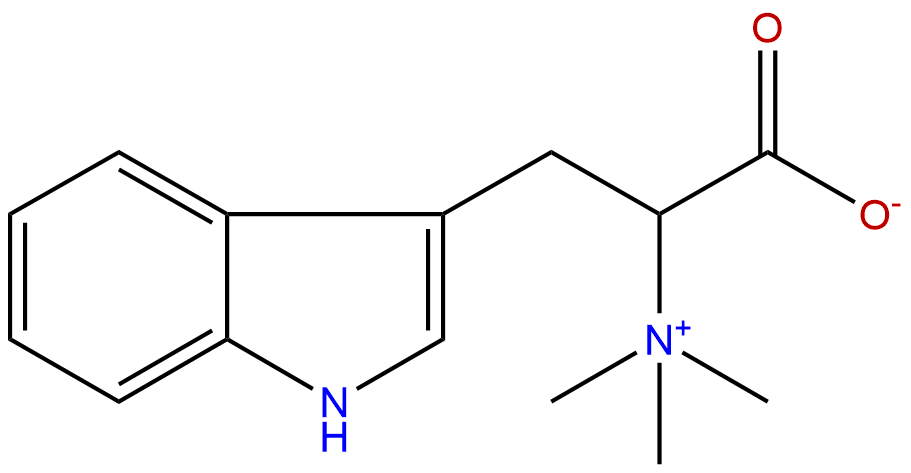


Product name: Hypaphorine
Synonym name:
Catalogue No.: BP3200
Cas No.: 487-58-1
Formula: C14H18N2O2
Mol Weight: 246.31
Botanical Source:
Physical Description: Powder
Type of Compound: Alkaloids
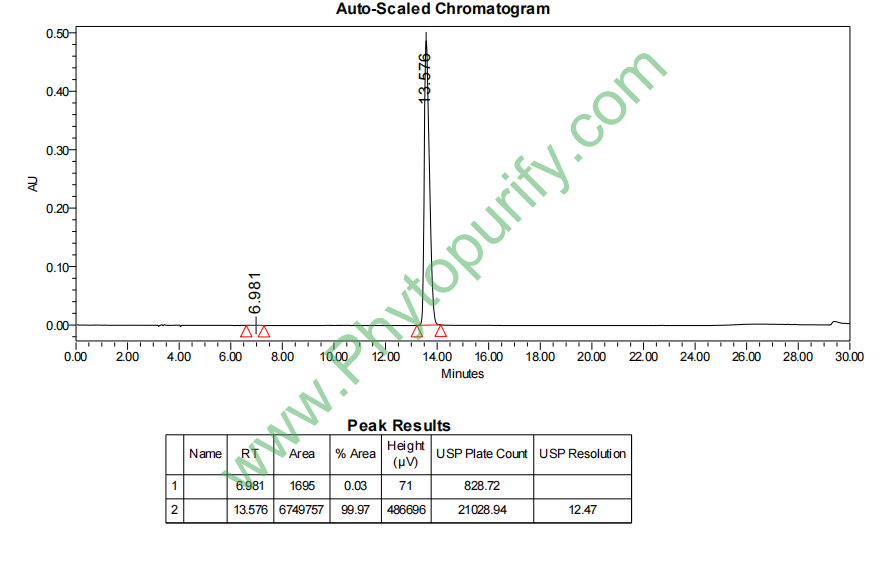
Purity: 95%~99%
Analysis Method: HPLC-DAD or/and HPLC-ELSD
Identification Method: Mass, NMR
Packing: Brown vial or HDPE plastic bottle
The product could be supplied from milligrams to grams. Inquire for bulk scale.
We provide solution to improve the water-solubility of compounds, thereby facilitating the variety of activity tests and clinic uses.
For Reference Standard and R&D, Not for Human Use Directly.
HPLC of Hypaphorine
Storage conditions:Short-term storage at 2~8℃, long-term storage at -20 ~ -80℃
55.9200
-.9654
-.9660
.2395
.5866
1.4801
High
49.4117
3.3818
Yes
No
No
No
No
No
0.3
No
No
No
No
Natural products, as an important source of drug discovery, play an irreplaceable role in the history of human disease treatment. Among them, alkaloid compounds have always been a hot topic in medicinal chemistry and pharmacology research due to their structural diversity and significant biological activity. Hypaphorine, an indole alkaloid, has attracted much attention since its discovery due to its unique chemical structure and potential pharmacological activity. Its CAS number is 487-58-1, molecular formula is C14H18N2O2, and molecular weight is 246.31. Early research mainly focused on its plant origin and preliminary physiological activity. In recent years, with the rapid development of molecular biology and cell biology technologies, the pharmacological effects and deep molecular mechanisms of matrine in neuroprotection, anti-inflammatory, hypoglycemic, and anti-tumor fields have gradually been revealed. Especially its anti-inflammatory effect by regulating the DUSP1/p38/JNK signaling pathway in inhibiting lipopolysaccharide (LPS) - induced acute lung injury (ALI) provides a solid theoretical basis for its application in inflammation related diseases. In addition, its potential association with multiple key targets related to the occurrence and development of lymphoma, such as MCL1, BCL2, STAT3, NF - κ B, etc., suggests its broad prospects in the field of tumor therapy. This article aims to systematically review the chemical structure, plant origin, pharmacological activity, mechanism of action, pharmacological evaluation, and clinical application prospects of matrine, in order to provide comprehensive references for the in-depth research and development of this natural product.
Ruthenine is a typical indole alkaloid, with the chemical name L-tryptophan betaine. Its core structure is composed of an indole ring and a trimethylammonium ethyl side chain connected by a carboxyl group, forming an internal salt (betaine) structure. This unique structure determines its special physicochemical properties.
From the perspective of physical and chemical parameters, the molecular weight of matrine is 246.3100, and its topological polar surface area (TPSA) is 55.92 Å ², which reflects its molecular polarity. The calculated value of its lipid water partition coefficient (LogP) is about -0.9654, indicating that the compound has strong hydrophilicity, which is consistent with its experimentally measured water solubility data (about 0.2395 mg/mL). High hydrophilicity and moderate TPSA values are usually beneficial for the dissolution and distribution of compounds in organisms. It is worth noting that matrine exhibits high blood-brain barrier permeability prediction, which provides an important material basis for its central nervous system related pharmacological effects (such as neuroprotection). In the preliminary safety screening, matrine showed no significant inhibitory effect on hERG potassium channels, indicating a low risk of causing QT interval prolongation in the heart. The Ames test result is 0.3, indicating that under the conditions of this experiment, its mutagenicity risk is low, providing preliminary support for further safety evaluation.
Rosacea is widely present in various plants such as Fabaceae, and its name comes from its discovery in plants of the Erythrina genus. However, this compound is also commonly present in other plants besides the genus Cymbidium. According to the provided information, matrine can be obtained from Caragana korshinskii Separated from the middle. Ningtiao is an important windbreak and sand fixing shrub, mainly distributed in northwest China, and its medicinal value is gradually being explored. In addition, matrine is used in medicinal plants such as Erythrina variegata、Glycyrrhiza uralensis It has also been reported in seedlings and some marine symbiotic organisms.
The extraction of matrine from plant materials often follows the classic alkaloid extraction and separation process. The general steps are as follows:
1. Raw material pretreatment Crush the dried parts of plants, such as roots, stem bark, or whole plants.
2. Solvent extraction Commonly used polar solvents for extraction. Due to its high polarity as a water-soluble alkaloid (existing in its internal salt form), tung oil alkaloids are often extracted or refluxed using solvents such as water, acidic water (such as 1% hydrochloric acid or acetic acid), methanol, or ethanol. Acid water extraction helps to convert alkaloids in plants into water-soluble salts.
3. Purification and Separation After concentration, the extract can be alkalized by adjusting the pH value to free the alkaloids, and then extracted with organic solvents such as chloroform and dichloromethane. Cation exchange resin adsorption method can also be used to selectively enrich alkaloid components. The obtained crude extract was further separated and purified repeatedly using methods such as silica gel column chromatography, reverse phase column chromatography (such as ODS), and preparative high-performance liquid chromatography (HPLC) to obtain high-purity tung alkaloid monomer. Structural identification involves the comprehensive use of modern spectroscopic techniques such as nuclear magnetic resonance (NMR), mass spectrometry (MS), and infrared spectroscopy (IR).
Hawthorn alkaloids exhibit various pharmacological activities, mainly focused on neurological protection, anti-inflammatory, hypoglycemic, and potential anti-tumor fields.
Neuroprotective and neuroregulatory effects Hawthorne is an important active substance in the central nervous system. Research has shown that it can act as an endogenous ligand and bind to imidazoline I2 receptors, which may be related to its regulation of norepinephrine release, production of anti nociceptive (analgesic) and anti anxiety like effects. In addition, it has also shown certain neuroprotective potential in Alzheimer's disease models.
Anti inflammatory and immune regulatory effects The anti-inflammatory activity of matrine has been a research hotspot in recent years. In the LPS induced acute lung injury (ALI) model, matrine can significantly reduce lung inflammatory cell infiltration, lower pulmonary edema and oxidative stress levels, and improve lung tissue pathological damage. Its anti-inflammatory effect is not limited to the lungs, and similar effects have also been observed in other inflammatory models.
Hypoglycemic effect Early research suggests that matrine has hypoglycemic activity, which may be achieved by affecting insulin secretion or improving insulin resistance, but its specific mechanism still needs further exploration.
Antitumor potential Although there are relatively few reports on the direct anti-tumor activity of matrine, based on its associated disease target information, there is a potential link between it and the occurrence and development of lymphoma. Hawthorn alkaloids may indirectly inhibit tumor cell proliferation, induce apoptosis, or enhance immune surveillance by affecting key targets such as apoptosis regulatory proteins (such as MCL1, BCL2), cyclin (CDC25B), signaling molecules (STAT3, NF - κ B1), and tumor suppressor factors (TP53, CDKN2A). This provides new clues and directions for the development of anti-tumor drugs.
The pharmacological effects of matrine depend on its precise regulation of multiple cellular signaling pathways. At present, the molecular mechanism of its anti-inflammatory properties is being studied in depth.
The core mechanism of anti-inflammatory effect: DUSP1/p38/JNK pathway regulation
The key to the anti-inflammatory effect of matrine in LPS induced macrophage or pulmonary epithelial cell inflammation models lies in its inhibition of the mitogen activated protein kinase (MAPK) signaling pathway. Specifically, matrine can Significantly upregulate dual specificity phosphatase 1 (DUSP1)The expression. DUSP1 is an important MAPK phosphatase that can specifically dephosphorylate and inactivate p38 MAPK and c-Jun N-terminal kinase (JNK). LPS stimulation strongly activates the p38 and JNK pathways, driving the transcription and release of downstream pro-inflammatory factors such as TNF - α, IL-6, IL-1 β. Hawthorn alkaloids accelerate the inactivation of p38 and JNK by increasing the expression of DUSP1, thereby Effectively block this key pro-inflammatory signaling axis Inhibiting the excessive production of inflammatory mediators ultimately alleviates inflammatory diseases such as acute lung injury.
Potential target network associated with lymphoma
The association between matrine and lymphoma related targets suggests that it may affect tumor biological behavior through multi-target pathways
These targets form a complex network, and matrine may act directly or indirectly on one or more rings, but its specific mode of action and dominant target remain to be experimentally verified.
Based on its physicochemical properties and preliminary biological data, matrine has shown certain potential as a drug, but its comprehensive pharmacokinetic characteristics and drug properties still need to be systematically studied.
Prediction and Challenges of Absorption, Distribution, Metabolism, and Excretion (ADME):
Pharmaceutical advantages:
Challenges in drug development and future research directions:
The multi-target and multi pathway properties of matrine provide possibilities for its application in various disease fields.
Treatment of inflammatory diseases Based on its clear anti-inflammatory mechanism, matrine is effective in treating Acute lung injury/acute respiratory distress syndrome (ALI/ARDS)、sepsis、Rheumatoid arthritis、Inflammatory bowel disease It has potential application value in various aspects. Developing inhaled or intravenous formulations for the control of acute pulmonary inflammation is a direction worth exploring.
Neurological disorders Its blood-brain barrier permeability and neuroregulatory activity enable it to Neuropathic Pain、anxiety disorder、depression and Neurodegenerative diseases (such as Alzheimer's disease) It has potential in adjuvant therapy. It can be studied for its combined efficacy with existing neuropsychiatric drugs.
Metabolic diseases In depth exploration of the mechanism of its hypoglycemic activity may lead to Type 2 diabetes The treatment provides new lead compounds or dietary supplement candidates.
Tumor adjuvant therapy and immune regulation Although there is insufficient evidence for direct anti-tumor effects, its potential inhibitory effects on tumor related pathways such as STAT3 and NF - κ B suggest that it may serve as a potential lymphoma Adjuvant therapy for hematological or solid tumors, used to regulate the tumor microenvironment, enhance chemotherapy drug sensitivity, or alleviate inflammatory damage caused by radiotherapy and chemotherapy. Its immune regulatory target PTPRC is also worth paying attention to.
Future research directions:
As a naturally occurring indole alkaloid, tung alkaloid is becoming a highly anticipated new star in the field of natural product drug development due to its unique chemical structure and increasingly clear pharmacological activity. From traditional neural regulation to modern molecular mechanism studies revealing anti-inflammatory effects by upregulating DUSP1 to inhibit the p38/JNK pathway, and to its potential association with key target groups in lymphoma, the breadth and depth of research on matrine continue to expand. Although it has shown good blood-brain barrier permeability and preliminary safety in drug development, there are still many challenges to truly develop it into a clinical drug, such as efficacy intensity, selectivity, systemic pharmacokinetics, and comprehensive toxicological evaluation. Future research should focus on in-depth analysis of its mechanism of action, structure based activity optimization, and systematic preclinical evaluation. I believe that with the integration and in-depth exploration of multidisciplinary technologies, matrine has the potential to achieve a leap from natural compounds to innovative drugs in the fields of inflammatory diseases, neurological and psychiatric disorders, and tumor adjuvant therapy, contributing its unique value to human health.
