
| Catalog No | Package | Original Price | Price | Inventory | Quantity | Operating |
|---|---|---|---|---|---|---|
| BP1354-20mg | 20mg | $96.00 | Sign in |
|
||
| BP1354-100mg | 100mg | Inquiry |
Inquiry |
|


Product name: Syringaresnol-4-O-beta-D-apiofuranosy
Synonym name:
Catalogue No.: BP1354
Cas No.: 136997-64-3
Formula: C33H44O17
Mol Weight: 712.698
Botanical Source: Albiziae Cortex
Physical Description:
Type of Compound: Lignans
Purity: 95%~99%
Analysis Method: HPLC-DAD or/and HPLC-ELSD
Identification Method: Mass, NMR
Packing: Brown vial or HDPE plastic bottle
Storage: Store in a well closed container, protected from air and light. Put into refrigerate or freeze for long term storage.
Whenever possible, you should prepare and use solutions on the same day. However, if you need to make up stock solutions in advance, we recommend that you store the solution as aliquots in tightly sealed vials at -20℃. Generally, these will be useable for up to two weeks.
The product could be supplied from milligrams to grams
Inquire for bulk scale.
Chengdu Biopurify Phytochemicals Ltd. is a leading company in the research, development, manufacture and marketing of High Quality Phytochemicals and Extracts(especially Active Ingredients from Traditional Chinese Medicine,TCM), Natural Active Pharmaceutical Ingredients worldwide.
The main services:
A. Supply active ingredients and reference standards of TCM, from mgs to kgs scale
B. Custom extraction and purification, target Herb Active Ingredients
C. Custom synthesis and semi-synthesis for Natural Active Ingredients
D. CR(contract research), CM(contract manufacture) and PD(process development) services from lab scale, pilot scale to commercial scale(GMP is also available)
E. TCM compounds library for drug screen,more than 3000 compounds available, many of them are rare and unique.
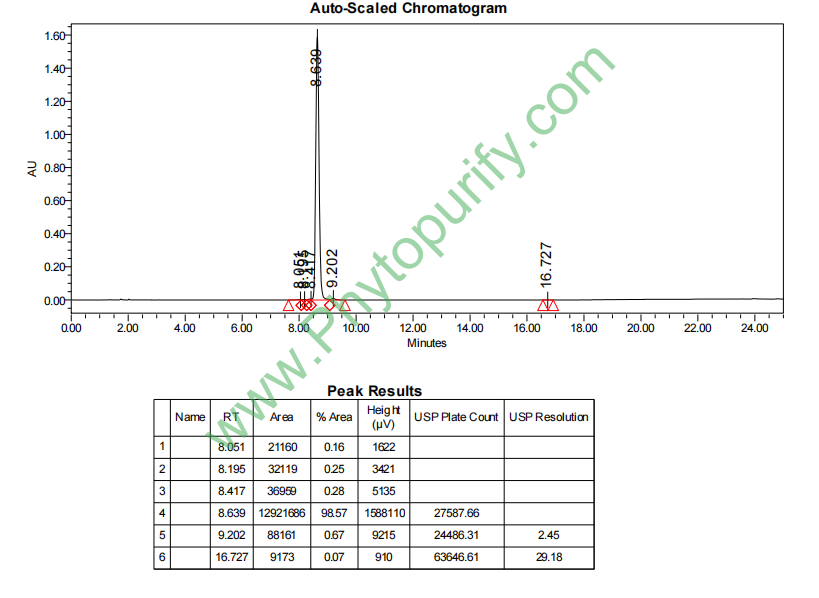
HPLC of Syringaresnol-4-O-beta-D-apiofuranosy
Storage conditions:Short-term storage at 2~8℃, long-term storage at -20 ~ -80℃
233.9100
-.0627
-.0644
1.8439
.6957
.2228
Low
76.0428
5.2755
Yes
No
No
No
No
No
0.0
Yes
No
Yes
Yes
Osteoporosis is a systemic bone disease characterized by reduced bone mass, destruction of bone microstructure, and increased bone fragility. It is a major public health challenge facing an aging society. At present, although first-line clinical drugs can effectively inhibit bone resorption or promote bone formation, long-term use often accompanies side effects such as mandibular necrosis, atypical fractures, and cardiovascular risks. Therefore, exploring new lead compounds from natural products that have multiple targets, high safety, and potential to promote bone formation has become a research hotspot in this field. Lignin compounds, as a widely present class of secondary metabolites in the plant kingdom, have attracted much attention due to their diverse chemical structures and extensive biological activities. Among them, (-) - syringaresinol-4-O - β - D-furanosyl - (1 → 2) - β - D-glucopyranoside (hereinafter referred to as "the compound", CAS: 136997-64-3), as a structurally unique disaccharide lignan, has shown significant potential in the pharmacological activity research of anti osteoporosis in recent years. This article aims to systematically review the chemical properties, plant sources, pharmacological activities, multi-target mechanisms of action, and pharmacological properties of this compound, in order to provide scientific basis for the development of anti osteoporosis drugs based on natural products.
This compound belongs to the furan type lignan glycoside class, and its parent nucleus is the classic syringaresinol, which is formed by the β - β 'connection of two pineol units to form a tetrahydrofuran structure. Its structural feature is that a disaccharide chain consisting of β - D-furan apiofuranosyl and β - D-glucopyranosyl is connected to the 4-hydroxy group of the eugenol core through a glycosidic bond, where apiofuranosyl is linked to glucose via a (1 → 2) bond. This disaccharide modification, especially the introduction of rare sugar apiose, significantly affects its polarity, solubility, and interaction mode with biomolecules, which is an important structural basis for its biological activity.
According to the provided pharmacological parameters, its molecular weight is 712.6980, which belongs to the category of medium to large molecules. The calculated lipid water partition coefficient (LogP) is -0.0627, indicating that the compound has balanced hydrophilic and lipophilic properties, slightly hydrophilic. The topologically polar surface area (TPSA) is as high as 233.91 Å ², mainly attributed to the numerous hydrogen bond acceptor and donor sites contributed by multiple ether bonds, hydroxyl groups, and two sugar units in the molecule. The high TPSA value is consistent with the good water solubility prediction value (1.8439), indicating that the compound has good solubility in aqueous environments, which is beneficial for its absorption and distribution in organisms. However, the higher polarity and molecular weight also indicate that there may be certain challenges in its transmembrane transport, and its blood-brain barrier permeability is predicted to be "low". This may actually reduce the potential risk of side effects in the central nervous system for anti osteoporosis drugs that mainly act on the peripheral skeletal system. In addition, the compound showed no hERG inhibition risk (no) and an Ames test mutagenicity risk of 0.0 in preliminary toxicity prediction, providing preliminary positive signals for its safety.
This compound has a relatively limited distribution in the plant kingdom and is mainly found in the roots, stem bark, or seeds of various traditional medicinal plants. According to literature reports, its important plant sources include but are not limited to: Eucommia ulmoides, a plant in the Eucommia family(Eucommia ulmoides Oliv.)The bark of Eucommia ulmoides, as a famous traditional Chinese medicine for strengthening muscles and bones, is considered to be one of the material foundations for its nourishing liver and kidney, and strengthening muscles and bones effects due to its lignans; Acanthopanax senticosus, a plant in the Araliaceae family(Eleutherococcus senticosus)The root and stem; And mulberry plants in the mulberry family(Morus alba L.)Root bark (mulberry white bark), etc. These plants are commonly used in traditional medicine to treat rheumatism, rheumatism, and soreness in the waist and knees, and have similarities with modern indications for osteoporosis.
The compound is usually extracted from plant materials using organic solvent reflux extraction or ultrasound assisted extraction methods. The commonly used solvents are methanol, ethanol, or their different ratios of aqueous solution to fully extract polar glycosides. The crude extract is subsequently purified using a series of chromatographic separation techniques, such as macroporous adsorption resin column chromatography (e.g. D101, AB-8 type) for initial decolorization and enrichment, followed by repeated separation and purification using normal phase silica gel column chromatography, reverse phase ODS column chromatography (C18 packing), and high-performance liquid chromatography (HPLC) or preparative liquid chromatography. The structural identification mainly relies on modern spectroscopic techniques, including nuclear magnetic resonance (1H-NMR, 13C-NMR, 2D-NMR such as HSQC, HMBC, etc.), mass spectrometry (ESI-MS, HR-ESI-MS), and optical rotation determination, to ultimately confirm its planar structure and stereoconfiguration. In recent years, efficient preparation techniques such as high-speed countercurrent chromatography have also been applied to the separation of such natural products.
The core pharmacological activity of this compound focuses on anti osteoporosis, and extensive in vitro and animal experiments have confirmed its strong dual potential for promoting bone resorption and anti bone resorption.
1. Promote bone differentiation and mineralization activity:
At the cellular level, this compound can significantly promote the proliferation, differentiation, and mineralization nodule formation of pre osteoblasts such as MC3T3-E1 and UMR-106 cells. Research has shown that under osteogenic induction conditions, treatment with this compound can dose dependently increase the activity of alkaline phosphatase (ALP), a key marker enzyme for early differentiation of osteoblasts. Meanwhile, it can significantly upregulate the expression of osteogenic specific transcription factors such as RUNX2 and SP7 (Osterix), which are the core switches regulating osteoblast differentiation and bone formation. Furthermore, the compound can promote the synthesis and secretion of type I collagen (COL1A1), the main component of the extracellular matrix, and accelerate calcium salt deposition, forming mature mineralized nodules, which is the ultimate functional manifestation of bone formation.
2. Inhibit osteoclastogenesis and bone resorption activity:
In osteoclast research, this compound effectively inhibits the differentiation of bone marrow mononuclear macrophages (BMMs) into osteoclasts induced by receptor activator of nuclear factor kappa B ligand (RANKL). It can reduce the formation of multinucleated osteoclasts and decrease the activity of osteoclast specific markers such as tartrate resistant acid phosphatase (TRAP). In the analysis of bone resorption cavities, pre-treatment with this compound can significantly weaken the ability of osteoclasts to absorb bone matrix. This inhibitory effect is crucial for maintaining bone metabolism balance.
3. In vivo anti osteoporosis effect:
In a rat or mouse model of postmenopausal osteoporosis induced by ovariectomy (OVX), in vivo administration (oral or intraperitoneal injection) of this compound can effectively alleviate bone loss. Micro CT analysis shows that it can significantly improve bone microstructural parameters, such as increasing the number (Tb. N) and thickness (Tb. Th) of bone trabeculae, reducing the degree of trabecular separation (Tb. Sp), and thus increasing bone density (BMD). Biomechanics tests have confirmed that animals treated with this compound have significantly improved mechanical properties such as maximum load and elastic modulus of the femur or lumbar spine, indicating that it can not only increase bone mass but also improve bone quality. Histomorphometrics further confirmed its dual effects of promoting bone formation and inhibiting bone resorption.
4. Other potential activities:
In addition to its core anti osteoporosis effect, based on the structure of its lignin core, this compound may also exhibit auxiliary activities such as antioxidant and anti-inflammatory. Chronic inflammation is one of the important causes of osteoporosis, and its potential anti-inflammatory effect may synergistically enhance its bone protective effect.
The mechanism of action of this compound against osteoporosis is complex and multi-target, involving multiple key signaling pathways and molecular targets that regulate the life cycle of osteoblasts and osteoclasts, forming a precise regulatory network.
1. Regulating osteoblast pathways and targets:
* Activate Wnt/β - catenin pathway: This pathway is one of the strongest positive regulatory pathways for bone formation. Research has shown that this compound may stabilize β - catenin protein and promote its nuclear translocation by inhibiting the activity of glycogen synthase kinase-3 β (GSK-3 β), thereby activating downstream transcription of RUNX2 and SP7 and driving osteogenic differentiation. Inhibition of the target AKR1B1 (aldose reductase) may indirectly affect intracellular redox status and signal transduction, and is associated with osteogenic differentiation.
* Regulating the balance of Bcl-2 family proteins: This compound can upregulate the expression of anti apoptotic proteins BCL2 and BCL2L1 (Bcl xL), while possibly downregulating the expression of pro apoptotic proteins such as BAX, and may affect the stability of MCL1. By maintaining the survival of osteoblasts and prolonging their functional cycle, bone formation is promoted. This is crucial for combating osteoblast apoptosis caused by aging or estrogen deficiency.
* Potential regulation of estrogen receptor 1 (ESR1): As a plant derived lignan, its structure may have slight similarities with estrogen, and it may partially activate ESR1 in bones through selective estrogen receptor modulators (SERM), mediating the promotion of bone synthesis metabolism, with minimal side effects on tissues such as the breast and uterus.
* Energy metabolism regulation: The regulation of the target LDHA (lactate dehydrogenase A) suggests that this compound may affect the cellular glycolysis process. Osteoblast differentiation requires a large amount of energy and biosynthetic precursors, and moderate metabolic reprogramming is crucial for it.
2. Inhibit osteoclast pathways and targets:
* Inhibition of RANKL/RANK/NF - κ B and MAPK pathways: This compound can interfere with the signal transduction after the binding of RANKL and its receptor RANK, inhibit the nuclear translocation of NF - κ B and the excessive phosphorylation of MAPK family (such as JNK, ERK, p38), thereby blocking the early key signals of osteoclast differentiation.
* Regulating the NFATc1 signaling axis: NFATc1 is the main transcription factor controlling osteoclast differentiation. This compound inhibits the transcription activation of NFATc1 by suppressing the upstream signals mentioned above, thereby downregulating the expression of downstream osteoclast specific genes (such as TRAP, CTSK, etc.).
* Inducing osteoclast apoptosis: By regulating the BCL2 family proteins within osteoclasts (such as the ratio of pro apoptotic proteins to anti apoptotic proteins), it is possible to induce apoptosis in the mitochondrial pathway and accelerate the death of mature osteoclasts.
* Affects the ratio of osteoprotegerin (OPG)/RANKL: This compound may promote the secretion of TNFRSF11B (osteoprotegerin, OPG) by osteoblasts, which acts as a decoy receptor for RANKL and competitively binds to RANKL, thereby systematically inhibiting osteoclastogenesis.
In summary, this compound exerts a synergistic effect through multiple targets and pathways, on one hand "opening up" (promoting osteoblast activity and survival), and on the other hand "throttling" (inhibiting osteoclast differentiation and function), bidirectionally regulating bone metabolism balance, which is the molecular basis for its highly effective anti osteoporosis effect.
Based on calculations and preliminary experimental data, conduct a preliminary evaluation of the pharmacological properties of the compound.
Prediction and Challenges of Pharmacokinetic Characteristics:
* Absorption: This compound has a moderate LogP value and good predictive water solubility, meeting the solubility requirements of the "class of drugs" rule, indicating that it may have certain oral absorption potential. However, its large molecular weight (>500) and high TPSA (>140) are the main unfavorable factors limiting its passive transmembrane diffusion and oral bioavailability. The glycosidic structure may make it a substrate or inhibitor of intestinal transporters, such as glucose transporters, which could be both an active pathway for their absorption and a potential source of complexity. In addition, gut microbiota may hydrolyze its glycosidic bonds to produce aglycones (eugenol), which have increased lipid solubility but may have altered activity.
* Distribution: The predicted blood-brain barrier permeability is low, mainly distributed in peripheral tissues. Its affinity with bone hydroxyapatite and targeting with osteoblasts/osteoclasts still require experimental verification. The plasma protein binding rate is unknown and is a key parameter affecting its free drug concentration and distribution volume.
* Metabolism: As a lignan glycoside, its metabolic pathway may include: 1) hydrolysis: hydrolysis by β - glucosidase, esterase, etc. in the intestine or liver into aglycones and sugars; 2) Phase I metabolism: The benzene ring of the aglycone may undergo demethylation, hydroxylation, and other reactions; 3) Phase II metabolism: Phenolic hydroxyl groups are prone to undergo glucuronidation and sulfation binding reactions, generating more water-soluble metabolites that are excreted through bile or urine. Glycosylation modification may affect its metabolic rate and site.
* Excretion: Expected to be primarily excreted through the kidneys (conjugates) and bile (prototypes or metabolites).
Preliminary safety assessment:
The provided predictive data shows no hERG inhibition and mutagenicity (Ames test negative), which is a good start. However, a comprehensive preclinical safety evaluation is still needed, including assessment of acute toxicity, long-term toxicity (28 day/90 day repeated administration), reproductive toxicity, and potential risks associated with its specific mechanism of action (such as potent regulation of BCL2 family proteins) (such as impact on immune cells).
Pharmaceutical considerations:
To improve its oral bioavailability, advanced formulation technologies such as nanocrystals, liposomes, solid dispersions, or in combination with absorption enhancers may be required. Given its multi-target effect on the local bone, developing targeted bone delivery systems (such as bone targeted drug delivery systems based on bisphosphonates or peptides) is a highly promising strategy that can increase bone tissue drug concentration, reduce systemic exposure and side effects.
As a natural lignan glycoside with clear multi-target anti osteoporosis activity, this compound has broad clinical application prospects, but solid research is still needed for its transformation.
Potential application directions:
1. Lead compounds of new anti osteoporosis drugs/health products: It can be directly used as an active ingredient to develop prescription drugs or dietary supplements for the prevention and treatment of postmenopausal osteoporosis and senile osteoporosis. Its dual characteristics of promoting formation and inhibiting absorption are superior to simple anti absorption drugs.
2. Components of combination therapy: It can be used in combination with existing drugs such as bisphosphonates, teriparatide, etc., which may produce synergistic effects, reduce their respective dosages and side effects, or be used to reverse the "bone formation inhibition" state that occurs after long-term use of anti resorptive drugs.
3. Functional additives for bone repair biomaterials: Load it into bone implants, bone cement, or tissue engineering scaffolds, and slowly release it locally to promote bone integration and defect repair around the implant.
Future research focus and challenges:
1. In depth mechanism research: It is necessary to use techniques such as gene knockout, chromatin immunoprecipitation (ChIP), proteomics, etc. to accurately elucidate its direct interaction mode with key targets (such as RUNX2, BCL2, AKR1B1, etc.) and draw a more complete signal network map.
2. Systematic pharmacokinetic studies: Urgent research is needed on the entire process of ADME (absorption, distribution, metabolism, excretion) in animals, to clarify its absolute bioavailability, main metabolites and their activities, tissue distribution characteristics (especially bone tissue enrichment), and excretion pathways.
3. Optimization of drug properties: Based on the study of structure-activity relationship, its structure is modified reasonably (such as glycosylation modification and preparation of prodrugs) to optimize its pharmacokinetic properties. Developing an efficient bone targeted delivery system is an important strategy to improve its therapeutic index.
4. Preclinical and clinical studies: After completing the GLP toxicology evaluation of the system, gradually advance clinical Phase I, II, and III trials to verify its safety, effectiveness, and optimal medication regimen in humans.
5. Sustainable source assurance: This compound has a low content in plants and requires the development of sustainable acquisition methods such as plant cell culture, synthetic biology (microbial heterologous synthesis), or total chemical synthesis to meet the needs of future large-scale production and quality control.
(-) - Syringa resin phenol-4-O - β - D-furanosyl - (1 → 2) - β - D-glucopyranoside, as an active lignan glycoside isolated from traditional Chinese medicine for tonifying muscles and bones, has shown great potential in the field of osteoporosis due to its unique chemical structure and clear multi-target pharmacological effects. It achieves precise bidirectional regulation of bone metabolism balance by synergistically regulating multiple key pathways, including RUNX2/SP7 mediated osteogenic differentiation, BCL2 family regulated cell survival, and RANKL/NFATc1 mediated osteoclastogenesis. Although it faces challenges in oral absorption and metabolism in drug development, these challenges are expected to be overcome through the empowerment of modern medicinal chemistry, pharmacy, and delivery technologies. In the future, in-depth exploration of the mechanism, pharmacokinetic optimization, and clinical translation research around this compound are expected to not only give birth to a new type of naturally derived anti osteoporosis drug, but also provide valuable molecular templates and research examples for a deeper understanding of the scientific connotation of "Chinese medicine tonifying the kidney and strengthening bones".
