

Storage conditions:Short-term storage at 2~8℃, long-term storage at -20 ~ -80℃
104.8900
1.6707
1.1940
.3361
.7393
8.4487
Low
81.0478
3.4810
Yes
No
No
No
Yes
Yes
0.9
No
No
No
No
Topotecan (CAS number: 123948-87-8) is a widely studied and clinically applied Topoisomerase I inhibitor with significant anti-tumor activity. As a semi synthetic derivative, topotecan mainly exerts anticancer effects by interfering with the topological structure regulation of DNA replication and transcription processes, inducing tumor cell cycle arrest and apoptosis. It has shown good efficacy in the treatment of various solid tumors such as ovarian cancer and small cell lung cancer, and has become one of the important chemotherapy drugs in clinical practice. This article provides a systematic review of the chemical structure, pharmacological activity, mechanism of action, pharmacological parameters, and clinical application prospects of topotecan, aiming to provide comprehensive and in-depth references for researchers in the field of natural product pharmacology.
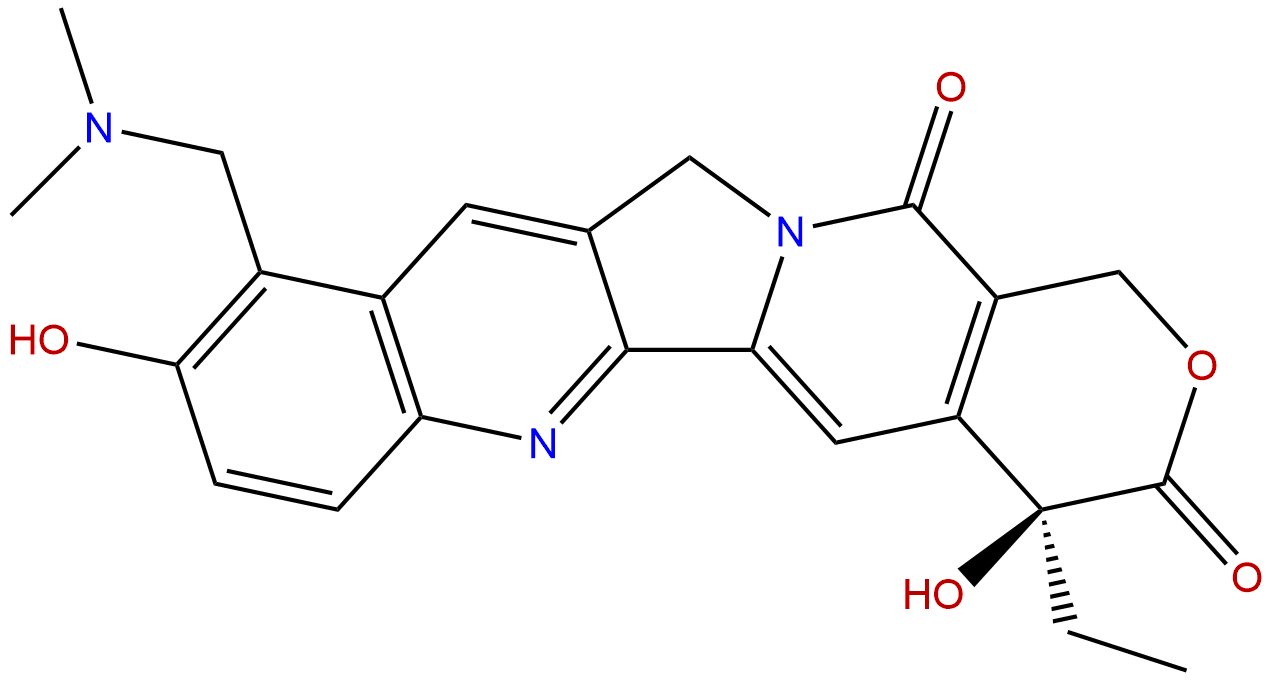
The molecular formula of topotecan is C23H23N3O5, with a molecular weight of 421.4530. Its structure is based on the typical skeleton of topoisomerase I inhibitors, containing a naphthalene like structure with aromaticity and nitrogen heterocycles, supplemented by multiple hydroxyl and carboxyl functional groups, giving it good water solubility and biological activity. Its LogP value is 1.6707, indicating moderate lipid solubility, which is beneficial for membrane penetration. The polar surface area (TPSA) of topotecan is 104.89 Å ², indicating that it has certain polarity characteristics that facilitate binding to target proteins and distribution in vivo. The water solubility is 0.3361, although not extremely high, it is sufficient to support its oral bioavailability. Its blood-brain barrier penetration ability is relatively low, reducing the risk of central nervous system toxicity. The hERG channel inhibition test result is negative, indicating a low risk of cardiac toxicity. The Ames test result is 0.9, indicating low mutagenicity and good safety.
Topotecan initially originated from the structural optimization and semi synthetic modification of natural product paclitaxel compounds. Although it is a semi synthetic drug, its parent structure is closely related to various natural products. The natural lead compounds of topoisomerase I inhibitors mainly come from plants such as Camptotheca acuminata, and its active ingredient camptothecin is the structural basis of topotecan. Camptothecin is obtained through complex extraction and purification processes, usually using organic solvents such as methanol or ethanol for extraction, combined with column chromatography technology for separation and purification. Topotecan was synthesized by chemical modification of the molecular structure of camptothecin, optimizing its water solubility and pharmacological properties. Currently, the production of topotecan mainly relies on chemical synthesis processes, combined with the structural advantages of natural products, to achieve efficient and large-scale production.
Topotecan, as a topoisomerase I inhibitor, exhibits broad-spectrum anti-tumor activity. It mainly stabilizes the complex between topoisomerase I and DNA, blocks the reconnection process of DNA chains, leads to the accumulation of DNA single strand breaks, and triggers DNA damage reactions, inducing tumor cell apoptosis. In vitro studies have shown that topotecan can induce cell cycle arrest and inhibit cell proliferation in various tumor cell lines during the G0/G1 and S phases. Its anti-cancer spectrum covers various solid tumors such as ovarian cancer, small cell lung cancer, cervical cancer, and colorectal cancer.
In ovarian cancer models, topotecan exerts anti-tumor effects by regulating key signaling pathway molecules such as BCL2, STAT3, ABCB1, TOP1, ESR1, NOS2, PIK3CA, MMP9, EGFR, and TP53. Especially its impact on multidrug resistance associated protein ABCB1 can help overcome drug resistance in tumor cells. In addition, topotecan can activate the apoptotic signaling pathway within tumor cells, promote programmed cell death, and enhance chemotherapy efficacy.
The core mechanism of action of topotecan is to inhibit the activity of topoisomerase I (TOP1) and block the supercoiled relaxation process of DNA. Topoisomerase I is an essential enzyme in cell replication and transcription processes, responsible for cutting and reconnecting single stranded DNA, maintaining the stability of DNA topology. Topotecan forms a stable ternary complex with TOP1, preventing the reconnection of DNA strands and leading to the accumulation of DNA single strand breaks, ultimately triggering cell death.
In addition, topotecan affects various signaling molecules related to tumor occurrence and development:
In summary, topotecan achieves effective inhibition of tumor cells through multi-target and multi pathway synergistic effects.
The pharmacological parameters of topotecan show that it has good potential for drug development. Moderate molecular weight and LogP value are beneficial for oral absorption and cell membrane penetration of drugs. A higher TPSA ensures its affinity with the target protein. Although its water solubility is limited, its bioavailability can be improved through formulation technology. The low penetration ability of the blood-brain barrier reduces the risk of adverse reactions in the central nervous system. HERG channel inhibition is negative, indicating a low risk of cardiac toxicity and good safety. The Ames test results showed that its mutagenicity was low and met the drug safety requirements.
Pharmacokinetic studies have shown that topotecan is rapidly absorbed after oral administration, with short peak plasma concentrations and moderate half-life, making it suitable for clinical dosing regimens. Its main metabolic pathway is hepatic metabolism, which is excreted through the kidneys. Due to its regulatory effect on multidrug resistance protein ABCB1, topotecan has potential advantages in the treatment of drug-resistant tumors. In addition, the pharmacokinetic characteristics of topotecan support its combination with other chemotherapy drugs to improve treatment efficacy.
Topotecan, as a topoisomerase I inhibitor, has been approved for the treatment of recurrent ovarian cancer and small cell lung cancer, demonstrating good clinical efficacy and controllable safety. In the future, topotecan has broad application prospects in the field of precision cancer treatment. Through molecular targeting and genomics techniques, it is possible to screen patient populations sensitive to topotecan and achieve personalized treatment.
In addition, the combination of topotecan with immune checkpoint inhibitors and targeted drugs may enhance anti-tumor efficacy and overcome the resistance problem of monotherapy. The development of nano formulations and sustained-release systems will also improve their pharmacokinetic properties, enhance efficacy, and reduce toxic side effects.
Future research should focus on in-depth analysis of the mechanism of action of topotecan, strategies to overcome drug resistance mechanisms, and the development of novel drug delivery systems to promote its clinical application in more types of tumors.
Topotecan, as a topoisomerase I inhibitor based on natural product structure optimization, has become an important member in the field of anticancer drugs due to its unique mechanism of action and broad-spectrum anti-tumor activity. Its good pharmacological parameters and safety provide a solid foundation for clinical application. With the development of molecular biology and medicinal chemistry, the research on topotecan will be further deepened, promoting its application and expansion in precision cancer treatment. In the future, through interdisciplinary collaboration, topotecan and its derivatives are expected to bring more benefits to cancer patients.
