
Pick To:objective Identification of mugwort leavesArtemisiae Argyi FoliumObjective to study the structure of the main chemical components and establish the content determination method.Methods utilizeUPLC-UV-Q/TOFTo optimize the analytical conditions of Artemisia argyi leaves21On the basis of the analysis of Folium Artemisiae argyi, the main chromatographic peaks on UV and MS were determined. After the structure was identified by the accurate relative molecular mass and fragment ions, the structure was determined by comparison with the reference substance; Further adoptionWatersAcquity I-ClassTMLiquid chromatography system,WatersAcquity HSS T3Chromatographic column(100 mm×2.1mm,1.8 μm), acetonitrile-0.2%Phosphoric acid water as mobile phase, volume flow rate0.5mL/min, gradient elution, column temperature40 ℃,PDADetector with detection wavelength of326nmObjective to establish a method for the determination of the main chemical components in Folium Artemisiae argyi.result Speculated that the identification of Artemisia argyi leaves in32The structures of the main compounds were determined by using the reference substance15The structures of compounds and established the14Compounds (chlorogenic acid, neochlorogenic acid, cryptochlorogenic acid, isochlorogenic acidA, isochlorogenic acidB, isochlorogenic acidC, caffeic acid, Chardonnay glycoside, apigenin, plantain, brown cyanidin, isoxalanin5,7,3′-Trihydroxy-6,4′,5′-Trimethoxyflavone, Vitexin)UPLC-UVContent determination method.14The separation, stability and reproducibility of the compounds were good, and the linear range was wide(0.5~800.0μg/mL)Good linearity(R2>0.999), the average recovery was at94.88%~103.58%。Conclusion Established Artemisia argyi14The quality of Folium Artemisiae argyi can be comprehensively evaluated by the content determination methods of the main compounds.
Mugwort leafArtemisiaeArgyi FoliumArtemisia argyi, belonging to the Artemisia genus of CompositaeArtemisiaargyi Lévl. et Vant.The dry leaves of the plant are pungent, warm and bitter in nature. They belong to the liver, spleen and kidney meridians. They have the effects of warming the meridians, hemostasis, dispersing cold and relieving pain. They are mainly used to treat hematemesis, bleeding, metrorrhagia and menorrheaFor many diseases, such as fetal blood leakage, less abdominal cold and pain, irregular menstrual cold, infertility due to uterine cold, external use can dispel dampness and relieve itching[1]According to modern pharmacological research, Folium Artemisiae argyi has antibacterial, antiviral, antiasthmatic and antitussive, expectorant, antioxidant, hemostatic, anticoagulant, hepatoprotective and cholagogic, antipyretic and sedative, and lipid regulating effects[2-4]At present, mugwort leaves are mainly used for moxibustion treatment as the material for processing moxa wool, and the heat and aromatic smell during moxibustion treatment are the key to exert the efficacy[5]Therefore, people pay more attention to its volatile components and moxa smoke after combustion[6-9]Artemisia argyi leaf is a compatibility of traditional Chinese medicine, and decoction is also its main use, so nonvolatile components should also be the chemical components of Artemisia argyi leaf that need attention. Literature research shows that chlorogenic acids, flavonoids and terpenoids are the main components[10-13]And these components have good pharmacological activities[14-18]。《Chinese Pharmacopoeia》2020Although the volatile oil components are used as the quality control indicators of mugwort leaves in the edition of, the author believes that the volatile components and combustion characteristics are more critical to the quality control of mugwort (moxa stick)[19-21]The quality control of Folium Artemisiae argyi using non-volatile components as indicators is more objective. Some scholars have carried out the determination of chlorogenic acid and flavonoids in Artemisia argyi leaves[22-25], which is a beneficial exploration for the quality research of mugwort leaves. This study usedUPLC- UV-Q/TOF MSTandem analysis of21Batch of Folium Artemisiae argyi. While determining the common chromatographic peaks on the UV and mass spectra of Folium Artemisiae argyi, the structure of the common peak was inferred by using the accurate relative molecular mass and the mass spectrum cleavage law, and the reference substance was used to determine15The exact structures of the compounds, further establishing the14The content determination method of compounds provided a reasonable and controllable method for the quality evaluation and control research of mugwort leaves.
1 Instruments and materials
Waters Acquity I-Class UPLCTMLiquid chromatograph in series (including binary high-pressure solvent manager, autosampler, column temperature control systemPDADetectorEmpower 3Workstation)Waters Xevo G2-SHigh resolution mass spectrometry system (USAWatersCompany). The chromatographic column isWaters Acquity UPLC HSS T3Chromatographic column(100 mm×2.1 mm,1.8μm)AndBEH C18Chromatographic column(100 mm×2.1 mm,1.7 μm)。Mettler Toledo XS105DUAnalytical balance (Mettler, Switzerland-Toledo), electrothermal thermostatic water bath (Tianjin taister Instrument Co., Ltd.), centrifuge(EppendorfCompany, Germany), ultrasonic cleaner(SB-800 DTD, Ningbo Xinzhi Biotechnology Co., Ltd.). Methanol (chromatographically pure,UN1230)And acetonitrile (chromatographically pure,UN1648)Purchased from Merck AG, Germany, ultrapure water is self-made for ultrapure water system(ThermoBarnstead Gen Pure UV/UF, Thermo Fisher, USA).
Reference neochlorogenic acid (batch No906-33-2), chlorogenic acid (batch No327-97-9), cryptochlorogenic acid (batch No905-99-7), caffeic acid (batch No331-39-5), Chardonnay glucoside (batch No51938-32-0), isoxaphoroside (batch No52012-29-0), isochlorogenic acidB(batch No14534-61-3), isochlorogenic acidA(batch No2450-53-5), isochlorogenic acidC(batch No32451-88-0)Apigenin (batch No520-36-5), kaempferol (batch No520-18-3), high plantain (batch No1447-88-7), brown cyanidin (batch No18085-97-7)、5,7,3′-Trihydroxy-6,4′,5′-Trimethoxyflavone (batch No78417-26-2), isozeaxanthin (batch No22368-21-4), Vitexin (batch No479-91-4)Average mass fraction ≥98%, purchased from Beijing Rongcheng Xinde Technology Development Co., Ltd.
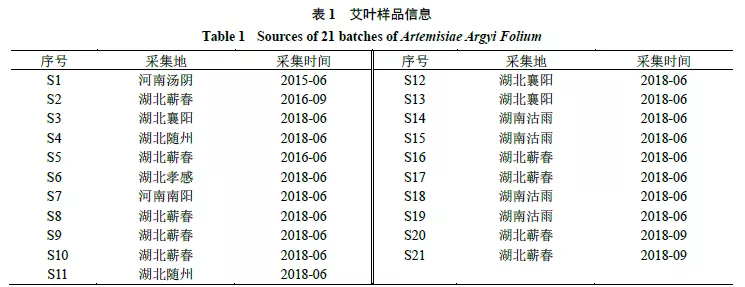
Artemisia argyi leaves are mainly collected from Hubei, Henan, Hunan and other places, and have been identified as Artemisia argyi in the Compositae family by Professor Huang XianzhangA. argyi Lévl. et Vant.The specific sample information is shown in table1。
2 Methods and results
2.1 Chromatographic and mass spectrometric conditions
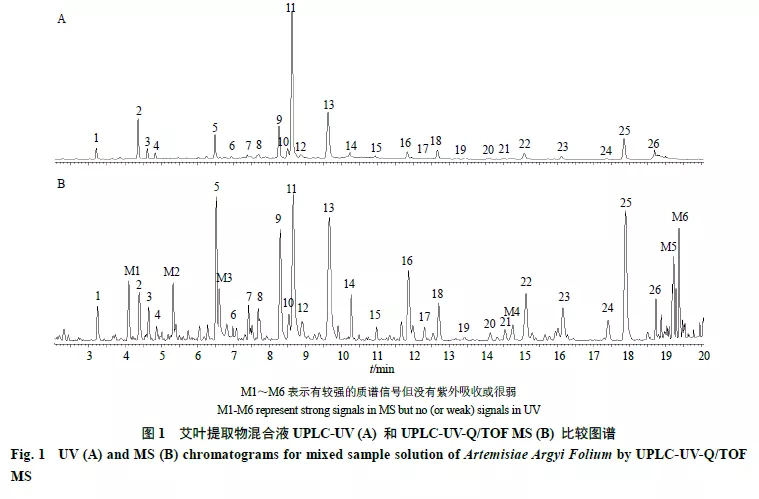
UPLC-UVThe mobile phase was0.2%Phosphoric acid aqueous solution(A)-(B)Gradient elution:0~0.2 min,5% B;0.2~0.8 min,5%~10% B;0.8~3.5 min,10%~13% B;3.5~4 min,13%~15% B;4~10 min,15%~18% B;10~10.5 min,18%~19% B;10.5~15.5 min,19%~21.2% B;15.5~19.5 min,21.2%~32% B;19.5~22.5 min,32%~55% B;22.5~23 min,55%~98% B;23~25 min,98% B;25~27 min,5% B; volumetric flow0.5 mL/min,Waters Acquity UPLC HSS T3Chromatographic column(100 mm×2.1 mm,1.8 μm), detection wavelength326 nm, column temperature40 ℃, injection volume1 μLThe chromatogram is shown in Fig1-A。
UPLC-UV-Q/TOFMSThe mobile phase analyzed was0.1%Formic acid aqueous solution(A)-0.1%(B), gradient elution,0~0.3 min,2%~5% B;0.3~1.0 min,5% B;1.0~7.0 min,5%~20% B;7.0~9.0 min,20% B;9.0~9.5 min,20%~25% B;9.5~12.5 min,25%~28% B;12.5~18.0 min,28%~40% B;18.0~18.3 min,40%~80% B;18.3~21.0 min,80%~98% B;21.0~24 min,98% B; volume flow is0.5 mL/min,Waters Acquity UPLC HSS T3Chromatographic column(100 mm×2.1 mm,1.8 μm),PDADetector, column temperature40 ℃, injection volume1 μL. mass spectrometry was usedESINegative ion mode,MSEAcquisition mode. Capillary voltage was2000 V,The taper hole voltage is40 V, except that the solvent gas is nitrogenQi,900L/h, except that the solvent temperature is450℃, ion source temperature was100℃, scan range ism/z 50~1200. During low-energy scanningtrapThe voltage is6eV, during high-energy scanningtrapThe voltage is50~70eVThe accurate mass number was corrected with leucine enkephalin.The calibration solution was used.The concentration of leucine enkephalin in the sample was 0.5% and 0.5% respectively.The concentration of leucine enkephalin in the sample was 0.5% and(554.2620)。MassLynxFor the operating system, the mass spectrum is shown in Fig1-B。
2.2 Preparation of reference solution
Neochlorogenic acid, chlorogenic acid, cryptochlorogenic acid, caffeic acid, Chardonnay glycoside and isochlorogenic acid were accurately weighed respectivelyB, isochlorogenic acidA, isochlorogenic acidC, apigenin, plantain, brown cyanidin5,7,3′-Trihydroxy-6,4′,5′-Trimethoxyflavone, isozeaxanthin and Vitexin were added to chromatographic methanol for ultrasonic dissolution, and then transferred to a measuring bottle to prepare the mass concentration as follows:0.77、0.768、0.798、0.77、0.818、0.79、0.824、0.766、0.758、0.808、0.742、0.776、0.782、0.800 mg/mLThe mother liquor of the mixed reference substance was diluted step by step into10Mass concentration, to be used.
2.3 Preparation of Artemisia argyi leaf sample solution
Accurately weigh different Artemisia argyi leaf samples200mg, placed in a corked Erlenmeyer flask, and added precisely70%Of methanol10 mL, weight and ultrasonic extraction60 minAfter placing at room temperature, weigh the mass, and70%Methanol makes up the lost mass,12 000×gcentrifugal15 min, and the supernatant of each sample was filtered0.22 μmFilter with organic microporous membrane and transfer the filtrate to liquid phase vial for quantitative analysis. 21Sample solutions are mixed and used as quality control samples for future use.
2.4 Of mugwort leaf samplesUPLC-UV-Q/TOF MSanalysis
By mixing samples ofUVandMSSpectrum, which can be marked on the UV and mass spectra26Chromatographic peaks (peaks1~26)In addition, there are also highly responsive6There are almost no chromatographic peaks on the UV chromatogram(M1~M6), see Fig1. in order to speculate that the identification of32The structures of the compounds were firstly analyzed by analyzing the accurate relative molecular mass of these chromatographic peaks, fragment ion peaks and their relative abundance, retention time and other information and references[4,11-12,26-28], speculated their possible structures, mainly chlorogenic acid and flavonoids, and then purchased16The mass spectra and chromatograms of the control samples were compared and finally determined15The structures of compounds, presumed11The structures of compounds, and6Compounds lacked fragment information and did not identify possible structures. Each compound was specificLC-MSSee table for data2。
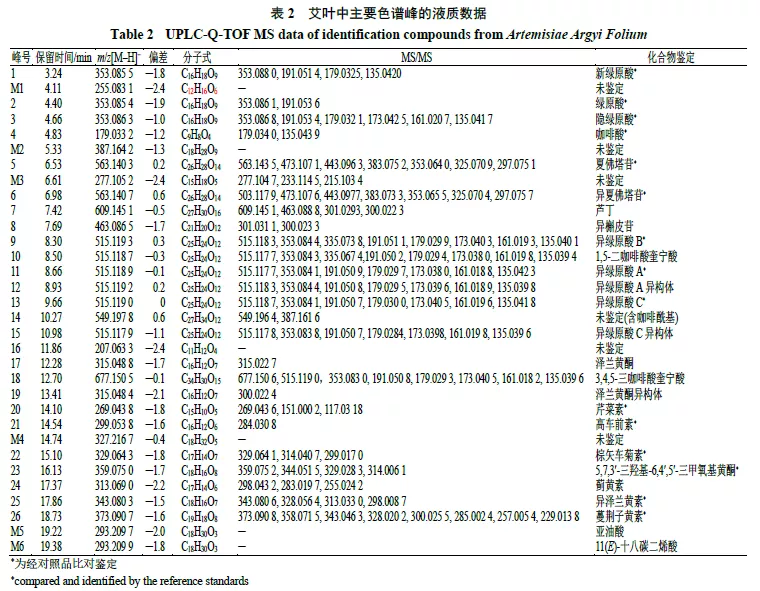
Chlorogenic acids havem/z 191.05 [Quinic acid–H]–There are many fragments ofm/z 179.03 [caffeic acid–H]–,173.04 [191.05–H2O]–、161.02 [179.03–H2O]–、135.04 [179.03–CO2]–Of ions. The substitution positions of caffeioyl groups on quinic acid are different, and their fragment ions are slightly different in mass spectrum, and the ion abundance between them is significantly different: quinic acid4When there is a caffeioyl substitution at position,m/z 173.04The ion abundance ofm/z 161.02、179.03、191.05,3When substituting, there are only two positions.The number of positions in the system is about 0.5....the number of positions in the system is about 0.5......the number of positions in the system is about 0.5m/z 191.05,5Bit substitutionm/z 179.03、191.05The abundance of ion fragments was high.
10.98 minThe chromatographic peaks ofm/z 677.150 5 [M–H]–Of the excimer ion peak, indicating that this is a3,m/z 515.119 0 [M–H–C9H6O3]–,353.083 0 [M–H–2C9H6O3]–,191.050 8 [M–H–3C9H6O3]–Respectively, the molecular ion peaks were continuously deparaffinized3Ionic fragments of caffeic acid, whichm/z 191.050 8、179.029 3、173.040 5、161.018 2The fragment abundance of quinic acid was similar, so it was judged that quinic acid had4It is presumed that the compound may be3,4,5-Tricaffeinate quinic acid.
Shown in flavonoid carboglycosides[M–H–H2C2O2]–,[M–H–H3C3O3]–,[M–H–H4C4O4]–Of fragment ions, respectively, for the molecular ion peak formed by the removal of glycosyl fragments60、90、120Of ions. Flavonoid oxyglycosides generally showed deparaffinization162and146Fragment ions of isoglycosyl formation. Flavonoids are mainly substituted by hydroxyl and oxymethyl groups in different numbers and positions, mainly showing[M–H]–And continuous desquamationCH3·Generally, several oxygen methyl groups are removedCH3Moreover, after the hydroxyl group was replaced by methyl group, its retention time increased significantly.
M5andM6The precise molecular ion of the indicated molecular formula isC18H30O3, and then according to the retention time and literature reports[29], which is presumed to be linoleic acid and11(E)-Octadecadienoic acid.
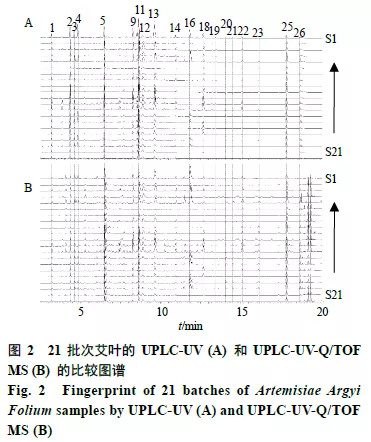
take21The UV and MS chromatograms of different batches of samples were superimposed and compared respectively to determine the common peaks on UV and MS in different batches of samples, as shown in Fig2. common peaks1~5、9、11~14、16、18~23、25、26, where peak12、14、16、18、19 5. So it is proposed to establish this14The quality control of Folium Artemisiae argyi was studied by the content determination method of common compounds.
2.5 quantitative determination
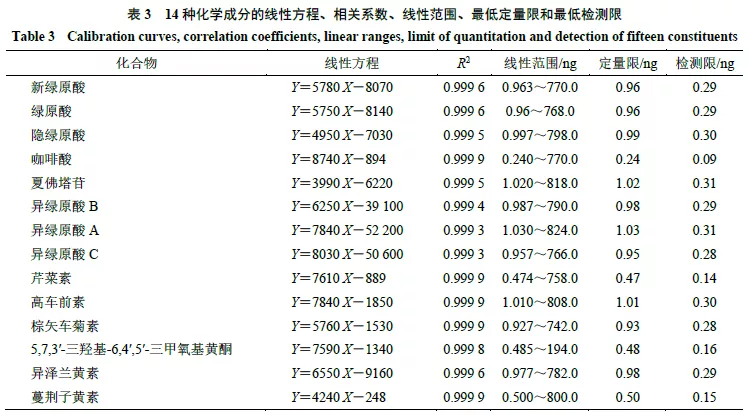
2.5.1 Investigation of linear relationship Take the diluted mixed reference solution and inject samples at each concentration1 μL, as above“2.1”For the conditional injection analysis under, the standard curve is established with the peak area as the ordinate and the mass concentration of each reference substance as the abscissa. Calculated14See the table for the linear regression equation, correlation coefficient, linear range, minimum limit of quantitation and minimum detection limit of each reference substance3. the results showed that Artemisia argyi leaves in14There was a good linear range and relationship among the three chemical components, and the detection sensitivity was high.
2.5.2 Precision test “2.1”Continuous injection under the following conditions6Times, neochlorogenic acid, chlorogenic acid, cryptochlorogenic acid, caffeic acid, Chardonnay glycoside, isochlorogenic acidB, isochlorogenic acidA, isochlorogenic acidC, apigenin, plantain, brown cyanidin5,7,3′-Trihydroxy-6,4′,5′-The peak areas of trimethoxyflavone, isozeaxanthin and VitexinRSDRespectively1.25%、1.07%、1.18%、1.15%、1.35%、0.99%、1.24%、1.28%、1.22%、1.2%、1.17%、1.19%、1.08%、1.13%The results show that the precision of the instrument is good.
2.5.3 stability test Precise weighing of Artemisia argyi leaves0.2 g, press“2.3”Prepare the test solution according to the method below“2.1”The following conditions apply to0、2、4、8、16、24、48、72 hInjection1 μLAnalysis and calculation of neochlorogenic acid, chlorogenic acid, cryptochlorogenic acid, caffeic acid, Chardonnay glycoside and isochlorogenic acid in samplesB, isochlorogenic acidA, isochlorogenic acidC, apigenin, plantain, brown cyanidin5,7,3′-Trihydroxy- 6,4′,5′-Content of trimethoxyflavone, isozeaxanthin and VitexinRSDValues were1.2%、1.11%、1.25%、1.24%、1.09%、1.16%、1.01%、1.13%、1.25%、1.11%、1.08%、1.14%、1.12%、1.22%。
2.5.4 Repeatability test Precise parallel weighing6The same batch of Wormwood Leaves0.2 g, press“2.3”Prepare the test solution according to the method below“2.1”Under the condition of sample injection analysis, calculate neochlorogenic acid, chlorogenic acid, cryptochlorogenic acid, caffeic acid, Chardonnay glycoside, isochlorogenic acid in the sampleB, isochlorogenic acidA, isochlorogenic acidC, apigenin, plantain, brown cyanidin5,7,3′-Trihydroxy-6,4′,5′-Content of trimethoxyflavone, isozeaxanthin and VitexinRSDValues were2.10%、2.22%、1.92%、1.54%、1.85%、1.28%、1.64%、1.77%、1.45%、1.23%、1.12%、1.41%、1.21%、1.23%。
2.5.5 Sample recovery test Precisely weigh the same batch of Wormwood Leaves with known content9Copies, each0.2g, according to1∶0.8、1∶1、1∶1.2The mass ratio of each proportion was added to the single reference solution precisely3Copies,N2After the solvent is volatilized by air flow, press“2.3”Prepare the test article according to the following conditions“2.1”Analyze the chromatographic conditions under, and calculate the recovery rate of each reference substance, including neochlorogenic acid, chlorogenic acid, cryptochlorogenic acid, caffeic acid, Chardonnay glycoside, and isochlorogenic acidB, isochlorogenic acidA, isochlorogenic acidC, apigenin, plantain, brown cyanidin5,7,3′-Trihydroxy-6,4′,5′-The recoveries of trimethoxyflavone, isozeaxanthin and Vitexin were94.9%、96.7%、96.9%、96.5%、103.6%、100.8%、100.5%、99.2%、98.6%、102.0%、100.8%、97.4%、99.3%、97.2%。
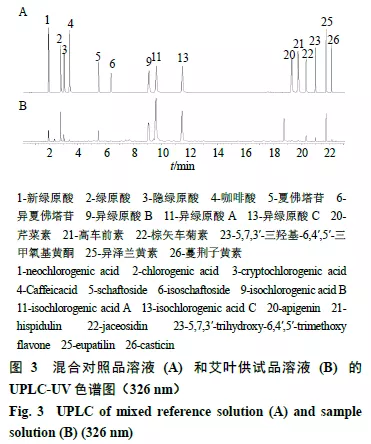
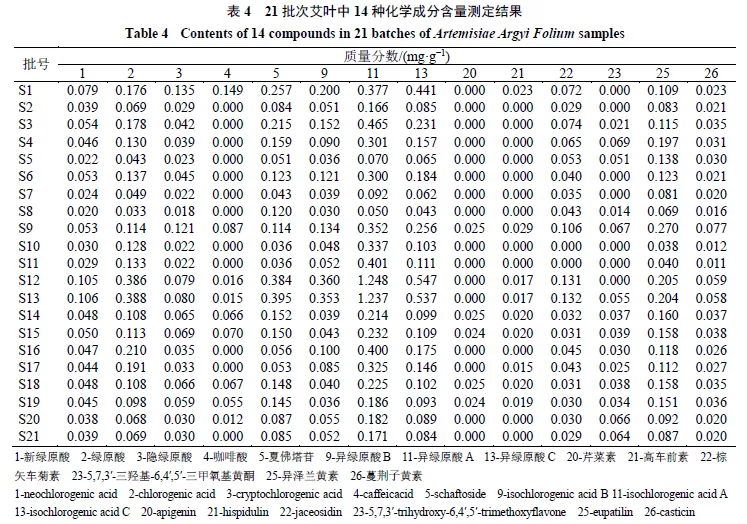
2.5.6 Sample content determination take21For different batches of Wormwood Leaves, press“2.3”Prepare the test solution according to the method under, and repeat for each sample3Times, the content is taken as3Sub average. Press“2.1”The method determined14The contents of compounds are shown in Fig3And table4。
3 discuss
adoptUPLC-UV-Q/TOF MSAnalysis, identified mugwort leaf70%Among the ethanol extracts, the chemicals with good response in both UV and MSCompound, presumed21In batch samples32The structures of compounds, in which the shared chromatographic peaks19Of which were determined by comparison of the reference materials15The structures of compounds (the content of isoflavone was too low to be determined). In order to better isolate and characterize the metabolites in mugwort leaves, especially14Isolation of compounds, selectedHSST3、HSS C18、BEH C18Isochromatic column, methanol-Water, ethanol-Water as well as mobile phases and additives such as formic acid and phosphoric acid were used forChromatographic stripFurther optimization of components,14Compounds were well separated and theirUPLC-UVContent determination method of. At the same time, we also carried outTOFandUVThe comparison of quantitative results showed that although the quantitative sensitivity of mass spectrometry was high1Orders of magnitude, but the quantitative range is slightly narrow, which is not suitable for the simultaneous quantitative analysis of compounds with large content differences, such as isochlorogenic acidA(high content, upper limit beyond the linear range) and high plantain. Mugwort leaves mainly contain chlorogenic acids and flavonoids, of which chlorogenic acids are higher, isochlorogenic acidAThe content of Chardonnay glucoside, brown cyanidin and isoxalanin in flavonoids was higher. Caffeic acid, chlorogenic acid, isoxalanin and other chemicals are also the main pharmacodynamic basis of hemostasis, antioxidant, anti-inflammatory and anti-tumor[14-18]The content of each compound in Folium Artemisiae argyi from different habitats is quite different, and the content of individual compounds is different10Times or more; Similarly, the content of Artemisia argyi leaves in Qichun has certain differences in different storage time and different collection time......................................the content of the leaves of Artemisia argyi. The results of this study and literature reports[24-25]The content of is relatively consistent, but there are some differences in specific values. This shows that the quality of Artemisia argyi leaves is not only related to the origin, but also related to the sea level height, harvesting time, drying method, storage (the stability of chlorogenic acid compounds may be different in different environments). More research is needed to clarify the role of different factors affecting the quality of Artemisia argyi leaves. Further research is needed to establish the quality standard of mugwort leaves.
Although this method can comprehensively evaluate the quality of Folium Artemisiae argyi, there are many cases of using reference substances. Some scholars have studied the method of one test and multiple evaluation6Determination of chlorogenic acids[30], which can better reduce the use of reference substances[31]In addition, the use of standard extracts for quality control research of different samples can reduce the use of reference substances to a greater extent and comprehensively control the quality of medicinal materials. The systematic phytochemical study of Artemisia argyi leaves is not deep enough. Several compounds with high content and unidentified structure in this experiment need further separation and identification research.
References (omitted)
Come Source: lanxiaoyan, zhulongbo, Huang Xianzhang, Liu Dahang, haoqingxiu, Zhou Li, Yang Jian, guolanping, Zhang Yuan, kanglipingIdentification and content determination of main chemical components in Artemisia argyi leaves [J] . Chinese herbal medicine, 2021, 52 (24): 7630-7637