
Pick To:Monascus is fermented by inoculating rice with Monascus bacteria, which can produceMonacolins、SterolsA variety of metabolites, such as Monascus pigment, have biological activities such as lipid regulation, anti-tumor, anti-oxidation and anti diabetes, and are widely used in medicine, food additives, fermented food, biocatalysis and other fields. The chemical constituents of Monascus at home and abroad were mainly reviewed、The research progress of pharmacological effect and clinical application is expected to provide references for further application and development of Hongqu.
MonascusMonascus spp.It belongs to the genus Monascus of Monascus, Monascus family, dyscystis class, Ascomycota subphylum of mycophylum, and uses mycelium and spores as medicine. The strains can be roughly divided into3Species: Monascus AnkaMonascus ankasp., Monascus tuftedMonascus pilosusSatoMonascus purpureusMonascus purpureusWentMost of its cultures are purplish red, which was called Danqu or Hongqu in ancient times. It is mainly made of rice, inoculated with Monascus bacteria and fermented. Hongqu has been used in China for a long time1000For more than years, it has been widely used in traditional Chinese medicine, wine making, food coloring, etc. . Modern research shows that its statin, fatty acid, sterol, pigment and other components have pharmacological effects of regulating blood lipids, anti-inflammatory, anti-tumor, antioxidant and so on.20century70In the s, Japanese scholars isolated and screened Monacolin, a physiologically active substance with the effect of regulating blood lipids, from MonascusK, which has set off an upsurge in the study of Hongqu, and has achieved remarkable results so far. .
1 chemical composition
1.1 Monacolins
1976Years,Endoetc.[1]For the first time, its metabolites were isolated from the culture broth of Penicillium citriML-236A(1)、ML-236B(2)AndML-236C(3), and the above metabolites are proposed to be novel inhibitors of cholesterol production, among whichML-236BThe inhibitory effect is the strongest.1979Years,Endo[2]From Monascus culture solution1Species specific substance and named it MonacolinK(4)。1980In, American scholars found that MonacolinK.1987In, lovastatin was listed in the United States, becoming the first listed lipid-lowering drug, which can significantly reduce cholesterol and low-density lipoprotein cholesterol(low density lipoprotein cholesterin,LDL-C)It is the representative drug of statins for lipid regulation. In recent years, the anti-tumor effect of lovastatin has also become a research hotspot. Studies have found that lovastatin has obvious inhibitory effect on lung cancer, gastric cancer, nasopharyngeal carcinoma, cervical cancer and other common malignant tumors.
Among the fermentation products of Monascus, MonacolinKWith open loopAcid form and closed-loop lactone form2Species exist. In general, internalEster type MonacolinKIt is more stable than the acid type. In the acidic environment, MonacolinKIt will change from acid type to lactone type. MonacolinKThe saturated mass concentration in aqueous solution can reach553.6mg/mL, and acid type MonacolinKMainly, lactone MonacolinKIt has poor solubility in water and is easy to form crystals or precipitates. Heating can cause MonacolinKDegradation, and acid and lactone MonacolinKThere is little difference in the degradation effect of; KDecomposition of[3]. acid type MonacolinKThe structure of human body3-hydroxyl-3-Methylglutarate monoacyl coenzymeA(3-hydroxy-3-methylglutaryl coenzyme A reductase,HMG-CoA)Reductase is the most similar. It has a competitive inhibitory effect in vivo and can effectively inhibit cholesterol synthesis; While the lactone type MonacolinKIt requires the participation of hydroxyesterase in human body to inhibit cholesterol synthesis. There are differences among different individuals, and the ability to produce hydroxyesterase is different, so acid type MonacolinKThe effect on human body is better than that of lactone MonacolinK, it is pointed out in the literature that Monacolin with open loop structureKThe efficacy of is a closed-loop structure2Times, and closed-loop MonacolinKIt will increase the burden on human liver and kidney[4-5]。
In recent years, with the deepening of research, people have found that there are more Monacolin compounds in Monascus. At present, a total of39Monacolin compounds, see table1And fig1. of which compounds11and12It is diastereomer, and its stereostructure needs further study.
1.2 Sterols
Ergosterol(40)Ergosterol, also known as ergosterol, is the main vitamin compound produced in the fermentation process of Monascus and one of the main components of microbial cell membrane[17]Ergosterol is a vitaminD2It is one of the precursors of vitamin A, which is structurally transformed into vitamin A after ultraviolet irradiationD2,It is involved in the metabolism of calcium and phosphorus in human body and affects cell proliferation and differentiation. The study found that vitaminD2It is also associated with cancer, osteoporosis, autoimmune diseases, cardiovascular diseases and other diseases[18]Ergosterol can significantly reduce the blood glucose level of diabetic nephropathy model mice, which provides a theoretical basis for the clinical treatment of diabetic nephropathy with ergosterol[19]。
Stigmasterol(41)Also known as stigmasterol, it is a plant sterol that widely exists in a variety of plant seeds.2012In, Ge Feng et al[20]Stigmasterol was isolated from Monascus for the first time. Studies have shown that stigmasterol has a variety of pharmacological activities, such as antitumor, antioxidant, anti-inflammatory, and so on[21]Stigmasterol is also a natural immune modulator, which can inhibit the potentially harmful innate immune response induced by lipopolysaccharide[22],Can protect the brain from cerebral ischemia by reducing oxidative stress and inflammation/Damage of reperfusion[23]Stigmasterol has many pharmacological effects, and it acts on the body through multiple pathways and targets. The pharmacological activity of stigmasterol is still in its infancy, and its anti-inflammatory and anti-tumor mechanism and complete signaling pathway model need further study[24]The chemical structures of ergosterol and stigmasterol are shown in Figure 2。
In addition to ergosterol and stigmasterol, researchers also isolated from Monascusβ-Sitosterol(42)、3-Hydroxystigmasterol-5-Alkene-7-Ketone(43)、3-Hydroxystigmasterone-5,22-Diene-7-Ketone(44)、6-Hydroxystigmasterol-4-Alkene-3-Ketone(45)、6-β-Hydroxystigmasterol-4,22-Diene-3-Ketone(46), carotene(daucosterol,47)Andβ-Sitosterol palmitate(48)[25]。
1.3 Monascus pigment
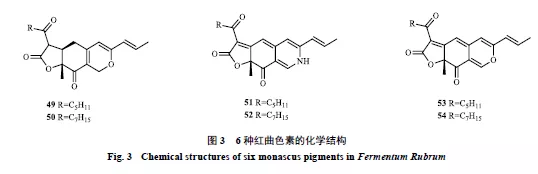
Monascus pigment is a secondary metabolite of Monascus, and its essence isPolyketides[26],Mainly composed of red, orange and yellow3Pigment like composition[27]。So far, it has been found that Monascus pigment has reached54Species, the research of Monascus pigment mainly focuses on6Components, i.e., yellowMonascine (49)AndAnka Monascus flavin(50), red erythema Monascus(51)And Monascus Rhodamine(52), orange erythema Monascus(53)And Monascus rutile(54)The chemical structure is shown in Fig3The red pigment accounts for the majority of the pigment content of Monascus, so Monascus appears dark red visually[28]In recent years, the anti-tumor effects of yellow pigment and orange pigment have become one of the research hotspots, which have inhibitory effects on a variety of malignant tumor cells[26]. liuyanling et al[29]Experiments have proved that Monascus Yellow pigment has significant liver protective effect on hyperlipidemia mice, and can effectively regulate blood lipids. The mechanism of action may be related to the regulation of lipid metabolism and the activation of adenylate activated protein kinase pathway to stimulate fatty acid oxidation.
. However, this does not mean that the research of other compounds is of little significance. In the future, the research of Monascus should focus on clarifying the types and functions of the compounds contained in Monascus, discovering the potential activities of different types of compounds, and corresponding the ingredients to the efficacy.
2 Quality control of Monascus
According to Chinese Pharmacopoeia, morphology, UV-Visible spectrophotometry, thin layer chromatography and HPLC(HPLC)And other methods to evaluate and control the quality of Monascus. Songhongtao et al[30]Use thin layer colorThe Monascus was qualitatively identified by spectral method, andHPLCThe content of lovastatin in red koji was determined. The method has high sensitivity and good repeatability, which laid a foundation for the quality evaluation and quality control of red koji. Liyongsheng et al[31]adoptHPLCThe contents of7The results showed that within a certain concentration range,7There was a good linear relationship between nucleosides and their peak areas(r≥0.999 5)The methodological investigation suggested that this method was suitable for the detection of nucleosides in Hongqu, which provided a certain reference and theoretical practice for the quality analysis of Hongqu in the future. [32]Taking the active secondary metabolites of Monascus as the key probe, an ultra-high performance liquid chromatography method that can distinguish different uses of Monascus was explored and established for the first time, which provided a feasible method for standardizing and improving the quality of Monascus medicinal materials. Tanyouli et al[33]Qualitative identification was established by microscopic and thin-layer chromatographyHPLCAcid type Monacolin was determined byKAnd lactone MonacolinKAccording to Chinese Pharmacopoeia, the contents of water, total ash, acid insoluble ash and extract were determined, and a set of simple, accurate, reliable and reproducible quality control method for highland barley Hongqu was established. Citrinin produced by Monascus has hepatorenal toxicity and carcinogenicity to vertebrates, which has raised concerns about the safety of Monascus and limited the application of Monascus. Therefore, on the premise of ensuring the production of target metabolites of Monascus, it is necessary to find low citrinin strains suitable for industrial production, and improve the detection methods and limit indicators of citrinin.
3 pharmacological action
3.1 Lipid regulation
Monacolin compounds isolated from Monascus are the main lipid regulating active substances, which have the characteristics of safety, low toxicity and high efficiency. Its structure is similar to that ofHMG-CoAReductase is very similar, and this enzyme is the rate limiting enzyme in the process of cholesterol synthesis. Monacolin like compoundThing can be compared withHMG-CoAReductase produces competitive inhibition, thus preventing or reducing the synthesis of endogenous cholesterol to achieve the purpose of regulating blood lipids[34]。Compared with refined lovastatin, Monacolin in Monascus extractKHigher bioavailability and more effective cholesterol lowering effect[35]Studies have shown that some patients will have adverse reactions such as muscle injury when taking statins[36]And when red yeast is used as a food supplement for patients with high cholesterol, it can significantly reduce the adverse reactions[37]. Ge Feng et al[20]The study found that at the same dose of lovastatin, the lipid regulating effect of Hongqu was significantly better than that of lovastatin. Therefore, it is believed that there are other substances in Hongqu that can regulate blood lipids, and the lipid regulating active ingredient stigmasterol was isolated from Hongqu, which proves that Monacolin is not the only lipid regulating ingredient in Hongqu. The experiment shows that Monascus can effectively reduce cholesterol in rats and has a certain effect of regulating blood lipids[38]. yangjunhui et al[39]Hongqu was micronized and filled with capsules to observe its effect on serum monocyte chemoattractant protein in patients with carotid atherosclerosis-1(monocytechemotactic protein-1,MCP-1), matrix metalloproteinases-9(matrix metalloproteinase-9,MMP-9)Level of influence. The results showed that Hongqu micropowder capsules could reduce carotid atherosclerotic plaque and significantly reduce the serum levels of patients with carotid atherosclerosisMCP-1、MMP-9Level, which plays a role in protecting vascular endothelium.
3.2 antioxidant
Zhang Honglin et al[40]The methanol extract of Gutian Monascus was isolated, purified and structurally identified, and linoleic acid andα-Linolenic acid, which confirmed the antioxidant activity of Monascus. [41]Monascus Yellow Pigment liposomes were prepared by thin-film dispersion method, and the antioxidant experiments showed that the liposomes could effectively remove1,1-Diphenyl-2-Trinitrophenylhydrazine radical. Lufangju et al[42]It was found that red koji was an important source of polyphenols in red koji wine, and the antioxidant activity of red koji wine increased with the increase of red koji addition. The research shows that the antioxidant activity of natural red Monascus pigment is significantly higher than that of orange and yellow Monascus pigments, but its hydrophobicity limits its application in medicine, food and other fields, which needs further development[43]。
3.3 Antitumor
Many substances in Monascus have antitumor activities, such as Monascus pigment, Monascus polysaccharide, MonacolinK, ergosterol, etc[34]. inp53In the mouse liver cancer model with gene mutation, statins can significantly inhibit tumor growth by inhibiting the expression of mevalonate pathway related genes to inhibit cholesterol synthesis[44]。Tanetc.[43]Monascus SppCGMCC 10910. By studying the effect of reduced Monascus on human breast cancerMCF-7The effect of cell migration and invasion, determined its antitumor activity. Chenqun et al[45]Synthesized3The anticancer and toxicity test results of three Monascus pigment derivatives showed that they all had good anticancer activity in vitro. Compared with paclitaxel, the metabolites of Monascus pigments were less toxic and cheap, and they were a potential new anticancer drug.
3.4 Treating diabetes
Rajasekaranetc.[46]Streptozotocin-induced diabetic model rats were used to study the therapeutic effect of Hongqu on diabetes. After Hongqu treatment, the elevated biochemical indexes of diabetic rats were significantly reduced, blood lipids returned to normal levels, blood glucose was significantly reduced, body mass was decreased, and kidney antioxidant level was improved. Monascus not only has antidiabetic activity, but also can prevent hypercholesterolemia and nephropathy caused by diabetes.Yoshizakietc.[47]Mice fed a high-fat diet with Monascus4Weeks later, the blood glucose level of mice in Hongqu group was significantly reduced, and the body weight, white adipose tissue and total adipose tissue mass of epididymis were significantly lower than those in ordinary rice group, which proved that Hongqu had the effect of reducing weight and treating diabetes.
3.5 Anti osteoporosis
Studies have pointed out that ergosterol and statins in Monascus are anti osteoporosis active substances, and Monascus alcohol extract can significantly increase bone morphogenetic protein(bone morphogenetic protein-4,BMP-4)Gene expression in osteoporotic rat callus, and low dose (including crude drugs0.1 mg/mL)It can increase the bone mass and the number of trabeculae, reduce the separation of trabeculae, improve bone mineral density, and effectively prevent osteoporosis[34,48-50]. lujianhua et al[51]It was found that Monascus, similar to conjugated estrogen, can increase osteoblast activity, reduce osteoclast activity, and increase bone mineral density. Its mechanism of action is similar to that of nuclear factorκBReceptor activating factor ligand/nuclear factorκBReceptor activator/Osteoprotegerin signaling pathway related.
3.6 Bacteriostasis
In addition to medicine, Monascus has been used as food colorant and preservative in China1000For more than years, since the Yuan Dynasty, working people in China have used the antibacterial activity of Monascus fermentation products to pickle fish and meat products for antisepsis. Monascus has always been an excellent choice of natural edible pigments at home and abroad. Citrinin, Monascus lactone, Monascus pigment andThe derivatives have antibacterial activity[27]. Monascus orange pigment against Staphylococcus aureusThe inhibitory effect of isogram positive bacteria is significant, and it also has a certain inhibitory effect on Gram negative bacteria such as Escherichia coli, Shigella and Salmonella[52]。Zhaoetc.[53]The antibacterial activity of orange pigment in Monascus pigment against Escherichia coli was studied. It can damage the plasma membrane of bacteria, resulting in cell death. Its minimum inhibitory concentration is2.5 mg/mL。Chencuixian et al[54]A novel antimicrobial peptide was found in MonascushqP1It has a good killing effect on Helicobacter pylori and Escherichia coli, and is not easy to produce drug-resistant bacteria.
3.7 other
Monascus has anti-inflammatory effect. Lovastatin and other components in Monascus have strong inhibitory effect on acute and chronic inflammation. A smaller dose can achieve a better anti-inflammatory effect. Its anti-inflammatory mechanism and anti-inflammatory mechanism. In addition, Monascus also has the effects of lowering blood pressure, anti fatigue and anti depression[34]。
At present, the research on the pharmacological effect of Monascus is mostly focused on its turbidity and lipid regulation, and the research is not deep enough, and the mechanism and pathway of action are not completely clear; In addition, there are few studies on its functions of digestion and spleen strengthening, warming the middle and stopping dysentery. Future studies can focus on these aspects to fully stimulate the medicinal value of Monascus and make it better serve the cause of human health.
4 Safety
1931In, citrinin (also known as citrinin) was first isolated from Penicillium as an antibiotic and studied. It is a secondary metabolite produced by Monascus fungi and a variety of Penicillium and belongs to mycotoxin. Citrinin has antibacterial activity, but it has strong renal toxicity, which can cause kidney enlargement, renal tubular expansion and epithelial cell necrosis. Toxicological experiments show that citrinin has neurotoxicity, hepatotoxicity and nephrotoxicity, and can also induce cell mutations, leading to malignant tumors and great harm to human body[55]At present, many countries have made limit regulations on citrinin content in Monascus fermentation products: Based on the unit color price, the limit standard of Monascus red pigment is40 μg/kgThe limit standard of Monascus Yellow pigment is1000 μg/kg, the limit standard of functional red koji is50 μg/kg[56]Therefore, searching for high-yield and low toxicity strains and improving fermentation methods have become research hotspots in Monascus industry.
5 clinical application
5.1 Application in ancient books
According to ancient medical records, red koji can be used in combination with different traditional Chinese medicines to treat diseases such as damp heat diarrhea, traumatic injury, food accumulation and vomiting. The compatibility of Hongqu with hawthorn, Shenqu, Huoxiang, Pulsatilla and other traditional Chinese medicines can treat bacterial dysentery, chronic colitis and other digestive system diseases, and the compatibility with lotus leaf, Gynostemma pentaphyllum, mulberry leaf, Alisma orientalis can treat metabolic diseases such as hyperlipidemia, diabetes, hypertension, and the compatibility with rhubarb, Coptis, leech and otherIt can treat diabetic nephropathy, and is compatible with Salvia miltiorrhiza, Panax notoginseng, turmeric, hawthorn, safflower, etc. Xiaogao Tiaozhi can be used to treat coronary heart disease and cerebral blood supply insufficiency, and it has been mainly used in Decoction and powder in clinical application of past dynasties[57]。Zishen Decoction in Song Dynasty is composed of red koji, agastache leaf, mercury, sulfur, talc, clove, and red koji in the prescriptionAgastache rugosa can dispel dampness and phlegm, and is used to treat children with Yin-Yang disharmony, epigastric stuffiness, salivary nausea, and convulsive vomiting[58]The red koji in Jiami Xiaoji powder is combined with Shenqu, hawthorn and fresh malt for the treatment of spleen injury caused by diet and dysentery[59]Shenqu decoction is composed of Shenqu, Qingpi, kudzu root, Zhishi, Hongqu and coriander root. In the prescription, Hongqu enters the liver and spleen to dissipate food and dissolve accumulation, Qingpi and Zhishi can guide Qi and stagnate pain, Shenqu strengthens the spleen and stomach, and relieves food and regulates the middle. It is mainly used to treat plague caused by food accumulation[60]In Huanglian Hongqu decoction, Scutellaria baicalensis and Coptis chinensis clear away heat and dampness, Hongqu dries the stomach, and orange dries dampness and regulates Qi, playing the effect of Qi and dysentery[61]Ham and red koji powder is divided into old fire leg bone (calcined, ground at the end), red koji and pine blossom, ground into fine powder, mixed with sugar, and served with aged wine to treat splenic discharge[62]。
5.2 Application in modern Chinese patent medicine
5.2.1 Xuezhikang Capsules (tablets) The main component of Xuezhikang is lovastatin, and it also contains13Statins homologues, sterols, isoflavones, amino acids, unsaturated fatty acids and other natural ingredients, which are superior to lovastatin in drug transport and elimination[63]Xuezhikang has been used in clinic for many years and has a definite effect of lipid regulation. In addition, Xuezhikang can also be used in the adjuvant treatment of hypertension, coronary heart disease, diabetes, atherosclerosis and other cardiovascular and cerebrovascular diseases[64]The lipid regulating mechanism of Xuezhikang is similar to that of statins. With the further research of Xuezhikang, its cardiovascular protective effect in clinic has far exceeded the lipid regulating effect, mainly because its main components areHMG-CoAReductase inhibitor, and it plays a synergistic role with multiple components. [65]。
Hypertension is an important risk factor for cardiovascular and cerebrovascular disease. Hypertension combined with dyslipidemia can increase the risk of cardiovascular disease3~4times[66]At the same time, the risk of death also increased significantly. The study pointed out that the combination of Xuezhikang and antihypertensive drugs could play a synergistic role, achieve both lipid regulation and cardiovascular protection, and effectively reduce the risk of cardiovascular disease[67]Diabetic patients are more likely to have dyslipidemia than non-diabetic patients. Diabetes mellitus combined with dyslipidemia will greatly increase the risk of macrovascular and microvascular complications. Each Xuezhikang Capsule contains about6 mgThe statin homolog, Xuezhikang, can improve blood lipidsIt can significantly reduce the risk of cardiovascular events in patients with diabetes and dyslipidemia, and is suitable for lipid-lowering treatment in patients with diabetes[68]. zhanghaichuan[69]with80Objective to compare the clinical effect and safety of fluvastatin and Xuezhikang Capsules in patients with hyperlipidemia. The results showed that the effective rate, serum lipid decline andCThe detection indexes of reactive protein were similar, and Xuezhikang Capsules were effective in regulatingLDL-CAt the same time, the incidence of adverse reactions of Xuezhikang was significantly lower than that of fluvastatin group; Another literature pointed out that the effect of Xuezhikang in reducing cardiovascular events was better than pravastatin[70]It can be seen that Xuezhikang Capsules can be used as an alternative to statins with high efficiency, strong safety and economical price, which is worthy of popularization and use.
5.2.2 Zhibituo tablets 1994In, Di'ao group launched the first Hongqu natural lipid regulating drug Zhibituo tablets, which once again set off a boom in the research of lovastatin lipid regulating drugs and Hongqu. Zhibituo is mainly composed of Poria cocos and Monascus ferment, which has good lipid-lowering effect and is not prone to adverse reactions, and has become a commonly used lipid-lowering drug in clinic. Tai Hongxiang[71]right35According to the analysis of randomized controlled trials, Zhibituo can effectively reduce total cholesterol in patients with hyperlipidemia(total cholesterol,TC), triacylglycerol(triglyceride,TG)、LDL-CThe treatment effect is similar to that of statins and fibrates. Wu Ruizhi[72]Compared the effect of Zhibituo and lovastatin in the treatment of early-onset coronary heart disease with acute myocardial infarction2Group drugsAll of them had a good regulatory effect on blood lipid levels, but the adverse reaction rate of Zhibituo group was significantly lower than that of lovastatin group, and the safety was higher. Zhibituo also has a good therapeutic effect on patients with coronary heart disease and hyperlipidemia[73]。
6 Application in health care products
Although red koji can be used as raw material of health products, due to its significant lipid-lowering ingredients such as lovastatin, the State Food and drug administration has made clear provisions on its consumption and unsuitable people: the recommended amount of red koji is temporarily not more than2 g/dLovastatin in the product should be derived from red yeast, and the total recommended lovastatin amount is temporarily not more than10 mg/d.
. LV Simin et al[74]The effect of Hongqu Capsule on senile osteoporosis rats was studied. Each Hongqu capsule contains1.31 mgLovastatin and6.28 μgcoenzymeQ10, statins have anti bone loss effects, while CoenzymesQ10It can regulate the differentiation of osteoblasts and osteoclasts and regulate bone mineral density. The results showed that the bone loss and bone microstructure of rats were improved, indicating that Hongqu capsule has good anti osteoporosis effect. [75]Hongqu Lingzhi Danshen capsule uses Ganoderma lucidum, Hongqu and Danshen as the main raw materials, Ganoderma lucidum polysaccharide in Ganoderma lucidum, lovastatin in Hongqu, Danshensu Sodium and salvianolic acid in DanshenBAnd TanshinoneⅡAAll have the effect of regulating blood lipid[76]Studies have confirmed that Hongqu Lingzhi Danshen capsule has significant auxiliary lipid regulating function[77]. Wangzongling[78]It was found that the combined intervention of Monascus and natto has obvious protective effect on alcohol exposed liver injury rats, and its mechanism may be related to the repair of intestinal mucosal barrier by Monascus and natto, the reduction of endotoxin intestinal leakage, and the down-regulation of the expression level of inflammation related proteins in liver tissue. Seabuckthorn Hongqu capsules are composed of seabuckthorn extract and Hongqu extract according to1∶1. Zhouxin et al[79]The effect of seabuckthorn Hongqu Capsule on hyperlipidemic rabbits was studied. The results showed that Seabuckthorn Hongqu capsule could increase the activity of superoxide dismutase in rabbit plasma and reduce the serumTC、TG、LDL-CLevels, indicating that it has a good antioxidant effect, and can regulate blood lipid metabolism in rabbits, inhibitTCDeposition in the liver.
7 Conclusion and Prospect
As a traditional Chinese medicine for both food and medicine, Monascus has a long history of application in China. According to ancient books, Monascus is often used to remove turbidity, activate blood circulation and remove blood stasis. Its extract and isolated compounds have a wide range of biological activities, such as regulating blood lipids, anti-tumor, anti atherosclerosis, anti-oxidation, etc. Chinese and foreign scholars have carried out extensive research on the separation and analysis methods and biological activities of Monascus and its metabolites, and developed related drugs and health food, but there are still the following problems in the research of Monascus.
(1)Issues of origin and resource evaluation: Monascus strains in Monascus products from different sources have rich genetic diversity. Identification of Monascus species, analysis of metabolites of different Monascus species and construction of Monascus strain resource bank are of great significance for the development and utilization of Monascus resources.
(2)Monascus composition-Pharmacodynamic relevance: the modern pharmacological research of Hongqu mostly focuses on some aspects of the functions and components of activating blood circulation and removing blood stasis, while the research on the active substances and mechanisms of the effects of Xiaoshi Jianpi, Wenzhong zhidysentery and so on is less. And in the current pharmacological research of Hongqu, in addition to the lipid regulating components and their mechanisms, other pharmacological effects mostly stay in the animal experimental stage, lacking the support of clinical research evidence, and the mechanism of action is still unclear; The toxicology and drug interactions of its main pharmacological active substances need further study.
(3). At the same time, the quality control of functional Monascus production raw materials, the limited detection of citrinin, MonacolinKOpen loop and closed loop2The proportion of species structure should not be ignored.
To sum up, future research should focus on the pharmacodynamic substances and mechanisms of action of Hongqu and drug interactions, especially on the efficacy of Hongqu in digestion and spleen strengthening, warming and stopping dysentery; We should also improve the fermentation process, screen high-yield strains, improve the quality standards, and deeply develop the medicinal value of Monascus, so that it can better serve the cause of human health.
References (omitted)
Come Source: jiangyuanqi, dongyujie, zhoufujun, chenjinpeng, zhouyutong, Tian Chengwang, Chen Changqing. Research progress on chemical constituents, pharmacological effects and clinical applications of Monascus [J] . Chinese herbal medicine, 2021, 52 (23): 7379-7388