Introduction/Overview
In the field of natural product chemistry and pharmacology research, caffeoylquinic acid compounds have attracted much attention due to their extensive and significant biological activities. These compounds are important products of the phenylpropanoid metabolism pathway in plants and are commonly found in various medicinal plants such as coffee, honeysuckle, chrysanthemum, etc. They are one of the material foundations for many traditional Chinese medicines to exert functions such as clearing heat, detoxifying, and antioxidation. 3-Feruloyl-4-caffeoylquinic acid (3F4CQA, CAS: 96990-65-7), as a member of this compound family, is an isomer of dicaffeoylquinic acid formed by ester bonds between quinic acid and ferulic acid and caffeic acid, respectively. In recent years, with the advancement of analytical techniques and the refinement of activity screening models, 3F4CQA has gradually been isolated and identified from complex plant extracts, exhibiting various potential pharmacological activities centered on antioxidant activity. Its antioxidant effect is not limited to directly clearing free radicals, but also involves regulating the endogenous antioxidant defense system of cells and intervening in oxidative stress-related signaling pathways, thus showing broad application prospects in anti-inflammatory, anti-aging, skin photoprotection, and potential prevention and treatment of cardiovascular and cerebrovascular diseases. This article aims to systematically review the chemical properties, plant sources, pharmacological activities, mechanisms of action, and medicinal properties of 3F4CQA, in order to provide comprehensive scientific references for the in-depth research and development of this compound.
Chemical structure and physicochemical properties
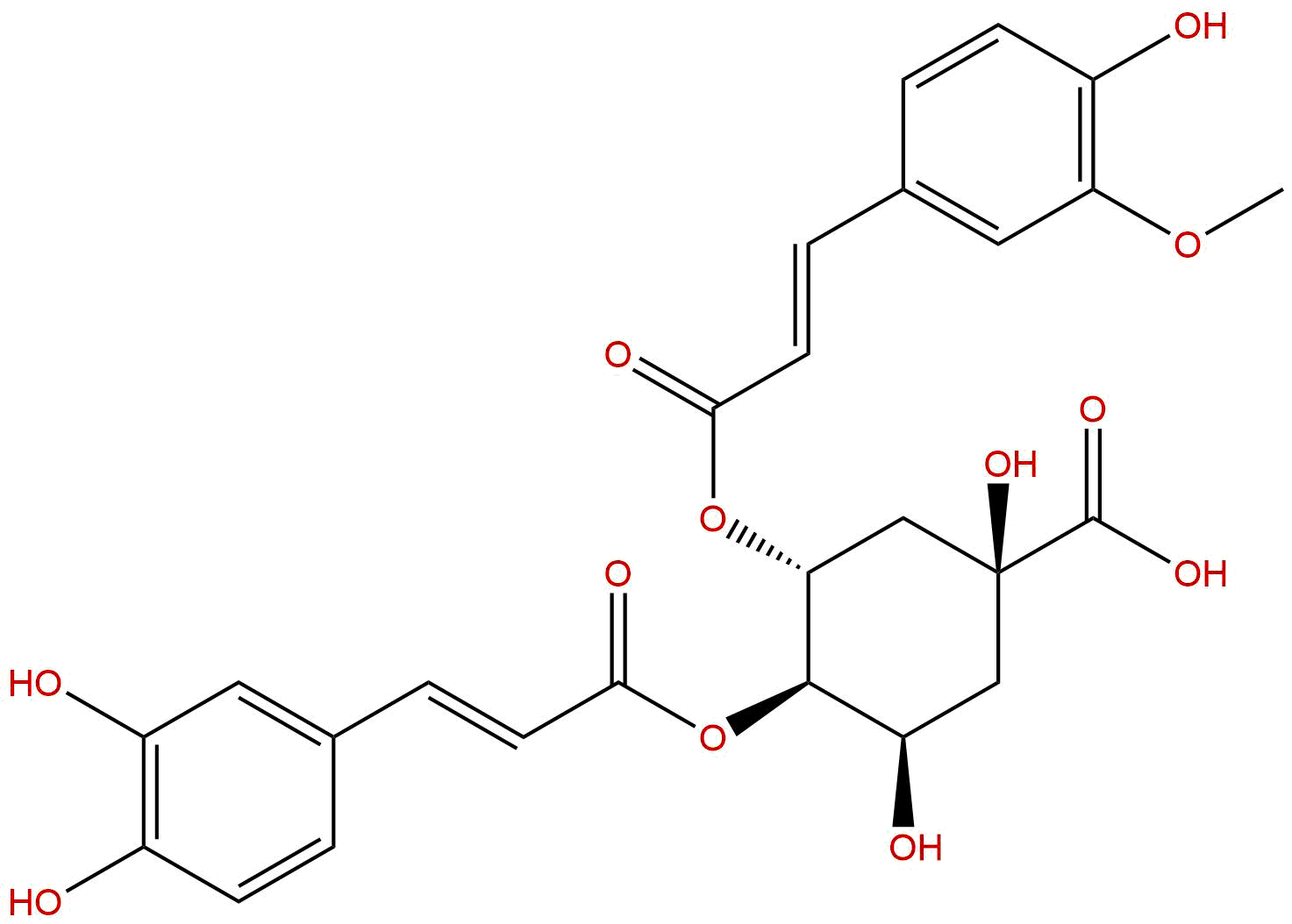
3-Feruloyl-4-caffeoylquinic acid is an organic acid with a molecular weight of 530.4820. Its core structure is quinic acid (a cyclic polyol acid), which is connected to Feruloyl and Caffeoyl groups through ester bonds at the 3rd and 4th hydroxyl groups of its molecule, respectively. Ferulic acid and caffeic acid are both derivatives of hydroxycinnamic acid, with the difference being that ferulic acid has methoxy and hydroxyl substituents on its benzene ring, while caffeic acid has two adjacent hydroxyl substituents. This specific acylation site and type determine its unique physicochemical properties and biological activity.
From the analysis of physical and chemical properties, the calculated lipid water partition coefficient (LogP) is 1.3604, indicating that the compound has a certain degree of lipophilicity, but overall still tends to be hydrophilic. Its topological polar surface area (TPSA) is as high as 200.28 Å ², mainly attributed to the presence of multiple polar groups such as hydroxyl, carboxyl, and ester bonds in the molecule. A higher TPSA usually affects its transmembrane permeability. The theoretically calculated water solubility value is 0.6451 mg/mL, belonging to the range of slightly soluble to soluble, which is consistent with its acidic characteristics. Under alkaline conditions, it may form salts and increase solubility. These basic pharmacokinetic parameters suggest that the absorption and distribution of 3F4CQA in vivo may face certain challenges and need to be optimized through pharmaceutical methods.
Plant sources and extraction methods
3F4CQA is widely present in various plants, especially abundant in medicinal plants of the Asteraceae and Lonicera families. Common sources include but are not limited to:honeysuckle(Lonicera japonica Thunb.)、chrysanthemum(Chrysanthemum morifolium Ramat.)、coffee beans(Coffea spp.) and some Artemisia plants. In these plants, it usually coexists with other isomers (such as 1,3-dicaffeoylquinic acid, 3,5-dicaffeoylquinic acid, etc.) and monocaffeoylquinic acid, forming a complex group of phenolic acid components.
The extraction and separation method follows the conventional process of natural product chemistry. Firstly, polar solvents are used for extraction, commonly with different concentrations of methanol, ethanol, or acetone aqueous solutions. Heating reflux, ultrasound assisted, or microwave-assisted methods are used to improve extraction efficiency. After obtaining the crude extract, a series of separation and purification steps are required to obtain high-purity 3F4CQA. The commonly used methods include:
1. Solvent extraction and enrichment Extract the aqueous extract using organic solvents such as ethyl acetate and n-butanol to enrich phenolic acid components.
2. Column chromatography technology This is a crucial step. Macroporous adsorption resins (such as D101 and AB-8) are often used for preliminary impurity removal and enrichment, and then they are subdivided by silica gel, polyamide or dextran gel (Sephadex LH-20) column chromatography. Prepa HPLC is currently the most effective method for obtaining high-purity monomers, typically using a reverse phase C18 chromatography column with methanol water or acetonitrile water (often containing a small amount of formic acid or acetic acid to adjust pH) as the mobile phase for gradient elution.
3. Identification Method The structural identification of compounds mainly relies on modern spectroscopic techniques. UV spectroscopy can display the characteristic absorption of caffeic acid and ferulic acid; Mass spectrometry (MS), especially electrospray ionization mass spectrometry (ESI-MS), can provide accurate molecular weight and characteristic fragment ion information; Nuclear magnetic resonance spectroscopy (NMR), including 1H NMR, 13C NMR, and two-dimensional spectra such as HSQC and HMBC, is a decisive tool for determining its planar structure and acyl linkage position. By analyzing the chemical shifts and coupling constants of each proton on the quinic acid skeleton, the substitution at positions 3 and 4 can be clearly distinguished.
Pharmacological activity research
A large number of in vitro and partially in vivo studies have shown that 3F4CQA has various pharmacological activities, with its core revolving around strong antioxidant capacity and extending to multiple related fields such as anti-inflammatory and skin protection.
-
antioxidant activity This is the most prominent and fundamental property of 3F4CQA. The caffeoyl (catechol structure) and ferulic (phenolic hydroxyl) groups in its molecule are effective free radical scavenging groups. In various in vitro antioxidant models, such as DPPH radical scavenging, ABTS radical cation scavenging, iron ion reducing power (FRAP), and oxygen radical absorption capacity (ORAC) assays, 3F4CQA exhibits stronger activity than common antioxidants such as ascorbic acid (vitamin C) or Trolox. Its antioxidant efficacy is attributed to the provision of hydrogen atoms by phenolic hydroxyl groups to neutralize free radicals, as well as the stable production of phenolic oxygen free radicals by its structure.
-
anti-inflammatory effect Oxidative stress is closely related to inflammatory response. Research has shown that 3F4CQA can significantly inhibit the excessive production of nitric oxide (NO), prostaglandin E2 (PGE2), and pro-inflammatory cytokines (such as TNF - α, IL-6, IL-1 β) in cell models such as lipopolysaccharide stimulated macrophage RAW264.7. This anti-inflammatory effect is related to its inhibition of the expression of inducible nitric oxide synthase (iNOS) and cyclooxygenase-2 (COX-2) proteins.
-
Skin protection and anti photoaging Ultraviolet (UV) radiation is the main environmental factor causing skin photoaging and pigmentation. The study of 3F4CQA shows its potential for application in skin pharmacology. Firstly, it can inhibit the activity of tyrosinase (TYR), a key enzyme in melanin synthesis, indicating its whitening effect. Secondly, it can effectively alleviate UV induced damage to skin fibroblasts and inhibit the overexpression of matrix metalloproteinases (such as MMP-1, MMP-3). MMPs are key enzymes that degrade extracellular matrix collagen and elastin, and their overactivation is the structural basis for the formation and relaxation of skin wrinkles. Therefore, 3F4CQA plays a role in protecting skin collagen and delaying photoaging by antioxidant and inhibiting MMPs.
-
Potential neuroprotective and metabolic regulatory effects: Based on its strong antioxidant and anti-inflammatory properties, it is speculated that 3F4CQA may have the potential to improve neurodegenerative diseases (such as Alzheimer's disease) and metabolic diseases (such as diabetes and its complications) related to oxidative stress, but more direct experimental evidence is needed in this regard.
Mechanism of action and molecular targets
The pharmacological effect of 3F4CQA is not simply free radical "scavenging", but regulates the cellular homeostasis through multi-target and multi pathway pathways. Its core mechanism is to activate the cell's own antioxidant defense system and inhibit downstream damage pathways of oxidative stress.
-
Activate Nrf2/ARE signaling pathway This is the pivotal mechanism by which it exerts antioxidant effects. Nuclear factor E2 related factor 2 (Nrf2, encoded by NFE2L2 gene) is a key transcription factor that regulates cellular antioxidant response. In the resting state, Nrf2 binds to Keap1 protein and is degraded by ubiquitination. 3F4CQA may promote the dissociation and transfer of Nrf2 from Keap1 to the nucleus by modifying cysteine residues on Keap1. In the nucleus, Nrf2 binds to antioxidant response elements (ARE) and initiates gene transcription of a series of downstream phase II detoxifying enzymes and antioxidant proteins. This includes:
- Direct antioxidant enzyme Superoxide dismutase (SOD1, SOD2), catalase (CAT), glutathione peroxidase (GPX1), together form an enzymatic defense system for clearing reactive oxygen species such as superoxide anions and hydrogen peroxide.
- Heme oxygenase-1 (HMOX1)The induction of HMOX1 not only has antioxidant effects, but also produces metabolites with anti-inflammatory and cell protective effects (such as carbon monoxide, biliverdin/bilirubin).
- Glutathione synthesis related enzymes Increase the level of intracellular reduced glutathione (GSH), which is an important non enzymatic antioxidant.
-
Inhibit downstream damage pathways of oxidative stress:
- Inhibition of MMPs expression UV or inflammatory factors can induce the expression of MMPs by activating signaling pathways such as MAPK and NF - κ B. 3F4CQA, through its antioxidant and anti-inflammatory effects, may inhibit the excessive activation of these pathways, thereby downregulating the expression of MMP-1, MMP-3, and protecting the extracellular matrix.
- Inhibition of Tyrosinase (TYR) Activity In addition to directly inhibiting TYR enzyme activity, its antioxidant effect can also reduce the activation of the melanin synthesis pathway by reactive oxygen species generated by UV and other stimuli.
-
Regulating the inflammatory signaling pathway Its anti-inflammatory effect is closely related to the inhibition of the activation of NF - κ B and MAPK signaling pathways. By reducing the degradation of I κ B or inhibiting the activity of IKK, NF - κ B nuclear translocation is prevented, thereby downregulating the transcription of iNOS, COX-2, and various inflammatory cytokines.
In summary, the mechanism of action of 3F4CQA is a network centered around activating Nrf2 and synergistically inhibiting damaging pathways such as NF - κ B, ultimately enhancing cellular antioxidant capacity, reducing inflammation and matrix degradation.
Evaluation of drug properties and pharmacokinetics
Based on the provided pharmacological parameters and existing studies on similar compounds, a preliminary evaluation of the pharmacological potential of 3F4CQA can be conducted.
-
Absorption, distribution, metabolism, excretion (ADME) prediction:
- absorb Moderate molecular weight (530.48), but high polar surface area (TPSA>140) and multiple hydrogen bond donors/acceptors indicate that its oral bioavailability may be low and its passive diffusion absorption in the intestine may be poor. It may be partially taken up as a substrate by transport proteins in the intestine, such as organic anion transport peptides, or hydrolyzed by microbial enzymes in the colon.
- distribution Predict low blood-brain barrier (BBB) permeability, which is consistent with high TPSA and polarity characteristics, indicating that it may not easily enter the central nervous system and has limited direct effects on central targets, but is beneficial for reducing potential central side effects.
- Metabolism As a phenolic ester compound, it is highly prone to undergo phase II metabolic reactions such as hydrolysis (esterase), methylation, sulfation, and glucuronidation in the body. Caffeoyl and feruloyl groups may be hydrolyzed into corresponding monoacids or quinic acids, and these metabolites may still be active. The liver cytochrome P450 enzyme system may be involved in its further metabolism.
- excretion The prototype drug and its water-soluble metabolites (such as glucuronic acid conjugates) are mainly excreted from urine through the kidneys.
-
Preliminary Safety Prediction:
- HERG inhibition A prediction of 'no' indicates a lower risk of causing QT interval prolongation and apical torsion type ventricular tachycardia, which is an important positive indicator of cardiac safety.
- Genotoxicity The predicted value of Ames test is 0.0, indicating that there is no mutagenic risk in this model system, but it needs to be confirmed through formal in vitro and in vivo genetic toxicity tests.
- Based on its natural product sources and phenolic acid structure, it is expected to have low acute toxicity, but long-term toxicity and specific organ toxicity need to be evaluated through systematic preclinical studies.
-
Formulation development challenges Due to its potential poor solubility and permeability, it belongs to Class IV (low solubility and low permeability) compounds in the Biopharmaceutical Classification System (BCS). Future formulation development needs to focus on addressing this issue, with possible strategies including developing phospholipid complexes, cyclodextrin inclusion complexes, nanocrystals, liposomes, or self microemulsions as delivery systems to improve their solubility, stability, and membrane permeability.
At present, there are very limited public reports on the pharmacokinetic studies of the 3F4CQA system, which is a key data gap that must be filled in order to move towards drug development.
Clinical application prospects and prospects
As a natural active ingredient with a clear multi-target antioxidant and anti-inflammatory mechanism, 3F4CQA has the following clinical application prospects:
-
Functional cosmetics and topical preparations for the skin This is the most direct and fast conversion direction. Based on its inhibition of tyrosinase (whitening) and matrix metalloproteinase (anti wrinkle), combined with strong antioxidant (anti light aging) ability, 3F4CQA can be used as the core active ingredient of high-end functional cosmetics (such as essence, face cream, sunscreen products). It has been developed into gel, cream and other external preparations, which can be used to improve skin pigmentation, wrinkles and photoaging symptoms, and can effectively avoid its shortcomings of poor oral absorption.
-
Health food and nutritional supplements As an active ingredient extracted from medicinal and edible plants such as honeysuckle and chrysanthemum, it can be developed as a health food for antioxidant, immune enhancing, and anti-inflammatory purposes. Further animal and human experiments are needed to clarify its effective dosage and long-term safety for consumption.
-
Potential therapeutic drugs At the level of drug development, the path is more long-term. Possible directions include:
- Local medication Used for the treatment or adjuvant therapy of skin diseases related to oxidative stress and inflammation, such as atopic dermatitis, psoriasis, skin ulcers, etc.
- oral medication Exploring its auxiliary therapeutic role in the management of chronic diseases such as metabolic syndrome, non-alcoholic fatty liver, and chronic mild inflammation by improving its bioavailability through advanced formulation technology.
- combination therapy As an antioxidant sensitizer, it can be used in combination with chemotherapy drugs or other therapeutic drugs to reduce their side effects (such as cardiac toxicity, liver damage), or reverse the drug resistance of tumor cells.
Future research should focus on:
1. In depth in vivo pharmacological validation Confirm the effectiveness of oral or local administration in animal models of diseases related to oxidative stress, inflammation, and aging.
2. Pharmacokinetic study of the system Elucidate its ADME process in animals and humans, and determine the main active metabolites.
3. Formulation technology research and development Develop a new delivery system that can significantly improve its bioavailability.
4. Deepening the mechanism of action Using chemical biology techniques such as molecular probes to more accurately reveal the protein targets they directly interact with.
5. Comprehensive evaluation of safety Complete standardized preclinical toxicology studies to lay the foundation for human trials.
Conclusion
3-feruloyl-4-caffeoylquinic acid is a representative active molecule in natural phenolic acid compounds. With its unique chemical structure, it exhibits a powerful antioxidant network regulatory ability centered on activating the Nrf2 pathway, and extends to various beneficial pharmacological activities such as anti-inflammatory and skin protection. Although it faces challenges in terms of oral absorption and distribution in terms of medicinal properties, it has clear immediate application value in the fields of functional cosmetics, topical skin preparations, and health foods. With the continuous in-depth analysis of its mechanism of action and the rapid development of new drug delivery technologies, 3F4CQA is expected to gradually move from an important phytochemical to more targeted disease prevention and adjuvant therapy applications, providing important lead compounds and scientific basis for the development of new antioxidant and anti-aging drugs derived from natural products. Continuous and in-depth research on it will not only help to reveal the modern scientific connotations of traditional medicinal plants, but also promote the discovery process of innovative natural product drugs.