| Catalog No | Package | Original Price | Price | Inventory | Quantity | Operating |
|---|---|---|---|---|---|---|
| BP5190-5mg | 5mg | $790.00 | Sign in |
|


Storage conditions:Short-term storage at 2~8℃, long-term storage at -20 ~ -80℃
Kadsurenone is a natural lignan compound derived from the stem of the traditional Chinese medicine Piper kadsura, which has attracted much attention for its specific antagonistic activity against platelet activating factor (PAF). Platelet activating factor, as a potent bioactive lipid mediator, participates in various physiological and pathological processes, including inflammatory reactions, blood coagulation, allergic reactions, and immune regulation. In recent years, with the in-depth study of the mechanisms of inflammation related diseases, sea breeze vine ketone has shown unique pharmacological potential in the field of anti-inflammatory.
This article will provide a systematic review of the chemical structure and physicochemical properties, plant sources, and extraction methods of sea cucumber ketone, with a focus on its pharmacological activity and mechanism of action, exploring its pharmacological parameters and pharmacokinetic characteristics, and looking forward to its potential value and development prospects in clinical applications. The aim is to provide theoretical basis and research direction for natural product pharmacology and new drug development.
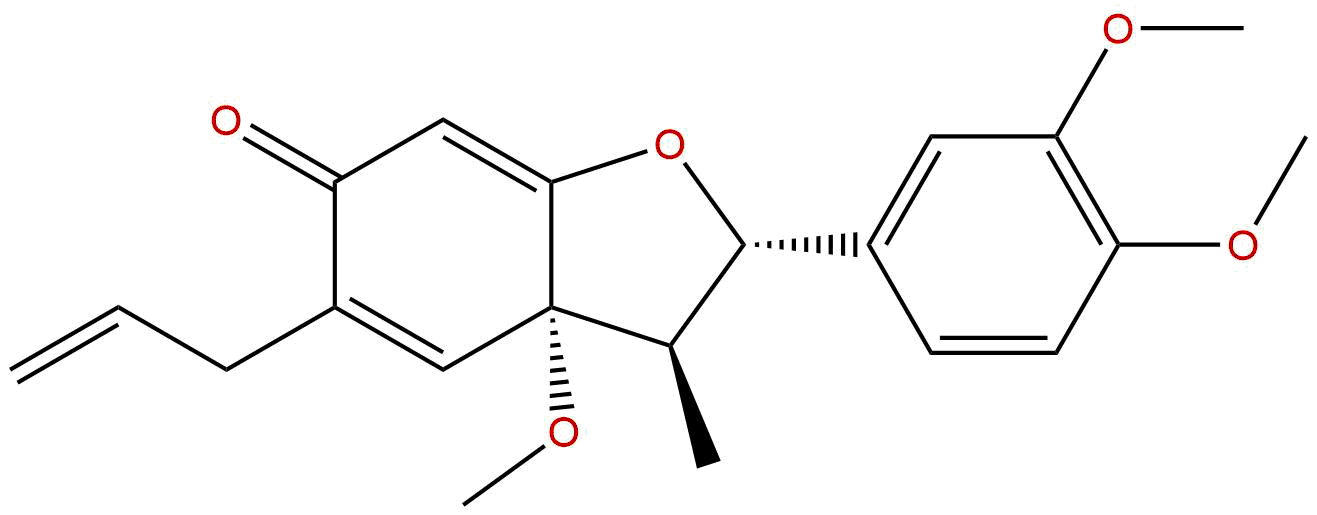
The molecular formula of sea breeze vine ketone is C21H24O5, with a molecular weight of 356.4180. Its chemical structure belongs to the lignin class compounds, with a typical diphenylpropane skeleton. The structure contains multiple hydroxyl and methoxy substituents, giving it a certain polarity and biological activity. According to existing literature reports, the LogP value of sea breeze vine ketone is 3.2507, indicating that it has moderate lipid solubility, which is beneficial for cell membrane penetration and in vivo distribution.
The polar surface area (TPSA) is 53.99 Å ², indicating a moderate level of molecular polarity that facilitates binding to biomolecule targets. Low water solubility (0.0466 mg/mL) suggests limited solubility in aqueous phase, which may affect its oral bioavailability. It is worth noting that sea breeze vine ketone has a high blood-brain barrier penetration ability, which provides a theoretical basis for its application in central nervous system related diseases. In addition, sea breeze vine ketone does not exhibit hERG channel inhibitory activity, and the Ames mutagenicity test result is negative, indicating its high safety and reducing the risk of cardiac toxicity and genetic toxicity.
Seawind vine ketone mainly comes from the stems of Piper kadsura plants. Piper kadsura is a perennial woody vine plant distributed in East Asia. It is commonly used in traditional Chinese medicine to treat rheumatoid arthritis, traumatic injuries, and inflammation related diseases. The stem contains abundant lignans, among which sea breeze vine ketone, as one of its main active ingredients, has significant biological activity.
The common methods for extracting sea breeze vine ketone include solvent extraction, column chromatography separation, and high-performance liquid chromatography (HPLC) purification. Ethanol or methanol is usually used as the extraction solvent, and the extraction efficiency is improved by reflux or ultrasound assisted extraction. After concentration, the extract was separated by silica gel column chromatography, and the target components were monitored by thin layer chromatography (TLC). Then, purification was carried out by reverse phase HPLC to obtain high-purity sea breeze vine ketone. In recent years, supercritical CO2 extraction technology has also been attempted to be applied to the extraction of sea cucumber ketone, which has the advantages of high extraction efficiency and environmental friendliness.
The pharmacological activity research of sea breeze vine ketone mainly focuses on its anti-inflammatory effect and platelet activating factor antagonistic activity. As a specific PAF antagonist, kaempferol can effectively inhibit PAF mediated platelet aggregation and inflammatory response, demonstrating potential anti thrombotic and anti-inflammatory effects.
Multiple in vitro and in vivo experiments have shown that kaempferol can significantly inhibit the production and release of inflammatory mediators. For example, in macrophage and monocyte models, sea breeze vine ketone inhibits the expression of pro-inflammatory cytokines such as IL-6 and TNF - α, reducing the inflammatory cascade of cytokines. In addition, sea breeze vine ketone has a regulatory effect on inflammation related enzymes such as cyclooxygenase (COX-1/PTGS1, COX-2/PTGS2) and inducible nitric oxide synthase (NOS2), reducing the production of inflammatory mediators.
The regulatory effect of sea breeze vine ketone on TRPV1 and TRPA1 channels provides a basis for its application in neuroinflammation and pain management. TRPV1 and TRPA1 are important ion channels for sensing pain and inflammatory stimuli, and kaempferol alleviates neuroinflammation and related pain symptoms by regulating these targets.
The regulatory effects of sea breeze vine ketone on inflammation related signaling pathways such as STAT3 and NF - κ B have also been widely reported. By inhibiting the activation of STAT3 and NF - κ B, sea breeze vine ketone reduces the transcription of inflammatory genes and suppresses the persistence and spread of inflammatory responses. In addition, the effect of sea breeze vine ketone on the inflammasome associated protein CASP1 suggests that it may be involved in regulating the process of inflammatory cell apoptosis (pyroptosis).
The pharmacological mechanism of sea breeze vine ketone mainly depends on its regulation of various inflammation related molecular targets, including:
Platelet activating factor (PAF) receptor antagonist As a specific antagonist of PAF, kaempferol blocks the binding of PAF to its receptors, inhibits PAF mediated platelet aggregation and inflammatory signaling, and reduces thrombosis and inflammatory response.
Cytokine regulation Sea breeze vine ketone inhibits the expression of pro-inflammatory cytokines such as IL-6 and TNF - α, reducing the inflammatory response of immune cells.
Regulation of signal transduction pathways By inhibiting the STAT3 and NF - κ B signaling pathways, sea breeze vine ketone blocks the transcriptional activation of inflammation related genes and reduces the production of inflammatory factors.
Enzyme activity regulation Regulate the expression and activity of key inflammatory enzymes such as PTGS1, PTGS2, and NOS2, and reduce the production of inflammatory mediators such as prostaglandins and nitric oxide.
Ion channel regulation The inhibitory effect of sea breeze vine ketone on TRPV1 and TRPA1 channels can help alleviate neuroinflammation and pain.
Regulation of inflammasomes By affecting CASP1 activity, sea breeze vine ketone may regulate inflammasome mediated cell apoptosis and inflammatory response.
Overall, sea breeze vine ketone exerts significant anti-inflammatory and antithrombotic activities through multi-target and multi pathway synergistic effects, reflecting the advantages of multi-target pharmacology of natural products.
The pharmacological parameters of sea breeze vine ketone show that it has good potential for drug development. Its molecular weight (356.4180) conforms to Lipinski's rule, and its LogP value (3.2507) is moderate, indicating that it has good membrane permeability and in vivo distribution ability. The TPSA is 53.99 Å ², below the threshold of 140 Å ², indicating that it may have good oral absorption.
Low water solubility (0.0466 mg/mL) may limit its oral bioavailability and needs to be improved through formulation optimization or structural modification. The high blood-brain barrier permeability provides the possibility for its application in central nervous system diseases. In terms of safety, sea breeze vine ketone has no hERG channel inhibition, reducing the risk of cardiac toxicity; The Ames test is negative, indicating a low risk of genetic toxicity.
At present, there is limited research on the pharmacokinetics of sea breeze vine ketone. Preliminary data indicate that it has good stability and distribution characteristics in vivo, but the metabolic pathways and clearance mechanisms still need further clarification. Future research should focus on its in vivo pharmacokinetics, oral bioavailability, and potential drug interactions to guide clinical development.
Based on the excellent anti-inflammatory activity and good safety of sea breeze vine ketone, its clinical application prospects in various inflammation related diseases are broad in the future. Specifically, it includes:
Rheumatic and immune diseases For conditions such as rheumatoid arthritis and systemic lupus erythematosus, sea breeze vine ketone is expected to alleviate joint inflammation and tissue damage by inhibiting inflammatory factors and signaling pathways.
Neuroinflammation and Pain Management Its regulatory effect on TRPV1/TRPA1 provides a new treatment strategy for chronic pain and neuropathic pain.
cardiovascular disease By blocking PAF mediated platelet aggregation, kaempferol may prevent thrombosis and reduce the risk of cardiovascular events.
Tumor associated inflammation Due to the important roles of STAT3 and NF - κ B pathways in the tumor microenvironment, the multi-target regulatory ability of kaempferol provides potential support for anti-tumor inflammation.
Future clinical research requires a systematic evaluation of the pharmacodynamics, safety, and dosage optimization of sea breeze vine ketone, combined with modern drug formulation technology, to enhance its bioavailability and targeting. Meanwhile, based on its multi-target properties, sea breeze vine ketone can serve as a candidate molecule for combination therapy, exerting synergistic effects in the treatment of complex diseases.
Sea breeze vine ketone, as a natural lignan with specific platelet activating factor antagonistic activity, exhibits significant anti-inflammatory, antithrombotic, and neuroprotective activities. Its multi-target regulatory mechanism and good pharmacological parameters have laid a solid foundation for the development of new drugs. Although the research on its pharmacokinetics and clinical application is still in its preliminary stage, as a model of natural product pharmacology research, sea breeze vine ketone has broad application prospects.
Future research should focus on in-depth analysis of its molecular mechanisms, optimization of extraction and formulation processes, systematic pharmacokinetic and toxicological evaluations, and promotion of preclinical and clinical trials. Through interdisciplinary collaboration, sea breeze vine ketone is expected to become an important drug candidate molecule in the field of anti-inflammatory and related disease treatment, promoting innovative development in natural product pharmacology.
