Introduction/Overview
Natural products have always been an important source of innovative drug discovery, among which steroid alkaloids have attracted much attention due to their complex and diverse chemical structures and extensive biological activities. Zhebeirine (also known as Puqiedinone, CAS number: 143120-47-2) is derived from the traditional medicinal plant Puqiedinone(Fritillaria puqiensis)A steroid alkaloid with significant pharmacological activity isolated from the bulb. Puqi Fritillaria, as a member of the Fritillaria genus, is commonly used in traditional Chinese medicine clinical practice to relieve cough and phlegm. Its traditional cough suppressing and phlegm dispelling effects provide important clues for the discovery of Zhebei Bing Su. Modern pharmacological research further reveals that Zhejiang Beibing not only has cough suppressant and expectorant effects, but also exhibits remarkable anti-tumor potential. Its effects involve inducing apoptosis, inhibiting proliferation, anti angiogenesis, and other aspects, and interact with multiple key tumor related targets such as MCL1, STAT3, TOP1, etc. With the deepening understanding of the molecular mechanisms of tumor occurrence and development, the research and development of multi-target, low toxicity natural anti-tumor drugs has become a hot topic. Zhejiang Beibing, with its unique chemical structure and multi-target action characteristics, provides valuable lead compounds for the development of new anti-tumor drugs. This article aims to provide a systematic review of the chemical structure, plant origin, pharmacological activity, mechanism of action, medicinal properties, and clinical application prospects of Zhejiang Beibing Su, in order to provide comprehensive scientific references for the in-depth research and development of this compound.
Chemical structure and physicochemical properties
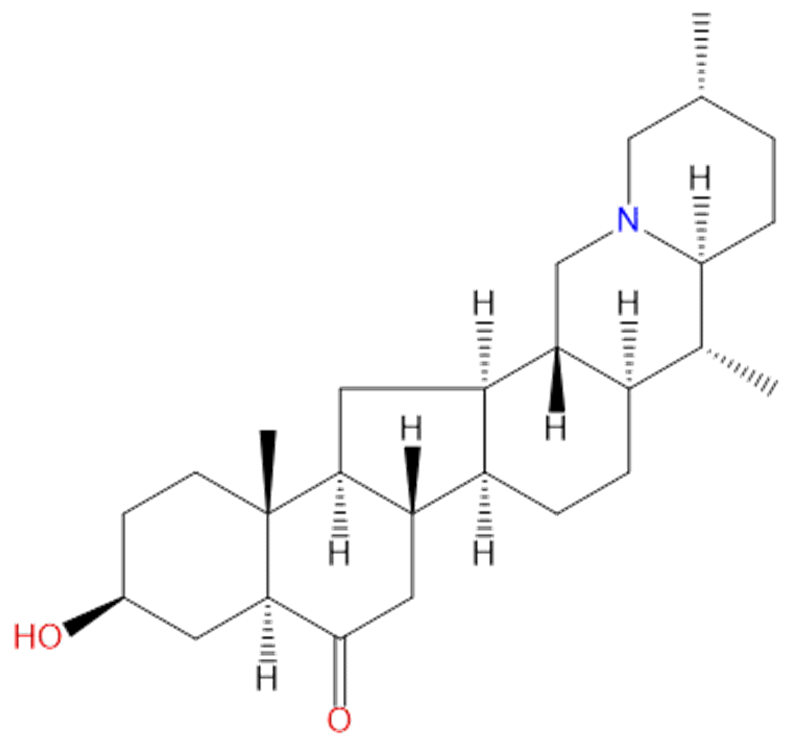
Zhe Bei Bing Su belongs to the class of steroid alkaloids, with a molecular formula of C27H43NO2 and a molecular weight of 413.6460. Its core structure is based on the steroid core of cyclopentane and phenanthrene, coupled with a nitrogen-containing six membered heterocyclic ring (pyridine ring or similar structure) on the D ring, which is the structural basis of its alkaloid properties. The presence and position of nitrogen atoms in the spatial structure are crucial for their interaction with biological targets. Molecules usually contain functional groups such as hydroxyl groups, which affect their polarity and biological activity.
From the analysis of physical and chemical properties, the lipid water partition coefficient (LogP) of Zhebei Bingsu is 4.0394, indicating that the compound has good lipophilicity, which is beneficial for its penetration of cell membranes, but may also affect its water solubility. Its topological polar surface area (TPSA) is 40.5400 Å ², which is relatively small, further confirming its strong hydrophobic properties. The calculated water solubility value is relatively low (about 0.0453 mg/mL), indicating that when developing it into oral or injectable formulations, it may be necessary to improve its solubility and bioavailability through dosage form modifications (such as making salts, cyclodextrin inclusion complexes, or nano formulations). It is worth noting that its predicted blood-brain barrier permeability is "high", which means that Zhebeipin may act on central nervous system related targets or have potential therapeutic effects on brain tumors, but at the same time, the risk of central nervous system neurotoxicity should also be cautious. The preliminary pharmacological risk assessment shows that the hERG inhibition risk is "no", and the Ames test result is 0.0, indicating that its potential risk of arrhythmia and genetic toxicity is low, providing preliminary favorable data for further safety evaluation.
Plant sources and extraction methods
Zhe Bei Bing Su mainly comes from the Primulaceae plant Primulaceae in the genus Primulaceae(Fritillaria puqiensis G. Dry bulbs of D. Yu&G. Y. Chen. The genus Fritillaria is rich in plant resources and has multiple medicinal varieties in China, such as Zhejiang Fritillaria and Sichuan Fritillaria. However, the chemical composition and proportion of different varieties vary. Puqibeimu, as a specific germplasm resource, is a characteristic source plant of Zhejiang Beisu.
The extraction and separation of berberine from plant materials usually follow the conventional process of natural product chemistry. Firstly, crush the dried bulbs of Primula platyphylla and extract them using an appropriate solvent. Considering that Zhebei Bingsu belongs to alkaloids and has a high LogP value, alcohols (such as methanol and ethanol) or mixed organic solvents (such as chloroform methanol) are often used for percolation, reflux, or ultrasound assisted extraction to effectively extract lipid soluble alkaloid components. After filtration and concentration, the crude extract is dissolved in acidic water (such as dilute hydrochloric acid) to convert alkaloids into salts and separate them from non alkaline impurities in the aqueous phase; Subsequently, alkalization (such as ammonia) is carried out to free the alkaloids, which are then extracted with organic solvents (such as chloroform, ethyl acetate) to obtain the total alkaloid fraction.
Further purification and separation rely heavily on chromatographic techniques. The silica gel column chromatography method is commonly used, with gradient elution using petroleum ether ethyl acetate or chloroform methanol systems in different ratios, to preliminarily separate each component based on polarity differences. Subsequently, repeated refining was carried out in combination with reversed-phase silica gel column chromatography (such as C18 packing, methanol water as mobile phase), gel column chromatography (such as Sephadex LH-20) or high performance liquid chromatography (HPLC) to finally obtain high-purity Zhebeipropyl monomer compound. Structural identification is accomplished through the comprehensive use of modern spectroscopic techniques such as nuclear magnetic resonance (NMR, including 1H-NMR, 13C-NMR, 2D-NMR), mass spectrometry (MS), infrared spectroscopy (IR), and X-ray single crystal diffraction.
Pharmacological activity research
The pharmacological activity research of Zhebei Bingsu mainly focuses on its cough suppressant, expectorant and anti-tumor effects, among which anti-tumor activity has been the research focus in recent years.
1. Coughing and expectorant effects:
As an active ingredient isolated from traditional Chinese medicinal materials for cough and phlegm reduction, the basic pharmacological research of Zhebei Bingsu has confirmed its cough suppressing and expectorant effects. Animal experiments have shown that Zhe Bei Bing Su can significantly prolong the latent period of cough induced by ammonia or sulfur dioxide in mice, reduce the number of coughs, and its mechanism of action may involve inhibition of the cough center or local effects on the sensory nerve endings of the airway. In terms of phlegm removal, Zhebei Bing Su can promote the secretion of phenol red in the trachea of mice, increase the secretion of respiratory glands, dilute sputum, and thus facilitate sputum excretion. These functions provide modern scientific basis for its traditional applications.
2. Antitumor activity:
Zhejiang Beibing Su has shown broad-spectrum and effective anti-tumor activity in various in vitro tumor cell models and some in vivo models.
* Cell proliferation inhibition: Studies have shown that Zhebeibingsu can inhibit the proliferation of many human tumor cells in a dose-dependent manner, such as lung cancer (such as A549), breast cancer (such as MCF-7), liver cancer (such as HepG2), colon cancer (such as HCT-116), and so on. Its IC50 values are mostly in the micromolar level, showing a certain cytotoxicity selectivity.
* Inducing cell apoptosis: Flow cytometry analysis revealed that treatment with Zhejiang Beibing Su significantly increased the proportion of Annexin V+/PI+cells in tumor cells and induced apoptosis. Hoechst 33258 or DAPI staining showed typical apoptotic morphological changes such as nuclear condensation and fragmentation.
* Inhibit cell migration and invasion: The scratch test and Transwell chamber test results indicate that Zhebei Bing Su can effectively inhibit the migration and invasion ability of tumor cells, suggesting its potential for anti-tumor metastasis.
* In vivo anti-tumor effect: In nude mice transplanted tumor models (such as human breast cancer MCF-7 transplanted tumor), intraperitoneal injection or intragastric administration of Zhebeibingsu can significantly inhibit tumor growth, reduce tumor volume and tumor weight, and has little impact on the weight of mice within a certain dose range, suggesting that it has certain anti-tumor activity in vivo and therapeutic window.
Mechanism of action and molecular targets
The anti-tumor effect of Zhe Bei Bing Su is not achieved through a single pathway, but involves a synergistic effect of multiple targets and pathways, which is consistent with its characteristics as a natural product. Existing research has preliminarily revealed its interactions with multiple key tumor associated proteins.
-
Regulating the apoptotic pathway (targeting MCL1, BCL2): Zhebe Bing Su can downregulate the expression of anti apoptotic proteins Bcl-2 and Mcl-1, while possibly upregulating the expression of pro apoptotic proteins such as Bax, leading to a decrease in mitochondrial membrane potential, release of cytochrome C, and activation of the Caspase cascade reaction, ultimately inducing tumor cell apoptosis. The targeting effect of MCL1 is particularly noteworthy, as it is a key dependent protein for the survival of many tumor cells and a hot target in current anti-cancer drug development.
-
Inhibition of signal transduction pathways (targeting STAT3, MAPK1): Signal transducer and activator of transcription factor 3 (STAT3) is an important oncogenic transcription factor. Research has shown that Zhejiang Beibing Su can inhibit the phosphorylation (activated form) of STAT3, block its nuclear translocation and the transcription of downstream target genes (such as Cyclin D1, Bcl-2, VEGF), thereby inhibiting cell proliferation, promoting apoptosis, and affecting the tumor microenvironment. In addition, its potential regulation of MAPK1 (ERK2) may also affect cell growth and survival signaling.
-
Interference with DNA metabolism (targeting TOP1, TOP2A): Topoisomerase I and II (TOP1/2A) are key enzymes that regulate DNA topology and are targets of various chemotherapy drugs such as irinotecan and etoposide. Zhebei Bing Su may inhibit the activity of TOP1/2A, hinder DNA replication and transcription, lead to DNA damage accumulation, and trigger cell cycle arrest and apoptosis.
-
Inhibiting tumor invasion and angiogenesis (targeting MMP2, HIF1A): Overexpression of matrix metalloproteinase 2 (MMP2) is closely related to tumor invasion and metastasis. Zhebe Bing Su can downregulate the expression or activity of MMP2, thereby inhibiting extracellular matrix degradation and hindering the invasion and migration of tumor cells. In addition, by inhibiting the stability or activity of hypoxia inducible factor 1 alpha (HIF1A), Zhejiang Beibing may interfere with the adaptive response of tumor cells under hypoxic conditions and inhibit the expression of angiogenic factors such as vascular endothelial growth factor (VEGF), exerting anti angiogenic effects.
-
Affects hormone related pathways (targeting ESR1, CYP19A1): The potential effects on estrogen receptor α (ESR1) and aromatase (CYP19A1) suggest that Zhebeibingsu may have specific effects on hormone dependent tumors (such as some breast cancer and prostate cancer). By antagonizing ER signaling or inhibiting estrogen synthesis, it interferes with hormone dependent growth of tumor cells.
In summary, Zhejiang Beibing Su has formed a multidimensional and networked anti-tumor mechanism by targeting multiple key links such as apoptosis regulation, signal transduction, DNA metabolism, invasion and metastasis, and hormone signaling, which helps overcome the problem of resistance to single target drugs.
Evaluation of drug properties and pharmacokinetics
Based on its physicochemical parameters and preliminary biological activity data, the pharmacological properties of Zhejiang Beibing Su present both opportunities and challenges.
Advantages:
1. Moderate molecular weight (413.6), novel structure Meet the basic requirements of drug like molecules.
2. Clear activity and multi-target effect It may have better therapeutic efficacy and lower risk of drug resistance.
3. Preliminary safety indicators are good The unpredictable hERG inhibition and Ames mutagenicity risks have laid an important safety foundation for subsequent development.
4. High blood-brain barrier permeability Provided the possibility for treating central nervous system tumors or metastases.
Challenge aspect:
1. Poor water solubility This is the main obstacle to its development as an injectable or highly bioavailable oral formulation. It is necessary to study its solubilization strategy, such as preparing soluble salts such as phosphate and citrate, or developing new drug delivery systems such as liposomes, nanoparticles, and solid dispersions.
2. Pharmacokinetic properties unknown Currently, there is very limited publicly available systematic research data on the absorption, distribution, metabolism, and excretion (ADME) of Zhejiang Beiping extract. It is necessary to conduct preclinical pharmacokinetic studies as soon as possible to clarify key parameters such as oral bioavailability, plasma protein binding rate, tissue distribution characteristics, main metabolic pathways (whether involving CYP450 enzyme system), and elimination half-life. Its high LogP value suggests that it may be prone to accumulation in adipose tissue, and the potential toxicity of long-term administration needs to be evaluated.
3. Metabolic stability in vivo The structure of steroid alkaloids may easily undergo metabolic reactions such as oxidation and hydrolysis in the liver, leading to strong first pass effects and insufficient exposure in vivo. Evaluation needs to be conducted through in vitro liver microsomal metabolism experiments, and structural modifications may be necessary to enhance metabolic stability.
4. Lack of comprehensive toxicological evaluation Although there is no specific risk predicted initially, systematic preclinical safety pharmacology studies such as acute toxicity, long-term toxicity, and reproductive toxicity are still needed.
Clinical application prospects and prospects
Zhejiang Beibing Su, as a natural steroid alkaloid with multi-target anti-tumor activity, has broad clinical application prospects, but the road ahead is long and requires interdisciplinary collaboration.
Potential application directions:
1. New lead compounds for anti-tumor drugs: It can be directly used as a raw material drug to develop innovative traditional Chinese medicine or natural drug injection or oral preparation for anti-tumor, especially for multiple tumors such as lung cancer, breast cancer and liver cancer, on the basis of overcoming the defects of water solubility and pharmacokinetics.
2. Combination therapy strategy Given its multi-target nature, the combination of Zhejiang Beibing Su with existing chemotherapy drugs (such as topoisomerase inhibitors, molecular targeted drugs) or immune checkpoint inhibitors may produce synergistic effects and reduce drug resistance, which is worth further exploration.
3. Treatment of central nervous system tumors Its high BBB permeability gives it unique potential in the treatment of primary brain tumors such as gliomas or brain metastases.
4. Modern cough and phlegm dispelling preparations Based on its clear antitussive and expectorant activity, it can be developed into traditional Chinese patent medicines and simple preparations or chemical medicine for acute and chronic bronchitis, cough variant asthma and other respiratory diseases.
Future research prospects:
1. In depth mechanism research Using chemical biology methods such as affinity fishing, molecular docking, surface plasmon resonance SPR, and co crystallization, confirm its direct interaction and binding mode with the speculated targets (especially MCL1, STAT3, TOP1), and elucidate its precise molecular mechanism.
2. Preclinical development of the system Accelerate the completion of comprehensive pharmacological (more tumor types, drug resistance models), pharmacokinetic, and toxicological evaluations, clarify their therapeutic indices and safety windows.
3. Structural optimization and modification Using Zhe Bei Bing Su as the parent nucleus, reasonable structural modifications (such as introducing water-soluble groups and optimizing side chains) are carried out to improve its solubility, metabolic stability, target selectivity, and in vivo activity, in order to obtain derivatives with better drug properties.
4. Pharmaceutical research To address the issue of poor solubility, active research is being conducted on new drug delivery systems, such as albumin nanoparticles and polymer micelles, to improve their delivery efficiency and tumor targeting.
5. Explore other activities In addition to its anti-tumor and respiratory system effects, its potential activities in other fields such as anti-inflammatory, neuroprotective, and cardiovascular protection can be explored to expand its application scope.
Conclusion
Zhe Bei Bing Su is a steroid alkaloid with important research value discovered from the traditional Chinese medicine Pu Qi Bei Mu. It not only confirms the wisdom of traditional medicine at its source, but also demonstrates outstanding biological activity centered on multi-target anti-tumor activity in modern pharmacological research. Its mechanism of action involves multiple key links such as apoptosis induction, signal pathway inhibition, DNA damage, invasion and metastasis blockade, and is associated with multiple popular tumor treatment targets such as MCL1, STAT3, TOP1, reflecting the characteristic of multi-component and multi-target synergistic effects of natural products. Despite facing challenges such as poor water solubility and unclear pharmacokinetic properties in drug development, its clear activity, novel structure, and good preliminary safety prediction have laid a solid foundation for its subsequent development. In the future, through in-depth mechanism elucidation, systematic preclinical evaluation, rational structural optimization, and advanced formulation technology, Zhejiang Beibing Su is expected to be developed into a new anti-tumor drug derived from traditional Chinese medicine that acts on multiple targets, or used for the treatment of respiratory system diseases, contributing new strength to human health. The research on it further highlights the importance of continuously excavating and modernizing the study of active natural products from the treasure trove of traditional medicinal plants.