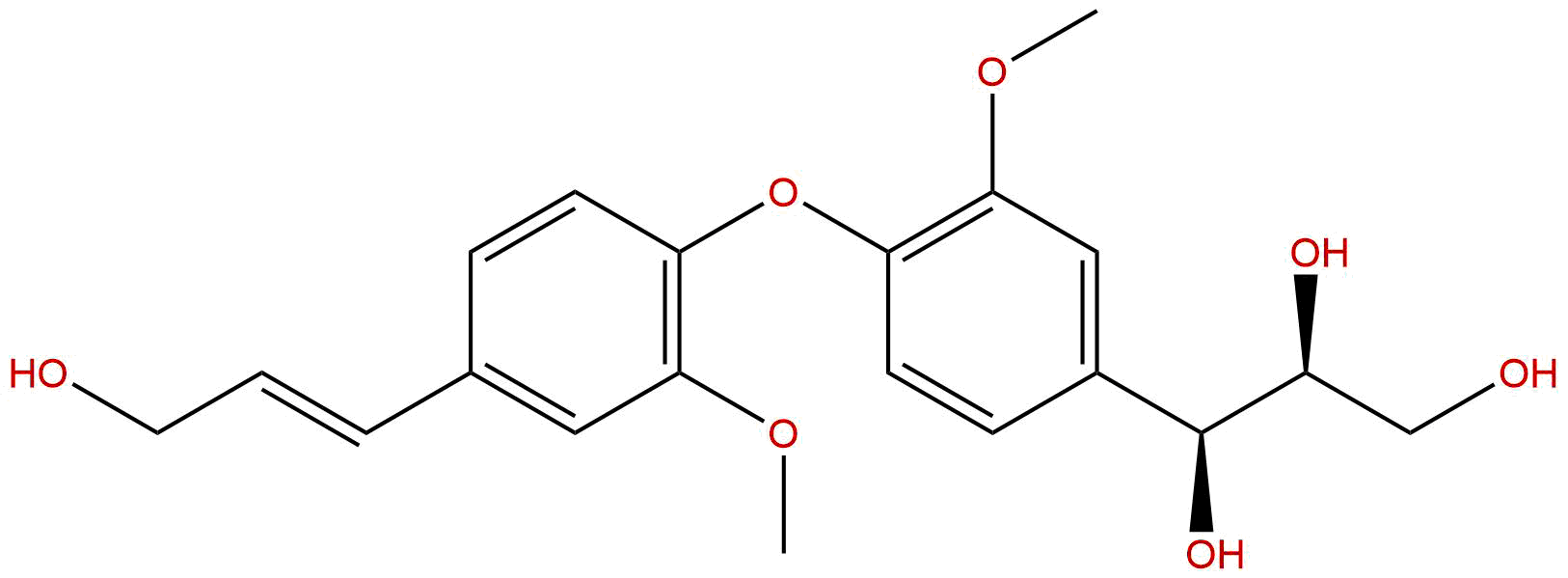
| Catalog No | Package | Original Price | Price | Inventory | Quantity | Operating |
|---|---|---|---|---|---|---|
| BP5120-5mg | 5mg | $350.00 | Sign in |
|


Storage conditions:Short-term storage at 2~8℃, long-term storage at -20 ~ -80℃
As the incidence rate of neurodegenerative diseases continues to rise, searching for natural products with neuroprotective effects has become an important direction of drug research and development. Natural products have become a treasure trove for exploring new neuroprotective agents due to their structural diversity and rich biological activity. 7'R,8'R-2, 2 '- dimethoxy-4-3- (3-hydroxypropenyl) -4' - (1,2,3-trihydroxypropyl) diphenyl ether (hereinafter referred to as 7'R, 8'R-dimethoxydiphenyl ether, CAS number 515813-60-2) is a natural product with potential neuroprotective activity. This article aims to systematically review the chemical structure, physicochemical properties, plant origin, pharmacological activity, mechanism of action, pharmacological evaluation, and clinical application prospects of this compound, with the hope of providing reference for research in related fields.
7'R, 8'R-dimethoxy diphenyl ether is a type of diphenyl ether compound with the molecular formula C20H24O7 and a molecular weight of 376.4050. Its structural features include two benzene rings connected by ether bonds, with methoxy substituents at positions 2 and 2 ', and 3-hydroxypropenyl and 1,2,3-trihydroxypropyl side chains at positions 4 and 4', respectively. The stereochemical configuration of this compound is 7'R, 8'R, indicating that it has a specific conformation at the key chiral center, which contributes to its biological activity.
In terms of physical and chemical properties, the LogP value of this compound is 1.4992, indicating that it has moderate lipid solubility, which is beneficial for cell membrane penetration but not prone to excessive hydrophobicity, balancing solubility and membrane permeability. The topological polar surface area (TPSA) is 108.61 Å ², indicating its high polarity, which may affect its ability to pass through the blood-brain barrier. The water solubility is 1.1194, indicating that it has a certain solubility in water, which is conducive to absorption and distribution in the body. The low permeability of the blood-brain barrier suggests that the compound may have difficulty directly entering the central nervous system, but its neuroprotective effect may be achieved through indirect mechanisms or local effects. The negative result of hERG inhibition experiment indicates a low risk of cardiac toxicity. The Ames mutagenicity test result is 0.0, indicating that the compound has no significant genetic toxicity.
7'R, 8'R-dimethoxy diphenyl ethers are mainly found in certain traditional Chinese medicinal plants, especially in plant genera rich in diphenyl ether compounds, such as certain Magnoliaceae and Lauraceae plants. Further systematic reporting is needed on the specific plant species and their distribution, but existing research indicates that this compound is mostly synthesized through secondary metabolic pathways in plants as part of their defense mechanisms.
The extraction method usually uses solvent extraction combined with chromatographic separation technology. Common solvents include ethanol, methanol, and their aqueous solutions to ensure effective dissolution of 7'R, 8'R-dimethoxydiphenyl ether with moderate polarity. The extraction process generally includes drying and crushing of plant materials, solvent extraction, filtrate concentration, and multi-stage column chromatography purification. High performance liquid chromatography (HPLC) and mass spectrometry (LC-MS) are widely used for qualitative and quantitative analysis of this compound, ensuring its purity and accuracy in structural identification.
The pharmacological activity of 7'R, 8'R-dimethoxy diphenyl ether is mainly concentrated in the field of neuroprotection. Both in vitro and in vivo studies have shown that it has significant neuroprotective effects, which can reduce neuronal damage, inhibit neuroinflammatory responses, regulate oxidative stress levels, and improve neurological dysfunction.
Antioxidant effect
This compound activates the nuclear factor erythroid associated factor 2 (NRF2) signaling pathway, enhances the expression of intracellular antioxidant enzymes, reduces reactive oxygen species (ROS) levels, and alleviates oxidative stress damage to nerve cells.
anti-inflammatory effect
7'R, 8'R-dimethoxydiphenyl ether can inhibit the release of pro-inflammatory cytokines, alleviate neuroinflammatory responses, and protect neurons from inflammation mediated damage.
Inhibit neuronal apoptosis
By regulating the expression of BCL2 family proteins (such as BCL2 and CASP3), promoting anti apoptotic signals, inhibiting cell apoptosis pathways, and maintaining neuronal survival.
Improve neurotransmitter metabolism
This compound has a certain inhibitory effect on acetylcholinesterase (ACHE), which helps to increase acetylcholine levels and improve cognitive function.
Regulating neuroprotein metabolism
It has a regulatory effect on key proteins in neurodegenerative diseases such as amyloid precursor protein (APP), beta secretase (BACE1), microtubule associated protein tau (MAPT), etc., which helps to slow down the pathological process of diseases such as Alzheimer's disease.
The neuroprotective effects of 7'R, 8'R-dimethoxydiphenyl ether involve multiple signaling pathways and key molecular targets, mainly including:
BCL2 and CASP3 This compound reduces neuronal apoptosis and maintains neuronal survival by upregulating the expression of anti apoptotic protein BCL2 and inhibiting the activity of apoptotic protease CASP3.
APP and BACE1 By inhibiting BACE1 activity, reducing abnormal APP lysis, lowering the production of β - amyloid protein, alleviating amyloid plaque deposition, and delaying the pathological progression of Alzheimer's disease.
MAPT (tau protein)Regulating the abnormal phosphorylation of tau protein, preventing the formation of neurofibrillary tangles, and protecting the structural integrity of nerve cells.
SIRT1 Activate the deacetylase SIRT1, promote cellular metabolic homeostasis and antioxidant capacity, and delay neuronal aging.
MAPK1 Regulating the mitogen activated protein kinase (MAPK) signaling pathway, regulating cellular stress response and survival signals.
ACHE Inhibit acetylcholinesterase activity, increase acetylcholine concentration, and improve neurotransmission function.
SNCA (alpha synuclein)Regulate the aggregation state of alpha synuclein and reduce the neurotoxicity associated with Parkinson's disease.
NRF2 Activate the NRF2 signaling pathway, enhance antioxidant enzyme expression, and resist oxidative stress damage.
Overall, 7'R, 8'R-dimethoxydiphenyl ether exerts its neuroprotective effect through multi-target and multi pathway synergistic effects, and has strong therapeutic potential.
Evaluation of drug properties is a crucial step in the development of natural product drugs. The molecular weight of 7'R, 8'R-dimethoxydiphenyl ether is 376.4050, which meets the Lipinski rule requirement of a molecular weight less than 500. The LogP is 1.4992, indicating that it has moderate lipid solubility and is beneficial for oral absorption. The TPSA is 108.61 Å ², slightly higher than the ideal threshold of 90 Å ², which may limit its ability to pass through the blood-brain barrier, consistent with the observation of low blood-brain barrier permeability in the experiment.
Moderate water solubility (1.1194), conducive to absorption and distribution in the body. The hERG channel inhibition experiment was negative, indicating a low risk of cardiac toxicity. The Ames test result is 0, indicating no mutagenicity and good safety.
In terms of pharmacokinetics, although there is currently a lack of systematic in vivo metabolic and kinetic data, based on its physicochemical properties, it is speculated that this compound may have good oral bioavailability. However, its blood-brain barrier permeability is limited, suggesting that its neuroprotective effect may need to be enhanced by improving drug delivery systems or structural modifications to increase the effective concentration of the central nervous system.
7'R, 8'R-dimethoxydiphenyl ether has shown potential in treating neurodegenerative diseases such as Alzheimer's disease and Parkinson's disease through its multi-target neuroprotective effects. Its comprehensive effects of antioxidant, anti-inflammatory, anti apoptotic, and regulation of neuronal protein metabolism provide new ideas for multi-target therapy of neurological diseases.
Future research should focus on the following aspects:
Pharmacokinetic and pharmacodynamic studies
Thoroughly analyze the in vivo absorption, distribution, metabolism, and excretion characteristics of the compound, clarify its effective concentration and time window of action.
Optimization of drug delivery system
To address the low permeability of the blood-brain barrier, delivery systems such as nanocarriers and liposomes have been developed to improve the bioavailability of the central nervous system.
Structural optimization and derivative design
By optimizing its physicochemical properties and targeting ability through chemical modification, the efficacy and safety of the drug can be enhanced.
Preclinical and clinical research
Conduct systematic toxicological evaluation and animal model validation, gradually advance clinical trials, and verify the safety and effectiveness of its treatment for neurodegenerative diseases.
Combination therapy strategy
Explore the synergistic effects with other neuroprotective drugs and leverage the comprehensive therapeutic advantages of multi-target and multi mechanism approaches.
7'R,8'R-2, 2 '- dimethoxy-4-3- (3-hydroxypropenyl) -4' - (1,2,3-trihydroxypropyl) diphenyl ether, as a natural product with unique structure and multiple neuroprotective effects, has demonstrated good pharmacological activity and superior safety. Its multi-target mechanism of action provides new targets and strategies for the treatment of neurodegenerative diseases. In the future, through systematic pharmacokinetic studies, drug delivery optimization, and clinical validation, it is expected to become a new type of neuroprotective drug, benefiting a large number of patients with neurological diseases.
