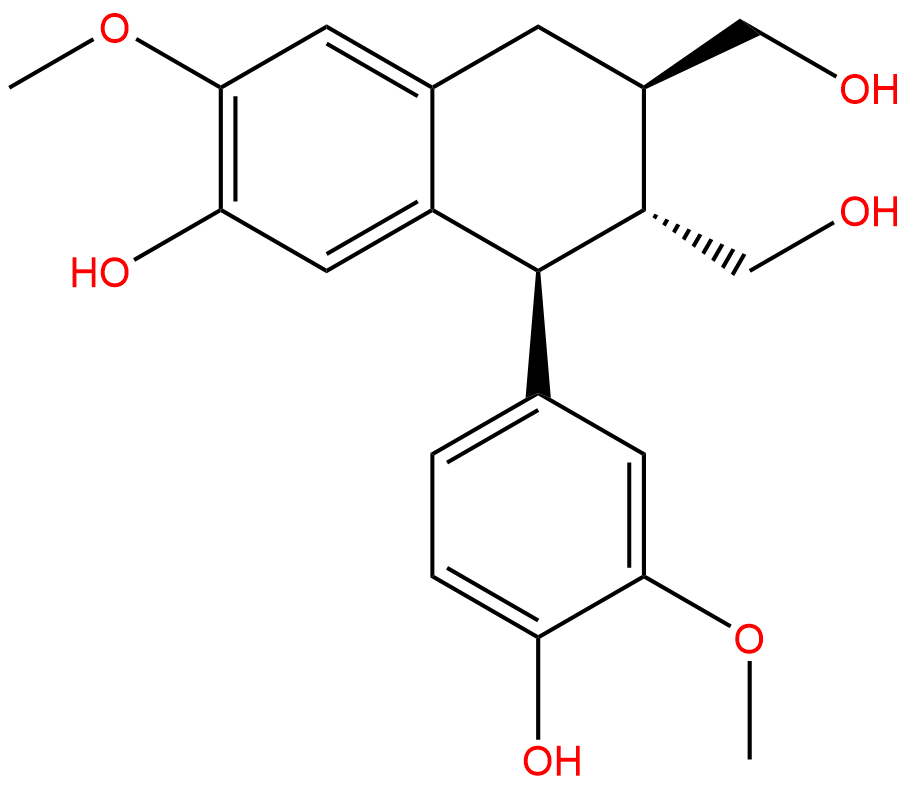


Product name: Isolariciresinol
Synonym name:
Catalogue No.: SBP01290
Cas No.: 548-29-8
Formula: C20H24O6
Mol Weight: 360.406
Botanical Source:
Physical Description: Powder
Type of Compound: Lignans
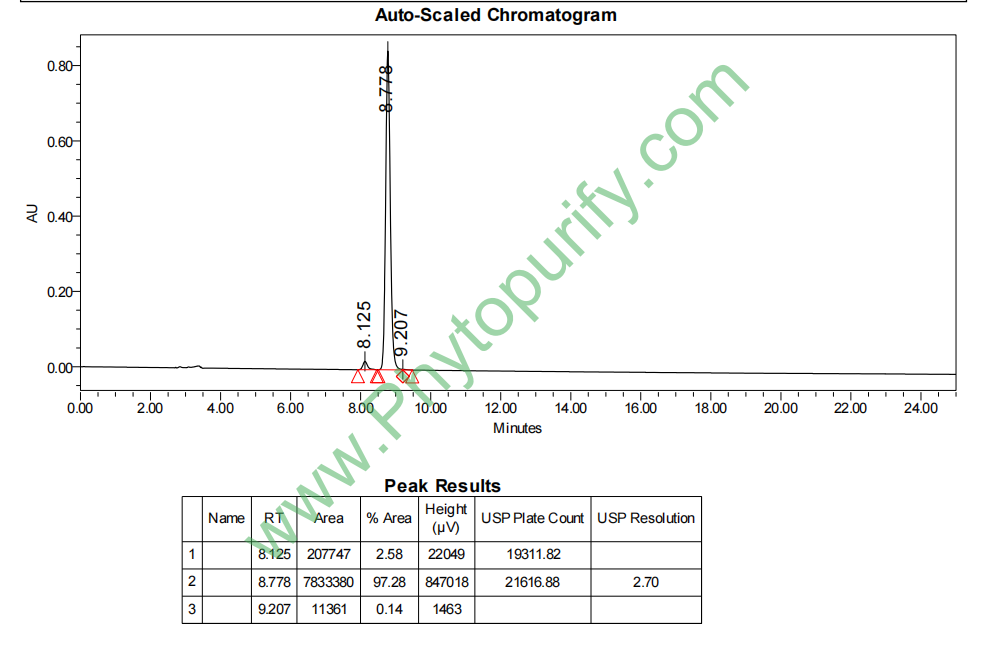
Purity: 95%~99%
Analysis Method: HPLC-DAD or/and HPLC-ELSD
Identification Method: Mass, NMR
Packing: Brown vial or HDPE plastic bottle
The product could be supplied from milligrams to grams. Inquire for bulk scale.
We provide solution to improve the water-solubility of compounds, thereby facilitating the variety of activity tests and clinic uses.
For Reference Standard and R&D, Not for Human Use Directly.
HPLC of Isolariciresinol
Storage conditions:Short-term storage at 2~8℃, long-term storage at -20 ~ -80℃
99.3800
2.0052
2.0029
.2808
4.3368
7.1710
Low
85.5996
3.5301
No
No
No
No
Yes
No
0.0
Yes
No
No
No
Natural products, as an important source of drug discovery, play an irreplaceable role in human health maintenance and disease treatment. Among numerous natural product families, lignans have attracted much attention due to their diverse biological activities and unique chemical structures. Isolaridisinol, as a typical tetrahydronaphthalene type lignan, has attracted widespread research interest in the field of natural product pharmacology in recent years.
Isolarch resin, also known as (+) - isolarch resin alcohol, is a natural polyphenolic compound with a tetrahydronaphthalene skeleton. Its CAS number is 548-29-8 and its molecular formula is C20H24O6. This compound was originally derived from Yunnan madder, a plant in the madder family(Rubia yunnanensis)It was isolated from the roots and subsequently discovered in various plants, including pine and cypress plants, flax plants, and certain medicinal plants. As a secondary metabolite of plants, isoquercetin may participate in physiological processes such as defense mechanisms, signal transduction, and cell wall construction in plants.
From a chemical structure perspective, isoquercetin belongs to the aromatic tetrahydronaphthalene subclass of the lignan family. Its core structure is 5,6,7,8-tetrahydronaphthalene-2-ol, which is substituted by hydroxymethyl at positions 6 and 7, methoxy at position 3, and 4-hydroxy-3-methoxyphenyl (i.e. guaiacol) at position 8. This unique substitution pattern endows the molecule with rich chemical properties and biological activity potential.
In recent years, with the deepening understanding of the role of oxidative stress in the pathogenesis of various diseases, research on natural products with antioxidant activity has become a hot topic. Isoquercetin, with its polyphenol structural characteristics, exhibits significant antioxidant capacity and exerts biological effects by regulating multiple key targets. Research has shown that this compound can regulate the expression or activity of molecules such as tyrosinase (TYR), matrix metalloproteinase 1 (MMP1), nuclear factor E2 related factor 2 (NFE2L2/NRF2), superoxide dismutase (SOD1, SOD2), catalase (CAT), glutathione peroxidase 1 (GPX1), heme oxygenase 1 (HMOX1), and matrix metalloproteinase 3 (MMP3), thereby playing a multi-level regulatory role in the antioxidant defense system.
This review aims to systematically sort out the chemical structure characteristics, plant sources, extraction and separation methods, pharmacological activities, mechanisms of action, pharmacological evaluation, and clinical application prospects of isoquercetin, providing comprehensive scientific basis for the in-depth research and development of this natural product.
Isoquercetin belongs to the aromatic tetrahydronaphthalene subclass of lignans, with a core skeleton of 5,6,7,8-tetrahydronaphthalene. Specifically, the parent nucleus of the molecule is a partially hydrogenated naphthalene ring system, where ring A is an aromatic ring and ring B is a partially saturated cyclohexene ring. In the substitution mode, the molecule exhibits a highly characteristic functional group distribution:
This substitution mode enables isoquercetin to possess multiple functional groups such as primary alcohols, phenolic hydroxyl groups, and methoxy groups, providing a structural basis for its diverse biological activities. It is worth noting that the molecule has a chiral center, and the naturally occurring (+) - isomer has a specific stereochemical configuration, which is crucial for its interaction with its biological target.
According to computational chemistry and experimental measurement data, the key physicochemical property parameters of isoquercetin are as follows:
Molecular weight and formula:
-Molecular weight: 360.4060 g/mol
-Molecular formula: C20H24O6
Fat solubility parameters:
-LogP (oil-water distribution coefficient): 2.0052
This value indicates that isoquercetin has moderate lipid solubility, which is soluble in organic solvents and has a certain degree of water solubility, which is beneficial for its absorption and distribution in organisms.
Polar Surface Area:
-Topological Polarity Surface Area (TPSA): 99.3800 Å ²
The TPSA value reflects the surface area of polar atoms (mainly oxygen and nitrogen) in the molecule, indicating that isoquercetin contains multiple polar groups (phenolic hydroxyl, alcohol hydroxyl, and ether oxygen) and has strong hydrogen bond donor and acceptor abilities.
Water solubility:
-Water solubility: 0.2808 mg/mL
This compound exhibits a certain degree of water solubility, but its solubility is relatively low, which is related to its polyphenol structure and molecular weight.
Blood-brain barrier penetrability:
-Penetration ability of blood-brain barrier: low
This characteristic indicates that isoquercetin is not easily able to enter the central nervous system through the blood-brain barrier, which may have advantages in the development of peripheral targeted drugs, but also limits its potential application in the treatment of neurological diseases.
Security parameters:
-HERG inhibition: No
-Ames test: 0.0 (negative)
These data preliminarily indicate that isoquercetin does not have significant hERG potassium channel inhibitory activity (with low risk of cardiac toxicity), and did not show mutagenicity in the Ames test, providing a positive signal for its safety evaluation.
The chemical structure of isoquercetin determines its biological activity characteristics. The multiple phenolic hydroxyl groups in the molecule endow the compound with direct free radical scavenging ability, which is the direct chemical basis for its antioxidant activity. Meanwhile, the presence of methoxy groups may affect the electron distribution and lipid solubility of molecules, thereby regulating their interactions with biological targets. The tetrahydronaphthalene skeleton provides a rigid structure that facilitates specific binding of molecules to enzyme or receptor active sites.
Isoquercetin is widely distributed in nature and mainly exists in the following plant groups:
Rubiaceae plants:
-Yunnan madder(Rubia yunnanensis)This plant is the first isolated and identified source of isoquercetin, and its roots contain abundant lignans
-Madder grass(Rubia cordifolia)As a traditional Chinese medicine, isoquercetin has also been detected in the roots and stems of madder
Pinaceae plants:
-European Red Pine(Pinus sylvestris)Its xylem and bark contain isoquercetin
-Spruce genus(Picea)Plant: This compound has been identified in extracts from the xylem of various spruce species
Linaceae plants:
-Flax(Linum usitatissimum)Flaxseed is an important source of lignin, which contains isoquercetin and its glycosidic forms
Other plant sources:
-Schisandraceae plants: Some Schisandraceae plants contain isoquercetin
-Asteraceae plants: This compound has also been detected in some medicinal plants of Asteraceae
It is worth noting that isoquercetin usually exists in free or glycosidic form in plants, and its content varies depending on plant species, tissue parts, growth stages, and environmental conditions. In pine and cypress plants, this compound is involved in the biosynthesis pathway of lignin and is one of the precursor substances of lignin.
The extraction of isoquercetin is usually carried out using classic natural product extraction strategies, combined with modern separation techniques:
Traditional extraction methods:
1. Solvent extraction method Using the solubility of isoquercetin in organic solvents, ethanol, methanol, or ethanol water mixed solvents are commonly used for extraction. For dry plant materials, 70% -95% ethanol reflux extraction is usually used, with extraction temperature controlled at 60-80 ° C, extraction time 2-4 hours, and repeated extraction 2-3 times.
2. Percolation extraction For thermosensitive components, room temperature percolation method can be used, using methanol or ethanol as solvents, which has a longer extraction time but can avoid high-temperature degradation.
Modern extraction techniques:
1. Ultrasonic assisted extraction Utilizing the cavitation effect of ultrasound to destroy plant cell walls and improve extraction efficiency. Usually 70% ethanol is used, ultrasound power is 200-500W, extraction time is 30-60 minutes, and temperature is controlled at 40-60 ° C.
2. Microwave assisted extraction The penetration and selective heating of microwaves can significantly shorten the extraction time. Microwave power of 300-600W, extraction time of 5-15 minutes.
3. Supercritical fluid extraction Using supercritical CO2 as the extraction solvent, non-polar to moderately polar compounds can be selectively extracted. For isoquercetin, ethanol is usually added as a co solvent (5-10%), with an extraction pressure of 20-30 MPa and a temperature of 40-60 ° C.
Separation and purification methods:
1. Liquid-liquid extraction After concentration of the extraction solution, fractional extraction was carried out using solvents such as petroleum ether, ethyl acetate, and n-butanol in sequence. Isoquercetin was mainly enriched in the ethyl acetate extraction site.
2. Column chromatography separation:
-Silica gel column chromatography: using chloroform methanol or petroleum ether acetone gradient elution
-Reverse phase column chromatography: using ODS (C18) stationary phase, methanol water or acetonitrile water gradient elution
-Sephadex gel chromatography: Sephadex LH-20, methanol or ethanol elution
3. Preparation by High Performance Liquid Chromatography High purity isoquercetin can be obtained using semi preparative or preparative HPLC, C18 reverse phase column, methanol water or acetonitrile water mobile phase.
Quality Control and Testing:
-Thin layer chromatography (TLC): using a silica gel GF254 plate, chloroform methanol (9:1 or 8:2) as the developing agent, and detecting at 254nm under ultraviolet light
-High performance liquid chromatography (HPLC): C18 reverse phase column, detection wavelength 280nm, mobile phase methanol water (40:60 to 60:40 gradient)
-Mass spectrometry (LC-MS): electrospray ionization (ESI) negative ion mode, m/z 359 [M-H] ⁻
The most prominent pharmacological activity of isoquercetin is its antioxidant effect, which is closely related to its polyphenol structural characteristics. Numerous in vitro and in vivo studies have confirmed the antioxidant capacity of this compound:
In vitro antioxidant activity:
1. Free radical scavenging ability Isoquercetin can effectively scavenge various free radicals, including DPPH free radicals, ABTS cationic free radicals, hydroxyl free radicals, and superoxide anion free radicals. The IC50 value of its DPPH radical scavenging activity is usually in the range of 10-50 μ M, comparable to standard antioxidants vitamin C and Trolox.
2. Restoration ability This compound exhibits significant iron ion reduction ability (FRAP method), capable of reducing Fe ³ ⁺ to Fe ² ⁺, indicating its electron donor ability.
3. Lipid peroxidation inhibition In liposome or low-density lipoprotein (LDL) oxidation models, isoleucine can effectively inhibit the generation of lipid peroxidation products, such as malondialdehyde (MDA) and conjugated dienes.
Cellular level antioxidant activity:
1. Oxidative stress protection In the oxidative stress model induced by H ₂ O ₂ or tert butyl hydroperoxide (t-BHP), pretreatment with isoquercetin can significantly improve cell survival rate and reduce intracellular reactive oxygen species (ROS) levels.
2. Regulation of antioxidant enzyme activity This compound can upregulate the expression and activity of intracellular antioxidant enzymes, including superoxide dismutase (SOD), catalase (CAT), and glutathione peroxidase (GPX).
3. Glutathione system regulation Isoquercetin can maintain the level of reduced glutathione (GSH) in cells, increase the GSH/GSSG ratio, and enhance the antioxidant defense ability of cells.
In vivo antioxidant activity:
In animal models, oral or intraperitoneal administration of isoflavones can significantly reduce levels of oxidative stress markers such as serum MDA and protein carbonyl content, while increasing antioxidant enzyme activity. These effects have been observed in tissues such as the liver, kidneys, and heart.
In addition to its antioxidant properties, isoquercetin also exhibits anti-inflammatory activity:
-Inhibition of nitric oxide (NO) and prostaglandin E2 (PGE2) production in macrophages stimulated by lipopolysaccharide (LPS)
-Reduce the expression of pro-inflammatory cytokines such as TNF - α, IL-1 β, and IL-6
-Inhibition of inducible nitric oxide synthase (iNOS) and cyclooxygenase-2 (COX-2) expression
Preliminary studies have shown that isoflavones have cytotoxic effects on certain tumor cell lines:
-Inhibiting the proliferation of breast cancer cells (MCF-7, MDA-MB-231)
-Inducing apoptosis of colon cancer cells (HT-29, HCT-116)
-Regulating the expression of cell cycle related proteins
Despite its low blood-brain barrier penetration, there are still studies reporting its neuroprotective effects
-Protecting neuronal cells from oxidative stress-induced damage
-Inhibition of neurotoxicity induced by β - amyloid protein
-Improving cognitive function in Alzheimer's disease model mice
The pharmacological activity of isoflavones is mainly achieved through multi-target and multi pathway regulatory mechanisms, among which antioxidant effect is its core biological effect.
NRF2 (Nuclear Factor E2 Related Factor 2) is a key transcription factor in the cellular antioxidant defense system, regulating the expression of various antioxidant and detoxifying enzymes. Isoquercetin activates the NRF2 signaling pathway through the following mechanisms:
Isoquercetin not only affects the expression of antioxidant enzymes through transcriptional regulation, but may also directly interact with antioxidant enzymes to regulate their activity:
The regulatory effect of isoquercetin on matrix metalloproteinases (MMPs) is closely related to its antioxidant and anti-inflammatory activities:
TYR (Tyrosinase) It is a key enzyme in melanin synthesis. The regulatory effect of isoquercetin on TYR exhibits concentration dependence:
-At low concentrations, it is possible to inhibit the oxidative activation of TYR through antioxidant activity
-At high concentrations, it may directly bind to the TYR active site and competitively inhibit its activity
As a polyphenolic compound, isoquercetin can directly scavenge free radicals, and this mechanism does not depend on cellular signaling pathways:
-Phenolic hydroxyl groups provide hydrogen atoms and neutralize free radicals
-The formed phenoxide radicals are stabilized by resonance, terminating the chain reaction of free radicals
-The presence of adjacent methoxy groups enhances the hydrogen donating ability of phenolic hydroxyl groups
The biological effects of isoquercetin involve cross regulation of multiple signaling pathways:
- Inhibition of NF - κ B pathway By inhibiting the phosphorylation and degradation of I κ B α, reducing NF - κ B nuclear translocation, and lowering the expression of pro-inflammatory genes
- MAPK pathway regulation Regulating the phosphorylation levels of ERK, JNK, and p38 MAPK
- Activation of PI3K/Akt pathway Promote cell survival and antioxidant defense by activating PI3K/Akt signaling
Based on computational chemistry and preliminary experimental data, the pharmacological characteristics of isoquercetin are as follows:
Drug Evaluation:
-Complies with Lipinski's five rules (molecular weight<500, LogP<5, hydrogen bond donor<5, hydrogen bond acceptor<10)
-The TPSA value (99.38 Å ²) is moderate, which is beneficial for oral absorption
-There are multiple rotatable bonds in the molecule, which have a certain degree of conformational flexibility
safety assessment:
-HERG inhibition: negative, low risk of cardiac toxicity
-Ames test: negative, no mutagenicity
-Preliminary toxicity studies have shown good safety within the therapeutic dose range
Pharmacokinetic Challenge:
-Low water solubility (0.2808 mg/mL) may affect oral bioavailability
-Low blood-brain barrier penetration limits central nervous system applications
-As a polyphenolic compound, it may undergo extensive phase II metabolism (glucuronidation, sulfation)
absorb:
-Oral absorption may be limited by low water solubility and first pass metabolism
-May be metabolized by gut microbiota in the intestine, producing metabolites that are more easily absorbed
-Co administration with food may increase its bioavailability
distribution:
-The plasma protein binding rate may be high, affecting the concentration of free drugs
-The organization is widely distributed, but the concentration is relatively low in the central nervous system
-May accumulate in certain tissues, such as the liver and kidneys
Metabolism:
-The main metabolic pathways include glucuronidation and sulfation binding reactions
-May undergo methylation or demethylation metabolism
-The gut microbiota may convert isoflavones into metabolites such as enterolactone
excretion:
-Mainly excreted through bile and urine
-Metabolites may undergo enterohepatic circulation
To overcome pharmacokinetic limitations, the following formulation strategies can be considered:
- nano-formulation Liposomes, nanoparticles, or micelles encapsulate to enhance water solubility and bioavailability
- Prodrug design Introducing phosphate groups or amino acid residues to improve water solubility and absorption
- Eutectic technology Forming eutectic with appropriate eutectic forming agents to improve solubility and dissolution rate
- Phospholipid complex Forming complexes with phospholipids to enhance lipid solubility and membrane permeability
Based on the pharmacological activity and safety characteristics of isoquercetin, it has clinical application potential in the following fields:
Skin Health and Anti Aging:
-As an antioxidant used in skincare products to prevent UV induced skin photoaging
-Inhibit MMP1 expression, reduce collagen degradation, and maintain skin elasticity
-Regulating TYR activity may be used for the treatment of pigmentary skin diseases
Metabolic diseases:
-As an antioxidant dietary supplement, it improves oxidative stress-related metabolic disorders
-Potential use for prevention and treatment of complications of diabetes
-Regulating lipid metabolism may be beneficial for non-alcoholic fatty liver disease
Inflammatory diseases:
-Exert anti-inflammatory effects through NRF2 activation and NF - κ B inhibition
-May be used as an adjuvant therapy for chronic inflammatory diseases such as arthritis and colitis
Tumor prevention and adjuvant therapy:
-As a chemopreventive agent, reducing the risk of cancer occurrence
-Enhance the anti-tumor effect of conventional chemotherapy drugs
-Reduce oxidative stress and toxic side effects caused by chemotherapy
Cardiovascular protection:
-Antioxidant and anti-inflammatory effects contribute to the prevention of atherosclerosis
-Improve endothelial function and lower blood pressure
Despite exhibiting various pharmacological activities, the clinical translation of isoflavones still faces many challenges
In terms of basic research:
1. In depth analysis of the mechanism of action Further clarification is needed on the precise molecular mechanism of NRF2 activation, particularly the details of its interaction with Keap1
2. Target confirmation Verify the necessity of key targets in the pharmacological effects of isoquercetin through gene knockout or overexpression models
3. Study on Structure Activity Relationship Systematically study the effect of structural modifications on activity and search for better derivatives
Pharmacokinetic optimization:
1. Improved bioavailability Develop new formulations or prodrug strategies to improve oral absorption
2. Metabolic stability Research metabolic pathways and design anti metabolic derivatives
3. Organizational targeting Develop delivery systems targeting specific tissues
Preclinical evaluation:
1. Long term toxicity study Conduct chronic toxicity, reproductive toxicity, and carcinogenicity evaluations
2. Drug interactions Assess the risk of interaction with commonly used drugs
3. Dose Optimization Determine the optimal dosing regimen and dosage range
clinical research:
1. Research on Healthy Volunteers Evaluate human pharmacokinetics and tolerability
2. Concept validation experiment Validate therapeutic efficacy in patients with specific diseases
3. Biomarker research Develop pharmacodynamic biomarkers to monitor treatment efficacy
The future research on isoquercetin requires interdisciplinary collaboration:
- Synthetic Chemistry Develop efficient fully synthetic or semi synthetic methods to solve the problem of limited natural sources
- computational chemistry Using molecular docking and molecular dynamics simulations to predict interactions with target proteins
- systems biology Through omics techniques, comprehensively analyze its biological effect network
- Nanomedicine Design an intelligent delivery system to achieve targeted and controlled release
As a natural tetrahydronaphthalene type lignan, isoquercetin has shown significant research value in the field of natural product pharmacology due to its unique chemical structure and multi-target pharmacological activity. This article systematically reviews the chemical structure characteristics, plant sources and extraction methods, pharmacological activity, mechanism of action, evaluation of drug properties, and clinical application prospects of the compound.
From a chemical perspective, the polyphenolic structure in the molecules of isoquercetin endows them with direct free radical scavenging ability, while the tetrahydronaphthalene skeleton provides a rigid structural basis for interacting with biological targets. The physicochemical properties parameters indicate that the compound has moderate lipid solubility and a certain degree of water solubility, meeting the basic requirements of drug like properties. However, oral bioavailability and blood-brain barrier penetration are challenges that need to be overcome.
In terms of pharmacological activity, the most prominent role of isoquercetin is antioxidant, which involves direct free radical scavenging, activation of the NRF2/ARE signaling pathway, and regulation of the antioxidant enzyme system. In addition, the compound exhibits various activities such as anti-inflammatory, anti-tumor, neuroprotective, and cardiovascular protection, which are closely related to its antioxidant core function. The regulation of targets such as TYR, MMP1, MMP3, SOD1, SOD2, CAT, GPX1, HMOX1, etc. constitutes a multi-layered molecular network of action of isoliquiritigenin.
The pharmacological evaluation shows that isoquercetin has good safety characteristics (no hERG inhibition, Ames test negative), but its water solubility and bioavailability need to be improved. Through strategies such as nanomedicine and prodrug design, it is expected to overcome these pharmacokinetic limitations.
Looking ahead to the future, isoflavones have broad application prospects in fields such as skin health, metabolic diseases, inflammatory diseases, and tumor prevention. However, from laboratory research to clinical translation, there are still many challenges that require collaborative efforts from multidisciplinary researchers such as chemistry, biology, pharmacology, and medicine. With a deeper understanding of the mechanism of action of isoquercetin and advances in formulation technology, this natural lignan is expected to become a lead compound for new antioxidant drugs, contributing to human health.
In short, as a precious gem in the treasure trove of natural products, the study of lignans not only enriches our understanding of the biological activity of lignans, but also provides important scientific basis for the development of antioxidant drugs based on natural products. In the future, through continuous basic research and application development, isoflavones and their derivatives are expected to play a greater role in the pharmaceutical and health industries.
