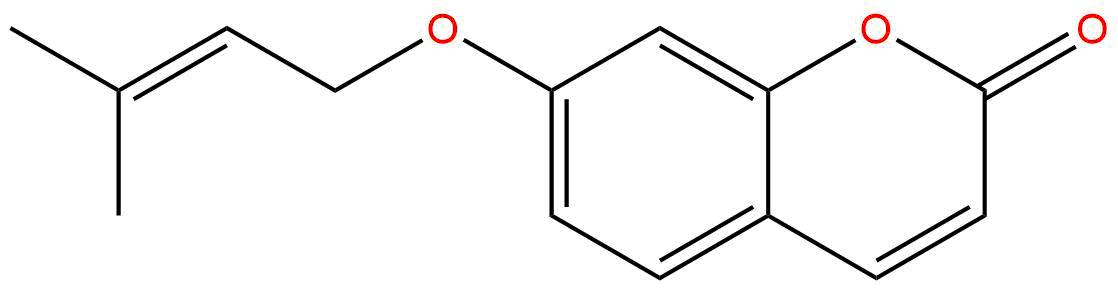
| Catalog No | Package | Original Price | Price | Inventory | Quantity | Operating |
|---|---|---|---|---|---|---|
| BP4202-20mg | 20mg | $165.00 | Sign in |
|


Product name: 7-Prenyloxycoumarin
Synonym name:
Catalogue No.: BP4202
Cas No.: 10387-50-5
Formula: C14H14O3
Mol Weight: 230.263
Botanical Source:
Type of Compound:
Purity: 95%~99%
Analysis Method: HPLC-DAD or/and HPLC-ELSD
Identification Method: Mass, NMR
Packing: Brown vial or HDPE plastic bottle
Storage: Store in a well closed container, protected from air and light. Put into refrigerate or freeze for long term storage.
Whenever possible, you should prepare and use solutions on the same day. However, if you need to make up stock solutions in advance, we recommend that you store the solution as aliquots in tightly sealed vials at -20℃. Generally, these will be useable for up to two weeks.
The product could be supplied from milligrams to grams
Inquire for bulk scale.
For Reference Standard and R&D, Not for Human Use Directly.
Storage conditions:Short-term storage at 2~8℃, long-term storage at -20 ~ -80℃
39.4400
3.4143
3.4146
.0141
4.4774
35.1186
High
87.6523
2.2312
Yes
Yes
Yes
No
Yes
Yes
0.9
No
Yes
Yes
Yes
7-Prenyloxycoumarin (CAS number: 10387-50-5), also known as 7-O-Prenylmberiferone, is a natural secondary metabolite derived from the endophytic fungus Annulohyoxylon ilanense. As a derivative of coumarin compounds, 7-isoprenyloxycoumarin has attracted widespread attention in the field of natural product pharmacology due to its unique structural modifications. In recent years, with in-depth research on its anti-inflammatory activity and related molecular mechanisms, this compound has shown great potential for drug development. This article provides a systematic review of the chemical structure, sources, pharmacological activity, mechanism of action, pharmacological evaluation, and future clinical application prospects of 7-isoprenyloxycoumarin, aiming to provide theoretical basis and research direction for the drug development of this natural product.
7-Isopentenyl coumarin belongs to the coumarin class of compounds, which is structurally based on the coumarin skeleton and is connected to an isopentene group through an ether bond at the 7th hydroxyl position. Its molecular formula is C14H14O3 and its molecular weight is 230.2630. The introduction of this structure gives it high lipophilicity, with a LogP value of 3.4143, indicating moderate lipophilicity that facilitates penetration of cell membranes and biological barriers.
In terms of physicochemical properties, the polar surface area (TPSA) of 7-isoprenyloxycoumarin is 39.44 Å ², and a lower TPSA contributes to its cell membrane permeability. Its water solubility is relatively low, about 0.0141 mg/mL, showing poor water solubility, which to some extent limits its absorption in vivo, but may also be beneficial for its distribution in the lipid environment. In addition, the compound has a high blood-brain barrier penetration ability, indicating its potential application value in the treatment of central nervous system related diseases. The negative result of hERG channel inhibition experiment indicates a low risk of cardiac toxicity. The Ames test score is 0.9, indicating a low risk of genotoxicity and good safety.
7-Isopentenyl coumarin was initially isolated from the endophytic fungus Annulohyoxylon ilanense. The Annulohyoxylon genus of fungi is widely distributed in tropical and subtropical regions, and its endophytic fungal community is a rich source of secondary metabolites. The discovery of this compound has expanded the scope of sources for coumarin natural products, demonstrating the importance of endophytic fungi as medicinal natural product resources.
The extraction method usually involves solid culture fermentation of fungi, followed by extraction using organic solvents such as ethyl acetate and methanol. After concentration, the extract was separated and purified using column chromatography (silica gel column, C18 reverse phase column) and high performance liquid chromatography (HPLC) techniques to obtain high-purity 7-isoprenyloxycoumarin. In recent years, the application of ultrasound assisted extraction and microwave-assisted extraction technologies has improved extraction efficiency and purity, providing technical support for large-scale preparation.
The pharmacological activity research of 7-isoprenyloxycoumarin mainly focuses on its anti-inflammatory effect. Inflammation, as a common pathological basis of various diseases, has important clinical significance in the development of drugs targeting inflammatory signaling pathways. Both in vitro cell models and in vivo animal models have confirmed that 7-isoprenyloxycoumarin can significantly inhibit the expression and release of various inflammatory mediators.
Specifically, this compound can downregulate the expression of pro-inflammatory cytokines IL-6 and TNF - α, inhibit the activity of inflammation related enzymes PTGS1 (COX-1) and PTGS2 (COX-2), and reduce the synthesis of inflammatory mediators. In addition, 7-isoprenyloxycoumarin has a significant inhibitory effect on the activity of key inflammatory signaling factors STAT3 and transcription factor NFKB1, thereby blocking the transmission of inflammatory signals. Its regulatory effect on inflammation related ion channels TRPV1 and TRPA1 further alleviates neuroinflammation and pain response. Inhibition of CASP1 (cysteine protease-1) helps to reduce the activation of inflammasomes and lower the inflammatory cascade. The inhibitory effect of NOS2 (inducible nitric oxide synthase) reduces the occurrence of oxidative stress and protects tissues from inflammatory damage.
In addition, some studies have shown that 7-isoprenyloxycoumarin has antioxidant activity, can scavenge free radicals, alleviate oxidative stress, and synergistically exert anti-inflammatory effects. Its anti-inflammatory activity has shown good therapeutic potential in various disease models such as inflammatory bowel disease, arthritis, and neuroinflammation.
The anti-inflammatory mechanism of 7-isoprenyloxycoumarin involves the regulation of multiple signaling pathways and molecular targets. Its main targets include:
IL-6 (interleukin-6)As a pro-inflammatory cytokine, IL-6 plays a crucial role in the inflammatory response. 7-Isopentenyl coumarin reduces the amplification effect of inflammatory signals by inhibiting the expression of IL-6.
STAT3 (Signal Transduction and Transcription Activation Factor 3)The STAT3 signaling pathway mediated by IL-6 plays an important role in inflammation and tumorigenesis. This compound inhibits the phosphorylation and nuclear translocation of STAT3, blocking its transcriptional activity.
CASP1 (cysteine protease-1)CASP1 mediates inflammasome activation and promotes the mature release of IL-1 β and IL-18. 7-Isopentenyl coumarin alleviates the inflammatory cascade by inhibiting CASP1 activity.
TRPV1 and TRPA1 (transient receptor potential channels)These two ion channels play important roles in inflammatory pain and neuroinflammation. The regulation of this compound helps alleviate pain and inflammation.
PTGS1 and PTGS2 (cyclooxygenase-1 and -2)Catalytic synthesis of prostaglandins is an important source of inflammatory mediators. 7-isoprenyloxycoumarin inhibits its activity and reduces prostaglandin production.
NOS2 (inducible nitric oxide synthase)Excessive NO is involved in inflammation and oxidative stress. This compound inhibits NOS2 expression and reduces NO levels.
NFKB1 (nuclear factor kappa B subunit)As a core transcription factor of inflammatory signaling, the inhibition of NFKB1 is an important mechanism of anti-inflammatory drugs. 7-Isopentenyl coumarin reduces the expression of pro-inflammatory genes by blocking the activation of NFKB1.
In summary, 7-isoprenyloxycoumarin exhibits a comprehensive anti-inflammatory mechanism by synergistically regulating inflammatory responses through multiple targets and pathways.
From the perspective of drug development, 7-isoprenyloxycoumarin has ideal drug properties. Its molecular weight of 230.2630 conforms to Lipinski's rule, and its LogP value of 3.4143 shows moderate lipid solubility, which is beneficial for absorption and distribution in vivo. The TPSA is 39.44 Å ², and its low polarity helps to penetrate the cell membrane and blood-brain barrier. Experimental data also confirms that it has high central nervous system penetration and is suitable for the treatment of central diseases such as neuropathy.
Low water solubility (0.0141 mg/mL) is a potential formulation challenge, and its bioavailability needs to be improved through techniques such as nanocarriers, liposomes, or solid dispersions. The hERG channel inhibition experiment was negative, indicating a low risk of cardiac toxicity and good safety. The Ames test score is 0.9, indicating a low risk of genotoxicity and suitability for further drug development.
At present, there is limited pharmacokinetic data on this compound in vivo, but based on structural speculation, it may undergo liver metabolism, mainly cleared through oxidation and binding reactions. In the future, systematic ADME (absorption, distribution, metabolism, excretion) and toxicology studies need to be conducted to comprehensively evaluate its drug development potential.
7-Isopentenyl coumarin, as a multi-target anti-inflammatory natural product, has broad clinical application prospects. Its inhibitory effect on key inflammatory signaling pathways such as IL-6/STAT3 and NFKB1 gives it potential advantages in the treatment of inflammatory diseases such as rheumatoid arthritis, inflammatory bowel disease, neuroinflammation, and chronic pain.
In addition, its excellent blood-brain barrier penetration ability provides the possibility for drug development for neurological diseases such as multiple sclerosis and Alzheimer's disease-related inflammation. Combining its low toxicity and good drug properties, 7-isoprenyloxycoumarin can be used as a candidate molecule for novel anti-inflammatory drugs.
Future research should focus on pharmacokinetic optimization, formulation development, and preclinical safety evaluation. At the same time, combining modern drug design techniques such as structural optimization and the construction of targeted delivery systems is expected to enhance its clinical application value. Based on its multi-target mechanism of action, it is also possible to explore combination therapy strategies with other drugs to achieve synergistic therapeutic effects.
7-isoprenyloxycoumarin, as a secondary metabolite of endophytic fungi, has shown great potential for drug development due to its unique structure and multi-target anti-inflammatory effects. Its mechanism of action in regulating key inflammatory molecules such as IL-6, STAT3, NFKB1, and related ion channels provides new ideas for the development of anti-inflammatory drugs. Although its low water solubility and pharmacokinetic properties require further research, its good safety and blood-brain barrier penetration ability give it unique advantages in the treatment of central nervous system diseases.
In the future, combining modern medicinal chemistry and pharmacology techniques, 7-isoprenyloxycoumarin is expected to become an important natural drug candidate molecule in the anti-inflammatory field, providing new drug options for the treatment of inflammation related diseases. The preclinical research and mechanism exploration of the system will lay a solid foundation for its clinical translation.
