Introduction/Overview
Natural products, as an important source of drug discovery, play a crucial role in the development of anti-tumor drugs due to their structural diversity and wide range of biological activities. As a class of polycyclic aromatic compounds, phenanthrene compounds have received widespread attention in recent years due to their unique molecular structure and biological activity. 2,7-dihydroxy-4,6-dimethylphenanthrene (hereinafter referred to as "2,7-dihydroxy-4,6-dimethylphenanthrene") is a natural product of phenanthrene with significant biological activity. This compound not only exhibits multi-target anti-tumor activity, but also demonstrates good pharmacological characteristics, making it a hot topic in natural product pharmacology research.
This article will provide a systematic review of the chemical structure and physicochemical properties, plant sources and extraction methods, pharmacological activity and mechanism of action, pharmacological evaluation and pharmacokinetic characteristics of 2,7-dihydroxy-4,6-dimethylphenol. Finally, its clinical application prospects and future development directions will be explored, aiming to provide a theoretical basis and reference for the in-depth research and drug development of this compound.
Chemical structure and physicochemical properties
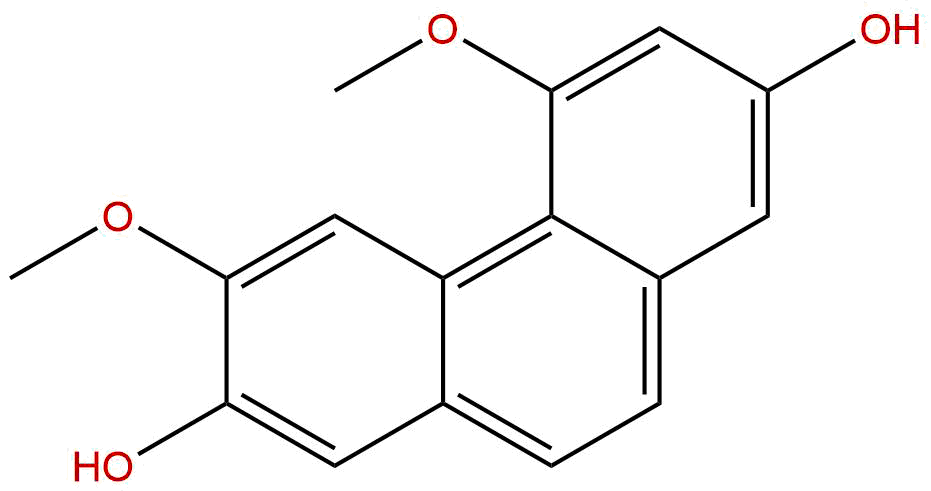
2,7-dihydroxy-4,6-dimethylphenol belongs to the phenanthrene class compounds, with a molecular formula of C15H14O4 and a molecular weight of 270.2840. The core of its structure is a tricyclic aromatic phenanthrene skeleton, with hydroxyl groups (- OH) at positions 2 and 7, respectively, while methoxy groups (- OCH3) are substituted at positions 4 and 6, forming a unique 2,7-dihydroxy-4,6-dimethyl substitution pattern.
In terms of physical and chemical properties, the LogP value of the compound is 3.0239, indicating its moderate hydrophobicity, which is conducive to cell membrane penetration and bioavailability. The topological polar surface area (TPSA) is 58.92 Å ², indicating moderate polarity and facilitating binding with biomolecule targets. The low water solubility (0.0576 mg/mL) reflects its limited solubility in the aqueous phase, but this can be improved to some extent through pharmaceutical methods. It is worth noting that the compound has a high blood-brain barrier penetration ability, indicating its potential application value in central nervous system related diseases. In addition, the hERG channel inhibition test result was negative, indicating a low risk of cardiac toxicity. The Ames mutagenicity test value was 1.2, indicating a low risk of genetic toxicity.
In summary, the chemical structure of 2,7-dihydroxy-4,6-dimethylphenol provides it with a good basis for biological activity and good safety, laying a solid foundation for subsequent pharmacological research and drug development.
Plant sources and extraction methods
2,7-dihydroxy-4,6-dimethylphenol is mainly found in various traditional Chinese medicinal materials and plants, especially in some orchids and Araceae plants with high content. Typical source plants include Dendrobium and Bletilla plants, which are commonly used in traditional Chinese medicine for anti-tumor, anti-inflammatory, and immune regulation treatments.
The extraction method usually uses organic solvent extraction combined with column chromatography separation technology. Common extraction solvents include methanol, ethanol, and their aqueous solutions, which are used to preliminarily extract polar and non-polar components based on their solubility. Subsequently, the crude extract was separated and purified using techniques such as silica gel column chromatography and reverse phase high performance liquid chromatography (RP-HPLC) to obtain high-purity 2,7-dihydroxy-4,6-dimethylphenol. In recent years, the application of emerging technologies such as ultrasound assisted extraction and microwave-assisted extraction has significantly improved extraction efficiency and purity, while reducing extraction time and solvent usage.
In addition, batch differences in plant sources and environmental factors have a significant impact on compound content, and the establishment of standardized extraction processes is crucial for ensuring product quality and reproducibility of research results.
Pharmacological activity research
The pharmacological activity research of 2,7-dihydroxy-4,6-dimethylphenol mainly focuses on its anti-tumor effect. In vitro cell experiments showed that the compound had significant inhibitory effects on a variety of tumor cell lines (such as breast cancer, lung cancer, colorectal cancer and liver cancer cells). Its IC_50 values are generally in the low micromolar range, showing strong cytotoxicity and proliferation inhibition ability.
Animal model studies further confirmed its anti-tumor activity. In mouse transplant tumor models, oral or intraperitoneal injection of 2,7-dihydroxy-4,6-dimethylphenidate can significantly reduce tumor volume and weight, and prolong the survival of experimental animals. Its anti-tumor effect is accompanied by changes in the expression of apoptosis related proteins and cell cycle arrest in tumor tissues.
In addition, the compound also exhibits multiple pharmacological activities such as anti-inflammatory, antioxidant, and immune regulation. Its anti-inflammatory effect is achieved by inhibiting the release of inflammatory mediators and the activity of inflammatory signaling pathways, while its antioxidant activity is exerted by clearing free radicals and regulating the intracellular antioxidant enzyme system. These auxiliary effects may synergistically enhance its anti-tumor effect.
Mechanism of action and molecular targets
The anti-tumor mechanism of 2,7-dihydroxy-4,6-dimethylphenol involves multiple signaling pathways and key molecular targets, reflecting its multi-target regulation characteristics.
-
Inhibition of anti apoptotic proteins MCL1 and BCL2
This compound can downregulate the expression of MCL1 and BCL2, disrupt the anti apoptotic defense line of tumor cells, and promote cell apoptosis. MCL1 and BCL2, as important members of the Bcl-2 family, play a crucial role in the survival and chemotherapy resistance of tumor cells, and their inhibition helps to restore the apoptotic program.
-
Inhibition of STAT3 signaling pathway
STAT3 is an abnormally activated transcription factor in various tumors, involved in cell proliferation, immune escape, and angiogenesis. 2,7-dihydroxy-4,6-dimethylphenol inhibits the phosphorylation and nuclear translocation of STAT3, blocks its transcriptional activity, and suppresses the growth and metastasis ability of tumor cells.
-
Regulating Matrix Metalloproteinase MMP2
MMP2 plays an important role in the invasion and metastasis of tumor cells. This compound can inhibit the expression and activity of MMP2, reduce the matrix degradation ability of tumor cells, and thus inhibit tumor infiltration and metastasis.
-
Inhibition of TOP1 and TOP2A topoisomerases
TOP1 and TOP2A are key enzymes involved in DNA topology regulation, involved in DNA replication and transcription. 2,7-dihydroxy-4,6-dimethylphenol inhibits the activity of these two enzymes, blocks DNA synthesis and cell cycle progression in tumor cells, and induces cell death.
-
Intervention of HIF1A-mediated hypoxia adaptation mechanism
The low oxygen state in the tumor microenvironment regulates various adaptive responses through HIF1A. This compound can inhibit the expression or activity of HIF1A, block tumor angiogenesis and metabolic reprogramming, and limit tumor growth.
-
Regulating the MAPK1 and ESR1 signaling pathways
MAPK1 participates in cell proliferation and differentiation, and ESR1 is an estrogen receptor, which plays an important role in breast cancer. The regulation of these two signaling pathways by 2,7-dihydroxy-4,6-dimethylphenol helps to inhibit tumor cell proliferation and hormone dependent tumor growth.
-
Affects CYP19A1 expression
CYP19A1 encodes aromatase and participates in estrogen synthesis. This compound may affect hormone levels and further exert anti-tumor effects by regulating CYP19A1.
In summary, 2,7-dihydroxy-4,6-dimethylphenyl exerts a synergistic effect through multiple targets and pathways to comprehensively regulate the growth, apoptosis, invasion, and metabolism of tumor cells, demonstrating its unique advantages as a potential anti-tumor drug.
Evaluation of drug properties and pharmacokinetics
From the perspective of drug properties, 2,7-dihydroxy-4,6-dimethylphenidate exhibits ideal drug properties. Its molecular weight is 270.2840, which meets the requirement of Lipinski rule for molecular weight less than 500. The LogP value is about 3.02, indicating moderate lipid solubility, which is beneficial for oral absorption and cell membrane penetration. The TPSA is 58.92 Å ², which is within a good range of drug polarity, supporting its effective binding to protein targets.
The low water solubility (0.0576 mg/mL) may limit its oral absorption efficiency, but its bioavailability is expected to be improved through formulation techniques such as nanocarriers and solid dispersions. The high penetration of the blood-brain barrier suggests its potential application in central nervous system diseases, but at the same time, attention should also be paid to possible central nervous system side effects.
In terms of safety, the hERG channel inhibition test was negative, indicating a low risk of cardiac toxicity. The Ames test value is 1.2, indicating a low risk of genetic toxicity and meeting the safety requirements for clinical development.
Pharmacokinetic studies are still in the preliminary stage, and existing data indicate that the compound is rapidly absorbed after oral administration, with a moderate plasma half-life. It is mainly metabolized by the liver, and the metabolites need further identification. The induction or inhibition of liver enzymes and the risk of drug interactions need to be further evaluated in subsequent studies.
Clinical application prospects and prospects
Based on its significant anti-tumor activity and good drug properties, 2,7-dihydroxy-4,6-dimethylphenidate has broad clinical application prospects. Its multi-target mechanism of action gives it potential advantages in overcoming tumor drug resistance, combination therapy, and personalized medication. Especially in the treatment of common solid tumors such as breast cancer and lung cancer, it has important value as a candidate for single or combined chemotherapy drugs.
Future research should focus on the following aspects:
-
In depth pharmacokinetic and toxicological research
Clarify its metabolic pathway, long-term toxicity, and safety to provide a basis for clinical trial design.
-
Optimize formulations and administration routes
By using nanotechnology, sustained-release formulations, and other methods to improve its bioavailability and targeting, and reduce side effects.
-
Preclinical study on combination therapy
Explore the synergistic effects with existing chemotherapy drugs, targeted drugs, and immune checkpoint inhibitors to enhance treatment efficacy.
-
Biomarker screening and precision medicine
By combining molecular targets and screening patient populations suitable for the treatment of this compound, precise treatment can be achieved.
-
Expand indication research
Exploring the potential application of its anti-inflammatory, antioxidant, and blood-brain barrier penetration properties in neurodegenerative and inflammation related diseases.
Conclusion
2,7-dihydroxy-4,6-dimethylphenol, as a natural phenanthrene compound with unique structure and multi-target anti-tumor activity, has shown good pharmacological and safety properties, becoming a research hotspot in the fields of natural product pharmacology and anti-tumor drug development. Through systematic pharmacological mechanism analysis and drug evaluation, it is expected to promote its clinical application in the future, enrich the anti-tumor drug library, and benefit the vast number of patients. With the continuous deepening of research and the advancement of technological means, 2,7-dihydroxy-4,6-dimethylphenol is expected to become a new generation of efficient and safe natural anti-tumor drugs.