Introduction/Overview
Diabetes, as a global chronic metabolic disease, its incidence rate continues to rise and has become a major public health problem threatening human health. Although current first-line hypoglycemic drugs can effectively control blood sugar, long-term use often accompanies side effects such as weight gain, risk of hypoglycemia, cardiovascular events, or liver and kidney burden, prompting researchers to continuously explore safer and multi-target new treatment strategies from natural products. Fructus Ligustri Lucidi (FLL), as a traditional essential medicine for tonifying the liver and kidney, has long been recorded in the ancient books and records of Chinese medicine for diabetes (diabetes). Modern research has also confirmed that FLL has significant hypoglycemic, lipid regulating and insulin resistance improving activities. In recent years, with the advancement of separation and identification techniques, a series of structurally novel and uniquely active compounds have been discovered from Ligustrum lucidum. Among them, Oleonuezhenide (CAS: 112693-21-7), as a complex cyclic iridoid glycoside, has gradually entered the research field. Early studies suggest that it has neuroprotective effects, while the latest pharmacological exploration reveals its great potential in anti diabetes, involving multiple key signal targets such as AMPK, PPARG, AKT1, etc. The purpose of this paper is to systematically review the chemical structure, plant origin, pharmacological activity of Oleonuezhenide, especially its anti diabetes mechanism and molecular target network, and to scientifically evaluate and prospect its pharmaceutical properties and clinical application prospects, in order to provide a theoretical basis for the in-depth development of this natural product.
Chemical structure and physicochemical properties
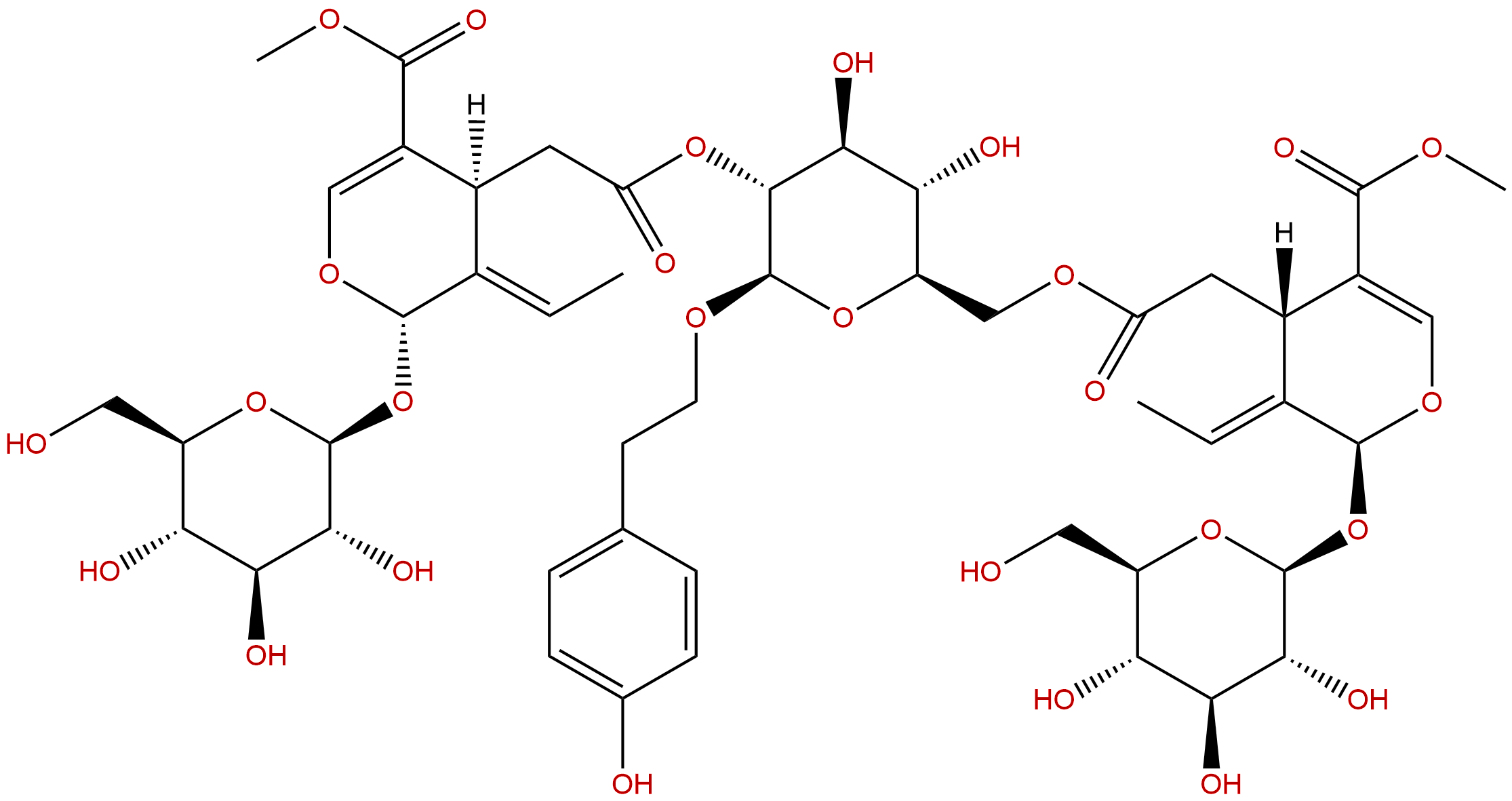
Oleonuezhenide is a complex of high molecular weight cyclohexene ether terpenoid glycosides and phenylethanoid glycosides. Its molecular formula is C ₅₄ H ₆₆ O ₂₄, with a molecular weight of 1073.0130 Da. Structurally, it is usually composed of a cyclohexene ether terpenoid glycoside (such as oleoside or similar) connected to a phenylethanolic glycoside moiety (such as acteoside or similar) through a glycosidic bond, forming a complex dimer or higher glycoside structure. This unique structure combines some of the biological activity characteristics of cyclohexene ether terpenes and phenylethanoid glycosides.
Its physical and chemical properties exhibit typical characteristics of polar macromolecular natural products. The calculated lipid water partition coefficient (LogP) is -0.1170, indicating that the compound has good hydrophilicity. The topologically polar surface area (TPSA) is as high as 401.570 Å ², which is closely related to the presence of multiple polar functional groups such as hydroxyl, sugar, and possibly carboxyl groups in its molecule. The high TPSA and negative LogP values together indicate good water solubility, with a calculated water solubility value of 4.3267 (usually indicating good solubility). These properties determine the distribution characteristics of Oleonuezhenide in the body: its extremely high polarity and high molecular weight result in a "low" ability to cross the blood-brain barrier, which may limit its direct effects on central nervous system diseases, but may be beneficial for its pharmacological effects in peripheral tissues such as liver, muscle, and fat. In early safety screening, the compound did not show hERG potassium channel inhibitory activity (hERG inhibition: No), indicating a low potential risk of cardiac toxicity; At the same time, the Ames test result was 0.0, indicating that it has no mutagenicity, providing important safety data for its further development.
Plant sources and extraction methods
Oleonuezhenide mainly comes from the dried and ripe fruit of Ligustrum Lucidum Ait, a plant in the family Rhinoceros, which is the traditional Chinese medicine Ligustrum lucidum. Ligustrum lucidum is widely distributed in China and is a traditional Chinese medicinal herb for nourishing and nourishing. In addition to Oleonuezhenide, Ligustrum lucidum is also rich in various active ingredients such as astragaloside, oleuropein, salidroside, oleanolic acid, and ursolic acid, which form the basis of its multi-component and multi-target pharmacological effects.
The extraction and separation of Oleonuezhenide from Ligustrum lucidum usually follow the conventional process of natural product chemistry, but due to its relatively low content and complex structure, separation and purification are somewhat challenging. The general steps are as follows:
1. Extract Solvent extraction method is often used. After crushing the dried Ligustrum lucidum fruit, extract it using a medium polarity solvent system, such as methanol, ethanol, or an ethanol water mixed solvent (such as 70% -95% ethanol). Heating reflux extraction or ultrasound assisted extraction can improve extraction efficiency.
2. Rough classification The extract is concentrated under reduced pressure to obtain a paste. The extract is often subjected to gradient extraction using solvents such as petroleum ether, ethyl acetate, and n-butanol in sequence. Due to its high polarity, Oleonuezhenide is mainly enriched in the n-butanol extraction site or water layer.
3. Separation and Purification The n-butanol or water fractions are further purified by macroporous adsorption resin column chromatography (such as D101, AB-8 type) using a water ethanol gradient elution to preliminarily enrich the target components. Subsequently, repeated silica gel column chromatography, reverse phase silica gel column chromatography (such as ODS, C18), dextran gel column chromatography (such as Sephadex LH-20), and high-performance liquid chromatography (HPLC) or preparative high-performance liquid chromatography (prep HPLC) were used for fine separation. The separation process is often monitored by thin layer chromatography (TLC) and HPLC, and the structure is identified by combining mass spectrometry (MS) and nuclear magnetic resonance (NMR).
At present, there are few research reports on the optimization of Oleonuezhenide extraction process (such as response surface methodology optimization of extraction parameters) and green extraction technology (such as supercritical fluid extraction), which may be an important direction for improving its yield and promoting related research in the future.
Pharmacological activity research
The pharmacological activity research of Oleonuezhenide initially focused on its neuroprotective effect. In vitro cell models (such as PC12 cells and primary cortical neurons) have shown that Oleonuezhenide can significantly improve cell survival, reduce lactate dehydrogenase leakage, and inhibit cell apoptosis in neurotoxic models induced by glutamate, hydrogen peroxide, or β - amyloid protein. Its mechanism may be related to antioxidant stress, inhibition of mitochondrial dysfunction, and regulation of apoptosis related proteins.
In recent years, its pharmacological activity against diabetes and related metabolic disorders has become a new research hotspot. Although direct in vivo and in vitro experimental data are still accumulating, based on network pharmacology prediction, molecular docking analysis and extensive research on its structural analogs (such as terligustroside and olivaloside), it can be reasonably inferred that Oleonuezhenide has multiple anti diabetes potential:
1. Improving insulin resistance It is speculated that it can enhance the responsiveness of insulin sensitive tissues (liver, skeletal muscle, fat) to insulin, promote glucose uptake and utilization.
2. Promote insulin secretion It may be achieved by protecting pancreatic beta cells, enhancing their function, or promoting insulin release under glucose stimulation.
3. Regulating key enzymes in sugar metabolism May affect the activity of key enzymes involved in gluconeogenesis and glycogen synthesis in the liver, and inhibit hepatic glucose output.
4. Regulating lipid metabolism Diabetes is often accompanied by abnormal lipid metabolism. Oleonuezhenide may improve hyperlipidemia and reduce ectopic fat deposition through related targets, thereby indirectly improving insulin resistance.
5. Antioxidant and anti-inflammatory properties Oxidative stress and chronic low-grade inflammation are the core links of insulin resistance and complications of diabetes. Its phenylethanoid glycoside structural unit usually endows it with strong antioxidant and anti-inflammatory capabilities, which helps to reduce oxidative damage and inflammatory reaction in diabetes.
These potential pharmacological activities together constitute the basis of Oleonuezhenide's comprehensive action against diabetes and its complications.
Mechanism of action and molecular targets
Oleonuezhenide's anti diabetes effect is not through a single target, but on a complex signal network. According to existing research, its core mechanism of action may revolve around the following key targets and pathways:
-
Activate AMPK signaling pathway AMP activated protein kinase (AMPK) is the overall switch of cellular energy metabolism. Oleonuezhenide may directly or indirectly activate AMPK (target PRKAA1/AMPK). The activation of AMPK produces a series of downstream effects: a) in the liver, it inhibits key transcription factors and enzymes involved in gluconeogenesis, reducing glucose production; b) In muscle and adipose tissue, promote the translocation of glucose transporter 4 (GLUT4, encoded by SLC2A4 gene) to the cell membrane, increasing glucose uptake; c) Promote fatty acid oxidation, inhibit fat synthesis, and improve lipid metabolism. This is one of the core mechanisms by which it enhances insulin sensitivity and regulates energy metabolism.
-
Regulating the PI3K/AKT signaling pathway This pathway is the core of insulin signaling. Oleonuezhenide may activate phosphatidylinositol 3-kinase regulatory subunit (PIK3R1) and its downstream serine/threonine kinase AKT1 (protein kinase B) by upregulating tyrosine phosphorylation of insulin receptor substrate 1 (IRS1). Activated AKT1 can promote membrane translocation of GLUT4, inhibit glycogen synthase kinase-3 (GSK-3) to promote glycogen synthesis, and regulate proteins related to cell survival and proliferation. This pathway interacts with the AMPK pathway to coordinate glucose homeostasis.
-
Regulating peroxisome proliferator activated receptor gamma (PPARG)PPARG is a member of the nuclear receptor superfamily and plays a critical role in adipocyte differentiation, lipid storage, and maintenance of insulin sensitivity. Oleonuezhenide may act as a regulator (partial agonist or positive regulator) of PPARG, promoting normal differentiation of adipocytes, increasing adiponectin secretion, and thus systematically improving insulin sensitivity.
-
Affects glucokinase (GCK) and sodium glucose cotransporter 2 (SGLT2)GCK is the "sensor" of glucose metabolism, regulating glucose metabolism and insulin secretion in the liver and pancreatic islet β cells. Oleonuezhenide may have an activating effect on it. On the other hand, SGLT2 is the main transporter for glucose reabsorption in the kidneys. Inhibiting SGLT2 can increase urinary glucose excretion and directly lower blood sugar. Whether Oleonuezhenide has SGLT2 inhibitory activity is worthy of experimental verification.
-
Inhibition of dipeptidyl peptidase-4 (DPP4)DPP4 can rapidly degrade intestinal insulinotropic hormones (such as GLP-1), inhibiting their activity can prolong the action time of GLP-1, promote glucose dependent insulin secretion, and inhibit glucagon release. Oleonuezhenide may have a certain DPP4 inhibitory ability.
To sum up, Oleonuezhenide exerts its anti diabetes effect from multiple dimensions such as increasing insulin sensitivity, promoting glucose utilization, protecting pancreatic islet function, regulating lipid metabolism, and promoting urinary glucose excretion through multi target and multi pathway synergy, which reflects the advantages of natural products in multi-component and multi target roles.
Evaluation of drug properties and pharmacokinetics
Based on its physicochemical parameters and preliminary data, a preliminary evaluation of the pharmacological properties of Oleonuezhenide is conducted
* Advantage:
* Good potential for safety No hERG inhibition or Ames mutagenicity alert, with a good starting point.
* Good water solubility Beneficial for the development of formulations (such as oral and injection solutions) and improving bioavailability.
* Rich targets Multi targeted effects may bring synergistic therapeutic effects and reduce drug resistance.
* challenge:
* High molecular weight and polarity May result in lower oral bioavailability. High TPSA and low LogP usually indicate that it is not easily passively diffused through the intestinal epithelial cell membrane, possibly relying on active transport or bypass pathways, but with limited efficiency.
* Poor blood-brain barrier permeability: It limits its direct application to central nervous system related indications (such as diabetes encephalopathy), but has little impact on peripheral targets.
* Metabolism and stability As glycoside compounds, they may be hydrolyzed by microbial communities or digestive enzymes in the gastrointestinal tract to produce aglycones or secondary glycosides, and their activity may be altered or lost. It is also susceptible to phase II metabolism in the body due to the influence of liver metabolic enzymes such as glucuronosyltransferase and sulfatase.
* Lack of pharmacokinetic data At present, there is almost no systematic pharmacokinetic research on the absolute bioavailability, tissue distribution, metabolite identification, excretion pathways, and half-life of Oleonuezhenide, which is a key information gap that must be filled for its progress towards drug development.
Possible future research strategies to improve its pharmacological properties include: 1) Structural modification On the premise of retaining the pharmacophore, esterification, alkylation and other modifications are carried out on sugar or certain hydroxyl groups to moderately reduce polarity and improve membrane permeability; 2) Formulation technology Using drug delivery systems such as nanocrystals, liposomes, microemulsions, and solid dispersions to improve their solubility, stability, and intestinal absorption; 3) Prodrug design Convert it into precursor molecules that are well absorbed in the intestine and then converted into the original drug in specific parts of the body.
Clinical application prospects and prospects
The clinical application prospect of Oleonuezhenide is mainly focused on the prevention and treatment of type 2 diabetes and its complications, especially in the following scenarios:
1. As a new multi target anti diabetes candidate drug: It can be used in combination with existing single target drugs or alone for early diabetes and insulin resistance syndrome to provide more comprehensive glucose and metabolic regulation.
2. Prevention and treatment of complications of diabetes Its potential antioxidant, anti-inflammatory and neuroprotective activities make it of exploration value in the prevention and treatment of diabetes nephropathy, retinopathy, neuropathy and macroangiopathy. Although its BBB permeability is low, it may still have an effect on peripheral neuropathy.
3. Comprehensive management of metabolic syndrome Its multiple functions in regulating glucose and lipid metabolism are suitable for patients with metabolic syndrome who also have problems such as high blood sugar, abnormal blood lipids, and obesity.
However, there is still a long and arduous research path to push it from the laboratory to clinical practice:
1. Deepening basic research: It is urgent to carry out rigorous pharmacodynamic evaluation in vivo, and clarify the specific effects and dose effect relationship of its hypoglycemic, insulin resistance improvement, and lipid regulation on type 2 diabetes animal models (such as db/db mice, ZDF rats, high-fat diet combined with STZ induction model).
2. Empirical Study on Mechanism At present, most target networks are predictive and require direct verification of their interactions with targets such as AMPK, PPARG, AKT1 at the cellular and molecular levels through techniques such as molecular docking, surface plasmon resonance, gene knockout/overexpression, reporter gene experiments, proteomics, etc.
3. Systematic pharmacokinetics and toxicology research This is the core of drug efficacy evaluation. It is necessary to complete the ADME (absorption, distribution, metabolism, excretion) study and preclinical safety evaluation of long-term toxicity, reproductive toxicity, etc. of the system.
4. Explanation of the Material Basis of Compound Traditional Chinese Medicine Starting from the holistic perspective of traditional Chinese medicine, this study aims to investigate the interactions between Oleonuezhenide and other components in the compound formula of Ligustrum lucidum (such as Er Zhi Wan), clarify whether it is one of the key material foundations for the "tonifying liver and kidney, strengthening waist and knee, and treating thirst" effects of Ligustrum lucidum, and provide a model for the modernization of traditional Chinese medicine.
Conclusion
Oleonuezhenide, as a unique structure secoiridoid glycoside phenylethanoid glycoside complex excavated from Ligustrum lucidum, is gradually showing great potential as a multi target natural lead compound against diabetes from the initially reported neuroprotective agent. Through acting on AMPK, PI3K/AKT, PPARG and other key signal nodes, it can intervene in the pathological process of diabetes through multiple ways such as improving insulin sensitivity, promoting glucose utilization, and regulating lipid metabolism. Although its good water solubility and preliminary safety data are encouraging, the absorption and metabolism challenges brought by large molecules and high polarity, as well as the key pharmacological and pharmacokinetic data that are still blank, are the scientific issues that must be faced in its conversion to drugs. Future research needs to actively explore structural optimization and novel delivery strategies based on deepening mechanism validation and improving drug efficacy evaluation. The research of Oleonuezhenide not only provides valuable candidate molecules for the development of new anti diabetes drugs, but also provides important clues for interpreting the scientific connotation of the traditional Chinese medicine Ligustrum lucidum, promoting the modernization of the active ingredients of traditional Chinese medicine and international chemical research. With the deepening of interdisciplinary research, this natural product is expected to open up new paths in the prevention and treatment of metabolic diseases.