

Storage conditions:Short-term storage at 2~8℃, long-term storage at -20 ~ -80℃
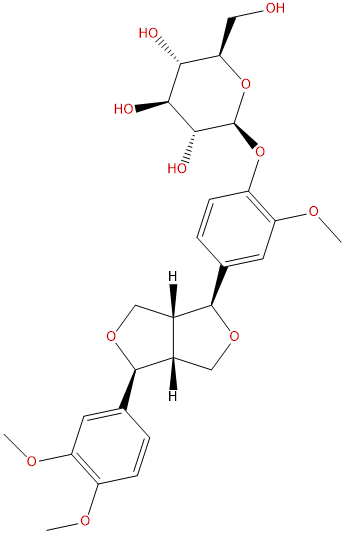
Pine resin monomethylether-4-O - β - D-glucoside (+) - Pinoresinol monomethyl ether 4-glucoside, CAS number: 74957-57-6) is an important natural lignan product widely present in various plants. As a member of the lignans family, this compound has attracted high attention in the field of natural product pharmacology in recent years due to its unique structural characteristics and diverse biological activities, particularly in the anti-inflammatory field. Inflammatory response, as a common pathological basis of various diseases, involves complex signal transduction networks and multiple cytokines. The development of natural products targeting inflammation related targets has become an important direction for new drug research and development. This article aims to systematically review the chemical structure, sources, pharmacological activities, and mechanisms of action of pine resin monomethylether-4-O - β - D-glucoside, and explore its application prospects and development potential in anti-inflammatory therapy based on its pharmacological parameters and pharmacokinetic characteristics.
Pine resin monomethylether-4-O - β - D-glucoside belongs to the lignan class compounds, and its basic skeleton is a diphenylpropane structure, with monomethyl ether modification and 4-position β - D-glucoside characteristics. Its molecular formula is C27H34O11, with a molecular weight of 534.5580, indicating a high molecular weight and belonging to the category of medium-sized natural product molecules. The LogP value is 0.9905, indicating that the compound has moderate lipophilicity, which is beneficial for cell membrane penetration but not excessively hydrophobic, promoting its bioavailability. The polar surface area (TPSA) is 145.53 Å ², and a higher polar surface area reflects its strong hydrophilicity. Combined with water solubility data (1.0934), it indicates that the compound has good solubility in the aqueous phase, which is beneficial for oral absorption and in vivo distribution.
Structurally, the glucoside moiety increases the water solubility and biocompatibility of the molecule, while potentially affecting its metabolic stability and targeting. The presence of monomethyl ether may regulate its binding affinity and selectivity with biological targets. The compound does not possess hERG channel inhibitory activity, indicating a low risk of cardiac toxicity. The Ames test result is 0.0, indicating no significant genetic toxicity risk. The low permeability of the blood-brain barrier suggests that it mainly acts on peripheral tissues, reducing the possibility of adverse reactions in the central nervous system.
Pine resin monomethylether-4-O - β - D-glucoside is mainly found in various woody and herbaceous plants, especially in some traditional Chinese medicinal materials such as Dalbergia spp., Phellodendron spp., and related plants, where its content is relatively abundant. It is widely distributed and mostly exists in the form of glycosides in the roots, stems, leaves, and resin of plants.
The extraction process usually uses polar solvents such as methanol, ethanol, or water alcohol mixed solvents for extraction, combined with ultrasound assisted extraction or reflux extraction to improve extraction efficiency. Subsequently, high-purity pine resin monomethylether-4-O - β - D-glucoside was obtained through liquid-liquid distribution, column chromatography (silica gel column, C18 reverse phase column), and high-performance liquid chromatography (HPLC) purification. In recent years, supercritical CO2 extraction and membrane separation technologies have also been used to optimize extraction processes, improve yield and purity, while reducing the use of organic solvents, in line with the concept of green chemistry.
The pharmacological activity research of pine resin monomethylether-4-O - β - D-glucoside mainly focuses on its anti-inflammatory effect. Numerous in vitro cell models and in vivo animal experiments have shown that this compound can significantly inhibit the release of various inflammatory mediators and the activation of inflammatory signaling pathways.
At the cellular level, pine resin monomethylether-4-O - β - D-glucoside can inhibit the expression of pro-inflammatory cytokines such as IL-6 and TNF - α in immune cells such as macrophages and monocytes, and reduce the synthesis of inflammatory mediators such as nitric oxide (NO) and prostaglandin E2 (PGE2). Its inhibitory effect on inflammation related enzymes such as cyclooxygenase-1 (PTGS1) and cyclooxygenase-2 (PTGS2) provides an enzymatic basis for its anti-inflammatory effect.
Animal model studies further confirm that the compound has good anti-inflammatory effects in various inflammatory disease models, including acute inflammation models (such as lipopolysaccharide induced inflammatory response) and chronic inflammation models (such as arthritis, inflammatory bowel disease, etc.). In addition, it also exhibits regulatory effects on TRPV1 and TRPA1 channels related to neuroinflammation, suggesting its potential application value in pain and neuroinflammation.
The anti-inflammatory mechanism of pine resin monomethylether-4-O - β - D-glucoside involves multiple signaling pathways and molecular targets, and the analysis of its mechanism of action provides a theoretical basis for its clinical development.
Firstly, this compound can significantly inhibit the activation of the nuclear factor kappa B (NFKB1) signaling pathway, block the transcriptional expression of pro-inflammatory genes, and reduce the release of inflammatory factors such as IL-6 and TNF - α. Secondly, by inhibiting signal transduction and transcription activator 3 (STAT3), cytokine signaling is regulated, further suppressing the spread of inflammatory response.
In addition, the inhibitory effect of turpentine monomethylether-4-O - β - D-glucoside on caspase 1 (CASP1) weakens the activation of inflammasomes and reduces the release of pro-inflammatory cytokines such as IL-1 β. Its inhibition of inducible nitric oxide synthase (NOS2) reduces excessive production of NO, alleviates oxidative stress and inflammatory damage.
In terms of pain perception related targets, this compound regulates transient receptor potential vanillic acid subtype 1 (TRPV1) and transient receptor potential ankyrin 1 (TRPA1) channels, alleviating symptoms of inflammatory pain and neuroinflammation, demonstrating its advantages in multi-target synergistic regulation.
Drug efficacy is an important evaluation indicator for the conversion of natural products into clinical drugs. The physicochemical properties of pine resin monomethylether-4-O - β - D-glucoside show that it has good water solubility and moderate lipid solubility, which is beneficial for absorption and distribution in the body. Its high TPSA value suggests strong polarity, which may limit its ability to pass through the blood-brain barrier and reduce the risk of central nervous system toxicity.
Toxicological evaluation shows that the compound has no hERG channel inhibitory effect, reducing the risk of arrhythmia. The Ames test is negative, indicating no genetic toxicity and high safety. Preliminary pharmacokinetic studies have shown that it has a moderate half-life and good bioavailability in vivo. The glucoside portion may be hydrolyzed by gut microbiota to release active lignans, which participate in metabolism and biotransformation in vivo.
However, due to its high molecular weight, there is still room for improvement in oral bioavailability, and its pharmacokinetic properties can be optimized in the future through drug carrier technology or structural modification. In addition, low blood-brain barrier permeability limits its application in central nervous system diseases, but is beneficial for targeted therapy of peripheral inflammatory diseases.
Based on its significant anti-inflammatory activity and good safety, turpentine monomethylether-4-O - β - D-glucoside has broad application prospects in the treatment of inflammation related diseases. Especially in the fields of chronic inflammatory diseases such as rheumatoid arthritis, inflammatory bowel disease, chronic obstructive pulmonary disease, etc., it has potential drug development value.
Future research should focus on in-depth analysis of its mechanism of action, especially in the systems biology study of multi-target synergistic regulatory networks, revealing their comprehensive regulatory effects in the inflammatory microenvironment. At the same time, combining modern drug delivery systems such as nanocarriers, liposomes, etc., to improve their in vivo stability and targeting, and optimize clinical drug delivery regimens.
In addition, the structural modification and derivative design of pine resin monomethylether-4-O - β - D-glucoside will also be key strategies to enhance its efficacy and drug properties. Develop novel lignans with higher activity and better pharmacokinetic characteristics through chemical synthesis and semi synthesis methods.
Preclinical safety and efficacy evaluation is a necessary stage for its transformation into clinical drugs. Combining multi center clinical trials to verify its efficacy and safety will promote its clinical application.
Pine resin monomethylether-4-O - β - D-glucoside, as a natural lignan compound with unique structure and significant anti-inflammatory activity, has shown great potential for drug development and broad clinical application prospects. Its multi-target and multi pathway anti-inflammatory mechanism provides valuable molecular basis for the development of new anti-inflammatory drugs. In the future, relying on the comprehensive research of modern pharmacology, medicinal chemistry, and pharmacokinetics, combined with advanced drug delivery technology and clinical evaluation system, it is expected to promote this compound and its derivatives to become a new type of natural medicine for the treatment of inflammation related diseases, benefiting a large number of patients.
