| Catalog No | Package | Original Price | Price | Inventory | Quantity | Operating |
|---|---|---|---|---|---|---|
| BP4404-20mg | 20mg | $96.00 | Sign in |
|


Storage conditions:Short-term storage at 2~8℃, long-term storage at -20 ~ -80℃
Phenethyl ferulate (CAS number: 71835-85-3), as a natural ester compound, has attracted widespread attention in recent years due to its significant content and multi-target pharmacological activity in traditional Chinese medicine Qianghuo. As a classic medicinal herb for treating rheumatic diseases, one of the main active ingredients of Qianghuo is phenethyl ferulate. This compound not only exhibits significant inhibitory effects on inflammation related cyclooxygenase (COX) and 5-lipoxygenase (5-LOX), but also demonstrates potential multi-target regulatory capabilities in the field of neuroprotection. This article aims to systematically review the chemical structure and physicochemical properties, plant sources and extraction methods, pharmacological activity, mechanism of action, pharmacological evaluation, and clinical application prospects of phenylethanol ferulate, in order to provide theoretical basis and research direction for subsequent basic research and drug development.
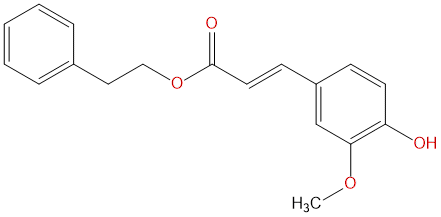
Ferulic acid phenethyl ester is an ester compound formed by esterification of ferulic acid and phenethyl alcohol. Its molecular formula is C18H18O4 and its molecular weight is 298.3380. Structurally, ferulic acid phenethyl ester contains a ferulic acid group with a conjugated double bond and a phenethyl alcohol group, endowing it with strong antioxidant activity and lipid solubility. Its LogP value is 3.7191, indicating that the compound has good lipid solubility and is beneficial for penetrating cell membranes and the blood-brain barrier (BBB). The TPSA (Topological Polarity Surface Area) is 55.7600, and moderate polarity facilitates the distribution and absorption of molecules in vivo. Low water solubility (0.0189 mg/mL) suggests limited solubility in aqueous phase, which may affect its bioavailability. It is worth noting that phenethyl ferulate has good blood-brain barrier penetration ability, which lays the foundation for its application in neurological diseases. In addition, the hERG channel inhibition experiment showed a negative result, indicating a low risk of cardiac toxicity; The Ames mutagenicity test result is 0.0, indicating a low risk of genetic toxicity and high safety.
Ferulic acid phenethyl ester mainly exists in the traditional Chinese medicine Ligusticum wallichii. Qianghuo is a plant of the Umbelliferae family, and its rhizome contains abundant volatile oils and phenolic compounds. As an important active ingredient in Qianghuo, the content of phenylethyl ferulate is greatly affected by plant growth environment, harvesting time, and processing technology.
The common methods for extracting phenethyl ferulate include solvent extraction, ultrasound assisted extraction, and liquid chromatography separation. Traditional solvent extraction often uses ethanol or methanol as solvents, combined with ultrasound assisted technology, significantly improving extraction efficiency. The extract was concentrated, liquid-liquid partitioned, and purified by silica gel column chromatography to obtain high-purity phenethyl ferulate. In recent years, green extraction techniques such as supercritical CO2 extraction have also been applied to the extraction of this compound, which has advantages such as low solvent residue and environmental friendliness.
The regulation of inflammatory mediators by phenethyl ferulate is the core of its pharmacological activity. In vitro studies have shown that the compound has significant inhibitory effects on cyclooxygenase (COX) and 5-lipoxygenase (5-LOX), with IC50 values of 4.35 μ M and 5.75 μ M, respectively. These two enzymes are key metabolic enzymes in the inflammatory response, catalyzing the synthesis of prostaglandins and leukotrienes respectively, and participating in the amplification of inflammatory signals. Through dual target inhibition, phenethyl ferulate can effectively reduce the production of inflammatory mediators, alleviate inflammatory reactions, and has potential anti rheumatic and anti-inflammatory effects.
In recent years, there has been an increasing amount of research on the neuroprotective properties of phenethyl ferulate. This compound exhibits excellent neuroprotective potential by regulating neuronal survival, apoptosis, and oxidative stress through multiple targets. Related targets include BCL2 family proteins (regulating cell apoptosis), APP and BACE1 (Alzheimer's disease-related proteins), MAPT (microtubule associated protein tau), NFE2L2 (antioxidant stress transcription factor), SIRT1 (deacetylase), MAPK1 (signal transduction protein), ACHE (acetylcholinesterase), CASP3 (caspase 3), and SNCA (alpha synuclein). By regulating these key molecules, phenethyl ferulate can alleviate oxidative damage to nerve cells, inhibit abnormal protein aggregation and inflammatory reactions, and delay the progression of neurodegenerative diseases.
Ferulic acid phenethyl ester has significant antioxidant capacity, which can clear free radicals and reduce cell damage caused by oxidative stress. It enhances the expression of intracellular antioxidant enzymes and improves the antioxidant defense ability of cells by activating the NFE2L2 signaling pathway. At the same time, by adjusting the BCL2/BAX ratio, inhibiting CASP3 activity, reducing neuronal apoptosis, and further exerting neuroprotective effects.
The mechanism of action of phenethyl ferulate is complex and diverse, involving multiple biological processes such as inflammation inhibition, antioxidant, and neuroprotection.
By directly inhibiting COX and 5-LOX, phenethyl ferulate reduces the synthesis of prostaglandins and leukotrienes, blocking the transmission of inflammatory signals. In addition, the compound can inhibit the activation of the NF - κ B signaling pathway, reduce the expression of pro-inflammatory cytokines such as TNF - α, IL-1 β, and IL-6, and alleviate the inflammatory response.
Phenylethanol ferulate regulates the survival and function of nerve cells through multi-target regulation. It activates the NFE2L2/ARE antioxidant pathway, enhancing the cell's resistance to oxidative stress; Regulating SIRT1 activity, promoting cellular energy metabolism, and delaying aging; Inhibiting BACE1 activity, reducing the production of β - amyloid protein, and delaying the pathological progression of Alzheimer's disease; Regulating the phosphorylation status of MAPT to prevent abnormal aggregation of tau protein; Simultaneously regulating the CASP3 mediated apoptotic pathway to protect neurons from apoptotic damage.
Ferulic acid phenethyl ester also affects ACHE activity, regulates acetylcholine metabolism, and improves nerve conduction function; By regulating SNCA expression and reducing abnormal aggregation of alpha synuclein, it may have a protective effect on neurodegenerative diseases such as Parkinson's disease.
Phenylethanol ferulate exhibits many advantages in drug formation. Its molecular weight of 298.3380 conforms to Lipinski's rule, with a LogP of 3.7191, indicating good lipid solubility, which is beneficial for oral absorption and cell membrane penetration. The TPSA is 55.76, which is suitable for penetrating the blood-brain barrier. Experimental data also confirms its high ability to distribute brain tissue. Low water solubility may limit its bioavailability, but its dissolution and absorption performance can be improved through formulation optimization (such as nanocarriers, liposomes, etc.).
In terms of safety, phenethyl ferulate does not inhibit hERG channels and reduces the risk of cardiac toxicity; The Ames test is negative, indicating a low risk of genetic toxicity and good safety. The pharmacokinetic studies in vivo are still in the preliminary stage, and existing data indicate that the plasma concentration can reach an effective level after oral administration, with a moderate half-life and certain in vivo stability.
Based on the multi-target anti-inflammatory and neuroprotective effects of phenethyl ferulate, it has great potential for application in rheumatic diseases, neurodegenerative diseases (such as Alzheimer's disease, Parkinson's disease), and cerebrovascular diseases. Currently, although most research is still in the in vitro and animal model stage, its good drug efficacy and safety have laid the foundation for clinical translation.
Future research should focus on the following directions: firstly, a systematic evaluation of the efficacy and mechanism of phenethyl ferulate in different neurological disease models; The second is to optimize the formulation technology, improve its bioavailability and targeting; Thirdly, conduct preclinical toxicology and pharmacokinetic studies to provide data support for clinical trials; The fourth is to explore its synergistic effect with existing drugs and expand its potential for compound application.
In addition, utilizing modern drug design techniques such as computer-aided drug design (CADD), structural biology, and multi omics technologies to deeply analyze the interaction mechanism between phenylethanol ferulate and targets will help guide its structural optimization and new drug development.
As an important active ingredient in Qianghuo, phenylethyl ferulate has shown great potential for drug development due to its significant anti-inflammatory and neuroprotective activities. Its multi-target mechanism of action and good pharmacological properties provide scientific basis for its application in neurodegenerative diseases and inflammation related diseases. In the future, by combining modern pharmacology and medicinal chemistry methods, in-depth systematic research on phenethyl ferulate is expected to promote its clinical application and benefit a large number of patients.
