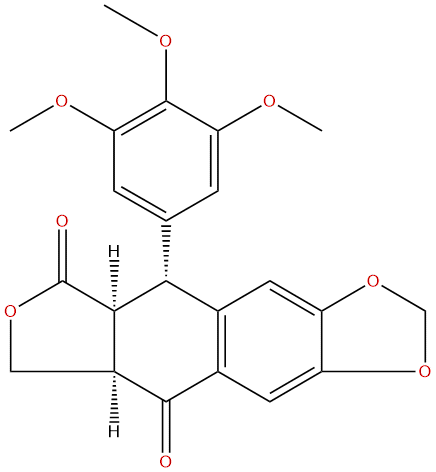


Product name: Picropodophyllotoxone
Synonym name:
Catalogue No.: BP4081
Cas No.: 477-48-5
Formula: C22H20O8
Mol Weight: 412.394
Botanical Source: (-)-Picropodophyllone; Picropodophyllotoxon
Physical Description:
Type of Compound: Lignans
Purity: 95%~99%
Analysis Method: HPLC-DAD or/and HPLC-ELSD
Identification Method: Mass, NMR
Packing: Brown vial or HDPE plastic bottle
Storage: Store in a well closed container, protected from air and light. Put into refrigerate or freeze for long term storage.
Whenever possible, you should prepare and use solutions on the same day. However, if you need to make up stock solutions in advance, we recommend that you store the solution as aliquots in tightly sealed vials at -20℃. Generally, these will be useable for up to two weeks.
The product could be supplied from milligrams to grams
Inquire for bulk scale.
For Reference Standard and R&D, Not for Human Use Directly.
Storage conditions:Short-term storage at 2~8℃, long-term storage at -20 ~ -80℃
Picropodophyllotoxone (CAS number: 477-48-5) is a natural product with significant biological activity, belonging to the family of podophyllotoxin lipid compounds. This type of compound has attracted widespread attention in recent years due to its unique structure and diverse pharmacological activities, especially its potential applications in the field of anti-tumor. Ku Gui Jiu Zhi Du ketone not only exhibits inhibitory effects on various tumor cells, but also involves the regulation of multiple key signaling pathways, demonstrating great potential as a candidate molecule for anticancer drugs.
The purpose of this review is to systematically summarize the chemical structure and physicochemical properties, plant sources, and extraction methods of Ku Gui Jiu Zhi Du ketone, explore its pharmacological activity and mechanism of action, evaluate its pharmacological parameters and pharmacokinetic characteristics, and prospect its clinical application prospects. Through comprehensive analysis of existing literature, provide theoretical support and scientific basis for further research and development of Ku Gui Jiu Zhi Du ketone.
Ku Gui Jiu Zhi Du ketone belongs to the derivatives of Gui Jiu lipid lignans, with a molecular formula of C22H20O8 and a molecular weight of 412.3940. Its structural core is a polycyclic aromatic system, which contains multiple hydroxyl and ketone functional groups, endowing it with unique chemical properties. The LogP value of Ku Gui Jiu Zhi Du ketone is 2.2585, indicating that it has moderate lipid solubility, which is beneficial for cell membrane penetration and in vivo distribution. Its polar surface area (TPSA) is 89.52 Å ², indicating that the molecule has a certain affinity in polar environments.
The low water solubility (0.0360 mg/mL) to some extent limits its bioavailability, but also provides direction for the improvement of drug formulations. It is worth noting that Ku Gui Jiu Zhi Du ketone has a high blood-brain barrier permeability, suggesting its potential application value in central nervous system diseases. In addition, the hERG channel inhibition test result was negative, indicating a low risk of cardiac toxicity, while the Ames test result was 0.0, indicating no significant genotoxicity.
Kudodophyllum lipotoxin is mainly found in plants of the family Podophyllum, especially in the rhizomes and roots of plants in the genus Picropodophyllum. This type of plant is widely distributed in temperate and subarctic regions and has traditionally been used in traditional Chinese medicine and folk herbs. It has the effects of clearing heat, detoxifying, and anti-tumor.
The common methods for extracting Ku Gui Jiu lipid toxin ketone include organic solvent extraction, ultrasound assisted extraction, and column chromatography separation technology. Generally, ethanol or methanol is used as the extraction solvent, and high-purity Kudoufen Lipotoxin is obtained through multi-step solvent extraction and silica gel column chromatography purification. In recent years, the application of supercritical CO2 extraction technology has improved extraction efficiency and purity, while reducing the use of organic solvents, in line with the concept of green chemistry.
The pharmacological activity of Kupodophyllol lipotoxic ketone is mainly anti-tumor, covering a variety of tumor cell lines, including breast cancer, lung cancer, colorectal cancer, ovarian cancer, etc. In vitro experiments have shown that Ku Gui Jiu Zhi Du ketone can significantly inhibit the proliferation of tumor cells, induce cell apoptosis, inhibit cell migration and invasion ability.
In addition, Ku Gui Jiu Zhi Du ketone has shown certain activities in anti-inflammatory, antioxidant, and immune function regulation, but related research is still in the preliminary stage. Its anti-tumor activity is closely related to its regulation of multiple signaling pathways, exhibiting pharmacological characteristics of multi-target and multi mechanism.
The anti-tumor mechanism of Ku Gui Jiu Zhi Du ketone involves multiple key molecular pathways and targets, mainly including:
MCL1 and BCL2 Ku Gui Jiu Zhi Du ketone promotes programmed cell death of tumor cells and enhances cell sensitivity to apoptotic signals by downregulating the expression of anti apoptotic proteins MCL1 and BCL2.
STAT3 This compound inhibits the phosphorylation and activation of STAT3, blocks its transcriptional activity, and weakens the proliferation and immune escape of tumor cells.
MMP2 By inhibiting the expression of matrix metalloproteinase MMP2, Ku Gui Jiu Lipotoxin effectively reduces the invasion and metastasis potential of tumor cells.
TOP1 and TOP2A Ku Gui Jiu Lipotoxin interferes with the activity of DNA topoisomerases I and II, hinders DNA replication and transcription processes, and leads to tumor cell cycle arrest and death.
HIF1A This compound inhibits the expression of hypoxia inducible factor HIF1A, weakens the adaptability of tumor cells in hypoxic environments, and inhibits tumor angiogenesis.
MAPK1 By regulating the MAPK signaling pathway, Ku Gui Jiu Lipotoxin affects cell proliferation, differentiation, and apoptosis processes.
ESR1 and CYP19A1: Kupodophyllol lipotoxic ketone can regulate estrogen receptor ESR1 and aromatase CYP19A1, which shows its potential application value in hormone dependent tumors such as breast cancer.
In summary, Ku Gui Jiu Zhi Du ketone exerts its anti-tumor effect through multi-target synergistic action, demonstrating a complex and effective mechanism of action.
The pharmacological parameters of Ku Gui Jiu Zhi Du ketone show that it has good potential for drug development. Moderate molecular weight and LogP value are beneficial for its in vivo absorption and distribution. The higher blood-brain barrier permeability suggests its potential use in the treatment of central nervous system tumors.
Its low water solubility may limit oral bioavailability and needs to be improved through pharmaceutical techniques such as nanocarriers, liposomes, or solid dispersions. The negative inhibition of hERG channel and no mutagenicity results in Ames test indicate its high safety and low risk of cardiac and genetic toxicity.
At present, the pharmacokinetic studies of Ku Gui Jiu Zhi Du ketone are relatively limited. Preliminary data indicate that it has a long half-life and good tissue distribution in vivo, but the specific metabolic pathways and excretion methods still need further systematic research.
Ku Gui Jiu Zhi Du ketone, as a multi-target anti-tumor natural product, has broad clinical application prospects. Its ability to regulate multiple tumor related targets gives it potential advantages in the treatment of various solid tumors and hematological tumors. Especially in the treatment of drug-resistant and recurrent tumors, Ku Gui Jiu Zhi Du ketone may improve treatment efficacy by overcoming the resistance mechanism of single target drugs.
Future research should focus on pharmacokinetic optimization, formulation development, and combination therapy strategies of Ku Gui Jiu Zhi Du ketone to improve its bioavailability and efficacy. Meanwhile, based on its high blood-brain barrier permeability, exploring its application in brain tumors and neurological diseases is also of great significance.
In addition, the safety evaluation and preclinical toxicology research of Ku Gui Jiu Zhi Du ketone need to be further strengthened to lay a solid foundation for clinical trials. With the development of molecular biology and medicinal chemistry, utilizing structural modification and drug design to optimize the pharmacological and pharmacokinetic properties of Ku Gui Jiu Zhi Du ketone will promote its clinical translation.
As a natural product with multi-target anti-tumor activity, Ku Gui Jiu Zhi Du ketone has shown good medicinal properties and broad application prospects due to its unique chemical structure and diverse pharmacological effects. Although the research on its mechanism of action and pharmacokinetics is not yet complete, the existing research results provide a solid theoretical basis for its development as an anti-tumor drug.
In the future, through in-depth mechanism research, drug optimization, and preclinical evaluation, Ku Gui Jiu Zhi Du ketone is expected to become an important candidate drug in the field of anti-tumor therapy, bringing new treatment options and hope to cancer patients.
