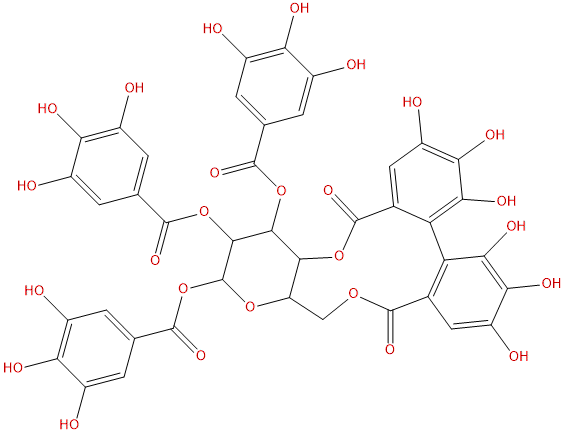


Product name: Eugenin
Synonym name: Tellimagrandin II
Catalogue No.: BP4713
Cas No.: 81571-72-4
Formula: C41H30O26
Mol Weight: 938.665
Botanical Source:
Type of Compound:
Purity: 95%~99%
Analysis Method: HPLC-DAD or/and HPLC-ELSD
Identification Method: Mass, NMR
Packing: Brown vial or HDPE plastic bottle
Storage: Store in a well closed container, protected from air and light. Put into refrigerate or freeze for long term storage.
Whenever possible, you should prepare and use solutions on the same day. However, if you need to make up stock solutions in advance, we recommend that you store the solution as aliquots in tightly sealed vials at -20℃. Generally, these will be useable for up to two weeks.
The product could be supplied from milligrams to grams
Inquire for bulk scale.
For Reference Standard and R&D, Not for Human Use Directly.
Storage conditions:Short-term storage at 2~8℃, long-term storage at -20 ~ -80℃
Natural products, as important resources for drug discovery, have attracted much attention due to their structural diversity and biological activity. Eugenin, a natural ketone product isolated from the Taiwan endemic plant Formosan Peucedanum japonicum, has attracted widespread research interest in recent years due to its significant anti platelet aggregation activity and cytotoxicity towards tumor cells. With the increasingly severe problem of antimicrobial resistance, the potential application value of Ding Zi Ya Tan in the field of antibacterial has gradually been revealed, especially its effects on various bacterial and fungal targets, providing a theoretical basis for its development as a new type of anti infective drug.
This review aims to systematically summarize the chemical structure and physicochemical properties, plant sources, and extraction methods of Ding Zi Ya Tan Su, explore its pharmacological activity and molecular mechanism of action, conduct pharmacokinetic analysis based on drug parameters, evaluate its clinical application prospects, and look forward to future research directions. By comprehensively reviewing relevant literature, it is expected to provide scientific basis and reference for the drug development and clinical application of Ding Zi Ya Tan Su.
Eugenin, with a complex molecular formula and a molecular weight of 938.6650, belongs to the class of chromone compounds. Its structural core is a typical ketone skeleton, containing multiple phenolic hydroxyl and ester groups, endowing it with strong biological activity. In terms of physical and chemical properties, the LogP value of Ding Ya Tan Su is 1.8158, indicating its moderate lipid solubility, which is beneficial for cell membrane penetration; The polar surface area (TPSA) is relatively high, reaching 444.18 Å ², indicating that the molecule has strong polarity and hydrogen bond donor/acceptor ability, which may affect its bioavailability and intracellular distribution.
The low water solubility (0.0028 mg/mL) limits its solubility in aqueous media, indicating the need to consider methods to improve solubility in drug formulation design. The low permeability of the blood-brain barrier indicates that astaxanthin is difficult to enter the central nervous system, reducing the risk of central neurotoxicity. The negative result of hERG channel inhibition experiment indicates a low risk of cardiac toxicity. The Ames test value is 0.6, indicating a low risk of genotoxicity and good safety potential.
Ding Zi Ya Tan Su is mainly isolated from the Taiwan endemic plant Formosan Peucedanum japonicum. This plant belongs to the Umbelliferae family and is traditionally used for folk medicine. It has various pharmacological activities such as anti-inflammatory and antibacterial. The extraction of Ding Zi Ya Tan Su is usually carried out using organic solvent extraction combined with column chromatography separation technology.
The specific steps include: first, cold soaking or reflux extraction of dried plant whole grass or rhizomes with ethanol or methanol, and then obtaining crude extract through vacuum concentration. The crude extract was separated by silica gel column chromatography, and different polar components were separated using gradient elution method. Further purification is carried out using high-performance liquid chromatography (HPLC) technology, combined with mass spectrometry and nuclear magnetic resonance (NMR) to confirm the structure. In recent years, ultrasound assisted extraction and supercritical fluid extraction techniques have also been applied to improve the extraction efficiency and purity of succinic acid extract.
Ding Zi Ya Tan Su was first reported to have significant anti platelet aggregation activity. Platelets play a crucial role in hemostasis and thrombus formation, and their abnormal activation is the pathological basis of various cardiovascular and cerebrovascular diseases. Ding Zi Ya Tan Su can effectively inhibit platelet factor induced aggregation reactions, demonstrating potential anti thrombotic risk prevention effects. Related in vitro experiments have shown that Ding Zi Ya Tan can regulate the concentration of calcium ions in platelets and inhibit the activity of platelet membrane receptors, thereby blocking the platelet aggregation signaling pathway.
Butyrotannin showed certain cytotoxicity to many tumor cell lines, especially to lung cancer, breast cancer and liver cancer cells. Its mechanism involves inducing tumor cell apoptosis, cell cycle arrest, and inhibiting cell migration and invasion. In vitro cell experiments and some animal model studies have confirmed that Ding Zi Ya Tan can promote tumor cell apoptosis by activating the mitochondrial pathway and regulating the expression of apoptosis related proteins.
Ding Zi Ya Tan Su also exhibits broad-spectrum activity in the antibacterial field, with inhibitory effects against Gram positive bacteria, Gram negative bacteria, and fungi. Its targets include key enzymes such as bacterial DNA gyrase (GYRA), cell wall synthase (FABI), dihydrofolate reductase (DHFR), as well as fungal enzymes such as ERG11 and CYP51A1, demonstrating its multi-target inhibitory properties. This multi-target mechanism of action helps to reduce the risk of drug resistance.
The multiple pharmacological activities of Ding Zi Ya Tan Su are closely related to its action on multiple molecular targets.
Antiplatelet aggregation mechanism
Ding Zi Ya Tan Su inhibits platelet aggregation by suppressing the activity of glycoprotein receptors (such as GPIIb/IIIa) on the platelet membrane, blocking the binding of platelets to fibrinogen. In addition, it can also regulate signal transduction pathways within platelets, such as inhibiting the activity of phosphatidylinositol 3-kinase (PI3K) and protein kinase C (PKC), reducing intracellular calcium ion concentration, and blocking platelet activation.
Antitumor mechanism
Ding Zi Ya Tan Su induces apoptosis in tumor cells mainly through mitochondrial dependent pathways, activating the caspase enzyme system, regulating the expression of Bcl-2 family proteins, and promoting cell apoptosis. In addition, it can also block the tumor cell cycle, especially in the G1 and G2/M phases, and inhibit cell proliferation. Ding Zi Ya Tan also affects the migration and invasion ability of tumor cells, possibly by regulating the expression of matrix metalloproteinases (MMPs).
antibacterial mechanism
Ding Zi Ya Tan targets key enzymes such as bacterial DNA gyrase (GYRA) and cell wall synthase (FABI), interfering with bacterial DNA replication and cell wall synthesis, leading to hindered bacterial growth. For fungi, Ding Ya Tan Su inhibits the activity of ERG11 and CYP51A1 enzymes, blocks ergosterol biosynthesis, and damages the integrity of fungal cell membranes. In addition, Ding Zi Ya Tan can also inhibit fungal drug efflux pumps (such as CDR1) and enhance the efficacy of antifungal drugs.
The pharmacological parameters of Ding Zi Ya Tan Su indicate that it has certain potential for drug development. A higher molecular weight (938.6650) may affect its oral absorption, but a moderate LogP value (1.8158) is beneficial for cell membrane penetration. A higher TPSA (444.18 Å ²) suggests stronger polarity, which may limit passive diffusion absorption. Low water solubility (0.0028 mg/mL) is a major challenge in its development, and its bioavailability needs to be improved through drug formulation optimization.
The low permeability of the blood-brain barrier reduces the risk of central nervous system side effects. Negative hERG channel inhibition indicates good cardiac safety. The Ames test results showed a low risk of genotoxicity and met safety requirements.
In terms of pharmacokinetics, there is currently limited research on the in vivo absorption, distribution, metabolism, and excretion (ADME) of Ding Ya Tan Su. Preliminary animal experiments have shown that its oral bioavailability is limited, with a moderate half-life in vivo, mainly metabolized through the liver metabolic enzyme system. Further systematic pharmacokinetic and toxicological studies are needed in the future to improve its clinical development data.
Ding Zi Ya Tan Su has the potential to become an adjuvant therapy and anti-cancer drug for cardiovascular and cerebrovascular diseases due to its unique anti platelet aggregation and anti-tumor activity. Its multi-target antibacterial effect provides a new approach to solving the problem of drug resistance, especially in the treatment of multidrug-resistant bacteria and fungal infections, which may have breakthroughs.
However, the clinical application of Ding Zi Ya Tan Su still faces many challenges. Firstly, the low water solubility and bioavailability limit the development of its oral dosage form, which requires improvement through technologies such as nanocarriers, liposomes, or solid dispersions. Secondly, there is a lack of systematic preclinical safety and pharmacokinetic data, and there is an urgent need to conduct relevant research to evaluate the safety and effective dose range of long-term medication. Again, high molecular weight and strong polarity may affect its distribution in the body, limiting the concentration of drugs in certain disease sites to therapeutic levels.
Future research should focus on:
1. Optimize extraction and synthesis processes to increase yield and purity;
2. Structural modification and drug carrier design to improve drug solubility and bioavailability;
3. Thoroughly analyze the mechanism of action, clarify key molecular targets and signaling pathways;
4. Expand in vitro and in vivo pharmacological and safety evaluations, and promote preclinical research;
5. Explore combination therapy strategies to enhance anti-tumor and antibacterial efficacy.
Ding Zi Ya Tan Su, as a natural ketone compound with multiple biological activities, exhibits pharmacological potential in various aspects such as anti platelet aggregation, anti-tumor, and broad-spectrum antibacterial. Its unique mechanism of action and good safety provide valuable candidate molecules for the development of natural product drugs. However, limitations in drug development and insufficient preclinical research still need to be further overcome. With the progress of modern pharmaceutical chemistry, pharmaceutics and molecular biology technology, eugenol is expected to achieve clinical transformation through structural optimization and preparation innovation, and become a new drug for the treatment of cardiovascular diseases, tumors and infectious diseases.
Future research should strengthen interdisciplinary collaboration, systematically evaluate the pharmacological, safety, and pharmacokinetic characteristics of Ding Zi Ya Tan Su, promote its transition from laboratory to clinical application, and contribute new treatment options to public health.
