

Storage conditions:Short-term storage at 2~8℃, long-term storage at -20 ~ -80℃
169.8000
1.1807
1.1805
.0716
1.8276
3.5348
Low
75.7263
6.5225
No
No
No
No
No
No
0.0
Yes
No
Yes
Yes
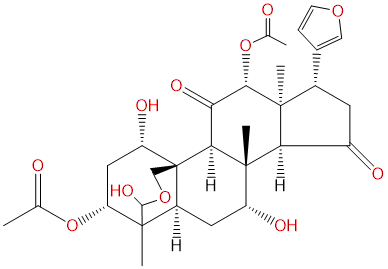
Isotoosendanin, CAS number 97871-44-8, is a bioactive compound derived from natural plants and has received widespread attention in recent years due to its multi-target pharmacological activity. As an orally active TGF β R1 inhibitor, isoquercetin has shown potential clinical application value in multiple fields such as tumor suppression, anti-inflammatory, and antiparasitic effects. Especially in the treatment research of triple negative breast cancer (TNBC) and non-small cell lung cancer (NSCLC) and other malignant tumors, azadirachtin inhibits the migration, invasion and metastasis of tumor cells by regulating key cell signal pathways, showing significant anti-tumor activity. In addition, its regulatory effect on inflammatory response also provides a theoretical basis for its application in inflammatory diseases. This article will provide a systematic review of the chemical structure and physicochemical properties, plant sources and extraction methods, pharmacological activity, mechanism of action, pharmacological evaluation, and clinical application prospects of isoquercetin, aiming to provide scientific basis for the in-depth research and development of this natural product.
Isonaringenin is a natural product with a molecular weight of 574.6230. Its chemical structure is complex, containing multiple cyclic structures and functional groups, endowing it with unique biological activity. Its LogP value is 1.1807, indicating that it has moderate lipid solubility, which is beneficial for cell membrane penetration and oral absorption. The polar surface area (TPSA) is 169.8 Å ², reflecting high polarity characteristics, indicating limited solubility in aqueous media (water solubility is about 0.0716), which may have some impact on its bioavailability. Isoquercetin does not have the ability to penetrate the blood-brain barrier, reducing the risk of central nervous system toxicity. The negative result of hERG channel inhibition experiment indicates a low risk of cardiac toxicity. The Ames mutagenicity test result is 0.0, indicating a low risk of genotoxicity and meeting the basic requirements for safety evaluation. These physicochemical and toxicological parameters have laid a solid foundation for the drug development of isoquercetin.
Isonaringenin mainly exists in plants of the Meliaceae family, especially in the root bark and leaves of Melia genus plants. Plants of the Melia genus are widely used in traditional Chinese medicine and have the effects of clearing heat, detoxifying, dispelling wind, and relieving pain. The extraction of isoquercetin is usually carried out by organic solvent extraction combined with column chromatography separation. The specific process includes the following steps:
In recent years, the application of ultrasound assisted extraction and microwave-assisted extraction technologies has significantly improved the extraction efficiency and purity of isoquercetin, providing technical support for its industrial production.
The pharmacological activities of isoquercetin cover multiple aspects such as anti-tumor, anti-inflammatory, and antiparasitic effects, demonstrating a wide range of biological effects.
As a TGF β R1 inhibitor, isoquercetin can effectively inhibit its kinase activity (IC50=6732 nM) and block the TGF β signaling pathway. TGF - β signal plays a key role in the occurrence and development of various tumors, especially in triple negative breast cancer (TNBC). TGF - β induced cell migration and invasion are the main mechanism of tumor metastasis. Isonaringenin directly targets SHP-2 protein, enhancing its stability and reducing ubiquitination, thereby inhibiting the JAK/STAT3 signaling pathway and blocking the migration and invasion ability of tumor cells. In the TNBC xenograft model and A549 non-small cell lung cancer xenograft model, isoquercetin significantly inhibited tumor growth and metastasis, indicating its good anti-tumor potential.
Isoquercetin showed significant anti-inflammatory effects in animal models of acetic acid-induced vascular permeability and λ - carrageenan induced hind paw edema, suggesting its ability to regulate the release of inflammatory mediators and the activity of inflammatory cells, alleviate tissue edema and increase vascular permeability. This characteristic makes it potentially valuable for the treatment of inflammation related diseases.
Although not the main research direction of icariin, it has shown certain inhibitory effects on various parasite related targets such as PFCRT, DHFR, CYP51, etc., indicating its potential in the field of antiparasitic treatment and worthy of further in-depth study.
The mechanism of action of isoquercetin is mainly achieved by regulating key signaling pathways within cells.
As an inhibitor of TGF β R1, isoquercetin can inhibit its kinase activity and block the activation of the TGF β signaling pathway. The TGF - β signaling pathway plays an important role in cell proliferation, differentiation, migration, and immune regulation, and its abnormal activation is closely related to tumor metastasis. By inhibiting TGF β R1, isoquercetin effectively blocks downstream signal transduction, inhibiting the migration and invasion of tumor cells.
Isoquercetin directly targets SHP-2 (Src homologous domain containing protein tyrosine phosphatase-2), enhancing its protein stability and reducing ubiquitination degradation. SHP-2 plays a regulatory role in cellular signal transduction and participates in the activity regulation of the JAK/STAT3 pathway. By stabilizing SHP-2 and inhibiting the JAK/STAT3 signaling pathway, isoquercetin blocks the proliferation and metastasis signals of tumor cells.
The JAK/STAT3 pathway is a key pathway for the growth and immune escape of various tumor cells. Isonaringenin regulates the activity of SHP-2, inhibits the signaling pathway, reduces the phosphorylation level of STAT3, and thus inhibits the proliferation and migration of tumor cells.
Isonaringenin reduces inflammation by inhibiting the release of inflammatory mediators and regulating immune cell function. The specific molecular mechanism still needs further clarification, but it is closely related to its regulation of signaling pathways.
The pharmacological parameters of isoquercetin indicate that it has certain potential for drug development:
At present, there is limited pharmacokinetic (PK) data on isoquercetin. Preliminary in vivo experiments have shown that it has good oral activity and a certain half-life. However, further systematic research is needed on its absorption, distribution, metabolism, and excretion (ADME) characteristics to guide clinical formulation design and medication regimens.
Isonaringenin has shown broad application prospects in the fields of anti-tumor, anti-inflammatory, and antiparasitic effects. Especially in the treatment of triple negative breast cancer and non-small cell lung cancer, azadirachtin regulates tumor cell signal pathway through multiple targets, inhibits tumor invasion and metastasis, and has the potential to become a new targeted drug. In addition, its significant anti-inflammatory effect also provides new ideas for the treatment of inflammatory diseases.
Future research should focus on the following directions:
As a multifunctional natural product, isoquercetin has shown significant potential in the fields of anti-tumor and anti-inflammatory due to its unique molecular structure and multi-target pharmacological activity. It exerts anti-tumor effects by inhibiting the activity of TGF β R1 kinase and regulating the SHP-2/JAK/STAT3 signaling pathway, while also having good safety and oral activity. Although current research on its pharmacokinetics and clinical applications is still in its infancy, isoquercetin undoubtedly provides an important candidate molecule for the development of natural product drugs. In the future, through in-depth mechanism research and drug optimization, isoquercetin is expected to become a new type of drug for the treatment of malignant tumors and inflammatory diseases, bringing new treatment options for patients with related diseases.
