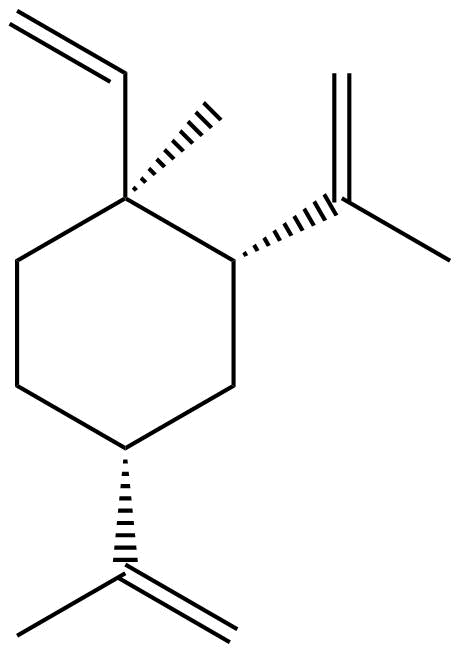


Product name: β-Elemene
Synonym name: Beta-Elemene; Levo-β-elemene
Catalogue No.: BP4492
Cas No.: 515-13-9
Formula: C15H24
Mol Weight: 204.357
Botanical Source:
Type of Compound:
Purity: 95%~99%
Analysis Method: HPLC-DAD or/and HPLC-ELSD
Identification Method: Mass, NMR
Packing: Brown vial or HDPE plastic bottle
Storage: Store in a well closed container, protected from air and light. Put into refrigerate or freeze for long term storage.
Whenever possible, you should prepare and use solutions on the same day. However, if you need to make up stock solutions in advance, we recommend that you store the solution as aliquots in tightly sealed vials at -20℃. Generally, these will be useable for up to two weeks.
The product could be supplied from milligrams to grams
Inquire for bulk scale.
For Reference Standard and R&D, Not for Human Use Directly.
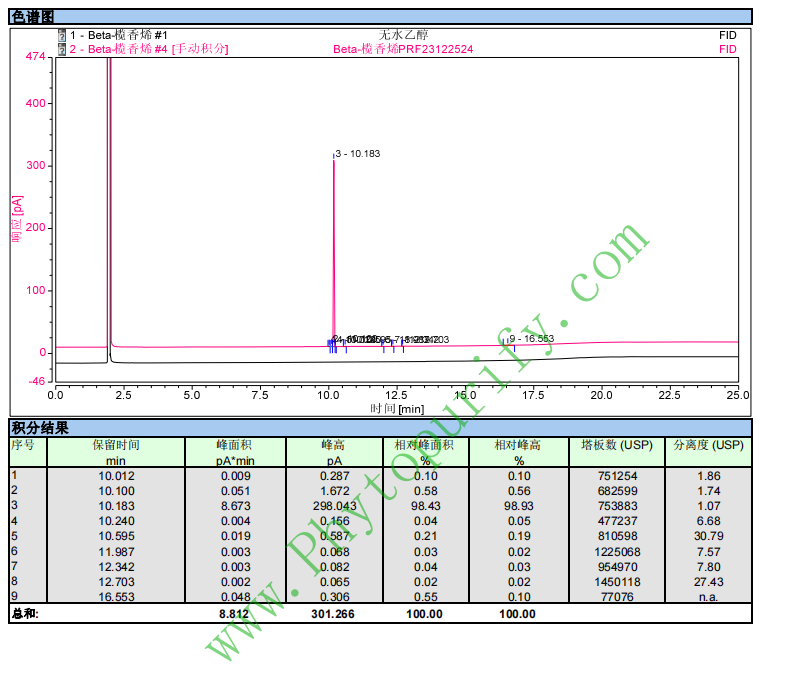
HPLC of β-Elemene
Storage conditions:Short-term storage at 2~8℃, long-term storage at -20 ~ -80℃
.0000
5.2508
5.2508
.0022
11.1810
22.1628
High
89.6516
4.1881
No
Yes
No
No
No
No
0.0
No
No
Yes
Yes
Malignant tumors are a major disease that seriously threatens human health. Although their treatment methods are constantly evolving, issues such as chemotherapy resistance and severe toxic side effects remain severe challenges in clinical practice. In this context, discovering highly efficient and low toxicity anti-tumor active ingredients from traditional medicinal plants has become one of the important directions for new drug development. Beta elemene, as a natural product of sesquiterpenes with unique chemical structure and clear pharmacological activity, has attracted much attention since the 1990s due to its broad-spectrum and low toxicity anti-tumor properties. Its (-) - enantiomer, namely the (1S, 2S, 4R) - configuration of β - elemene, is its main active form.
β - elemene was initially isolated from the volatile oil of traditional Chinese medicine Curcuma wenyujin, and subsequent studies have found that it is widely present in various plants such as the ginger family and magnolia family. Unlike traditional cytotoxic drugs, β - elemene exhibits multi-target, multi pathway, and multi effect anti-tumor effects, which can induce tumor cell apoptosis, inhibit proliferation, block cell cycle, inhibit invasion and metastasis, reverse multidrug resistance, and enhance chemoradiotherapy sensitivity. Its mechanism of action involves the regulation of multiple key signaling pathways and targets such as Bcl-2 family proteins, STAT3, HIF-1 α, MAPK, etc. Of particular importance is that β - elemene exhibits good safety both in vitro and in vivo, with much lower toxicity to normal cells than to tumor cells.
At present, elemene injection and oral milk, mainly composed of β - elemene, have been approved in China for the clinical treatment of various solid tumors and cancerous pleural and ascites, accumulating rich evidence-based medicine. This article aims to systematically review the chemical structure, plant origin, pharmacological activity, molecular mechanism of action, pharmacological characteristics, and clinical application prospects of (-) - β - elemene, in order to provide comprehensive academic references for the in-depth research and development of this natural product.
The chemical name of (-) - β - elemene is (1S, 2S, 4R) -1-ethyl-1-methyl-2,4-dis (1-methylvinyl) cyclohexane, with a CAS number of 515-13-9. Its molecular formula is C15H24 and its molecular weight is 204.3570 g/mol.
From a chemical structure perspective, β - elemene belongs to monocyclic sesquiterpenes, with a core of a six membered ring connected by ethyl, methyl, and two isopropyl groups. Its (1S, 2S, 4R) - configuration determines its specific three-dimensional spatial structure and optical activity. This unique cyclic olefin structure gives it high lipid solubility and hydrophobicity.
Its physical and chemical properties are closely related to its structure:
1. Fat solubility and water solubility The calculated lipid water partition coefficient (LogP) is 5.2508, indicating its strong lipophilicity. Correspondingly, its water solubility is extremely low, only 0.0022 mg/mL. This characteristic determines the need for delivery technologies such as liposomes, emulsions, and cyclodextrin inclusion complexes in formulation development to improve bioavailability.
2. Polar Surface Area The topological polar surface area (TPSA) is 0 Å ², which is consistent with its pure hydrocarbon structure without hydrogen bond donors or acceptors in the molecule, further confirming its strong hydrophobicity.
3. Preliminary prediction of drug properties According to its physicochemical parameters, β - elemene exhibits high blood-brain barrier (BBB) penetration, which provides potential advantages for its treatment of brain tumors or brain metastases. At the same time, the hERG inhibition risk and Ames mutagenicity prediction were both negative ("no" and 0.0, respectively), indicating a low risk of cardiac toxicity and genetic toxicity, providing preliminary theoretical basis for its good safety.
β - elemene is relatively widely distributed in nature and mainly exists in the volatile oils of various medicinal plants.
* Main plant sources:
* Ginger family plants This is the most famous and primary source of β - elemene.Curcuma wenyujin、Curcuma phaeocaulis and Curcuma longa The content of volatile oil in the roots and stems is relatively high, especially in the production of β - elemene, which is currently the main raw material for industrial production of β - elemene preparations.
* Plants of other families and genera: In some cases Magnoliaceae(such as Illicium verum)Baike(such as Juniperus rigida)the composite family and Taxaceae family It has also been detected in essential oils of plants.
* Extraction and Separation Methods:
* traditional method Mainly used steam distillation and Organic solvent extraction method The steam distillation method is easy to operate and can directly obtain plant volatile oils, but higher temperatures may cause changes in some thermosensitive components. The solvent extraction method (commonly used petroleum ether, ether, etc.) has a high yield, but subsequent solvent removal is required.
* modern technology To improve extraction efficiency and product purity,Supercritical CO2 Fluid Extraction Technology It has been widely applied. This technology operates at lower temperatures, with good selectivity and no solvent residue, making it particularly suitable for extracting lipid soluble sesquiterpenes and obtaining higher purity and activity of β - elemene extracts.
* Separation and purification Further purification of β - elemene from volatile oils or extracts is often carried out using silica gel column chromatography、Preparation type high-performance liquid chromatography Waiting methods. Due to the presence of other isomers of elemene such as α - and γ -, as well as structurally similar sesquiterpenes, obtaining high-purity (-) - β - elemene monomers requires sophisticated chromatographic separation techniques.
* Chemical synthesis and biosynthesis There have been multiple reports on the synthetic route of complete chemistry, but the steps are relatively complex. Utilizing synthetic biology techniques to reconstruct the biosynthetic pathway of β - elemene in microorganisms such as yeast is an important research direction for achieving green and sustainable large-scale production in the future.
A large number of preclinical studies have confirmed that (-) - β - elemene has broad and significant anti-tumor activity, and has both immunomodulatory and adjuvant therapeutic effects.
Direct anti-tumor effect:
Reverse multidrug resistance (MDR)β - elemene is an effective MDR reversing agent. It can downregulate the expression and function of drug efflux pumps such as P-glycoprotein (P-gp), increase the accumulation of chemotherapy drugs (such as doxorubicin and paclitaxel) in drug-resistant tumor cells, and restore their sensitivity to chemotherapy.
Radiosensitization effectβ - elemene can enhance the sensitivity of tumor cells to radiation and improve the efficacy of radiotherapy by inhibiting DNA damage repair and increasing the production of reactive oxygen species (ROS).
Immune regulatory effect Research has shown that β - elemene can activate the body's immune system, such as promoting dendritic cell maturation, enhancing the killing activity of T cells and NK cells, and regulating the immunosuppressive state in the tumor microenvironment.
Security advantage Compared with traditional cytotoxic drugs, β - elemene has significantly lower toxicity to the hematopoietic system, liver and kidney function, which has been repeatedly validated in animal experiments and long-term clinical applications.
The anti-tumor effect of (-) - β - elemene is not achieved through a single target, but through a complex "multi-target network". Its core mechanism involves inducing apoptosis, inhibiting survival signals, and regulating the tumor microenvironment.
Regulating the apoptotic pathway (core mechanism):
Inhibiting critical survival signaling pathways:
Acting on specific functional proteins:
Inhibition of invasion and metastasis related proteins: Direct or indirect inhibition MMP2 The activity of matrix metalloproteinases is the molecular basis for their resistance to invasion and metastasis.
These targets and pathways interweave with each other, forming a molecular network of multidimensional anti-tumor effects of β - elemene, which also explains its characteristic of not easily developing drug resistance.
Although the activity of β - elemene is clear, its inherent physicochemical properties pose challenges for its medicinal properties and promote further research in related formulation and pharmacokinetics.
Drug Challenge:
Formulation strategy (successfully applied):
Pharmacokinetic characteristics:
(-) - β - elemene has moved from the laboratory to clinical practice, demonstrating unique application value and development potential.
Current clinical applications:
Future research and development directions and prospects:
(-) - β - elemene, as a natural sesquiterpene derived from traditional Chinese medicine, has been successfully developed into a modern anti-tumor drug with independent intellectual property rights in China after decades of research. Its multi-target and multi pathway mechanism of action effectively avoids the defect of single target drug resistance; Its broad-spectrum anti-tumor activity and good safety characteristics make it occupy a unique position in the comprehensive treatment of tumors. The development process of β - elemene, a modern medicine with a clear mechanism of action, is a successful example of the modernization and internationalization of traditional Chinese medicine, from the extraction of volatile oil components from the Wen Ge technique.
Currently, facing challenges in drug development, breakthroughs are constantly being made in the research and development of new delivery systems and structural derivatives; However, its complex molecular network mechanism still requires more detailed analysis. In the future, with the deepening of interdisciplinary research, β - elemene and its derivatives are expected to play a greater role in tumor targeted therapy, drug resistance reversal, immune combination therapy and other fields, and provide valuable experience and inspiration for the research and development of other natural products. This ancient plant molecule, with its new scientific significance, continues to contribute to the journey of humanity in the fight against cancer.
