Introduction/Overview
Natural products, as an important source of drug discovery, play an irreplaceable role in the history of human disease prevention and treatment. Among them, lignin compounds are increasingly attracting the attention of pharmacological researchers due to their structural diversity and wide range of biological activities. Guaiacin (CAS number: 36531-08-5) is a type of lignin derived from thick bark(Machilus thunbergii Aromatic naphthalene lignin isolated from SIEB. et ZUCC bark. Early studies have revealed its potential in promoting osteoblast differentiation and enhancing alkaline phosphatase activity, suggesting its application prospects in the treatment of bone diseases such as osteoporosis. In recent years, with the deepening of research, the pharmacological activity spectrum of lignin has been continuously expanded, especially in the fields of anti-inflammatory and immune regulation, showing new potential. In view of the high incidence rate of inflammatory diseases such as respiratory infection worldwide and the challenges in clinical treatment (such as antibiotic resistance, excessive inflammatory reaction, etc.), it is urgent to find new, efficient and safe anti-inflammatory drugs. The purpose of this article is to systematically review the chemical properties, plant sources, pharmacological activities of guaiacol, especially its mechanism of action against respiratory infection related targets, and to deeply explore its medicinal properties and clinical application prospects, in order to provide comprehensive scientific references for further research and development of this natural product.
Chemical structure and physicochemical properties
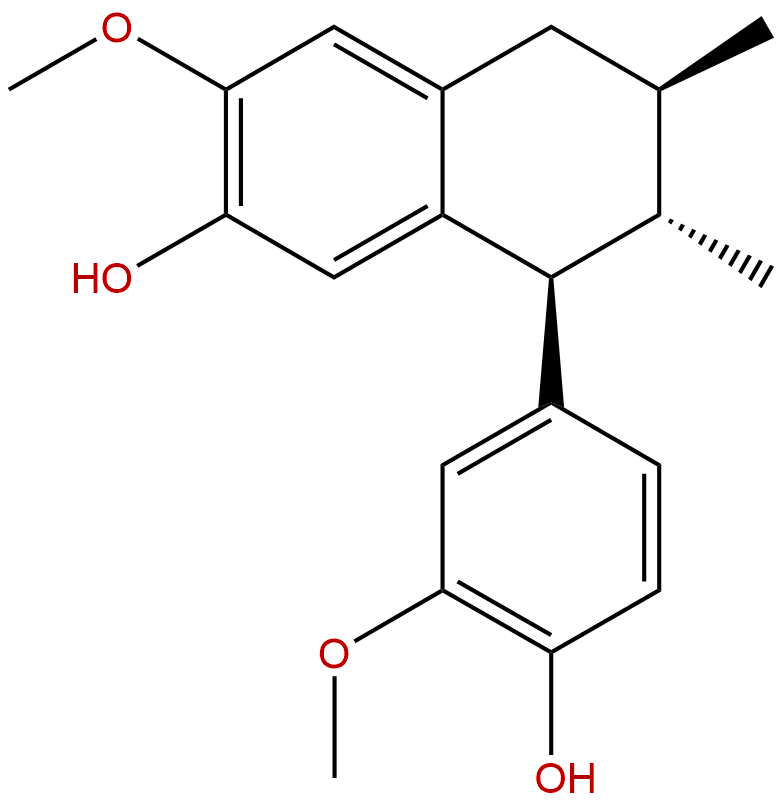
Yuchuang lignin is a typical aromatic naphthalene lignin with a molecular formula of C20H24O4 and a molecular weight of 328.4080. Its core structure is composed of two benzene rings (A ring and C ring) connected by a naphthalene ring (B ring) system, belonging to the tetrahydronaphthalene lignin class. The structural features include methoxy (- OCH3) and hydroxyl (- OH) substituents on the aromatic ring, which have a decisive impact on its biological activity and physicochemical properties.
In terms of physicochemical properties, the lipid water partition coefficient (LogP) of guaiacol is 4.1947, indicating that the compound has high lipophilicity, which is beneficial for its penetration of cell membranes, but may also affect its solubility and distribution in aqueous media. Its topological polar surface area (TPSA) is 58.9200 Å ², which is relatively small, further confirming its hydrophobic properties. The water solubility value is relatively low, about 0.0113 mg/mL, indicating that structural modification or the use of appropriate delivery systems (such as cyclodextrin inclusion, nano formulations, etc.) may be necessary to improve its solubility and bioavailability during formulation development. It is worth noting that drug prediction shows that guaiacol has a high blood-brain barrier permeability, which provides the possibility for its potential central nervous system related applications (such as neuroinflammation). In addition, preliminary toxicity predictions showed no significant risk of hERG channel inhibition (hERG inhibition: no) and genotoxicity (Ames test: 0.0), providing early supporting data for its relatively good safety.
Plant sources and extraction methods
Yuchuang lignin mainly comes from Lauraceae plants with thick bark fragrance(Machilus thunbergii SIEB. et ZUCC), Commonly known as Hongnan, it is widely distributed in East Asia, including China, Japan, and South Korea. The bark of this plant is the main enrichment site of guaiacol, which has traditionally been used in folk medicine in certain regions.
Its extraction and separation usually follow the standard process of natural product chemistry. Firstly, the dried thick bark of fragrant bark is crushed and subjected to cold soaking or hot reflux extraction using organic solvents such as methanol, ethanol, or acetone to obtain the crude extract. Subsequently, the crude extract was preliminarily separated using solvent partitioning method (such as extraction with petroleum ether, ethyl acetate, n-butanol, and water in sequence). Due to its equipolarity, guaiacol is often enriched in the ethyl acetate extraction site. Further purification depends on a variety of chromatographic techniques, including silica gel column chromatography, gel LH-20 column chromatography and high performance liquid chromatography (HPLC). During the separation process, thin-layer chromatography (TLC) is often used in combination with specific color reagents (such as sulfuric acid vanillin reagent) for tracking and detection. Modern technologies such as high-speed countercurrent chromatography (HSCCC) can also be used for large-scale preparation. The optimization of extraction processes, such as solvent selection, extraction temperature and time, and the use of ultrasound or microwave-assisted extraction, is crucial for improving the yield and purity of guaiacol.
Pharmacological activity research
The pharmacological activity research of guaiacol has expanded from its initial skeletal effects to a wider range of anti-inflammatory and immunomodulatory fields.
-
Promote bone activity This is the earliest reported activity of Yuchuang lignin. Research has shown that in osteoblast precursor cell models such as MC3T3-E1 cells, guaiacol can significantly enhance alkaline phosphatase (ALP) activity in a dose-dependent manner. ALP is a key biomarker for early differentiation and maturation of osteoblasts. In addition, it can promote the formation and mineralization of bone nodules, upregulate the expression of osteogenic related genes (such as Runx2, Osterix, osteocalcin), indicating its clear role in promoting osteoblast differentiation and bone formation, providing candidate molecules for the development of anti osteoporosis drugs.
-
Anti inflammatory and immune regulatory activity This is the pharmacological activity of Yuchuang lignin that has received much attention in recent years, especially closely related to its therapeutic potential for respiratory infections. In various inflammatory cell models induced by lipopolysaccharide (LPS) or cytokines, such as macrophages and epithelial cells, guaiacol exhibits strong anti-inflammatory effects. It can significantly inhibit the excessive production of pro-inflammatory mediators such as nitric oxide (NO) and prostaglandin E2 (PGE2). More importantly, it has an inhibitory effect on the expression of a series of inflammatory and chemokines closely related to the pathological process of respiratory infections, which lays a solid pharmacological foundation for its intervention in respiratory infections.
Mechanism of action and molecular targets
The core mechanism of the anti-inflammatory effect of Yuchuang lignin lies in its regulation of multiple inflammatory signaling pathways, especially by intervening in key receptors and transcription factors, affecting the expression of numerous downstream target genes. Its target network highly overlaps with the pathophysiology of respiratory infections:
- Pattern recognition receptors (TLR4/TLR2)TLR4 and TLR2 are sentinel receptors that recognize pathogen associated molecular patterns, such as LPS. Research has shown that guaiacol may directly or indirectly interfere with the activation of TLR4/TLR2 or the recruitment of downstream adaptor proteins, thereby inhibiting the initiation of inflammatory signals at the source.
- Core inflammatory transcription factor NF - κ B NF - κ B (composed of subunits such as NFKB1) is the central switch that regulates the expression of the vast majority of pro-inflammatory genes. Yuchuang lignin can effectively inhibit the degradation of I κ B α and the nuclear translocation of NF - κ B p65 subunit, thereby blocking the transcriptional activity of NF - κ B. This directly leads to a decrease in the expression of a series of downstream effector molecules.
- Key pro-inflammatory cytokines (TNF, IL-6, IL-1 β)Tumor necrosis factor - α (TNF), interleukin-6 (IL-6), and interleukin-1 β (IL-1 β) are core cytokines that drive the inflammatory cascade response. Yuchuang lignin significantly reduces the mRNA and protein levels of these cytokines by upstream inhibition of pathways such as NF - κ B, alleviating systemic and local inflammatory damage.
- Chemokines and adhesion molecules (CXCL8, CXCL10, ICAM1)Chemokines CXCL8 (IL-8) and CXCL10 are involved in recruiting neutrophils, T cells, and other infected sites; Intercellular adhesion molecule-1 (ICAM1) promotes the adhesion and exudation of white blood cells and vascular endothelial cells. The inhibition of these molecules by Yuchuang lignin helps to control excessive infiltration of white blood cells at the site of inflammation and reduce tissue damage.
- Mucin MUC5AC In the respiratory tract, excessive secretion of mucin MUC5AC by goblet cells is an important pathological feature that leads to high secretion of airway mucus and blockage of the airway. Yuchuang lignin has been shown to downregulate the expression of MUC5AC, which has potential therapeutic value in alleviating mucus symptoms in chronic obstructive pulmonary disease (COPD), asthma, and infectious bronchitis.
In summary, guaiacol forms a synergistic network through multi-target action, which inhibits the initiation of inflammatory signaling (TLRs), blocks core signaling (NF - κ B), and reduces the production of effector molecules (cytokines, chemokines, adhesion molecules, mucins), thereby suppressing excessive inflammatory response and tissue damage in respiratory tract infections at multiple stages.
Evaluation of drug properties and pharmacokinetics
Based on its physical and chemical parameters and preliminary predictions, Yuchuang lignin shows certain potential as a drug, but also faces challenges.
- Absorption and distribution A higher LogP value and lower TPSA indicate that it may have better intestinal permeability after oral administration, which is beneficial for absorption. Prediction of high blood-brain barrier permeability suggests that it may be distributed to the central system. However, lower water solubility may limit its dissolution rate in gastrointestinal fluids, becoming the main limiting factor for oral bioavailability.
- Metabolism and excretion As lignin compounds, the phenolic hydroxyl and methoxy groups in the structure of guaiacol may be the main sites for phase I metabolism (such as demethylation and hydroxylation) and phase II combined metabolism (glucuronidation and sulfation). At present, there is a lack of detailed in vivo metabolite identification and research data on major metabolic enzymes (such as CYP450 isoenzymes). Its excretion pathway (bile or urine) is also unclear.
- Preliminary Safety Assessment The predictive results of hERG inhibition and Ames test negativity are positive early safety signals, reducing the risk of cardiac toxicity (QT interval prolongation) and gene mutations. However, a comprehensive safety evaluation still requires in vitro cytotoxicity experiments, as well as in vivo animal experiments for acute and long-term toxicity.
- Optimization direction of drug properties To enhance its pharmacological properties, future research may consider: 1) designing prodrugs, such as introducing hydrolysable groups on phenolic hydroxyl groups to improve water solubility and absorption, and releasing the active drug in vivo; 2) Develop new drug delivery systems, such as liposomes, polymer nanoparticles, or solid dispersions, to improve solubility and targeting; 3) Conduct systematic pharmacokinetic studies to clarify the ADME (absorption, distribution, metabolism, excretion) characteristics in animals such as rats and dogs.
Clinical application prospects and prospects
The multi-target anti-inflammatory properties of Yuchuang lignin provide broad prospects for its application in various disease fields:
-
Inflammatory diseases of the respiratory system This is the most promising direction. Based on its inhibitory effect on the TLR/NF - κ B pathway, downregulation of key inflammatory factors, and MUC5AC, guaiacol may be used for the treatment of:Acute respiratory infection Adjuvant treatment (such as viral or bacterial bronchitis, pneumonia) to control excessive inflammatory damage;Chronic inflammatory airway disease, such as COPD and asthma, as candidate drugs for alleviating airway inflammation and mucus hypersecretion;Acute lung injury/acute respiratory distress syndrome (ALI/ARDS)Its powerful anti-inflammatory effect may help alleviate damage to the pulmonary capillary endothelium and alveolar epithelium.
-
Skeletal disorders Its clear promotion of bone differentiation activity enables it to osteoporosis It has development value in the prevention and treatment of osteoporosis, especially postmenopausal osteoporosis, and may be used as a drug to promote bone formation.
-
Other inflammation related diseases Its anti-inflammatory mechanism is universal and can be extended to other diseases with abnormal activation of the NF - κ B pathway, such as Rheumatoid arthritis、Inflammatory bowel disease、Neuroinflammatory disease Thanks to its BBB permeability prediction, etc.
However, there are still many challenges in pushing it into clinical practice: firstly, it is necessary to complete systematic preclinical studies, including verifying its in vivo efficacy and clarifying the dose-response relationship in appropriate animal models such as LPS induced acute lung injury models and OVA induced asthma models. Secondly, comprehensive drug development and safety evaluation must be carried out. Finally, considering the complex structure and limited sources of natural products Fully synthetic or semi synthetic routes The development of and based on its pharmacophore Structural optimization and modification It is crucial to obtain derivatives with better activity and properties and ensure stable supply.
Conclusion
Yuchuang lignin, as an aromatic naphthalene type lignin isolated from thick bark fragrance, has expanded its pharmacological activity from initially promoting bone function to a powerful anti-inflammatory and immune regulatory field centered on multi-target inhibition of TLR/NF - κ B signaling pathway. It demonstrates great potential in treating acute and chronic respiratory inflammatory diseases by precisely regulating key molecules closely related to respiratory infections such as TNF, IL-6, CXCL8, and MUC5AC. Although there are challenges in its pharmacological properties, such as water solubility, preliminary safety predictions are positive. Future research should focus on delving into the details of its molecular action, optimizing its structure using medicinal chemistry, developing suitable delivery systems, and conducting rigorous preclinical efficacy and safety evaluations. With the advancement of these works, Yuchuang lignin is expected to develop from a promising natural lead compound into a novel drug candidate for the treatment of inflammatory diseases, especially refractory respiratory infections, providing an example for the modern research and transformation of natural products.