Introduction/Overview
Natural products, as an important treasure trove for drug discovery, have played an irreplaceable role in the long history of humanity's fight against infections and inflammatory diseases. Schisandra chinensis(Schisandra chinensis Turcz. Baill., as a famous traditional Chinese medicine for strengthening the body and strengthening the foundation, has a complex chemical composition and diverse pharmacological activities, and has received widespread attention for a long time. In addition to its well-known hepatoprotective, antioxidant, and neuroprotective effects, a series of lignans isolated from Schisandra chinensis in recent years have shown remarkable potential in the fields of antiviral and anti-inflammatory effects. Among them, Wuliangnan A1, as a unique lignan extracted from the stem of Schisandra chinensis, has entered the research field due to its significant inhibitory activity against H1N1 influenza virus and its oseltamivir (Tamiflu) resistant strain (H1N1-TR). Further research reveals that its pharmacological effects extend far beyond this, and it also demonstrates strong potential in regulating various inflammatory mediators and signaling pathways. This article aims to systematically review the chemical structure, plant origin, pharmacological activity, molecular mechanism of action, and pharmacological characteristics of pentalipin A1, in order to provide comprehensive scientific basis for the further development of this compound as a candidate antiviral and anti-inflammatory drug.
Chemical structure and physicochemical properties
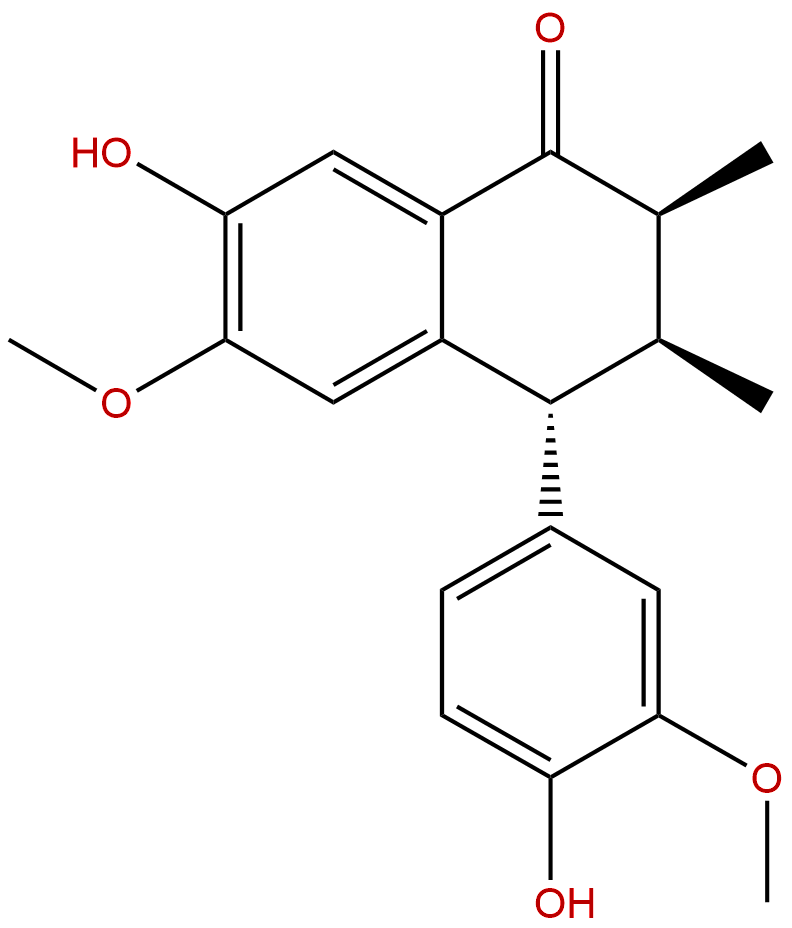
The chemical name of pentalignan A1 is (7R, 8S, 7'R, 8'R) -4,4 ', 9' - trihydroxy-3,3 ', 5,5' - tetramethoxy-7,9 ': 7', 9-diepoxylignin. Its CAS registration number is 117047-76-4. Structurally, pentalignan A1 belongs to the tetrahydrofuran type lignan, with a molecular formula of C20H22O6 and a molecular weight of 342.39 g/mol. Its core structure is composed of two phenylpropanoid units (C6-C3) connected by C-C and ether bonds, forming a characteristic tetrahydrofuran ring system. There are three phenolic hydroxyl groups (4,4 ', 9' positions) and four methoxy groups (3,3 ', 5,5' positions) distributed on this structure, and these polar functional groups have a decisive impact on its biological activity and physicochemical properties.
Based on calculations and experimental data, the lipid water partition coefficient (LogP) of pentalipin A1 is approximately 3.37, indicating its moderate lipophilicity and favorable transmembrane transport. Its topological polar surface area (TPSA) is 76.0 Å ², which is relatively moderate. However, its water solubility is poor, at approximately 0.0401 mg/mL, which may be a potential limiting factor for its oral bioavailability. The preliminary pharmacological risk assessment showed that the compound had no significant inhibitory effect on hERG potassium channels (indicating a low potential risk of arrhythmia), and the Ames test result was negative (0.0), indicating that no genetic toxicity was shown in the preliminary screening. It is worth noting that its blood-brain barrier permeability is predicted to be "low", indicating that it may mainly act on the peripheral system, with limited direct effects on the central nervous system. These basic physicochemical and pharmacokinetic parameters provide a key starting point for subsequent formulation design and pharmacokinetic optimization.
Plant sources and extraction methods
The main source of pentalipin A1 is Schisandra chinensis, a plant of the Schisandra genus in the Schisandraceae family(Schisandra chinensis)Dry vine stems. Although the fruit of Schisandra chinensis is more widely used, modern plant chemistry studies have shown that its stems, leaves, and other parts are also rich in lignin components with diverse structures and unique activities, which are important resources for discovering new lead compounds.
The extraction and isolation of pentalipin A1 from Schisandra chinensis stems usually follow the classic process of natural product chemistry. Firstly, dry and crushed plant materials are subjected to reflux extraction or room temperature leaching with medium polarity solvents such as methanol, ethanol, or acetone to obtain crude extracts. Subsequently, the crude extract was preliminarily separated using a system solvent extraction method (such as sequentially extracting with petroleum ether, ethyl acetate, and n-butanol), and pentalipin A1 was often enriched in the ethyl acetate extraction site due to its equipolarity. Further purification relies on various chromatographic techniques. Silica gel column chromatography is commonly used for preliminary fractionation, with different ratios of petroleum ether ethyl acetate or chloroform methanol gradient elution. After obtaining the stream rich in the target compound, it is repeatedly refined by reversed phase silica gel (such as ODS) column chromatography, dextran gel (Sephadex LH-20) column chromatography and high performance liquid chromatography (HPLC, usually using C18 column, methanol water or acetonitrile water as mobile phase) to finally obtain high-purity pentalipin A1 monomer. Structural identification is accomplished through the comprehensive use of techniques such as nuclear magnetic resonance (NMR, including 1H, 13C, 2D-NMR), mass spectrometry (MS), infrared spectroscopy (IR), and optical rotation measurement.
Pharmacological activity research
The pharmacological activity research of pentalipin A1 mainly focuses on two fields: antiviral and anti-inflammatory, showing the characteristic of multi-target action.
1. Antiviral activity:
The most prominent activity of pentalipin A1 is against influenza A virus (IAV). In vitro cell experiments (such as MDCK cell model) have confirmed that it has significant inhibitory activity against influenza virus A/PR/8/34 (H1N1) strain, with a half effective concentration (EC50) at the micromolar level and a high selectivity index (SI, CC50/EC50), indicating that it has a good therapeutic window. More valuable is that pentalipin A1 is also effective against oseltamivir resistant strains (H1N1-TR, carrying H274Y neuraminidase mutation), and its antiviral efficacy is not significantly reduced by the virus developing resistance. This characteristic makes it strategically significant in addressing the increasingly severe issue of influenza virus drug resistance. Preliminary studies on its anti influenza virus mechanism suggest that it may be achieved by interfering with the early stages of the virus lifecycle (such as virus adsorption or internalization) or by regulating the host cell's antiviral immune response, rather than directly targeting neuraminidase (NA), which explains why it remains effective against NA inhibitor resistant strains.
2. Anti inflammatory activity:
In various in vitro inflammatory models, pentalipin A1 exhibits a wide range of anti-inflammatory effects. In the lipopolysaccharide (LPS) - stimulated macrophage model (such as RAW264.7 cells), pentalipin A1 can dose dependently inhibit the excessive production of nitric oxide (NO) and prostaglandin E2 (PGE2), which are key mediators of inflammatory response. Meanwhile, it can significantly downregulate the expression and secretion of various pro-inflammatory cytokines and chemokines, including tumor necrosis factor - α (TNF - α), interleukin-6 (IL-6), etc. In an in vivo inflammatory model induced by carrageenan or Freund's complete adjuvant, administration of pentalipin A1 also showed significant anti-inflammatory effects, reducing tissue edema and inflammatory cell infiltration. These studies collectively established the identity of pentalipin A1 as a potential broad-spectrum anti-inflammatory agent.
Mechanism of action and molecular targets
The multiple pharmacological activities of pentalipin A1 stem from its regulation of multiple key signaling pathways and molecular targets within cells. Current research suggests that its functional network involves the following core targets and pathways:
1. Nuclear factor kappa B (NF - κ B) signaling pathway: NF - κ B is a core transcription factor that regulates inflammation and immune response. Pentalipin A1 can inhibit LPS induced NF - κ B activation. Specifically, it manifests as inhibiting the activation of I κ B kinase (IKK, especially IKBKB), preventing the phosphorylation and degradation of I κ B α, thereby reducing the translocation of p65 (RELA) subunits to the nucleus. This directly leads to a decrease in transcription of downstream pro-inflammatory factors, such as TNF - α, IL-6, and inducible nitric oxide synthase iNOS encoded by NOS2.
2. Signal transduction and transcription activator 3 (STAT3) pathway: STAT3 is another important pathway that connects cytokine signaling and gene expression, and sustained activation of STAT3 is closely related to chronic inflammation and immune dysfunction. Research has shown that pentalipin A1 can inhibit the phosphorylation (activation) of STAT3 induced by cytokines such as IL-6 and the expression of downstream target genes, thereby cutting off the positive feedback loop of pro-inflammatory signals.
3. Inflammatory bodies and cell pyroptosis: The activation of inflammasomes (such as NLRP3) leads to the cleavage and activation of caspase-1 (CASP1), which in turn promotes the maturation and release of IL-1 β and IL-18, and triggers cell pyroptosis. It has been confirmed that pentalipin A1 can inhibit the assembly and activation of NLRP3 inflammasomes, reduce the activity of caspase-1, thereby alleviating excessive inflammatory response and tissue damage.
4. Cyclooxygenase and Pain Perception: Pentalipin A1 has a certain regulatory effect on cyclooxygenase-1 (PTGS1/COX-1), which may be related to its inhibition of PGE2 production. In addition, the study suggests that it may exert analgesic effects by regulating the activity of pain related ion channels such as transient receptor potential vanillic acid subtype 1 (TRPV1) and transient receptor potential anchor protein subtype 1 (TRPA1), which complement its anti-inflammatory effects.
5. Antiviral immune regulation: In addition to potentially interfering directly with the virus, the antiviral activity of pentalipin A1 is likely related to its regulation of host type I interferon (IFN-I) response and alleviation of excessive immunopathological damage caused by the virus, such as cytokine storm. Its inhibitory effect on pathways such as NF - κ B and STAT3 is equally crucial in antiviral immunity.
In summary, pentalipin A1 has constructed a comprehensive network that inhibits viral replication, alleviates excessive inflammation, and immune pathological damage through multi-target and multi pathway synergistic effects, providing a solid molecular basis for its treatment of viral infections such as influenza combined with inflammatory diseases.
Evaluation of drug properties and pharmacokinetics
Although pentalipin A1 has shown good activity in vitro and preliminary in vivo models, its successful development as a drug highly depends on systematic drug efficacy evaluation and pharmacokinetic studies.
Drug Evaluation:
As mentioned earlier, the molecular weight of pentalipin A1 is moderate (342.39), which meets the basic requirements of the five rules for generic drugs. Its LogP value (~3.37) is within the ideal range (1-5), which is beneficial for oral absorption. The main challenge lies in its low water solubility (0.0401 mg/mL), which may result in poor dissolution, irregular absorption, and low bioavailability after oral administration. Its low blood-brain barrier permeability limits its indications mainly to peripheral system diseases. In terms of safety, the absence of hERG inhibition and Ames negativity are positive early signals, but comprehensive toxicological assessments (such as acute toxicity, subchronic toxicity, reproductive toxicity, etc.) have not been systematically reported, which is a gap that must be filled in preclinical development.
Pharmacokinetic prediction and challenges:
At present, there is a lack of pharmacokinetic research data on the pentalipin A1 system. Based on its structural characteristics, some predictions can be made: after oral administration, its moderate lipophilicity may contribute to passive diffusion absorption, but low water solubility is the main limiting step. After absorption, the phenolic hydroxyl groups in its molecules may undergo II phase binding metabolism (such as glucuronidation and sulfation), leading to strong first pass effects and potentially limited plasma exposure. Its distribution may be limited by plasma protein binding rate (unknown) and tissue specificity. Metabolites are mainly excreted through bile and kidneys.
To improve its pharmacological properties, future research strategies may include:
1. Formulation Engineering: Using techniques such as nanocrystals, solid dispersions, liposomes, and cyclodextrin inclusion complexes to improve its solubility and dissolution rate.
2. Pre drug design: Derive its phenolic hydroxyl group to prepare a more water-soluble prodrug, and release the original drug through enzymatic interpretation in vivo.
3. Structural modification: Reasonably modify the pharmacophore while preserving its solubility, metabolic stability, and targeting.
4. System PK/PD research: Conduct complete absorption, distribution, metabolism, excretion (ADME) and pharmacodynamic (PD) studies in appropriate animal models to clarify the relationship between in vivo processes and drug efficacy.
Clinical application prospects and prospects
The unique dual mechanism of action of pentalipin A1- anti influenza virus (including drug-resistant strains) and anti-inflammatory - depicts broad and clear prospects for its clinical application.
Potential indications:
1. Treatment of influenza and its complications: This is the most direct application direction. Wuliangsu A1 can inhibit virus replication and alleviate excessive inflammatory reactions caused by viral infections (such as cytokine storms), which may more effectively control the condition, shorten the course of the disease, and reduce the incidence of complications such as severe pneumonia. Its effectiveness against oseltamivir resistant strains makes it a potential reserve drug or combination therapy option for addressing clinical resistance issues.
2. Inflammatory diseases: Based on its powerful multi-target anti-inflammatory mechanism, the indications of pentalipin A1 can be extended to other acute and chronic inflammatory diseases, such as rheumatoid arthritis, inflammatory bowel disease, acute lung injury/acute respiratory distress syndrome (ALI/ARDS), etc. Its potential to inhibit TRPV1/TRPA1 also suggests its potential application in chronic pain management.
3. Combination therapy: Combined use with existing antiviral drugs (such as oseltamivir, paramivir) or anti-inflammatory drugs (such as nonsteroidal anti-inflammatory drugs, glucocorticoids) may produce synergistic effects, reduce their respective dosages and side effects, and improve treatment index.
Future research directions and challenges:
1. Deep exploration of mechanisms: It is necessary to use chemical biology methods such as affinity fishing, molecular docking and kinetic simulation, gene knockout/knockdown techniques to accurately identify its direct target proteins and draw more detailed signal regulation maps.
2. Preclinical development: The urgent task is to complete the pharmacological (validated in animal models closer to human diseases), pharmacokinetic, and toxicological studies of the system, and obtain a complete data package to support its entry into clinical trials.
3. Synthetic Biology and Sustainable Supply: Schisandra chinensis resources are limited, and large-scale extraction from plants is difficult to meet future demand. Exploring the total or semi synthetic routes of pentalipin A1, or utilizing synthetic biology techniques such as microbial heterologous synthesis to achieve its green and sustainable large-scale production, is a key issue that must be addressed in industrialization.
4. Intellectual Property and Conversion Path: Clarify its core patent layout, design a reasonable path for drug development and translational medicine, and attract industry capital investment.
Conclusion
As a natural lignan molecule discovered from the traditional Chinese medicine Schisandra chinensis, Wuliangsu A1 has shown great potential as a multi-target therapeutic drug due to its significant activity in combating influenza viruses (including drug-resistant strains) and regulating multiple inflammatory pathways. Its chemical structure is unique, and its mechanism of action involves multiple key nodes such as NF - κ B, STAT3, inflammasomes, etc., forming a synergistic network. Despite facing challenges such as low water solubility in drug formulation, these obstacles are expected to be overcome through the optimization of modern medicinal chemistry and pharmacology methods. In the future, through in-depth mechanism research, systematic preclinical evaluation, and innovative production process development, pentalipin A1 is expected to grow from a potential natural product to a new generation of candidate drugs for responding to influenza pandemics and complex inflammatory diseases. It not only provides novel lead compounds for modern drug development, but also provides strong scientific evidence for the modernization and internationalization of traditional Chinese medicine. The research process once again confirms the eternal value of exploring solutions to complex diseases from natural treasures.