Guan fu base G - a diterpenoid alkaloid from Aconitum plants: progress in chemical, pharmacological, and medicinal research
Introduction/Overview
Natural products are an important source of drug discovery, especially in the fields of cardiovascular disease and pain management, where plant derived active ingredients have always played an irreplaceable role. Aconitum genus(Aconitum)Plants, as an important member of the Ranunculaceae family, have a medicinal history that can be traced back thousands of years to traditional Chinese medicine practices. Aconitum medicinal herbs (such as Chuanwu, Caowu, and Fuzi) are renowned for their significant analgesic, anti-inflammatory, and cardiotonic effects, but their clinical application has long been strictly limited by their high toxicity. The main active and toxic components in Aconitum plants are a class of structurally unique C19- and C20 diterpenoid alkaloids. Among them, Guan fu base G (G-FG), as a representative C20 diterpenoid alkaloid, has attracted widespread attention in the pharmacological community in recent years.
Guanfu Geng Su was first derived from Aconitum carmichaelii(Aconitum coreanum It is one of the alkaloids with high content in this plant, also known as Guanbaifu, which was isolated and identified. Compared with the common diester diterpenoid alkaloids in the Aconitum genus (such as aconitine and aconitine), Guan Fu Geng Su has significantly lower acute toxicity and exhibits a unique pharmacological activity spectrum, especially in anti arrhythmic and ion channel regulation. This characteristic makes it an ideal lead compound for developing new, low toxicity cardiovascular drugs. Although basic research on Guan Fu Geng Su has made some progress, there are still many gaps in its systematic pharmacological evaluation, in-depth molecular mechanism analysis, and clinical translation pathways. This article aims to comprehensively review the chemical structure, plant origin, extraction process, pharmacological activity, mechanism of action, and medicinal characteristics of Guan Fu Geng Su, in order to provide a systematic academic reference for further research and development of this natural product.
Chemical structure and physicochemical properties
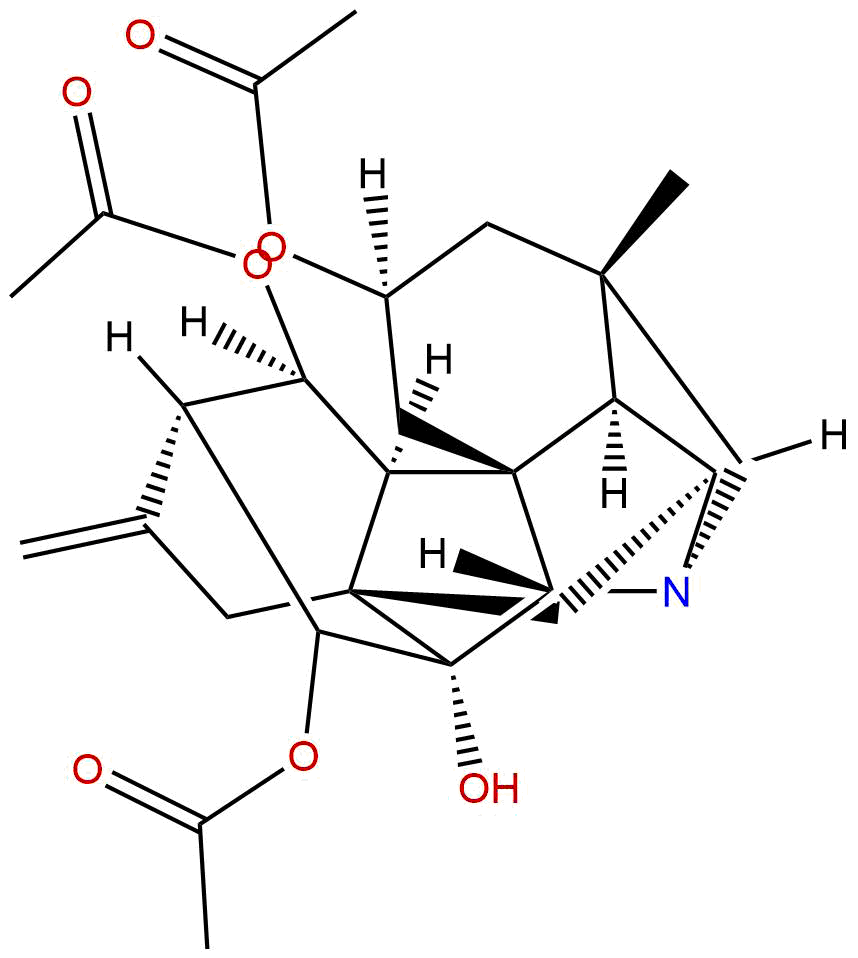
Guan Fu Geng Su belongs to the hetisine subtype of C20 diterpenoid alkaloids. The core of its chemical structure is a highly condensed five ring system, containing a unique nitrogen-containing bicyclic [2.2.2] octane skeleton. Specifically, its parent nucleus consists of 20 carbon atoms, with nitrogen atoms embedded in the skeleton, forming a stable tertiary amine structure. The molecular formula of Guan Fu Geng Su is C ₂₆ H ∝ ∝ NO ₇, with a molecular weight of 471.54 g/mol (exact mass 471.2256). Its structure contains multiple hydroxyl and methoxy substituents: typically consisting of three hydroxyl groups (- OH) and one methoxy group (- OCH ∝), the presence of these polar groups is crucial for its water solubility and biological activity. In addition, there is a unique acetoxy group (- OAc) substitution in the molecule of Guan Fu Geng Su, which may affect its metabolic stability and interaction with target proteins.
From the perspective of physical and chemical properties, Guan Fu Geng Su is a white or off white crystalline powder. Due to the presence of multiple hydroxyl and ester groups in its molecule, it has good solubility in polar solvents such as methanol, ethanol, and dimethyl sulfoxide, while its solubility in water is relatively low, but better than most non-polar diterpenoid alkaloids. This compound has optical rotation, and the specific optical rotation is usually positive. In the ultraviolet spectrum, due to the lack of conjugated double bond system, heptylene only has strong absorption at the end (about 200-210 nm). The infrared spectrum shows characteristic peaks of hydroxyl (about 3400 cm ⁻¹), carbonyl (acetoxy, about 1730 cm ⁻¹), and C-O stretching vibration. The nuclear magnetic resonance hydrogen and carbon spectra show typical Hetisine type skeletal features, including multiple high field methyl signals (such as acetyl methyl) and low field sub methyl proton signals.
It is worth noting that the chemical stability of heptyline is affected by pH and temperature. Under strong acid or strong base conditions, its acetoxy group may undergo hydrolysis, leading to structural changes and loss of activity. At room temperature, the solid state is relatively stable, but long-term storage in solution may lead to oxidation or degradation. These physicochemical properties provide important foundational data for their extraction, purification, formulation development, and in vivo pharmacokinetic studies.
Plant sources and extraction methods
The main plant source of Guan Fu Geng Su is Aconitum carmichaelii(Aconitum coreanum Rapaics, also known as "Guanbaifu" in traditional Chinese medicine, is a unique species of Aconitum in Northeast China. In addition, in some other species of the Aconitum genus, such as the North Aconitum(A. kusnezoffii)Ganqing Aconitum(A. tanguticum)In the middle, trace amounts were also detected, but the content was much lower than that of Aconitum carmichaelii. The root tuber of Aconitum carmichaelii is the main medicinal part and also the main organ for the enrichment of hepcidin. It is worth noting that there are significant differences in the content of hepcidin among Aconitum carmichaelii from different origins, harvest seasons, and growth years. Usually, the total content of alkaloids in autumn harvested tubers is relatively high, and hepcidin, as one of the main components, can account for 0.1% -0.5% of the weight of dried tubers.
The extraction method of Guan Fu Geng Su has undergone an evolution from traditional solvent extraction to modern green extraction technology. The classic extraction process usually includes the following steps: first, the dried roots of Aconitum carmichaelii are crushed and soaked in an acidic solvent (such as 0.5% -1% hydrochloric acid or sulfuric acid aqueous solution) to dissolve the alkaloids in salt form. Subsequently, the acidic extraction solution is alkalized (usually adjusted to pH 9-10 with ammonia water), and then liquid-liquid extraction is performed using organic solvents such as chloroform, ether, or ethyl acetate to obtain the crude extract of total alkaloids. The crude extract usually contains various diterpenoid alkaloids, including structural analogues such as guanfu A, guanfu B, guanfu Geng, and guanfu Ren.
In order to obtain high-purity Guan Fu Geng Su, further separation and purification steps are required. Classic separation methods include silica gel column chromatography and alumina column chromatography. Due to the slight differences in polarity between Guanfu heptyline and other Guanfu alkaloids, gradient elution (such as chloroform methanol system, gradually increasing the methanol ratio from 100:0 to 90:10) is usually used to achieve separation. In recent years, modern separation techniques such as high-performance liquid chromatography (HPLC) and high-speed counter current chromatography (HSCCC) have also been applied to the preparation of heptyline, significantly improving purity and yield. Especially HSCCC technology, utilizing the difference in distribution coefficients of solutes in two-phase solvent systems, can achieve high-purity separation from milligrams to grams in a relatively short period of time, avoiding the problem of irreversible adsorption of samples in traditional column chromatography.
In terms of quality control, HPLC-UV or HPLC-MS methods are usually used for the determination of the content of Guan Fu Geng Su. The commonly used chromatographic column is a C18 reverse phase column, and the mobile phase is an acetonitrile water (containing 0.1% formic acid or triethylamine) system. The detection wavelength is 205-210 nm. This method can effectively separate heptyline and its structural analogues, providing a reliable analytical tool for quality evaluation and extraction process optimization of medicinal materials. In addition, with the promotion of green chemistry concepts, new technologies such as supercritical fluid extraction (SFE) and microwave-assisted extraction (MAE) have also been applied to the extraction of aconitine alkaloids. These methods have the advantages of low solvent consumption, high extraction efficiency, and environmental friendliness, and are expected to become the mainstream technology for industrial production of aconitine in the future.
Pharmacological activity research
The pharmacological activity research of Guan Fu Geng Su mainly focuses on the cardiovascular system, especially in terms of anti arrhythmic effects. In addition, its anti-inflammatory, analgesic, and neuroprotective effects have gradually received attention.
Antiarrhythmic effect It is the most prominent pharmacological activity of Guan Fu Geng Su. Multiple in vitro and in vivo experiments have confirmed that Guan Fu Geng Su has significant protective effects on various experimental arrhythmia models. In the overall animal model, intravenous injection of Guan Fu Geng Su can dose dependently counteract arrhythmias induced by aconitine, barium chloride, calcium chloride, and coronary artery ligation reperfusion, including ventricular premature beats, ventricular tachycardia, and ventricular fibrillation. Its strength of action is comparable to classical antiarrhythmic drugs quinidine and lidocaine, but its therapeutic index is wider. It is worth noting that Guan Fu Geng Su has a relatively small effect on physiological parameters of the normal heart, such as heart rate and blood pressure, indicating its potential to selectively act on myocardial cells under pathological conditions. In ex vivo cardiac perfusion experiments, Guan Fu Geng Su can prolong the effective refractory period (ERP), slow down conduction velocity, and increase ventricular fibrillation threshold. These electrophysiological effects are the basis of its anti arrhythmic effect.
Anti inflammatory and analgesic effects It is another important pharmacological activity of Guan Fu Geng Su. Traditionally, Aconitum plants have been widely used to treat rheumatism and rheumatism, and Guanfu Geng Su, as one of its main components, exhibits significant anti-inflammatory activity. In the rat paw swelling model induced by carrageenan and the mouse ear swelling model induced by xylene, Guan Fu Geng Su can effectively inhibit the inflammatory response, and its mechanism of action may be related to the inhibition of the release of inflammatory mediators such as prostaglandin E2, tumor necrosis factor - α, and interleukin-1 β. In terms of analgesia, Guan Fu Geng Su showed dose-dependent analgesic effects in both acetic acid writhing and hot plate pain models, but its effect was weaker than morphine and did not produce tolerance or addiction, suggesting that it may exert analgesic effects through non opioid pathways.
Neuroprotective effect It is a new direction in recent years for the study of heptulene. In vitro experiments have shown that Guan Fu Geng Su can alleviate glutamate induced neuronal damage and neuronal apoptosis caused by oxygen glucose deprivation/reoxygenation (OGD/R). Its protective mechanism involves inhibiting intracellular calcium overload, reducing reactive oxygen species (ROS) production, and upregulating the expression of anti apoptotic protein Bcl-2. In addition, it has been found that Guan Fu Geng Su can inhibit the excessive activation of microglia and reduce the release of pro-inflammatory cytokines, thus playing a potential protective role in neuroinflammatory related diseases such as Parkinson's disease and Alzheimer's disease.
Other pharmacological activities It also includes inhibitory effects on myocardial hypertrophy. In the model of myocardial cell hypertrophy induced by angiotensin II or isoproterenol, hepcidin can significantly reduce the surface area of myocardial cells and the expression of hypertrophy markers (such as ANP and BNP), suggesting its potential for anti myocardial remodeling. In addition, preliminary studies have found that Guanfuheptyl has a weak inhibitory effect on the proliferation of some tumor cell lines (such as human hepatoma cell HepG2 and breast cancer cell MCF-7), but this activity needs further verification.
Mechanism of action and molecular targets
The pharmacological mechanism of Guan Fu Geng Su is multi-target and multi pathway, among which the regulation of ion channels in myocardial cells is the core mechanism of its anti arrhythmic effect.
Sodium channel blocking effect It is the most clear molecular target of Guan Fu Geng Su. Using patch clamp technology, researchers have found that hepcidin can inhibit sodium channel currents (INa) in myocardial cells in a concentration dependent and usage dependent manner. Similar to classic class I antiarrhythmic drugs such as lidocaine and quinidine, Guan Fu Geng Su mainly acts on the inactive state of sodium channels, prolonging the time for channels to recover from the inactive state and thus prolonging the effective refractory period of myocardial cells. This use of dependent blocking properties means that during increased heart rate (such as tachycardia), the sodium channel blocking effect of hepcidin is enhanced, while its impact on sodium channels at normal heart rate is relatively small, which explains its good safety and selectivity. Molecular docking and mutation studies suggest that hepcidin may bind to specific amino acid residues (such as F1760 and Y1767) on the DIV-S6 transmembrane fragment of the sodium channel alpha subunit, which are also binding regions of classical sodium channel blockers.
Potassium channel regulation It is another important component of the anti arrhythmic mechanism of Guan Fu Geng Su. Research has found that Guan Fu Geng Su can inhibit various subtypes of potassium channels, including delayed rectifier potassium channels (IKr and IKs) and transient outward potassium channels (Ito). Especially the inhibition of the fast delayed rectifier potassium channel (IKr, encoded by the hERG gene) can prolong the action potential duration (APD) and QT interval of myocardial cells. This effect is similar to class III antiarrhythmic drugs, but Guan Fu Geng Su has a relatively low affinity for hERG channels, and its ability to prolong APD is weakened during tachycardia, thereby reducing the risk of apical torsion type ventricular tachycardia (TdP). In addition, the effect of Guan Fu Geng Su on inward rectifying potassium channels (IK1) is relatively small, which is beneficial for maintaining the stability of resting membrane potential.
Calcium channel regulation effect In terms of aspect, Guan Fu Geng Su has a mild inhibitory effect on L-type calcium channels (ICa-L). This inhibitory effect can reduce the influx of calcium ions, lower intracellular calcium concentration, thereby alleviating myocardial damage and triggering activity caused by calcium overload. It is worth noting that the inhibitory effect of Guan Fu Geng Su on calcium channels is much weaker than its blocking effect on sodium channels, which makes it less effective in inhibiting myocardial contractility while anti arrhythmic, avoiding negative inotropic effects on cardiac function.
Anti inflammatory and antioxidant mechanisms Involving multiple signaling pathways. Guanfu Geng Su can inhibit the activation of nuclear factor kappa B (NF - κ B) and reduce the transcription of inflammatory factors. At the same time, it can activate the nuclear factor E2 related factor 2 (Nrf2)/antioxidant response element (ARE) pathway, upregulate the expression of antioxidant enzymes such as superoxide dismutase and glutathione peroxidase, thereby reducing oxidative stress damage. In addition, it has been found that Guan Fu Geng Su can inhibit the phosphorylation of the mitogen activated protein kinase (MAPK) pathway (including p38, JNK, and ERK), which plays a key role in inflammation and cell apoptosis.
Evaluation of drug properties and pharmacokinetics
The pharmacological evaluation of Guan Fu Geng Su is a complex and yet to be fully resolved issue, facing major challenges including unsatisfactory pharmacokinetic properties and potential risks of cardiac toxicity.
Pharmacokinetic characteristics Currently, research data is relatively limited. Animal experiments have shown that after intravenous injection, Guan Fu Geng Su exhibits a two chamber open distribution model in vivo, with a short half-life in the distribution phase (about 5-10 minutes) and an elimination phase half-life of about 30-60 minutes. Its apparent distribution volume is relatively large (>1 L/kg), indicating widespread tissue distribution and possible enrichment in organs such as the central nervous system and heart. The metabolism of Guan Fu Geng Su in the body is mainly mediated by the liver cytochrome P450 enzyme system (especially CYP3A4 and CYP2D6) through oxidative metabolism and esterase mediated hydrolysis reaction. The main metabolic pathways include hydrolysis of acetoxy groups, glucuronic acid binding of hydroxyl groups, and N-demethylation. The pharmacological activity of metabolites has not been systematically studied, but it is preliminarily speculated that the hydrolysis product (deacetylated heptyline) may retain some activity. The bioavailability of Guan Fu Geng Su is relatively low (<10% after oral administration), mainly due to its poor water solubility and first pass effect. Therefore, current research mainly adopts intravenous administration route, while the development of oral formulations faces huge challenges.
safety evaluation It is the focus of research on the medicinal properties of Guan Fu Geng Su. Compared with other diester alkaloids such as aconitine, the acute toxicity of heptyline is significantly reduced. The LD50 for intravenous injection in mice is about 50-80 mg/kg, while the LD50 for oral administration is>500 mg/kg. The therapeutic index (LD50/ED50) is about 10-20, indicating a relatively wide safety window. However, caution should still be exercised regarding the cardiac toxicity of Guan Fu Geng Su. When administered at high doses or rapidly intravenously, Guan Fu Geng Su can cause electrocardiographic abnormalities, including prolonged PR interval, widened QRS complex, and prolonged QT interval, which are directly related to its sodium and potassium channel blocking effects. It is worth noting that although the inhibitory activity of Guan Fu Geng Su on hERG potassium channels (IC50 of approximately 10-30 μ M) is weaker than many class III antiarrhythmic drugs, there is still a potential risk of inducing TdP. In addition, there is currently no clear data on the hepatotoxicity and genotoxicity (Ames test) of Guan Fu Geng Su, which constitutes a key knowledge gap in its pharmacological evaluation.
Formulation development In view of the poor water solubility and strong first pass effect of Guan Fu Geng Su, researchers have tried various formulation strategies. New drug delivery systems such as liposomes, cyclodextrin inclusion complexes, and nanoemulsions have been explored to enhance the solubility and bioavailability of hepcidin. Preliminary results show that hydroxypropyl - β - cyclodextrin inclusion complex can significantly increase the solubility of heptyl in water (by about 10 times) and improve its oral absorption. In addition, prodrug design strategies such as hydroxyl phosphorylation or amino acid esterification have also been proposed to improve water solubility and metabolic stability.
Clinical application prospects and prospects
As a natural product with unique chemical structure and multiple pharmacological activities, the clinical application prospects of Guan Fu Geng Su mainly focus on the field of cardiovascular diseases, especially the treatment of arrhythmias.
Development of antiarrhythmic drugs It is the most direct clinical translation direction of Guan Fu Geng Su. The anti arrhythmic drugs currently used in clinical practice, such as amiodarone, lidocaine, and propafenone, all have varying degrees of side effects, including arrhythmogenic effects, extracardiac toxicity (such as amiodarone induced pulmonary fibrosis and thyroid dysfunction), and narrow treatment window. As a multi-channel blocker (combining the characteristics of Class I, III, and some Class IV antiarrhythmic drugs), Guan Fu Geng Su's unique use dependent sodium channel blockade and relatively mild potassium channel inhibition make it theoretically have a lower risk of arrhythmia. Especially for clinically difficult to treat rapid cardiac arrhythmias such as atrial fibrillation and ventricular tachycardia, Guan Fu Geng Su may provide a new treatment option. However, the translation from laboratory to clinical still faces many obstacles. Firstly, it is necessary to conduct systematic preclinical toxicology studies, especially in evaluating the cardiac and hepatic toxicity of long-term administration. Secondly, it is necessary to develop formulations suitable for clinical use to address the issue of low oral bioavailability. Finally, it is necessary to design rigorous Phase I-III clinical trials to verify its effectiveness and safety in humans.
Anti inflammatory and analgesic applications It is another direction worth exploring. The anti-inflammatory activity of Guan Fu Geng Su is comparable to classical nonsteroidal anti-inflammatory drugs (NSAIDs), but it may avoid the gastrointestinal and cardiovascular side effects of NSAIDs. If its analgesic activity can be improved and cardiac toxicity reduced through structural modification, Guan Fu Geng Su is expected to become a new candidate drug for the treatment of chronic inflammatory diseases such as rheumatoid arthritis.
Research on Structure Modification and Structure Activity Relationship It is the key to promoting the clinical translation of Guan Fu Geng Su. At present, researchers have prepared a series of derivatives of hepcidin through semi synthetic methods and preliminarily explored their structure-activity relationships. Research has found that hydroxyl groups at C-3 and C-13 positions are crucial for sodium channel blocking activity, while modification with acetoxy groups significantly affects metabolic stability. The methoxy group at C-1 position may affect the binding ability with potassium channels. In the future, through computer-aided drug design (CADD) and structural biology methods, it is expected to design analogs of hepcidin with higher selectivity and lower toxicity. For example, improving water solubility by introducing polar groups or enhancing metabolic stability through fluorination modification are strategies worth exploring.
Combination therapy strategy It may also become an important direction for the clinical application of Guan Fu Geng Su. Given the multi-channel blocking properties of Guan Fu Geng Su, its combination with low-dose amiodarone or beta blockers may produce a synergistic effect, thereby enhancing the anti arrhythmic effect while reducing their respective doses. In addition, the combination use of Guan Fu Geng Su with antiplatelet or anticoagulant drugs requires careful evaluation of its bleeding risk.
Conclusion
Guanfu Geng Su, as a representative C20 diterpenoid alkaloid in Aconitum carmichaelii, occupies a special position in the field of natural product drug development due to its unique chemical structure, significant cardiovascular pharmacological activity, and relatively low toxicity. Over the past few decades, research has revealed its potential in antiarrhythmic, anti-inflammatory, analgesic, and neuroprotective effects, and has preliminarily elucidated its molecular mechanisms by regulating sodium, potassium, calcium ion channels, as well as signaling pathways such as NF - κ B and Nrf2. However, the pharmacological research of Guan Fu Geng Su is still in its early stages, and its poor pharmacokinetic properties, potential cardiac toxicity, and lack of systematic toxicological data are the main bottlenecks restricting its clinical translation.
Looking ahead to the future, research on Guan Fu Geng Su should focus on the following key directions: firstly, conducting in-depth studies on structural modifications and structure-activity relationships, and developing derivatives with higher selectivity and better pharmacokinetic properties; Secondly, systematically evaluate the safety of long-term administration, especially in terms of cardiac, hepatic, and renal toxicity; Thirdly, explore new drug delivery systems to improve their oral bioavailability; Fourthly, utilizing modern molecular biology techniques such as CRISPR gene editing and proteomics to accurately identify its target of action, providing a basis for precision medicine. The research process of Guan Fu Geng Su fully reflects the value of natural products in drug discovery, and also demonstrates the opportunities and challenges faced in the transformation from traditional Chinese medicine active ingredients to modern innovative drugs. With the deepening of interdisciplinary research, Guan Fu Geng Su and its derivatives are expected to provide new treatment options for cardiovascular disease patients in the future.