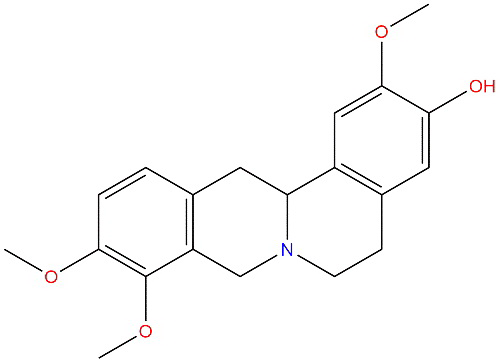


Product name: Corypalmine
Synonym name: (R)-(+)-Corypalmine
Catalogue No.: BP3903
Cas No.: 13063-54-2
Formula: C20H23NO4
Mol Weight: 341.407
Botanical Source:
Physical Description:
Type of Compound:
Purity: 95%~99%
Analysis Method: HPLC-DAD or/and HPLC-ELSD
Identification Method: Mass, NMR
Packing: Brown vial or HDPE plastic bottle
Storage: Store in a well closed container, protected from air and light. Put into refrigerate or freeze for long term storage.
Whenever possible, you should prepare and use solutions on the same day. However, if you need to make up stock solutions in advance, we recommend that you store the solution as aliquots in tightly sealed vials at -20℃. Generally, these will be useable for up to two weeks.
The product could be supplied from milligrams to grams
Inquire for bulk scale.
For Reference Standard and R&D, Not for Human Use Directly.
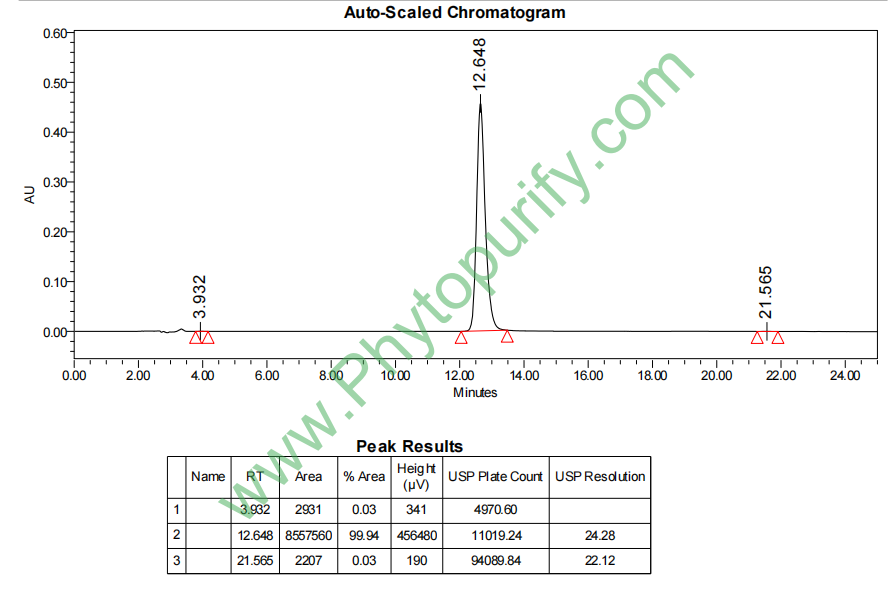
HPLC of Corypalmine
Storage conditions:Short-term storage at 2~8℃, long-term storage at -20 ~ -80℃
51.1600
2.9044
2.7087
.0527
7.9319
14.4715
High
89.5183
2.9304
No
No
No
No
No
No
0.6
No
No
No
No
Natural products, as an important treasure trove for drug discovery, play an irreplaceable role in the history of human disease prevention and treatment. Among them, isoquinoline alkaloids have always been a hot topic in medicinal chemistry and pharmacology research due to their structural diversity and wide range of biological activities. Corypalmine, as a tetrahydroisoquinoline alkaloid, has attracted attention since its isolation and identification from plants in the family Menispermaceae due to its unique chemical structure and potential pharmacological activity. Early research mainly focused on its antifungal properties, but with the deepening of molecular pharmacology and signaling pathway research, its broader pharmacological spectrum, especially the multi-target regulatory potential demonstrated in the anti-inflammatory field, has gradually become a new focus of research. Inflammation is the fundamental pathophysiological process by which the body responds to injury or infection, but uncontrolled chronic inflammation is the common pathological basis for various major diseases such as tumors, metabolic syndrome, neurodegenerative diseases, and autoimmune diseases. Therefore, the search for efficient and low toxicity new anti-inflammatory drugs has important clinical significance. The purpose of this article is to systematically review the chemical properties, plant sources, pharmacological activities, and multidimensional molecular mechanisms of D-tetrahydrogen alkaloids, especially their anti-inflammatory effects. Combined with their pharmacological parameters, the development prospects of D-tetrahydrogen alkaloids as candidate drugs are scientifically discussed.
D-tetrahydrojatrozine, chemical name (6aS) -1,2,10-trimethoxy-6-methyl-5,6,6a, 7-tetrahydro-4H-dibenzo [de, g] quinoline, CAS number 13063-54-2. Its molecular formula is C20H25NO4 and its molecular weight is 341.4070 g/mol. Structurally, it belongs to the tetrahydroberberine type alkaloid, with a tetrahydroisoquinoline nucleus and methoxy and methyl substituents attached at specific positions. This flexible and rigid molecular skeleton is the structural basis for its interactions with various biomolecules.
Its physicochemical properties have a decisive impact on its bioavailability and pharmacological activity. The calculated lipid water partition coefficient (LogP) is 2.9044, indicating that the compound has moderate lipophilicity, which is beneficial for its penetration of cell membranes, but also suggests that its water solubility may be limited. The measured water solubility data is 0.0527 mg/mL, which belongs to the category of slight solubility, which may be one of the main challenges faced by its oral administration. The topological polar surface area (TPSA) is 51.1600 Å ², which is at a moderate level and reflects the hydrogen bond acceptor ability provided by nitrogen and oxygen atoms in the molecule, which has a significant impact on its interaction with target proteins and membrane permeability. Based on its molecular weight, LogP, and TPSA, this compound basically conforms to the Rule of Five, indicating that it has good oral absorption potential. Of particular note is the prediction of high blood-brain barrier (BBB) permeability, which provides an important material basis for its application in central nervous system related inflammatory diseases such as neuropathic pain and neurodegenerative diseases. In addition, preliminary in vitro safety screening showed that its hERG channel inhibitory activity was' no ', reducing the risk of inducing QT interval prolongation in the heart; The Ames test result is 0. (Note that the data "0.6" here may be the mutation rate ratio under specific experimental conditions. It is generally considered negative when the ratio is less than 2 and there is no dose dependence, indicating that no clear mutagenicity has been shown in this experimental system, but it needs to be comprehensively judged in conjunction with more genetic toxicity tests).
D-tetrahydrogen alkaloids mainly come from Stephania plants in the family Menispermaceae. The literature clearly records that it was isolated from the golden thread hanging turtle (Stephania cepharantha). The plants of this genus are widely used in Asian traditional medicine, often used to treat fever, pain, inflammation and many infectious diseases, which provides a traditional basis for searching for active ingredients from the plants of this genus. In addition to the golden thread hanging turtle, other plants of the same genus such as Stephania glabra and Stephania japonica may also contain this compound or its analogues, reflecting the distribution pattern of natural products in the plant kingdom.
Extracting D-tetrahydroalkaloids from plant materials usually follows the general extraction process for alkaloids. Classic methods include solvent extraction, commonly using methanol, ethanol, or acidic water (such as 0.5-1% hydrochloric acid or acetic acid) for percolation or reflux extraction, and utilizing the characteristic of alkaloids and acid salts dissolving in water for preliminary enrichment. After concentration, the extract is alkalized (such as using ammonia or sodium hydroxide) to free the alkaloids, and then extracted with organic solvents such as chloroform and dichloromethane. The crude total alkaloids obtained need to be purified through further chromatographic separation techniques, such as silica gel column chromatography, alumina column chromatography, and high-performance liquid chromatography (HPLC) preparation. Modern extraction techniques such as ultrasound assisted extraction and microwave-assisted extraction can effectively improve extraction efficiency and shorten time. The key to the extraction process lies in optimizing the solvent system, pH value, and chromatographic separation conditions based on the polarity of the target compound and the characteristics of the plant matrix, in order to obtain high-purity monomer compounds for subsequent research.
The pharmacological activity research of D-tetrahydrogen alkaloids has expanded from the initial antifungal field to a broader scope, with anti-inflammatory activity being the core of current research.
Antifungal activity As its earliest recognized biological activity, D-tetrahydrogen alkaloids have shown inhibitory effects on various plant pathogenic fungi and some human pathogenic fungi. Its mechanism of action may involve interfering with the biosynthesis of ergosterol on fungal cell membranes or disrupting the deposition of chitin on cell walls, but the specific molecular targets remain to be elucidated. This activity provides the possibility for it to serve as a lead for agricultural or medical antifungal agents.
anti-inflammatory activity This is currently the most promising research direction for development. Numerous in vitro and in vivo studies have shown that D-tetrahydrogen alkaloids exhibit significant inhibitory effects on various acute and chronic inflammation models.
Other potential activities Based on its anti-inflammatory core function and related signaling pathways, research suggests that it may play a role in other pathological processes, such as neuroprotection (by inhibiting neuroinflammation), analgesia (related to anti-inflammatory and ion channel effects), etc. However, research in these fields is still in its infancy and requires more evidence to support it.
The anti-inflammatory effect of D-tetrahydrogen alkaloids is not achieved through a single target, but exhibits the characteristics of multi-target and multi pathway synergistic regulation, which is consistent with its complex chemical structure and may also help reduce the risk of drug resistance. Existing research has revealed interactions with multiple key inflammation related targets:
Regulating transcription factors and inflammatory signaling hubs:
Regulating inflammatory mediator synthase:
Intervention in pain perception and neurogenic inflammation:
Directly regulate key inflammatory factors:
In summary, D-tetrahydrogen alkaloids act simultaneously on upstream key nodes of multiple signaling pathways such as NF - κ B, JAK-STAT, NLRP3, and regulate membrane channels such as TRPV1/TRPA1, forming a three-dimensional anti-inflammatory network that inhibits inflammatory responses at multiple levels, including gene transcription, protein expression, cell signaling, and sensory nerve activation.
Based on the physical and chemical parameters and preliminary activity data mentioned earlier, a preliminary evaluation of the pharmacological properties of D-tetrahydrojatrorrhizine is conducted
Absorption, distribution, metabolism, excretion (ADME) prediction:
Preliminary safety evaluation:
Pharmacokinetic research needs At present, there is a lack of publicly available pharmacokinetic studies on the D-tetrahydrogen alkaloids system, such as plasma concentration time curves, absolute bioavailability, tissue distribution, half-life, clearance rate, etc. in animals such as rats and dogs. These data are the basis for determining the dosing regimen (dosage, frequency), understanding the efficacy concentration relationship, and evaluating potential cumulative toxicity, and are of paramount importance in preclinical research.
D-tetrahydrogen alkaloids, as a multi-target anti-inflammatory natural small molecule, have broad clinical application prospects, but the road ahead is long and requires interdisciplinary collaboration.
Potential therapeutic areas:
Development Challenges and Strategies:
Future research directions:
D-tetrahydroisoquinoline alkaloid is a multi-target anti-inflammatory alkaloid discovered from traditional medicinal plants. It exhibits good intervention effects on various inflammatory models by synergistically inhibiting key inflammatory signaling pathways such as NF - κ B, JAK-STAT, NLRP3, and regulating pain sensing channels such as TRPV1/TRPA1. Its physical and chemical properties that comply with the rules of class drugs, especially the predicted high blood-brain barrier permeability, bring unique hope for its treatment of central nervous system inflammatory diseases. However, its low water solubility, unclear systemic pharmacokinetic and toxicological characteristics are obstacles that must be overcome to move towards clinical application. Future research should focus on improving its pharmacological properties through formulation and structural modification strategies, and conducting systematic and in-depth preclinical evaluations. In summary, D-tetrahydrogen alkaloids, as a promising natural lead compound, provide valuable chemical templates and biological insights for the development of novel, multi-target anti-inflammatory drugs, and their subsequent research deserves continued attention.
