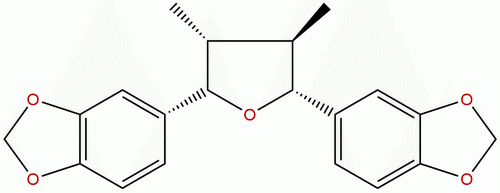


Product name: rel-(8R,8'R)-dimethyl-(7S,7'R)-bis(3,4-methylenedioxyphenyl)tetrahydro-furan
Synonym name: rel-(8R,8'R)-dimethyl-(7S,7'R)-bis(3,4-methylenedioxyphenyl)tetrahydro-furan
Catalogue No.: BPF0655
Cas No.: 178740-32-4
Formula: C20H20O5
Mol Weight: 340.375
Botanical Source:
Physical Description:
Type of Compound: Lignans
Purity: 95%~99%
Analysis Method: HPLC-DAD or/and HPLC-ELSD
Identification Method: Mass, NMR
Packing: Brown vial or HDPE plastic bottle
The product could be supplied from milligrams to grams
Inquire for bulk scale.
For Reference Standard and R&D, Not for Human Use Directly.
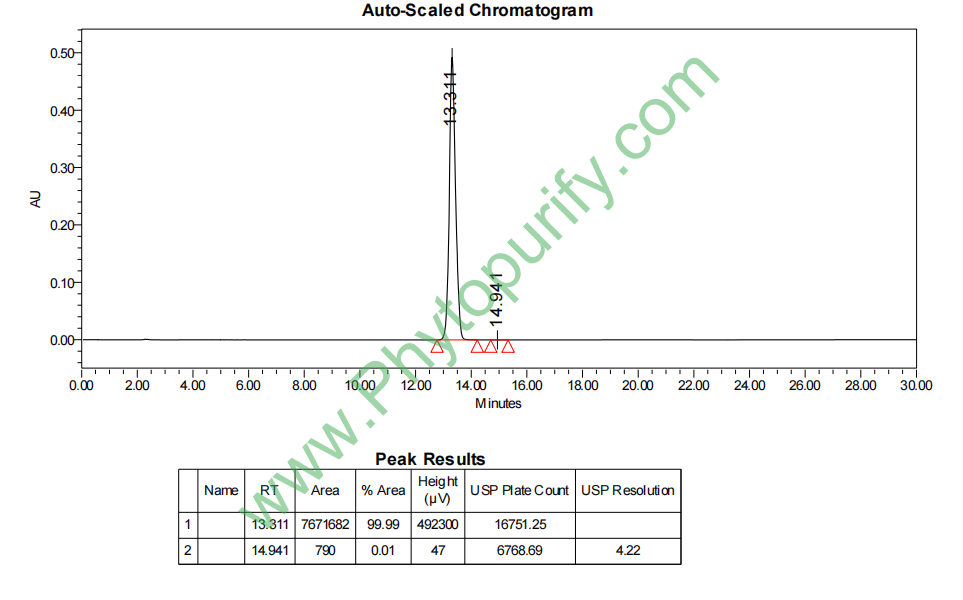
HPLC of rel-(8R,8'R)-dimethyl-(7S,7'R)-bis(3,4-methylenedioxyphenyl)tetrahydro-furan
Storage conditions:Short-term storage at 2~8℃, long-term storage at -20 ~ -80℃
46.1500
3.5716
3.5716
.0014
7.6086
12.4043
High
90.3980
3.5241
Yes
Yes
Yes
No
No
No
0.0
No
Yes
No
Yes
Natural products, as an important source of drug discovery, have played an irreplaceable role in the long history of human struggle against diseases. Especially secondary metabolites derived from the plant kingdom, with their structural diversity and unique biological activity, provide a rich library of lead compounds for modern drug development. Among the numerous biologically active natural product families, tetrahydrofuran lignans have attracted much attention due to their extensive pharmacological activities, particularly their significant neuroprotective effects. These compounds are usually composed of two phenylpropanoid units connected by a C8-C8 'bond, forming a tetrahydrofuran ring. The subtle differences in their stereochemistry often lead to significant changes in their biological activity.
The compound focused on in this article - (7S, 7'R) - bis (3,4-methylenedioxyphenyl) - rel - (8R, 8'R) - dimethyltetrahydrofuran (rel - (8R, 8'R) - dimethyl - (7S, 7'R) - bis (3,4-methylenedioxyphenyl) tetrahydrofuran), with CAS number 178740-32-4, is a typical tetrahydrofuran type lignan. Its structural feature is that two 3,4-methylenedioxyphenyl groups (i.e. piperonyl) are respectively connected to the C7 and C7 'positions of the tetrahydrofuran ring, while two methyl groups are located at the C8 and C8' positions, and the relative configuration is rel - (8R, 8'R). This compound has become a research hotspot due to its potential neuroprotective activity, especially in pathological processes related to neurodegenerative diseases such as Alzheimer's disease (AD), demonstrating the potential for multi-target regulation. This review aims to systematically summarize the chemical properties, sources, pharmacological activities, mechanisms of action, and drug properties of the compound, in order to provide comprehensive references for further in-depth research and development.
(7S, 7'R) - bis (3,4-methylenedioxyphenyl) - rel - (8R, 8'R) - dimethyltetrahydrofuran belongs to the diaryltrahydrofuran lignan type. Its core skeleton is a highly substituted tetrahydrofuran ring, which is connected to a 3,4-methylenedioxyphenyl group at positions C2 and C5 (corresponding to lignin numbering C7 and C7 '), respectively. 3,4-methylenedioxyphenyl is a common pharmacophore in many biologically active natural products, such as berberine and sesamin. Its methylenedioxyl (- O-CH2-O -) structure endows the molecule with certain lipophilicity and the ability to form hydrogen bonds or π - π stacking interactions with target proteins.
There is a methyl group attached to each of the C3 and C4 positions (corresponding to C8 and C8 '). According to the naming "rel - (8R, 8'R)", it indicates that the methyl groups at positions C8 and C8 'are both in the R configuration and in the relative configuration (i.e., a pair of enantiomers in the racemic form). And '7S, 7'R' indicates the absolute configuration of C7 and C7 'positions. This specific stereochemical arrangement is crucial for the three-dimensional recognition of molecules and biomolecules, directly determining the strength and selectivity of their biological activity. This molecule has a symmetry plane (meso compound) or chiral center, and its precise stereoconfiguration is a key feature that distinguishes it from other lignin analogues.
According to the pharmacokinetic parameters predicted by computational chemistry (in silica), the compound has the following key physicochemical properties:
- Molecular weight (MW):340.3750 Da, Meets the typical range of small molecule drugs (<500 Da), which is beneficial for transmembrane transport and target binding.
- Lipid water partition coefficient (LogP)3.5716 indicates that the molecule has moderate to high lipophilicity. A higher LogP value is beneficial for its penetration through biological membranes, especially the blood-brain barrier (BBB), but it may also lead to poor water solubility.
- Topological Polarity Surface Area (TPSA): 46.1500 Å ². TPSA is an important parameter for predicting the ability of molecules to penetrate cell membranes and the blood-brain barrier. Generally, molecules with TPSA less than 60-70 Å ² have good BBB penetration. The TPSA of this compound is 46.15 Å ², far below the threshold, indicating its excellent BBB penetration potential.
- Water solubility:0.0014 mg/mL。 This value is extremely low, indicating that the solubility of the compound in water is very limited. This may be a potential bottleneck in its in vivo pharmacokinetics, requiring appropriate formulation techniques (such as nanoemulsions, liposomes, cyclodextrin inclusion complexes) to improve its bioavailability.
- Blood-brain barrier (BBB) penetrability Predicted as' high '. This is highly consistent with low TPSA and high LogP values, indicating that the compound can effectively enter the central nervous system (CNS), which is a prerequisite for its neuroprotective effects.
- HERG inhibition Predicted as' no '. HERG (human Ether - à - go Related Gene) potassium channel inhibition is one of the main causes of drug cardiac toxicity. The negative predictive result reduces the risk of QT interval prolongation and arrhythmia caused by the compound, which is a positive signal in its safety evaluation.
- Ames test The prediction is 0.0. The Ames test is used to detect the mutagenicity of compounds. The result is 0.0, indicating that the compound has no mutagenicity in the in vitro bacterial recovery mutation test and has a low risk of genetic toxicity.
In summary, the compound exhibits excellent "drug like" properties in terms of physicochemical properties, particularly with outstanding CNS penetration ability, but poor water solubility is the main obstacle that needs to be overcome.
(7S, 7'R) - bis (3,4-methylenedioxyphenyl) - rel - (8R, 8'R) - dimethyltetrahydrofuran, as a typical tetrahydrofuran type lignan, is widely present in various medicinal plants, especially in plants such as Lauraceae, Magnoliaceae, Schisandraceae, and Piperaceae. Specifically, the compound has been reported to be isolated from the following plants:
- Schisandra plants Like Schisandra chinensis(Schisandra chinensis)And Huazhong Schisandra chinensis(Schisandra sphenanthera). The fruit of Schisandra chinensis is a famous traditional Chinese medicine used to treat neurasthenia, insomnia, and liver protection. Its rich lignans are considered the main active substances.
- Piper plants Like long pepper(Piper longum)And black pepper(Piper nigrum). Pepper plants are known for their spicy component piperine, but they also contain various lignans.
- Myristica plants Like nutmeg(Myristica fragrans). The kernel (i.e. nutmeg) and false seed coat (i.e. nutmeg coat) of nutmeg contain abundant lignans and volatile oils.
- Other sources It may also exist in certain camphor families (such as Machilus Genus) and Magnoliaceae (such as Magnolia Belonging to plants.
These plants typically grow in tropical and subtropical regions of Asia, America, and Africa, and are an important component of traditional medical systems.
The classic process for extracting this compound from plant materials typically includes the following steps:
The most notable pharmacological activity of this compound is its neuroprotective effect, particularly in pathological models associated with Alzheimer's disease (AD). AD is a neurodegenerative disease characterized by progressive cognitive impairment and memory loss. Its core pathological features include senile plaques formed by β - amyloid (A β) deposition, neurofibrillary tangles (NFTs) formed by excessive phosphorylation of Tau protein, neuronal loss, and synaptic dysfunction.
Research has shown that (7S, 7'R) - bis (3,4-methylenedioxyphenyl) - rel - (8R, 8'R) - dimethyltetrahydrofuran can protect neurons from damage through multiple pathways:
- Anti A β toxicity In the A β - induced neurotoxic model, this compound can significantly improve the survival rate of neurons and reduce cell apoptosis caused by A β aggregation. It may exert its effect by inhibiting the aggregation or promoting the clearance of A β, as well as blocking the binding of A β to cell membrane receptors.
- anti-oxidative stress Oxidative stress is an important event in the early stages of Alzheimer's disease. This compound can activate the antioxidant defense system in the body, for example, by upregulating the activity of nuclear factor E2 related factor 2 (NFE2L2/Nrf2), promoting the expression of downstream antioxidant enzymes (such as heme oxygenase-1 HO-1, quinone oxidoreductase NQO1), thereby clearing reactive oxygen species (ROS), protecting mitochondrial function, and reducing oxidative damage.
- anti-inflammatory effect Neuroinflammation is another key characteristic of AD pathology. This compound may alleviate the damage of neuroinflammation microenvironment to neurons by inhibiting the excessive activation of microglia and astrocytes, reducing the release of pro-inflammatory cytokines such as TNF - α, IL-1 β, IL-6.
- Anti apoptotic effect By regulating apoptosis related proteins, such as upregulating the expression of anti apoptotic protein BCL2, downregulating the expression of pro apoptotic protein BAX, and inhibiting the activation of CASP9 (caspase 9), the mitochondrial mediated endogenous apoptosis pathway is blocked to protect neurons.
In addition to neuroprotective effects, based on the activity of its structural analogues, this compound may also have other pharmacological activities, but there are relatively few direct research reports on this specific compound. These potential activities include:
- Antitumor activity Some tetrahydrofuran lignans show cytotoxicity to a variety of cancer cell lines (such as breast cancer, lung cancer, prostate cancer cells), which may be achieved by inducing apoptosis, inhibiting cell cycle or anti angiogenesis.
- Hepatoprotective activity The lignans in Schisandra chinensis, such as Schisandrin B and Schisandrin A, have significant hepatoprotective effects by reducing transaminase levels and protecting liver cells from chemical damage. As a similar component, this compound may also have similar liver protective potential.
- anti-inflammatory activity In non neurological inflammatory models, anti-inflammatory effects may be exerted by inhibiting signaling pathways such as NF - κ B.
The core of the neuroprotective effect of this compound lies in its ability to simultaneously regulate multiple key signaling pathways and molecular targets related to AD pathology, reflecting the characteristic of "multi-target, multi pathway" action of natural products. According to the provided target information, its mechanism of action can be summarized as follows:
Overall, this compound exerts neuroprotective effects through a complex network mechanism. Its upstream targets may include direct interaction with A β, inhibition of BACE1 and GSK3B activity; The midstream involves activating Nrf2 and SIRT1 mediated antioxidant and metabolic regulatory pathways, as well as MAPK1 mediated survival pathways; Downstream regulation of the BCL2/CASP9 axis ultimately inhibits mitochondrial apoptosis, protecting neurons from multiple impacts of A β toxicity, oxidative stress, and Tau pathology. This multi-target synergistic mode of action may give it an advantage over single target drugs in dealing with complex diseases such as AD.
Based on the aforementioned physicochemical properties, this compound exhibits good "drug like" and CNS drug potential. Its molecular weight, LogP, and TPSA all comply with the Lipinski Rule of Five and the preferred range for CNS drug development. More importantly, its predicted hERG inhibition and Ames test negative results greatly reduce the risk of early cardiac toxicity and genetic toxicity, providing important safety guarantees for its further development.
However, its extremely low water solubility (0.0014 mg/mL) is the main pharmaceutical barrier. Low water solubility not only affects oral absorption and leads to low bioavailability, but may also increase the difficulty of formulation development. Therefore, advanced formulation technology is needed to improve its solubility and dissolution rate, such as:
- Solid dispersion Disperse the drug in hydrophilic polymer carriers (such as PVP, HPMC) in an amorphous form to increase the dissolution rate.
- Lipid preparations Such as self emulsifying drug delivery systems (SEDD) and liposomes, they can be encapsulated in lipid carriers to improve their dispersibility and lymphatic absorption.
- Cyclodextrin inclusion complex Using the cavity structure of β - cyclodextrin or its derivatives to encapsulate drug molecules and improve their apparent solubility.
- nanocrystal Reduce drug particles to the nanometer level through grinding or high-pressure homogenization techniques, increase specific surface area, and improve dissolution rate.
Although there is a lack of specific pharmacokinetic data for this compound in vivo, based on its physicochemical properties and structural characteristics, the following reasonable predictions can be made:
- Absorption Oral absorption may be poor, mainly due to its low water solubility. But due to its moderate LogP, once dissolved, it may have good membrane permeability. It is expected that its absorption process is limited by the dissolution rate.
- Distribution It has high BBB penetration and can effectively distribute to the central nervous system, which is the key to its neuroprotective effect. Meanwhile, due to its lipophilicity, it may be widely distributed in various tissues in the body, especially adipose tissue.
- Metabolism This compound contains a methylenedioxyphenyl structure, which is easily oxidized and metabolized by cytochrome P450 enzymes (especially CYP3A4, CYP2D6) in vivo, opening the ring to form catechins, and may further undergo methylation or glucuronidation. Tetrahydrofuran ring may also undergo hydroxylation. Therefore, its metabolism may be faster and its half-life may be shorter.
- Excretion Metabolites are mainly excreted through bile and urine. Due to its moderate molecular weight, the prototype drug may have less renal excretion.
Given its clear neuroprotective mechanism and good CNS penetration, (7S, 7'R) - bis (3,4-methylenedioxyphenyl) - rel - (8R, 8'R) - dimethyltetrahydrofuran has shown promising clinical application prospects in the treatment of neurodegenerative diseases, particularly Alzheimer's disease. Its multi-target mode of action, targeting multiple pathological processes such as A β, Tau, oxidative stress, neuroinflammation, and apoptosis, makes it a potential "Disease Modifying Therapy" (DMT), rather than just relieving symptoms.
In addition, its potential applications may also extend to other CNS diseases related to oxidative stress and neuroinflammation, such as:
- Parkinson's disease (PD)
- Amyotrophic lateral sclerosis (ALS)
- Ischemic stroke
- Huntington's disease
Despite its broad prospects, this compound still has a long way to go before it can be truly applied in clinical settings. Future research should focus on the following aspects:
(7S, 7'R) - Bis (3,4-methylenedioxyphenyl) - rel - (8R, 8'R) - dimethyltetrahydrofuran is a natural tetrahydrofuran type lignan, and its unique chemical structure endows it with various biological activities, especially in the field of neuroprotection, showing great potential. By regulating multiple key targets such as BCL2, APP, BACE1, MAPT, NFE2L2, SIRT1, MAPK1, CASP9, and GSK3B, this compound can combat neurodegenerative diseases at multiple levels including A β production, Tau phosphorylation, oxidative stress, neuroinflammation, and cell apoptosis. Its excellent CNS penetration and preliminary safety prediction make it a highly valuable lead compound for development. Despite facing challenges such as poor water solubility, these obstacles are expected to be overcome through modern medicinal chemistry and formulation methods. In the future, with in-depth research on its pharmacological mechanism, pharmacokinetics, and toxicology, this compound and its derivatives are expected to bring new hope for the treatment of neurodegenerative diseases such as Alzheimer's disease, once again confirming the core position of natural products in innovative drug discovery.
