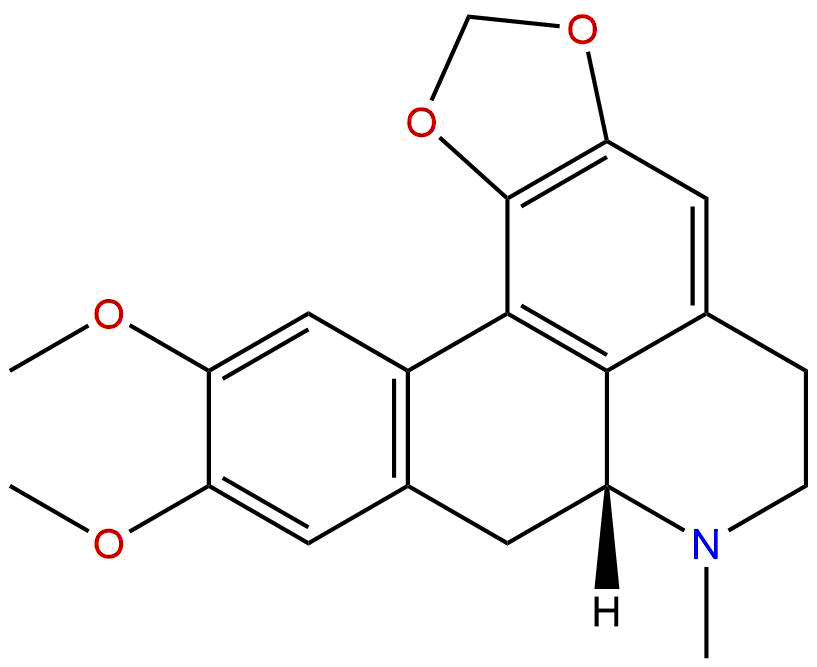


Synonym name: (R)-form; (-)-Dicentrine
Catalogue No.: BP0848
Cas No.: 28832-07-7
Formula: C20H21NO4
Mol Weight: 339.391
Botanical Source: Alkaloid from a Brazilian Duguetia sp. (Annonaceae)
Purity: 95%~99%
Analysis Method: HPLC-DAD or/and HPLC-ELSD
Identification Method: Mass, NMR
Packing: Brown vial or HDPE plastic bottle
Can be supplied from milligrams to grams.
For Reference Standard and R&D, Not for Human Use Directly.
Inquire for bulk scale.
Storage conditions:Short-term storage at 2~8℃, long-term storage at -20 ~ -80℃
L-Dicentrine is a natural alkaloid derived from the traditional Chinese medicinal plant Dicentra spp., derived from the traditional Chinese medicinal plant. As a natural compound with multi-target effects, L-encapsulated peonymine has demonstrated significant pharmacological activity in the field of analgesia and has gradually become a hot topic in natural product pharmacology research in recent years. Its unique chemical structure endows it with good bioactivity and superior pharmacokinetic characteristics, especially in its ability to penetrate the central nervous system. This paper aims to systematically review the chemical structure and physicochemical properties of L-pursed peony, plant origin and extraction methods, pharmacological activity and mechanism of action, druggability evaluation and pharmacokinetic characteristics, and to explore its clinical application prospects and future research directions.
L-Pocket Peonine has the molecular formula C20H21NO4, molecular weight 339.3910, and CAS number 28832-07-7. Its structural feature is a typical alkaloid framework, containing multiple aromatic rings and nitrogen-containing heterocycles, exhibiting certain stereochemical complexity. The compound has a LogP value of 3.0551, indicating moderate lipid solubility, which facilitates cell membrane penetration and distribution in vivo. Its topological pole surface area (TPSA) is 40.1600, indicating moderate molecular polarity, which is beneficial for the blood-brain barrier (BBB) permeability. Experimental data also confirm its high central nervous system penetration.
Its low water solubility (0.0370 mg/mL) suggests limited solubility in the aqueous phase, which may affect oral bioavailability, but its lipophilic solubility aids passive diffusion through cell membranes. hERG channel inhibition experiments showed that L-pursed peonine had no significant cardiotoxicity risk, while the Ames test value was 1.2, indicating low genotoxicity risk and a solid safety foundation.
L-Wallet Peonyrine is mainly found in the papavery family plant genus Dicentra spp., especially species such as Dicentra spectabilis and Dicentra eximia. Plants of this genus are widely distributed in North America and parts of East Asia, and have traditionally been used to treat pain, inflammation, and neurological disorders.
The extraction method typically uses organic solvent extraction combined with column chromatography for separation and purification. Common extraction solvents include methanol, ethanol, and their aqueous solutions. First, a mixture containing alkaloids is obtained through crude extraction, followed by acid-base extraction to enrich the alkaline components. Purification steps often use silica gel column chromatography, reversed-phase high-performance liquid chromatography (RP-HPLC), and other techniques to ensure the acquisition of high-purity L-pocketed peonymine.
In recent years, the application of ultrasound-assisted extraction (UAE) and microwave-assisted extraction (MAE) technologies has improved extraction efficiency and purity, while reducing solvent usage and extraction time, promoting large-scale preparation of this compound.
Pharmacological studies of L-pursed peonine mainly focus on analgesic effects, with in vivo and in vitro experiments showing significant relief effects on various pain models. Its analgesic effects cover various types including inflammatory pain, neuropathic pain, and chronic pain.
In animal experiments, L-pouch peonymine significantly reduced pain responses induced by heat and mechanical stimuli, demonstrating dose-dependent analgesic effects. Compared with traditional opioid analgesics, L-pouch peonyline relieves pain while having milder side effects, especially lower dependency and tolerance, demonstrating good clinical application potential.
In addition, L-pursed peonine also exhibits anti-inflammatory effects, inhibiting the release of inflammatory mediators and reducing tissue inflammatory responses. Its antioxidant activity has also been reported, possibly reducing nerve damage by scavenging free radicals and assisting in analgesic effects.
The analgesic mechanism of L-pursed peonine involves multiple molecular targets, reflecting its multi-target coordinated regulation. The main targets include:
TRPV1 (Vanillic Acid Subtype 1 Instantaneous Receptor Potential): TRPV1 is a key ion channel in pain perception. L-pouch peonyline regulates TRPV1 activity, inhibits calcium ion influx, reduces nerve excitability, and exerts analgesic effects.
CNR1 (Cannabinoid Receptor 1): As a G protein-coupled receptor in the central nervous system, CNR1 is involved in regulating pain transmission and emotional responses. L-pursed peonine stimulates CNR1 and helps enhance the activity of the endogenous analgesic system.
OPRD1 (δ-opioid receptor), OPRM1 (μ-opioid receptor), OPRK1 (κ-opioid receptor): These opioid receptors are targets of traditional analgesics. L-Pocket Pelastine modulates opioid receptors, especially μ and κ receptors, promoting the transmission of analgesic signals while reducing the risk of common opioid side effects.
PTGS1 (cyclooxygenase-1) and PTGS2 (cyclooxygenase-2): These two enzymes are key enzymes for prostaglandin synthesis, mediators of inflammation. L-pocket peonine reduces the production of inflammatory mediators by inhibiting PTGS1 and PTGS2 activities, exerting anti-inflammatory and analgesic effects.
TRPA1 (transient receptor potential acrolein subtype 1): TRPA1 is involved in the perception of inflammation and neuropathic pain, and its inhibitory effect on L-pouch peonine helps relieve pain and inflammatory responses.
SLC6A4 (serotonin transporter): This transporter regulates the reuptake of the neurotransmitter serotonin, affecting central pain regulation. L-Pocket Peonyine may improve pain-related mood disorders by regulating SLC6A4 activity.
DRD2 (Dopamine D2 receptor): The dopamine system is involved in pain regulation and emotional control. L-pursed peonine modulates DRD2, which may enhance analgesic effects and improve pain-related emotional symptoms.
In summary, L-pocketed peonymine regulates pain transmission and inflammatory responses through multi-target and multi-pathway synergistic effects, demonstrating its unique advantages as a natural analgesic.
From a druggability perspective, L-encapsulated peonymine has good drug similarity. Its molecular weight and LogP value comply with the Lipinski rule, suggesting good oral absorption potential. TPSA is moderate, which helps cross the blood-brain barrier and supports its effects on the central nervous system.
Low water solubility is a major challenge in formulation development, requiring improved bioavailability through technologies such as salt formation, nanocarriers, or liposomes. hERG channels have no inhibitory effect, reducing the risk of cardiotoxicity. Ames test results show a low genotoxicity risk and relatively ideal safety.
Pharmacokinetic studies show that L-pursed peonine is rapidly absorbed orally, has a moderate plasma half-life, and is widely distributed in the body, especially at high concentrations in brain tissue, aligning with its central analgesic mechanism. Liver metabolism is mainly completed through the CYP450 enzyme system, and the activity and toxicity of these metabolites require further research.
As a multi-target natural analgesic, L-pocket peony has broad clinical application potential. Its remarkable analgesic and anti-inflammatory properties, combined with a lower risk of side effects, make it promising as a novel treatment for chronic pain, neuropathic pain, and inflammatory diseases.
Future research should focus on the following aspects:
Preclinical safety and toxicology evaluation: Systematically assess the safety of long-term medication, identify potential toxicities and adverse reactions.
Pharmacokinetic optimization: Improving oral bioavailability through formulation improvement, prolonging duration of action, and reducing dosing frequency.
In-depth mechanism analysis: Using molecular biology and pharmacological techniques, further elucidating its multi-target synergistic mechanism to guide precise clinical drug use.
Clinical trial design: Conduct multicenter, randomized, double-blind clinical trials to verify efficacy and safety, and promote clinical translation.
Combination drug studies: Explore combined use with existing analgesics to evaluate synergistic effects and side effect reduction.
L-Pocket Peony, a natural alkaloid derived from traditional Chinese medicine, demonstrates excellent druggability and broad clinical application prospects thanks to its unique chemical structure and multi-target analgesic mechanism. Current pharmacological and pharmacokinetic studies have laid a solid foundation for its clinical development, but systematic preclinical and clinical studies are still needed to verify its safety and efficacy. In the future, with continuous advances in natural product pharmacology and medicinal chemistry technologies, L-pursed peonine is expected to become a new generation of highly efficient and safe analgesic drugs, bringing new breakthroughs to pain management.
