| Catalog No | Package | Original Price | Price | Inventory | Quantity | Operating |
|---|---|---|---|---|---|---|
| BP5046-5mg | 5mg | $450.00 | Sign in |
|


Storage conditions:Short-term storage at 2~8℃, long-term storage at -20 ~ -80℃
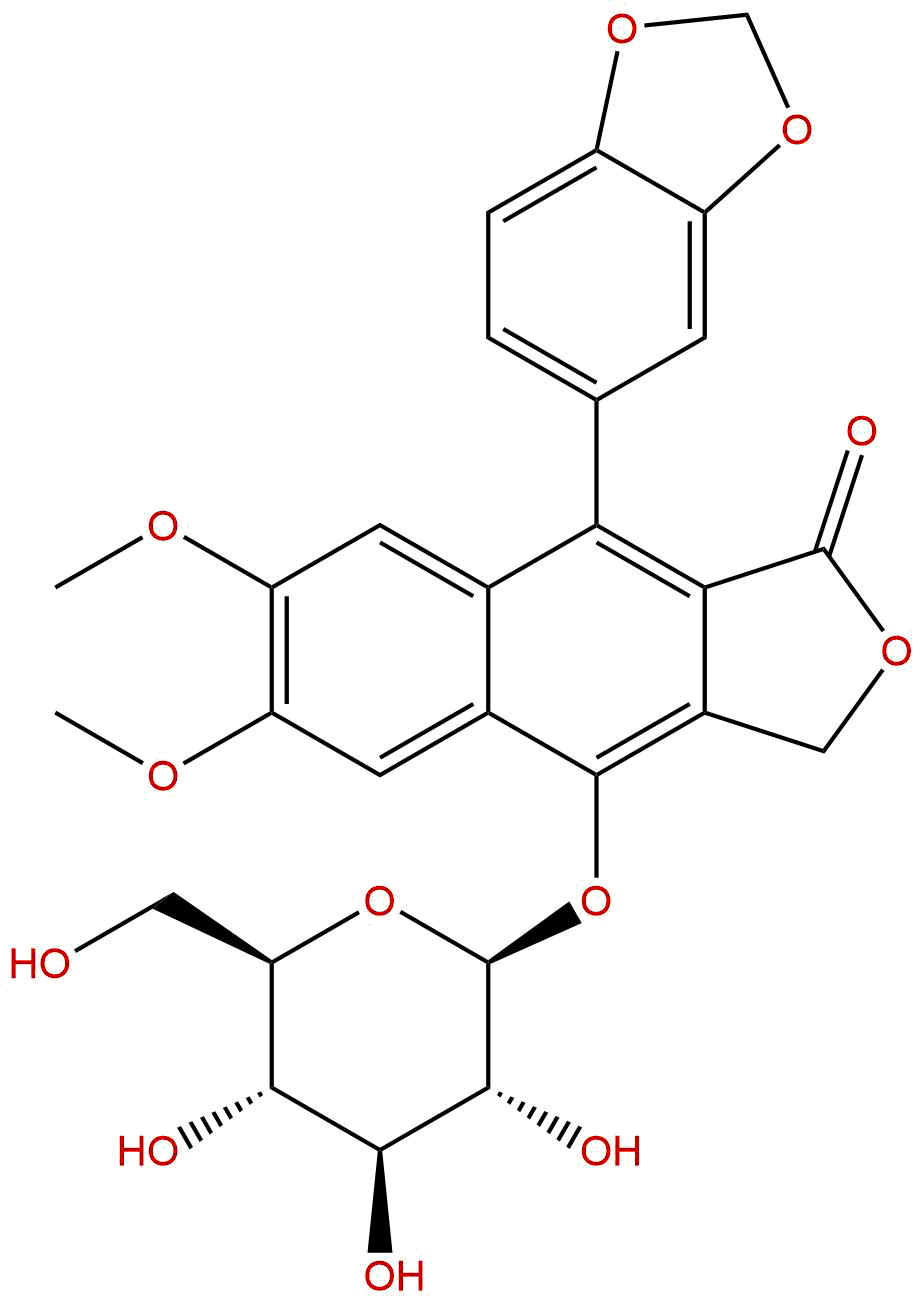
Diphyllin O-glucoside (CAS number: 30021-77-3) is a natural product with significant biological activity and belongs to the lignan class of compounds. In recent years, with the increasing demand for bone metabolism diseases and antiviral drug development, mountain lotus leaf extract O-glucoside has gradually attracted widespread attention from the scientific research community due to its unique pharmacological activity. This compound not only exhibits potent V-ATPase inhibition (IC50=17 nM), but also effectively inhibits HIV-1 virus replication (IC50=0.38 μ M), demonstrating its dual potential in antiviral and bone metabolism regulation fields. Especially in bone metabolism related diseases, mountain lotus leaf extract O-glucoside effectively inhibits bone resorption process by blocking lysosomal acidification and bone resorption pit acidification of osteoclasts (inhibiting acid influx with IC50=0.6 nM), while having no significant effect on bone formation of osteoblasts, indicating its promising application prospects in the treatment of osteoporosis and other diseases.
This article will provide a systematic review of the chemical structure and physicochemical properties, plant sources and extraction methods, pharmacological activity and mechanism of action, pharmacological evaluation, and clinical application prospects of O-glucoside, aiming to provide comprehensive and in-depth reference materials for researchers in related fields.
Mountain lotus leaf extract O-glucoside is a typical lignan glycoside compound with a molecular formula of C27H30O12 and a molecular weight of 542.4930. Its structural characteristics include a core structure of mountain lotus leaf extract connected to a glucose unit through an O-glycosidic bond. This structure endows it with good water solubility and biological activity.
In terms of physicochemical properties, the LogP value of mountain lotus leaf extract O-glucoside is 1.0331, indicating that it has moderate lipophilicity and is beneficial for oral absorption. Its topological polar surface area (TPSA) is 162.6 Å ², and its high polarity facilitates the binding of molecules to biomolecule targets. The water solubility is 0.1709 mg/mL, indicating that it has a certain solubility in water, which is convenient for formulation development. The low permeability of the blood-brain barrier suggests a lower risk of side effects in the central nervous system. The negative result of hERG channel inhibition experiment indicates a low risk of cardiac toxicity. The Ames test result is 0.9, indicating that the compound has no significant mutagenicity.
In summary, the physicochemical properties of mountain lotus leaf extract O-glucoside are suitable for oral administration and have a good safety basis.
The O-glucoside of mountain lotus leaf is mainly found in various plants rich in lignans, especially in the mountain lotus leaf (Diphylleia sinensis) and its related species with high content. In traditional Chinese medicinal materials, compounds of mountain lotus leaf extract are widely used in fields such as anti-inflammatory, analgesic, and regulation of bone metabolism.
The extraction method usually uses ethanol or methanol as solvents for extraction, combined with ultrasound assisted extraction technology to improve extraction efficiency. The extract was concentrated, liquid-liquid partitioned, and purified multiple times by column chromatography. Finally, it was separated and purified by high performance liquid chromatography (HPLC) to obtain high-purity kaempferol O-glucoside. In recent years, the application of supercritical CO2 extraction technology and membrane separation technology has also provided new ideas for the industrial extraction of this compound.
The optimization of the extraction process not only improves the yield, but also ensures the stability of the active ingredients of the compound, laying the foundation for subsequent pharmacological research and clinical applications.
As a highly efficient V-ATPase inhibitor, mountain lotus leaf extract O-glucoside plays a key role in regulating osteoclast function. V-ATPase is a key enzyme in osteoclast lysosomes and bone resorption invagination acidification, regulating the dissolution of bone matrix and bone resorption processes. Mountain lotus leaf extract O-glucoside effectively inhibits bone resorption by suppressing V-ATPase activity (IC50=17 nM), blocking lysosomal acidification of osteoclasts and acid influx into bone resorption pits (IC50=0.6 nM).
In vitro cell experiments have shown that mountain lotus leaf extract O-glucoside can significantly inhibit osteoclast mediated bone resorption without affecting the bone formation function of osteoblasts, indicating its potential for selective regulation of bone metabolism. Animal model studies have also confirmed that the compound can slow down the progression of osteoporosis and reduce levels of bone resorption markers.
Mountain lotus leaf extract O-glucoside showed significant inhibitory effect on HIV-1 virus, with an IC50 of 0.38 μ M. Its antiviral mechanism involves multiple targets, including various enzymes and receptors required for virus replication, such as HIV1 protease (HIV1-PR), integrase (INT), viral envelope glycoprotein gD, as well as CCR5 and CXCR4 receptors associated with virus entry. Through multi-target synergistic inhibition, mountain lotus leaf extract O-glucoside effectively blocks multiple key steps in the virus lifecycle.
In addition, mountain lotus leaf extract O-glucoside exhibits certain inhibitory activity against various viral proteins (such as UL42, UL54, ICP27, TK), indicating its broad-spectrum antiviral potential. Its low cytotoxicity and good oral activity make it a promising candidate drug for anti HIV and other viral infections.
Mountain lotus leaf extract O-glucoside directly binds to and inhibits the enzymatic activity of V-ATPase, blocking proton pump function and leading to inhibition of lysosomal and bone resorption lacunae acidification in osteoclasts. This process inhibits the dissolution of bone matrix and the bone resorption function of osteoclasts, reducing bone loss. The specificity of this mechanism gives it significant advantages in the treatment of bone metabolism diseases, avoiding negative effects on osteoblast bone formation.
Mountain lotus leaf extract O-glucoside inhibits HIV-1 virus replication through multi-target action. Its targets include:
Through the synergistic effect of multiple targets, mountain lotus leaf extract O-glucoside effectively reduces viral load and delays disease progression.
The pharmacological parameters of mountain lotus leaf extract O-glucoside show that it has good potential for drug development. The molecular weight of 542.4930 is within a reasonable range, and the LogP value of 1.0331 indicates moderate lipid solubility, which is beneficial for oral absorption. A higher TPSA (162.6 Å ²) suggests stronger polarity, which may affect membrane permeability, but its water solubility (0.1709 mg/mL) is helpful for formulation design.
The low permeability of the blood-brain barrier reduces the risk of central nervous system side effects. The negative inhibition of hERG channel and the absence of mutagenicity in Ames test further demonstrate its good safety.
In terms of pharmacokinetics, although the relevant data is currently limited, previous studies have shown that the oral bioavailability of mountain lotus leaf extract O-glucoside is high, and its metabolism is stable in vivo. It is mainly metabolized through the liver metabolic enzyme system, and the excretion pathway is mainly through the kidneys. Further systematic pharmacokinetic and toxicological studies are needed in the future to support clinical development.
Mountain lotus leaf extract O-glucoside has shown broad application prospects in both bone metabolism diseases and antiviral fields. In osteoporosis and bone resorption related diseases such as rheumatoid arthritis and bone metastases, selective inhibition of osteoclast function without affecting osteoblasts provides a new therapeutic strategy that is expected to overcome the side effects and resistance issues of existing anti bone resorption drugs such as bisphosphonates.
In the field of antiviral therapy, the multi-target inhibition of HIV-1 virus replication by mountain lotus leaf extract O-glucoside provides a potential new drug candidate for antiretroviral therapy. Its oral efficacy and low toxicity advantages make it suitable for long-term treatment. In addition, its inhibitory effect on other viral proteins suggests potential value in the development of broad-spectrum antiviral drugs.
In the future, it is necessary to strengthen the preclinical pharmacokinetics, toxicology, and pharmacodynamics research of mountain lotus leaf extract O-glucoside, explore its potential for combination therapy, and optimize its dosage form. At the same time, based on its structural characteristics, structural modification and drug design are expected to obtain more efficient and safer derivatives, promoting their clinical translation.
Mountain lotus leaf extract O-glucoside, as a natural product with significant V-ATPase inhibitory activity and anti-HIV-1 viral activity, has dual functions of bone metabolism regulation and antiviral activity. Its unique mechanism of action, good pharmacological properties, and safety provide new ideas and directions for the development of bone metabolism diseases and antiviral drugs. With the deepening of research, mountain lotus leaf extract O-glucoside is expected to become an important candidate drug for the treatment of diseases such as osteoporosis and HIV infection. Future systematic research and clinical validation will further reveal its potential and drive it towards clinical applications.
