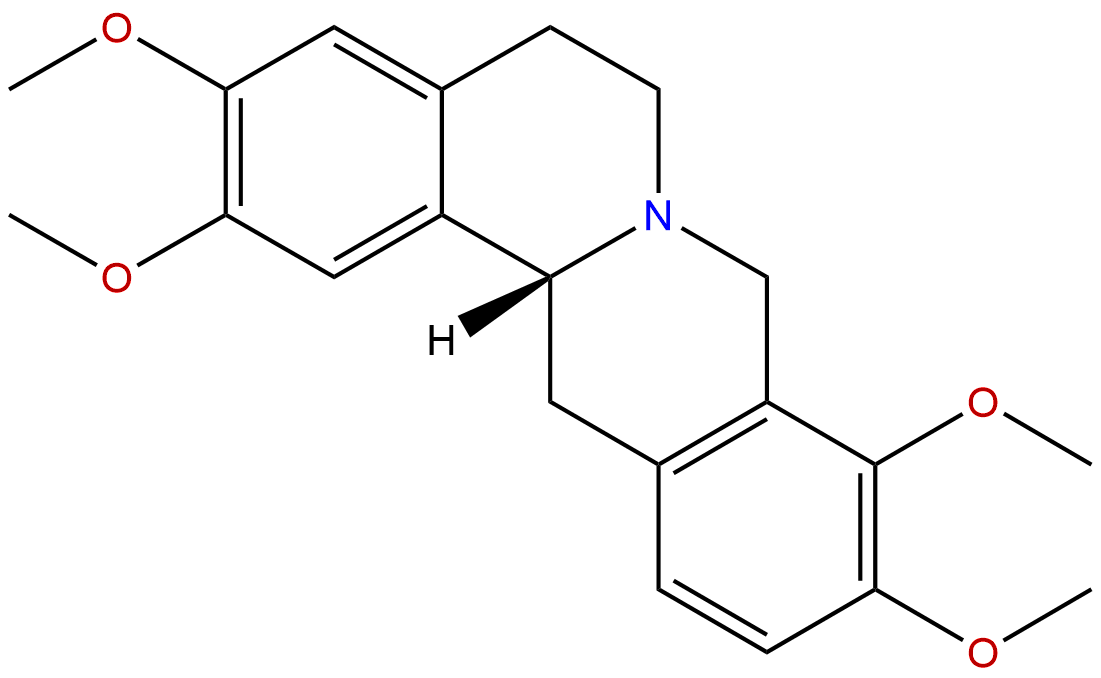


Synonym name: (S)-form; Rotundine; (S)-Tetrahydropalmatine; Hyndarine; Gindarine
Catalogue No.: BP0888
Cas No.: 483-14-7
Formula: C21H25NO4
Mol Weight: 355.434
Botanical Source: Alkaloid from Corydalis spp. and Pachypodanthium confine (Fumariaceae, Annonaceae)
Purity: 95%~99%
Analysis Method: HPLC-DAD or/and HPLC-ELSD
Identification Method: Mass, NMR
Packing: Brown vial or HDPE plastic bottle
Can be supplied from milligrams to grams.
For Reference Standard and R&D, Not for Human Use Directly.
Inquire for bulk scale.
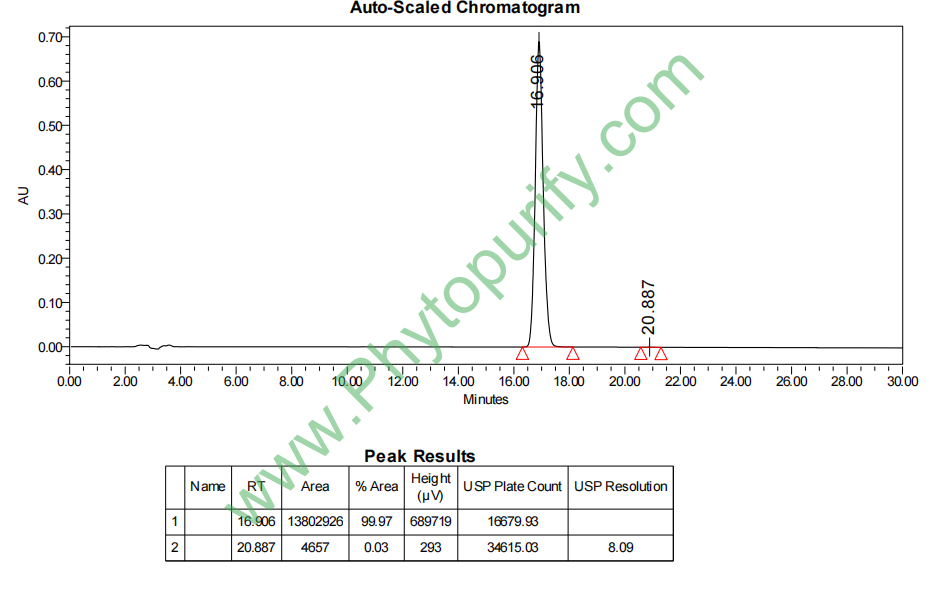
HPLC of L-Tetrahydropalmatine
Storage conditions:Short-term storage at 2~8℃, long-term storage at -20 ~ -80℃
L-tetrahydropalmatine (L-Tetrahydropalmatine, abbreviated as L-THP) is an important berberine alkaloid, first isolated from traditional Chinese medicinal plants. It has attracted widespread attention due to its unique pharmacological activity and good safety profile. As a (S)-7,8,13,14-tetrahydroberberine, L-THP structurally belongs to the organic heterocyclic tetracyclic compound with multiple neuromodulatory functions, exhibiting various pharmacological effects including non-narcotic analgesia, adrenergic regulation, and dopamine receptor antagonism. In recent years, with in-depth research into its molecular targets and mechanisms of action, L-THP's potential applications in analgesia, addiction treatment, and neuropsychiatric disorders have gradually emerged, making it a research hotspot in the field of natural product pharmacology.
This paper aims to systematically review the chemical structure and physicochemical properties, plant origin, and extraction methods of L-tetrahydropalmatine, focusing on analyzing its pharmacological activity and mechanism of action. By combining druggability evaluation and pharmacokinetic data, it explores its clinical application prospects and development directions, providing theoretical basis and reference for related research and drug development.
The chemical structure of L-tetrahydropalmatine is based on the berberine skeleton, forming tetrahydrogen derivatives through the hydrogenation reaction of the pyridine ring in the palmatine molecule. Its molecular formula is C21H25NO4, and its molecular weight is 355.4340. L-THP is a (S)- configuration with specific stereochemical characteristics, which significantly affect its binding affinity and selectivity for various neurotransmitter receptors.
In terms of physicochemical properties, L-THP has a LogP value of 3.3789, indicating moderate lipid solubility that facilitates penetration of biological membranes, especially the blood-brain barrier (BBB). Its high BBB permeability indicates that this compound can effectively enter the central nervous system to exert its effects. The Polarized Surface Area (TPSA) is 40.1600, classified as a low-polarity compound, which facilitates oral absorption and brain distribution. Low water solubility (0.0234 mg/mL) suggests that strategies to improve solubility should be considered in formulation development. Safety evaluations showed that L-THP does not inhibit hERG channels, and Ames-induced mutagenic tests were negative, indicating low cardiotoxicity and genotoxicity risks and a solid safety foundation.
L-tetrahydropalmatine is mainly found in various Chinese medicinal materials, especially Corydalis yanhusuo and related species from the Berberidaceae family. Bamazine alkaloids are widely distributed in the rhizomes of plants of this genus and are important components in traditional Chinese medicine analgesic medicines.
The extraction process typically combines organic solvent extraction with acid-base separation. The specific steps include:
Modern extraction technologies such as ultrasound-assisted extraction, microwave-assisted extraction, and membrane separation have been introduced to improve extraction efficiency and purity, while reducing solvent usage, aligning with the concept of green chemistry.
The pharmacological activity of levotetrahydroparmatine is mainly concentrated in the central nervous system, showing diverse neuromodulatory functions, with its non-narcotic analgesic effects being particularly notable. Moreover, its regulatory role in the neurotransmitter system has led to potential therapeutic effects in models of addictive behaviors, anxiety, and depression.
As a non-narcotic analgesic, L-THP can effectively relieve various types of pain, including neuropathic pain, inflammatory pain, and chronic pain. Its analgesic effect differs from traditional opioids, with a lower risk of addiction and side effects. In vivo and in vitro experiments have shown that L-THP can significantly reduce pain responses caused by thermal and mechanical stimuli, and exhibits long-lasting analgesia in models of chronic nerve injury.
L-THP antagonizes dopamine receptors (especially D2 receptors), regulates dopaminergic neural transmission, and influences movement, mood, and reward mechanisms. Additionally, it acts on the adrenergic system, regulates sympathetic nervous system activity, and has anti-anxiety and antidepressant potential.
Research shows that L-THP also has anti-inflammatory, antioxidant, and neuroprotective effects, which may reduce nerve cell damage and promote neurological function recovery by regulating inflammatory mediators and oxidative stress pathways.
The multi-target mechanism of L-tetrahydropalmatine forms the basis for its pharmacological diversity. The main targets include:
The synergistic effects of these targets enable L-THP to exhibit multiple pharmacological effects in analgesia, anti-addiction, and anxiety relief.
From a druggability perspective, L-tetrahydroparmatine has promising drug development potential. Its molecular weight is moderate, and its lipid solubility and polarization area are within the ideal range for oral small molecule drugs. High blood-brain barrier permeability ensures its effective concentration in the central nervous system. In terms of safety, there was no significant hERG channel inhibition or genotoxicity, reducing the risk of cardiotoxicity and mutagenicity.
Pharmacokinetic studies show that L-THP is well absorbed orally, has a moderate plasma half-life, and possesses good bioavailability. Its metabolism is mainly through hepatic enzyme systems, including the CYP450 family, whose metabolites have certain activity and may participate in drug efficacy. The main excretory pathways are the kidneys and bile. Optimization of pharmacokinetic parameters provides a basis for clinical dose design and formulation of dosing regimens.
As a naturally derived non-narcotic analgesic, L-tetrahydropalmatine has broad clinical application prospects. It demonstrates advantages in chronic pain management and neuropathological pain treatment, especially suitable for patients who are long-term medication users and avoid the risk of opioid dependence. Additionally, L-THP's regulatory role in the dopamine system in detox treatment offers new ideas for adjunctive treatment of addictive diseases.
Future research should further clarify its mechanism of action, optimize drug formulations, and improve bioavailability and targeting. At the same time, large-scale clinical trials are being conducted to systematically evaluate efficacy and safety, promoting the transition from laboratory research to clinical application. In addition, the design and synthesis of L-THP derivatives also provide direction for the development of novel central nervous system drugs.
As a natural alkaloid with multiple neuromodulatory functions, L-tetrahydropalmatine demonstrates broad pharmacological activity and clinical application potential due to its unique chemical structure and good druggability. Its research in pain relief, addiction treatment, and neuropsychiatric disorders has deepened, driving the development of natural product pharmacology. In the future, through multidisciplinary integration and modern medicinal chemistry and molecular pharmacology technologies, L-tetrahydroparmatine is expected to become a safe and effective central nervous system drug, offering new options for clinical treatment.
