Introduction/Overview
Natural products, as an important source of drug discovery and development, have played an irreplaceable role in the long history of human fight against diseases. Febrifugine is derived from the traditional Chinese medicine Changshan(Dichroa febrifuga The quinazolinone alkaloids isolated from Lour. have significant antimalarial activity, but their strong antimalarial efficacy is limited in clinical applications due to the accompanying severe gastrointestinal toxicity. To overcome this deficiency, scientists have made a series of modifications and optimizations to its structure, and Halofuginone hydrobromide (RU-19110) is one of the most representative derivatives. Since its synthesis in the 1970s, research on hydrobromic acid ketone has far exceeded its initial anti malaria scope. Research has found that it is a competitive, high affinity inhibitor of Prolyl tRNA synthetase (ProRS), which specifically inhibits the synthesis of type I collagen by interfering with the tRNA loading of proline. This core mechanism has shown broad application prospects in fields such as anti fibrosis, anti-tumor, anti-inflammatory, and immune regulation. In recent years, its new pharmacological activities in disease models such as pulmonary hypertension and osteoarthritis have been continuously revealed, further expanding its potential therapeutic boundaries. This article aims to systematically review the chemical properties, pharmacological activities, molecular mechanisms of action, pharmacological characteristics, and clinical application prospects of hydrobromic acid ketone, in order to provide a comprehensive academic perspective for the in-depth research and development of this multi-target and multi active natural product derivative.
Chemical structure and physicochemical properties
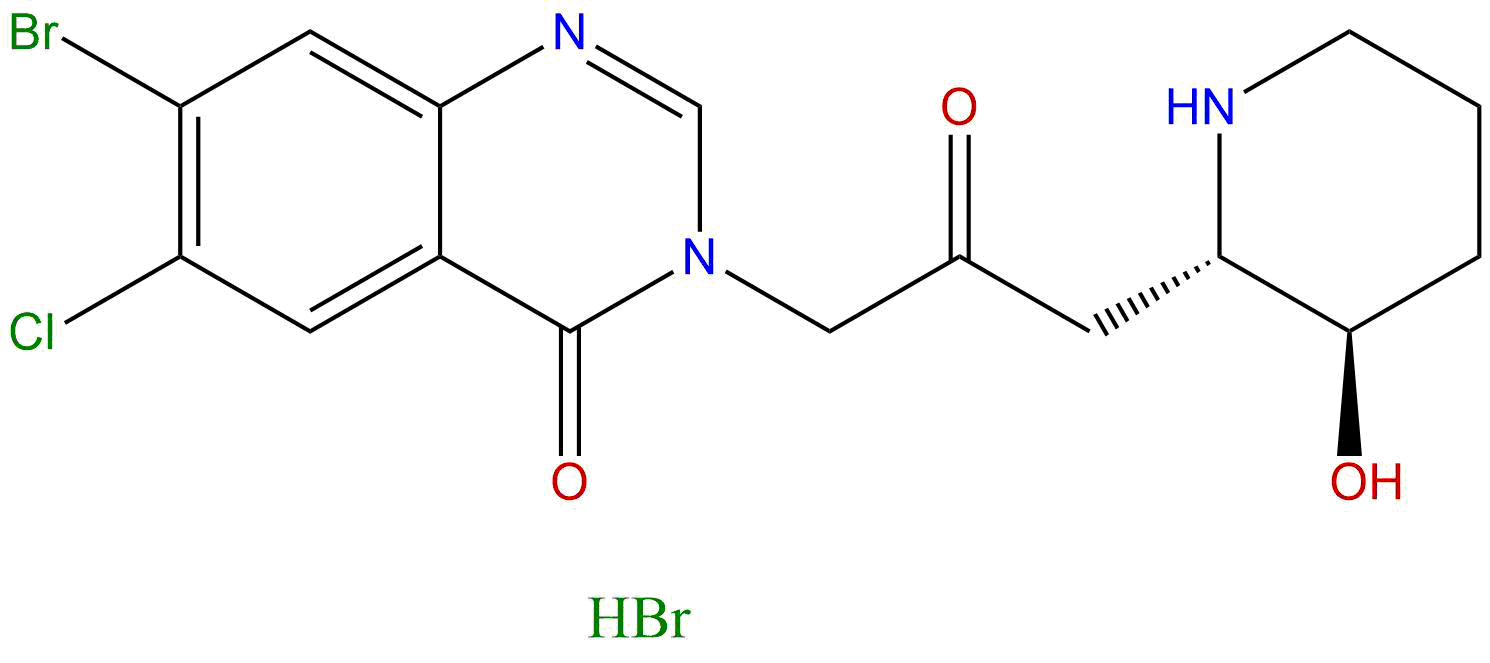
The chemical name of hydrobromic acid Changshanketone is 7-bromo-6-chloro-3- [3- (3-hydroxy-2-piperidinyl) -2-oxopropyl] -4 (3H) - quinazolinone hydrobromide, with a CAS number of 64924-67-0. Its molecular formula is C ₁₆ H ₁₇ BrClN ∝ O ∝ · HBr, and its molecular weight is 414.6870. Structurally, it retains the core skeleton of the parent compound, quinazolinone, and introduces bromine and chlorine atoms at positions 7 and 6, respectively. At the same time, the side chain is optimized and ultimately exists in the form of hydrobromide, significantly improving its solubility and stability.
In terms of physicochemical properties, the lipid water partition coefficient (LogP) of hydrobromic acid ketone is 1.28, indicating its moderate lipophilicity and favorable transmembrane transport. Its topological polar surface area (TPSA) is 84.22 Å ², reflecting the presence of multiple hydrogen bond acceptor and donor sites in the molecule. The water solubility data (approximately 1.83 mg/mL) shows that it is slightly soluble to soluble, and its salt form enhances its solubility in aqueous media, which is crucial for formulation development and in vivo administration. Preliminary pharmacological parameter predictions indicate that the compound has a high blood-brain barrier permeability potential, which provides a possibility for its application in central nervous system related diseases such as glioma. In addition, key toxicity warning indicators showed no significant inhibitory effect on hERG potassium channels (hERG inhibition: no), reducing the risk of inducing QT interval prolongation in the heart; The Ames test result is 1.2, indicating a low risk of mutagenicity, which lays a relatively safe foundation for further drug development.
Plant sources and extraction methods
Hydrobromic acid Changshanketone is not directly derived from plants, but is a derivative obtained through a semi synthetic pathway using natural product Changshanalkaloid as the lead compound. Its source, Changshan alkali, is extracted from the plant Changshan in the family Saxifragaceae(Dichroa febrifuga Dry roots of Lour. Changshan, as a traditional anti malaria Chinese medicine, has a long history of use and is recorded in the "Shennong Bencao Jing".
The extraction of Changshan alkali usually adopts the classic natural product separation process of organic solvent extraction combined with chromatographic separation. The general steps are as follows: After drying and crushing the roots of Changshan, heat and reflux with polar solvents such as ethanol or methanol for extraction. Combine the extracts and concentrate them under reduced pressure to obtain the extract. The extract is then dissolved in acidic water (such as dilute hydrochloric acid), filtered out of insoluble substances, alkalized (such as using ammonia water) to precipitate alkaloids, or extracted with organic solvents (such as chloroform) to obtain the total alkaloid fraction. Further separation and purification were carried out using techniques such as silica gel column chromatography and high-performance liquid chromatography (HPLC) to obtain the monomer of Changshan alkaloid. Due to the high toxicity of Changshan alkaloid, its direct medicinal use is limited.
The synthesis of hydrobromic acid Changshanketone is based on Changshanalkaline as the starting material, and is prepared through multiple chemical reactions such as halogenation (bromination and chlorination), side chain protection and modification, and salt formation. This half of the synthesis process not only achieves structural modification of the parent nucleus to reduce toxicity and improve activity, but also ensures that the compound can be produced in a standardized and large-scale manner, meeting the needs of pharmacological research and clinical development. Therefore, its "plant origin" is more accurately described as "plant inspired, chemically synthesized".
Pharmacological activity research
Hydrobromic acid Changshanketone exhibits a wide range of pharmacological activities, and its research has expanded from the initial anti parasitic field to multiple major medical fields such as fibrosis diseases, tumors, inflammation, and vascular diseases.
1. Anti malaria activity:
As a derivative of Changshan alkaloid, hydrobromic acid Changshan ketone inherits strong anti malaria activity. It exhibits nanomolar level inhibitory efficacy against various strains of malaria parasites, including chloroquine sensitive and resistant strains. Its anti malarial effect involves multiple targets, not only interfering with protein synthesis by inhibiting the prolyl tRNA synthase of malaria parasites, but also possibly affecting the functions of multiple key proteins of malaria parasites such as PfCRT (chloroquine resistance transporter), PfMDR1 (multidrug resistance protein), PfDHFR (dihydrofolate reductase), etc., thereby overcoming or delaying the development of drug resistance. The potential role of PfK13 (Kelch13 protein) and other related targets has also attracted attention in the prevention and treatment of artemisinin resistant malaria.
2. Anti fibrotic effect:
This is one of the most notable pharmacological activities of hydrobromic acid ketone. It can specifically inhibit the synthesis of type I and type III collagen, with little effect on other types of collagen. In preclinical animal models of liver fibrosis, pulmonary fibrosis (such as idiopathic pulmonary fibrosis), renal fibrosis, skin fibrosis (such as scleroderma), and myocardial fibrosis, berberine hydrobromide can significantly reduce collagen deposition and improve organ structure and function. Its anti fibrotic effect is not only derived from directly inhibiting collagen synthesis, but also closely related to its subsequent discovery of anti-inflammatory and immune regulatory effects.
3. Antitumor activity:
Hydrobromic acid ketone exerts anti-tumor effects through various mechanisms. Firstly, its inhibitory effect on collagen synthesis can disrupt the tumor matrix, affecting the growth and metastasis microenvironment of the tumor. Secondly, it can inhibit tumor angiogenesis. More importantly, it can induce tumor cell cycle arrest, promote apoptosis, and enhance sensitivity to chemotherapy drugs by activating the amino acid starvation response (AAR) pathway, inhibiting TGF - β/Smad signaling transduction. Studies have confirmed that it has inhibitory effects on a variety of solid tumors (such as colorectal cancer, breast cancer, glioma, pancreatic cancer) and blood tumors (such as multiple myeloma, T-cell lymphoma).
4. Anti inflammatory and immune regulatory activity:
Hydrobromic acid can significantly inhibit the production of pro-inflammatory cytokines (such as IL-1 β, IL-6, TNF - α) and regulate the differentiation and function of immune cells. For example, it can inhibit the differentiation of Th17 cells (which are associated with various autoimmune diseases), while promoting the production of regulatory T cells (Tregs), thereby restoring immune balance. This characteristic demonstrates therapeutic potential in autoimmune disease models such as rheumatoid arthritis, multiple sclerosis, and inflammatory bowel disease.
5. Treatment of osteoarthritis:
In the osteoarthritis model, hydrobromic acid ketone can reduce the degeneration of articular cartilage, inhibit osteophyte formation and synovial fibrosis, protect joint structure, relieve pain by inhibiting TGF - β activity, providing new ideas for the disease modification and treatment of osteoarthritis.
6. Pulmonary vasodilation and treatment of pulmonary arterial hypertension:
The latest research has found that hydrobromic acid ketone is an effective pulmonary vasodilator. The mechanism involves activating voltage-gated potassium channels (Kv) and blocking calcium ion channels involved in voltage-gated, receptor operated, and storage operated processes, thereby reducing intracellular calcium ion concentration in pulmonary artery smooth muscle cells and inducing vasodilation. In animal models of pulmonary arterial hypertension, it can reduce pulmonary artery pressure, reverse right ventricular hypertrophy, and demonstrate therapeutic potential.
Mechanism of action and molecular targets
The core mechanism of action of hydrobromic acid ketone is as a competitive inhibitor of prolyl tRNA synthase (ProRS). ProRS is a member of the aminoacyl tRNA synthetase family, responsible for linking proline to the corresponding tRNA during protein translation, forming Pro tRNA ^ Pro. Hydrobromic acid ketone binds to the active site of ProRS with high affinity (Ki=18.3 nM), competing with substrates proline and ATP to prevent the generation of Pro tRNA ^ Pro.
This initial enzyme inhibition event triggered a series of downstream cellular stresses and signal pathway reprogramming:
Activation of the Amino Acid Hunger Response (AAR) Pathway:
The depletion of Pro tRNA ^ Pro leads to the accumulation of unloaded tRNA, which is perceived by cells as a proline "starvation" state. Furthermore, it activates the conservative GCN2-eIF2 α - ATF4 signaling axis. ATF4, as a transcription factor, upregulates the expression of a series of stress response genes.
2. Specific inhibition of collagen synthesis:
The activated AAR pathway, especially ATF4, specifically downregulates the transcription of extracellular matrix proteins such as type I collagen (COL1A1 and COL1A2). The specific mechanism involves the interaction between ATF4 and the collagen gene promoter region, and may be achieved by inhibiting the activity of downstream signaling molecules such as Smad3 and TGF - β. This is the direct molecular basis for the anti fibrotic effect of hydrobromic acid ketone.
3. Inhibition of TGF - β signaling pathway:
TGF - β is a key cytokine that promotes fibrosis and tumor growth. Hydrobromic acid can interfere with TGF - β signal transduction through the AAR pathway, inhibit Smad2/3 phosphorylation and nuclear translocation, thereby blocking TGF - β - mediated gene expression. This mechanism is crucial in its anti fibrotic, anti-tumor, and osteoarthritis relieving effects.
4. Regulation of immune cell differentiation:
By inhibiting ProRS and activating AAR, hydrobromic acid can affect the differentiation fate of T cells. It can inhibit the expression of the key transcription factor ROR γ t that induces Th17 cell differentiation, while promoting the expression of the key transcription factor Foxp3 that induces Treg cell differentiation, thereby exerting immunomodulatory effects.
5. Ion channel regulation (cardiovascular function):
Its pulmonary vasodilation effect is independent of ProRS inhibition, mainly achieved through direct regulation of ion channels: activating Kv channels leads to cell membrane hyperpolarization, while blocking multiple calcium ion channels (voltage-gated, receptor operated, and storage operated calcium channels) to prevent calcium influx, collectively leading to vascular smooth muscle relaxation.
6. Multi target antimalarial effect:
In malaria parasites, in addition to inhibiting PfProRS, its antimalarial activity may also involve interactions with multiple resistance related or essential proteins such as PfCRT, PfMDR1, PfDHFR, PfATP6 (calcium ion pump), forming a multi-target attack network, which may be its advantage in combating drug resistance.
Evaluation of drug properties and pharmacokinetics
Based on its physicochemical parameters and existing research, hydrobromic acid ketone has shown certain potential as a drug, but also faces challenges.
Pharmacokinetic characteristics:
Animal pharmacokinetic studies have shown that hydrobromic acid ketone is rapidly absorbed after oral administration, but its absolute bioavailability varies depending on the species and dosage form, typically in the moderate range. It is widely distributed in the body, and due to its high lipid solubility and moderate molecular weight, it can penetrate into various tissues, including fibrotic lesions and tumor tissues. The predicted high blood-brain barrier permeability has been indirectly confirmed in some brain tumor models. In terms of metabolism, it mainly undergoes oxidative metabolism through the liver cytochrome P450 enzyme system (such as CYP3A4) and may undergo glucuronic acid binding reactions. The prototype drug and its metabolites are mainly excreted through bile and kidneys. The half-life varies among different species, and overall, it belongs to compounds with medium to short half lives, which may require multiple daily administrations or the use of sustained-release formulations to maintain effective blood drug concentrations.
Safety evaluation:
The severe gastrointestinal toxicity (vomiting, diarrhea) of Changshan alkaloid has been greatly reduced by hydrobromic acid Changshan ketone, but it has not been completely eliminated. The dose limiting toxicity is still mainly gastrointestinal reactions. Other potential toxicities include effects on embryonic development (teratogenic, contraindicated for pregnant women), as well as possible liver and kidney function effects at high doses. It is worth noting that its lack of significant hERG inhibitory properties reduces the risk of cardiac toxicity, and a negative Ames test has preliminarily ruled out genotoxicity alerts. The safety of long-term medication still needs to be closely monitored in clinical trials targeting different indications.
Formulation development:
To improve efficacy and reduce side effects, researchers are exploring various delivery strategies. It includes the development of enteric coated preparations to reduce gastric irritation, the preparation of targeted delivery systems such as liposomes and nanoparticles to improve the accumulation in fibrotic tissues or tumor sites, and the development of local dosage forms (such as gel and aerosols) for intra-articular administration of skin fibrosis or osteoarthritis, aiming to achieve a treatment mode of high local concentration and low systemic exposure.
Clinical application prospects and prospects
Hydrobromic acid Changshanketone has evolved from a derivative of traditional antimalarial Chinese medicine to a multifunctional small molecule that acts on core biological pathways (proline metabolism and protein synthesis), with broad and challenging clinical application prospects.
Current progress:
At present, berberine hydrobromide has been approved as a veterinary drug in multiple countries worldwide for the prevention of poultry coccidiosis and the treatment of idiopathic pulmonary fibrosis (commonly known as "bovine emphysema") in cattle. This has accumulated a wealth of safety and efficacy practical experience for its human application. In terms of human clinical trials, its research mainly focuses on the field of anti fibrosis. Early (phase I/II) clinical trials have been completed or are currently underway for diseases such as scleroderma, idiopathic pulmonary fibrosis, and myelofibrosis. Preliminary results show that they can reduce disease-related biomarkers (such as collagen metabolites) and demonstrate the potential to improve symptoms. In the field of cancer, it is mainly used as an adjuvant therapy drug, combined with chemotherapy or targeted drugs, aiming to enhance efficacy and overcome drug resistance. Relevant clinical trials are being explored.
Future directions and challenges:
1. Indications expansion: Based on its newly discovered mechanisms, such as the treatment of pulmonary arterial hypertension and osteoarthritis, it is worth conducting systematic preclinical validation and subsequent clinical research. Its application in autoimmune diseases and anti fibrosis after organ transplantation also has great potential.
2. Precision Medicine and Biomarkers: It is crucial to search for biomarkers that can predict the efficacy of hydrobromic acid ketone. For example, patients with subtypes of high proline dependence, active TGF - β signaling, or vigorous collagen synthesis in tumor or fibrotic tissues may benefit more. Monitoring the activation status of the AAR pathway (such as p-eIF2 α, ATF4 levels) may help evaluate target engagement and treatment response.
3. Combination therapy strategy: Combining it with existing standard therapies (such as anti fibrotic pirfenidone/nintedanib, anti-tumor chemotherapy/immunotherapy) may produce synergistic effects and is a mainstream research and development strategy for improving efficacy.
4. Reduce toxicity and optimize administration: The key to maximizing therapeutic index and reducing gastrointestinal toxicity is to achieve targeted drug delivery through advanced drug delivery technology. Developing prodrugs or searching for analogues with comparable activity and lower toxicity is also an important direction.
5. Overcoming drug resistance: Although its multi-target nature helps to delay antimalarial resistance, prospective studies are needed to investigate whether and how cells develop adaptive resistance to it in long-term anti fibrotic or anti-tumor treatments.
Conclusion
The research process of hydrobromic acid ketone is a model of deepening and expanding from traditional medical wisdom through modern chemical and biological methods. It has successfully transformed from an efficient anti malaria compound into a multi-target small molecule probe and candidate drug with unique anti fibrotic, anti-tumor, anti-inflammatory, and immunomodulatory activities centered on inhibiting prolyl tRNA synthase. The study of its mechanism of action not only reveals the profound connection between proline metabolism and physiological and pathological processes such as collagen synthesis, immune response, and tumor growth, but also provides new intervention ideas for the treatment of related diseases. Despite facing multiple challenges such as efficacy optimization, toxicity management, and administration strategies on the road to becoming a heavyweight drug for humans, the existing successful experience in animal use and the constantly emerging preclinical evidence bring practical hope for its future application in major chronic diseases such as fibrosis, tumors, autoimmune diseases, and vascular diseases. With the deepening of precision medicine concepts and advances in drug delivery technology, hydrobromic acid ketone is expected to achieve its therapeutic value in specific patient populations, continuing a new chapter in the development of natural product derived drugs in modern medicine.