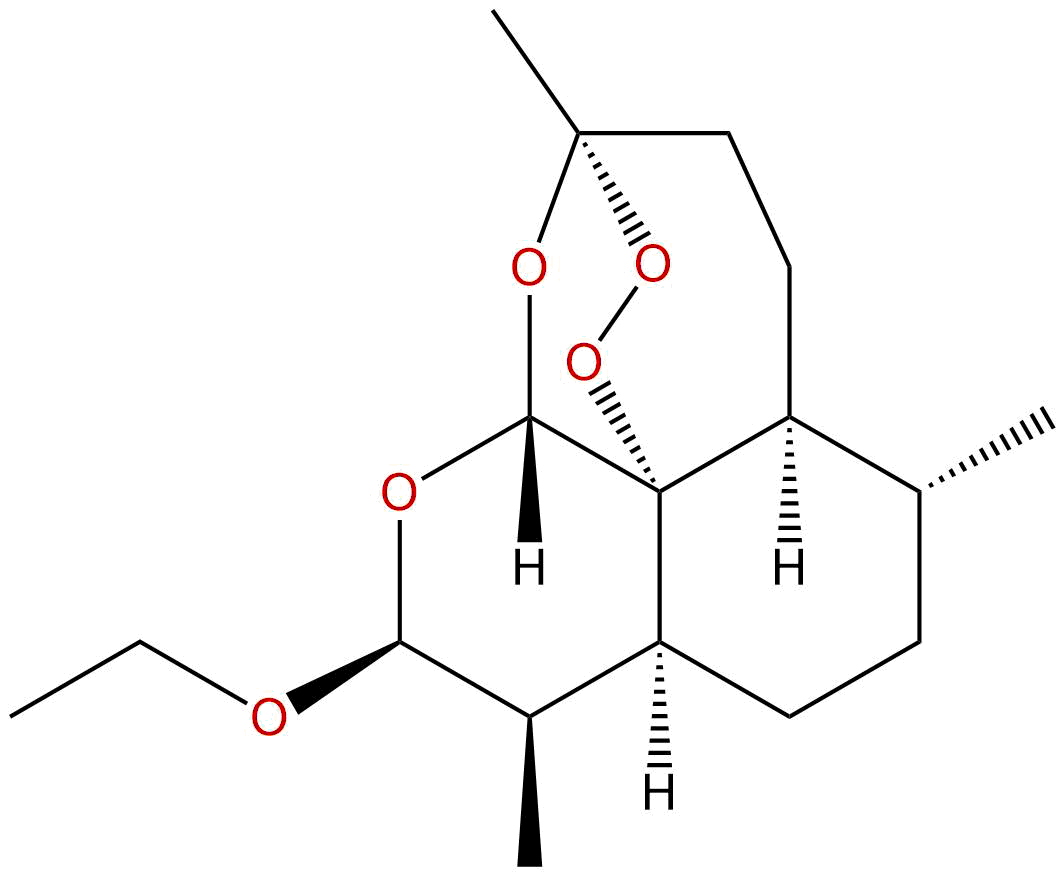


Product name: Arteether
Synonym name: Artemotil; Dihydroartemisinin ethyl ether; Dihydroqinghaosu ethyl ether
Catalogue No.: BP4357
Cas No.: 75887-54-6
Formula: C17H28O5
Mol Weight: 312.406
Botanical Source:
Type of Compound:
Purity: 95%~99%
Analysis Method: HPLC-DAD or/and HPLC-ELSD
Identification Method: Mass, NMR
Packing: Brown vial or HDPE plastic bottle
Storage: Store in a well closed container, protected from air and light. Put into refrigerate or freeze for long term storage.
Whenever possible, you should prepare and use solutions on the same day. However, if you need to make up stock solutions in advance, we recommend that you store the solution as aliquots in tightly sealed vials at -20℃. Generally, these will be useable for up to two weeks.
The product could be supplied from milligrams to grams
Inquire for bulk scale.
For Reference Standard and R&D, Not for Human Use Directly.
Storage conditions:Short-term storage at 2~8℃, long-term storage at -20 ~ -80℃
Arteether, as a semi synthetic derivative of artemisinin, has attracted much attention since the late 20th century due to its excellent anti malarial activity. Malaria, as a parasitic disease that threatens public health worldwide, is particularly prevalent in tropical and subtropical regions, seriously affecting the lives and health of hundreds of millions of people. The discovery and application of artemisinin and its derivatives have greatly promoted the progress of malaria treatment and become a milestone in the development of anti malaria drugs. Artemisia ether has become one of the important anti malaria drugs in clinical practice due to its excellent efficacy and low toxicity.
This article provides a systematic review of the chemical structure and physicochemical properties, plant sources and extraction methods, pharmacological activity and mechanism of action, pharmacological evaluation and pharmacokinetic characteristics of artemether, combined with its clinical application status and future development trends, aiming to provide comprehensive and in-depth academic references for researchers in the field of natural product pharmacology.
The chemical name of artemether is artemether, CAS number 75887-54-6, molecular formula C16H26O5, molecular weight 312.4060. Its structure is based on the lactone skeleton of artemisinin, belonging to the sesquiterpene lactone class compounds, characterized by the presence of a peroxide bridged ring structure, which is the key structural basis for its anti malaria activity.
In terms of physical and chemical properties, the LogP value of artemether is 3.2931, indicating its moderate lipid solubility, which is beneficial for cell membrane penetration and in vivo distribution. Its topological polar surface area (TPSA) is 46.15 Å ², indicating moderate polarity and good drug permeability. Low water solubility (0.0119 mg/mL) suggests limited solubility in the aqueous phase, but this can be overcome to some extent through formulation techniques. Artemisia ether has a high blood-brain barrier penetration ability, which has potential advantages for the treatment of cerebral malaria. In addition, artemether does not exhibit hERG channel inhibitory activity, reducing the risk of cardiac toxicity. The Ames test result is 1.5, indicating a low risk of genotoxicity.
The parent compound artemisinin of artemether mainly comes from the traditional Chinese medicine plant Artemisia annua L. The discovery of artemisinin and its derivatives is attributed to the systematic isolation and identification of active ingredients in Artemisia annua. The natural content of artemisinin is relatively low, usually between 0.01% and 1.5%, and optimizing the extraction process is crucial for industrial production.
Traditional extraction methods include solvent extraction, liquid-liquid extraction, and chromatographic separation. Modern processes often use supercritical fluid extraction and high-performance liquid chromatography techniques to improve purity and yield. Artemisinin ether, as a semi synthetic derivative of artemisinin, is usually obtained through chemical modification of artemisinin. The specific synthesis route includes the reduction of artemisinin to produce artemether, followed by the preparation of artemether through glycolic acid esterification reaction. This process has high conversion efficiency and product stability, making it suitable for large-scale production.
The main pharmacological activity of artemether is focused on its anti malaria effect. It exhibits strong killing ability against Plasmodium falciparum and other malaria parasite strains, especially significantly inhibiting artemisinin sensitive and partially resistant strains. In vitro experiments and animal model studies have shown that artemether can rapidly reduce parasitic load in the blood, shorten the onset time of malaria, and alleviate clinical symptoms.
In addition, artemether has shown good synergistic effects in combination therapy for malaria, often used in combination with other antimalarial drugs such as chloroquine, quinine, or chloroquine phosphate to delay the development of drug resistance. The research on its anti-inflammatory and immune regulatory effects is gradually unfolding, suggesting that artemether may exert comprehensive therapeutic effects through multiple targets and pathways.
The anti malarial mechanism of artemether mainly relies on the interaction between its peroxide bridged ring structure and iron ions in malaria parasite cells, which generates free radicals and reactive oxygen species (ROS), leading to oxidative damage to parasite proteins and membrane lipids, ultimately causing parasite death.
Specific molecular targets include:
In summary, artemether significantly enhances the anti malaria effect and reduces the risk of drug resistance through multi-target and multi mechanism synergistic effects.
The pharmacological parameters of artemether indicate that it has good potential for drug development. The molecular weight of 312.4060 conforms to Lipinski's rule, and the LogP value of 3.2931 is suitable for cell membrane penetration. TPSA 46.15 Å ² ensures its good bioavailability. Although the water solubility is low, it can be effectively improved through modern formulation technologies such as liposomes and nanoparticles.
Pharmacokinetic studies have shown that artemether is rapidly absorbed after oral or intramuscular injection, with short plasma peak concentration time and moderate biological half-life, making it suitable for rapid control of malaria outbreaks. Its high blood-brain barrier permeability gives it an advantage in the treatment of cerebral malaria. Artemisia ether is mainly metabolized by the liver, and its metabolites have good safety. The main excretion pathways are bile and urine.
In the safety evaluation, artemether did not show hERG channel inhibition and had a low risk of cardiac toxicity. The Ames test results show that its genotoxicity risk is relatively low, and long-term toxicology studies support its clinical safety.
Artemisia ether, as an anti malaria drug, has shown good efficacy and safety in clinical applications in multiple countries, especially in the treatment of complex and drug-resistant malaria, demonstrating unique advantages. It has the ability to quickly eliminate parasites, effectively reduce malaria recurrence and mortality, and has become one of the artemisinin based drugs recommended by the World Health Organization.
Future research directions include:
With the continuous increase in global demand for malaria prevention and control, the clinical value and market potential of artemether will continue to grow, promoting the deep integration of natural product pharmacology and modern drug development.
Artemisia ether, as a semi synthetic derivative of artemisinin, has become an important drug in the field of anti malaria due to its unique chemical structure and excellent pharmacological activity. Its multi-target mechanism of action, good drug efficacy, and safety provide powerful weapons for the treatment of malaria. In the future, combined with modern drug design and formulation technology, artemether is expected to play a greater role in anti malaria and related fields. Continuous basic and clinical research will further promote the breadth and depth of its application, helping the global malaria prevention and control cause reach a new level.
