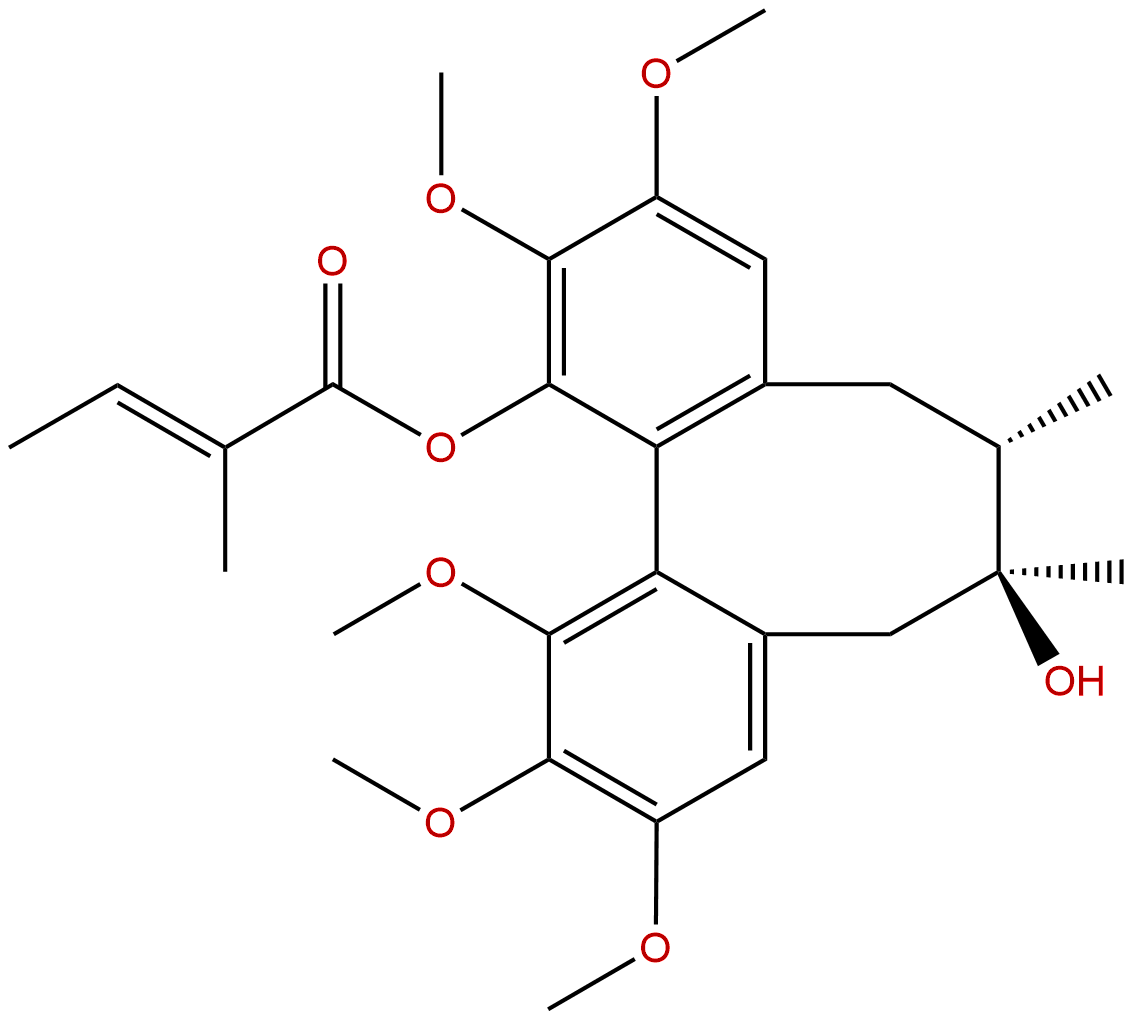


Product name: Tigloylgomisin H
Synonym name:
Catalogue No.: SBP04216
Cas No.: 66069-55-4
Formula: C28H36O8
Mol Weight: 500.588
Botanical Source:
Physical Description:
Type of Compound: Lignans
Purity: 95%~99%
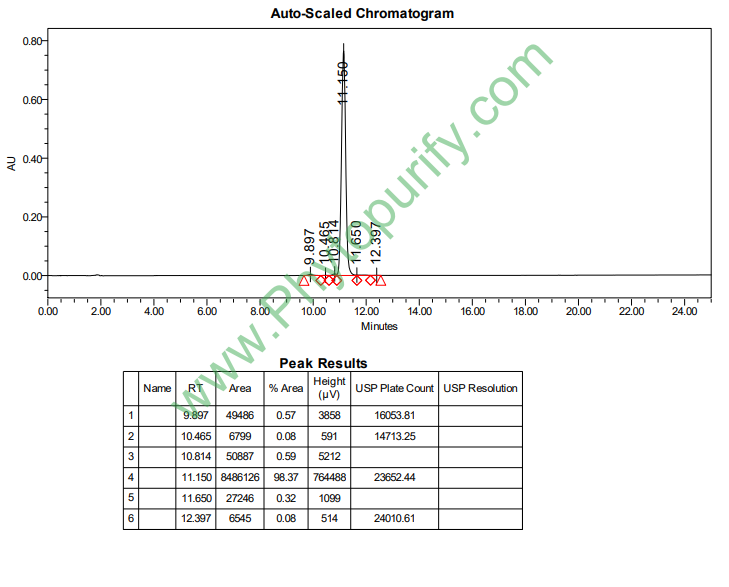
Analysis Method: HPLC-DAD or/and HPLC-ELSD
Identification Method: Mass, NMR
Packing: Brown vial or HDPE plastic bottle
The product could be supplied from milligrams to grams. Inquire for bulk scale.
We provide solution to improve the water-solubility of compounds, thereby facilitating the variety of activity tests and clinic uses.
For Reference Standard and R&D, Not for Human Use Directly.
HPLC of Tigloylgomisin H
Storage conditions:Short-term storage at 2~8℃, long-term storage at -20 ~ -80℃
92.6800
4.4122
4.4122
.0070
3.1495
9.9946
High
90.1847
3.7849
No
No
Yes
No
No
Yes
0.0
Yes
Yes
Yes
Yes
In the field of natural product chemistry and pharmacology research, lignin compounds have attracted much attention due to their extensive biological activities. Tigloylgomisin H (CAS number: 66069-55-4) is derived from the traditional Chinese medicine Schisandra chinensis(Schisandra chinensis)A biphenyl cyclooctene lignin isolated from the fruit. Schisandra chinensis is known for its calming, nourishing qi, and promoting diuresis effects. Modern pharmacological research has revealed that its active ingredients have significant potential in liver protection, antioxidant, anti-inflammatory, and anti-tumor effects. As one of the members, the unique biological activity spectrum of Tigecyl Gomisine H, especially its ability to selectively activate phase II detoxifying enzymes as a single functional inducer, has shown important research value in the field of chemoprevention, especially in the prevention of liver cancer. This article aims to provide a systematic review of the chemical structure, plant origin, pharmacological activity, mechanism of action, pharmacological evaluation, and clinical application prospects of Tizoxystrobin H, in order to provide comprehensive scientific references for the in-depth research and development of this compound.
Ti'goylgomixin H belongs to the biphenyl cyclooctene class of lignans, with a molecular formula of C28H34O8 and a molecular weight of 500.5880. Its basic skeleton consists of two phenylpropane units connected by side chain β - carbon atoms to form a biphenyl structure and form a cyclooctadiene ring. The structural feature of Tigoloyloxy H is that it has a Tigoloyloxy substituent attached to its C-6 or C-7 position (depending on stereochemistry), which is one of its important active groups. The introduction of 2-methyl-2-butenoic acid significantly affects the lipophilicity and interaction ability with target proteins of the compound.
From the analysis of physical and chemical properties, the compound has high lipid solubility, with a calculated LogP value of 4.4122, indicating that it is easy to penetrate cell membranes, but has poor water solubility (about 0.0070 mg/mL), which poses certain challenges for its formulation development. Its topological polar surface area (TPSA) is 92.68 Å ², belonging to a moderately polar molecule. Preliminary pharmacological risk assessment shows that Tizoxystrobin H has a high blood-brain barrier permeability potential, suggesting its potential role in central nervous system related diseases. However, attention should also be paid to its potential effects in the central nervous system. Importantly, the compound did not show hERG potassium channel inhibitory activity in the preliminary screening (hERG inhibition: No), and the Ames test result was 0.0, indicating a low risk of mutagenicity and a relatively good safety starting point.
The main source of Tijiaogaomixin H is Schisandra chinensis, a plant of the Schisandra genus in the Schisandraceae family(Schisandra chinensis Dry and ripe fruit of (Turcz.) Baill. Schisandra chinensis is mainly distributed in Northeast China, South Korea, Japan, and the Far East region of Russia. Its fruit is rich in various lignans, such as schisandrin, schisandrin esters, and gossypol series. Among them, the content of kaempferol is relatively low but the activity is significant.
Its extraction and separation usually follow the conventional process of natural product chemistry. Firstly, the dried Schisandra fruit is crushed and subjected to reflux extraction or ultrasound assisted extraction using organic solvents such as methanol, ethanol, or acetone. The crude extract obtained was concentrated under reduced pressure and subjected to gradient extraction with solvents such as petroleum ether, ethyl acetate, and n-butanol in sequence. The main enrichment site of thienoxystrobin H was in the ethyl acetate extraction site. Further purification often relies on a combination of various chromatographic techniques, including silica gel column chromatography (using chloroform methanol or petroleum ether ethyl acetate system gradient elution), reverse phase silica gel column chromatography (such as ODS, using methanol water system elution), and high-performance liquid chromatography (HPLC) preparation. Through nuclear magnetic resonance (NMR, including 1H-NMR, 13C-NMR, 2D-NMR), mass spectrometry (MS), and comparison with literature data, its chemical structure can be ultimately identified. Modern green extraction techniques such as supercritical CO2 fluid extraction are also being explored for efficient extraction of such high-value lignin due to their high selectivity and absence of solvent residues.
Although the pharmacological activity research of Tigeramide H is currently in the preclinical stage, its outstanding potential in cancer chemoprevention and anti-inflammatory has been revealed.
Cancer chemopreventive activity The most significant feature of this compound is its ability to act as a single functional inducer, specifically inducing phase II detoxifying enzymes. Research has shown that Ticinol can effectively induce the activity of quinone reductase (QR, i.e. NAD (P) H: quinone oxidoreductase 1, NQO1) in mouse liver cancer cell Hepa1c1c7. NQO1 is a key antioxidant and detoxifying enzyme in cells, which can reduce carcinogenic quinones to hydroquinone, promote their subsequent binding and excretion, and protect cells from oxidative damage and carcinogenic attacks. The induction effect of Tigecyl Gomisine H is highly selective and does not induce phase I metabolic enzymes (such as cytochrome P450), avoiding the risk of activating pre carcinogens into terminal carcinogens. This makes it an ideal candidate for chemoprevention, especially for the prevention of liver cancer.
anti-inflammatory activity In addition to its detoxifying enzyme inducing effect, tigenoxicam H has also shown clear anti-inflammatory effects in various inflammatory models. Its anti-inflammatory effect involves the regulation of multiple key inflammatory mediators and signaling pathways. Research has shown that this compound can inhibit the expression of inflammatory factors such as tumor necrosis factor - α (TNF - α), interleukin-6 (IL-6), and inducible nitric oxide synthase (NOS2) induced by stimuli such as lipopolysaccharide (LPS). In addition, it can inhibit the activity of cyclooxygenase-1 (PTGS1/COX-1) and reduce the production of prostaglandin inflammatory mediators. In pain related neurogenic inflammation, the potential regulatory effects of tigecycline H on transient receptor potential vanillic acid subtype 1 (TRPV1) and anchored protein subtype 1 (TRPA1) channels are also worth noting. These broad anti-inflammatory targets suggest promising applications in the treatment of chronic inflammatory diseases such as arthritis, colitis, and neuroinflammation.
The core mechanism by which Tigeramide H exerts its pharmacological effects lies in its precise regulation of the cellular defense system, and its molecular target network mainly revolves around antioxidant stress response elements (ARE) and inflammatory signaling pathways.
The core role of Nrf2 ARE pathway As a single functional inducer, the core mechanism by which Tijiaogaomixin H induces NQO1 and other phase II detoxifying enzymes is achieved through the activation of the nuclear factor E2 related factor 2 (Nrf2) signaling pathway. In the resting state, Nrf2 binds to its inhibitory protein Keap1 in the cytoplasm and is degraded by ubiquitination. Tigecyl Golimicin H may promote the dissociation and stabilization of Nrf2 from Keap1 by modifying key cysteine residues on Keap1 or affecting the interaction between Nrf2 and Keap1. Subsequently, Nrf2 translocates to the nucleus and binds to antioxidant response elements (ARE), initiating the transcription of a series of downstream cell protective genes, including NQO1, glutathione S-transferase (GST), heme oxygenase-1 (HO-1), etc. This pathway is the core defense mechanism for cells to resist oxidative stress and electrophilic toxins, and it is also the molecular basis for the chemopreventive effect of Tizoxystrobin H.
Multiple targets for anti-inflammatory effects Its anti-inflammatory effect involves intervention in multiple classic inflammatory signaling pathways
These mechanisms do not exist in isolation, and the activation of the Nrf2 pathway itself has a strong anti-inflammatory effect, as products such as HO-1 can inhibit the production of pro-inflammatory mediators. Therefore, Tigeramide H constructs a multi-target, networked pharmacological mode of action by synergistically activating protective pathways (Nrf2) and inhibiting destructive pathways (NF - κ B, STAT3, etc.).
Based on its physical and chemical parameters and preliminary biological data, a preliminary evaluation was conducted on the pharmacological properties of Tizoxystrobin H.
Drug like properties and absorption distribution The molecular weight (500.6) is slightly higher than the conventional upper limit (500) of the "Five Rules for Generic Drugs", but still within an acceptable range. A higher lipophilicity (LogP>4) suggests that its oral bioavailability may face challenges, as excessive lipophilicity may result in poor solubility in gastrointestinal contents or undergo strong first pass metabolism in the intestinal wall and liver. Its high blood-brain barrier permeability (predicted) suggests its ability to enter the central nervous system, which may be advantageous for the treatment of central related diseases, but potential central side effects also need to be evaluated. At present, there is a lack of detailed experimental data on its absorption, distribution, metabolism, and excretion (ADME) in the body.
Metabolism and Safety As an exogenous substance, Tigeramide H is likely to be mainly metabolized by the liver cytochrome P450 enzyme system in vivo. Its Tigeramide group and methoxy and hydroxyl groups on the lignin skeleton may become metabolic sites, generating glucuronic acid or sulfate complexes. Its non inhibition of hERG channels is an important safety benefit, reducing the risk of causing QT interval prolongation and apical torsion ventricular tachycardia in the heart. The Ames test negative preliminarily ruled out its direct genotoxicity, but a complete genotoxicity combination test and long-term toxicology research are still needed.
Gap in pharmacokinetic research At present, there is almost no available literature on the pharmacokinetic studies of the Ticinol Golimicin H system, including its absolute bioavailability, plasma protein binding rate, tissue distribution characteristics, identification of major metabolites, elimination half-life, and other key parameters. This is the core information gap that must be filled to advance towards drug development. The establishment of highly sensitive in vivo analysis methods using liquid chromatography tandem mass spectrometry (LC-MS/MS) technology is a prerequisite for conducting these studies.
The unique pharmacological properties exhibited by Tigecyl Gomimicin H indicate potential directions for its clinical application, but at the same time, it also faces typical challenges from lead compounds to candidate drugs.
Potential application areas:
Challenges faced and future research directions:
As a biphenylcyclooctene lignan derived from traditional Chinese medicine Schisandra chinensis, Tigecylgomisin H has established significant research value in the field of cancer chemoprevention and anti-inflammatory treatment due to its unique ability to specifically induce phase II detoxifying enzyme NQO1 through the Nrf2 ARE pathway, as well as its inhibitory effects on multiple inflammatory pathways such as NF - κ B and STAT3. Its characteristic as a "single function inducer" enhances cellular defense while avoiding potential risks, reflecting the wisdom of natural products in regulating complex biological networks. Although there are obvious shortcomings in drug formulation, especially in solubility and systemic pharmacokinetics, these challenges are precisely the areas that modern medicinal chemistry and pharmacy can focus on addressing. In the future, through interdisciplinary collaboration, we will delve into the details of its molecular action, optimize its physicochemical properties, and complete systematic preclinical development. Tigeramide H is expected to develop from a potential natural lead compound into an innovative drug or health product for the prevention and treatment of liver diseases and inflammation related diseases, contributing modern power from traditional medicine to human health.
