pick To:2020year7month1The new version of China's measures for the administration of drug registration (the "measures") was officially implemented on August th, marking that the administration of registration of traditional Chinese medicine has entered a new era. The new version of the "measures" highlights the framework principle, and no longer stipulates the relevant contents of the specific technical requirements for new drug research and development, but is issued separately in the form of supporting documents such as technical guidelines. Through systematic review of the measures2007.
The traditional Chinese medicine industry is a characteristic and advantageous field in China, and the supervision of traditional Chinese medicine has also been paid much attention to. since1985In, the former Ministry of Health issued the new drug approval measures, which listed traditional Chinese medicine, chemical drugs and biological products as the same category for the first time3The management of large categories of new drugs has experienced1999The new drug approval measures and2002、2005、2007year3Version of the measures for the administration of drug registration (the "measures"), especially the "measures"2007The annual edition has played an important role in standardizing the registration behavior of traditional Chinese medicine, guiding the research and development of new drugs and the development of the industry. However, due to frequent changes in regulatory policies, the rationality, continuity and predictability of drug registration management policies have been criticized repeatedly[1-2]。2015After the "opinions of the State Council on reforming the review and approval system for drugs and medical devices" launched a new round of drug regulatory reform in, the new version of the "measures" was published in2020year7month1It was officially implemented on August 1. It highlights the framework principle and no longer specifically stipulates the technical requirements involved in new drug research and development, but is separately issued in the form of supporting documents such as technical guidelines for timely adjustment. For example, the new registration classification and application data requirements of chemical drugs and traditional Chinese medicine are issued in the form of "notice"[3-4]More supporting documents related to the registration of traditional Chinese medicine, such as "special provisions on the registration and administration of traditional Chinese medicine", "changes of listed traditional Chinese medicine and requirements for application materials", are also being formulated[5]This way can not only give consideration to the stability of laws and regulations and the flexibility of technical system, but also better adapt to the current development level of China's pharmaceutical industry and science and technology.
Current measures2007Although the 2004 edition has been abolished, its implementation13Years, the relevant supporting document "Supplementary Provisions on the administration of registration of traditional Chinese medicine"[6]For the first time, it is proposed that the registration of traditional Chinese medicine should reflect the characteristics of traditional Chinese medicine, which is also the first time that the new version of the "measures" should reflect the characteristics of traditional Chinese medicine19The article puts forward the earliest prototype of "establishing and improving the registration management system and technical evaluation system in line with the characteristics of traditional Chinese medicine". Therefore, the measures2007The annual edition is not only a stage sign of the development and perfection of China's drug registration management[1]. This paper aims to systematically review the registration and approval of new traditional Chinese medicine drugs in China during its implementation, and empirically analyze the current situation and possible problems of the research and development and registration of new traditional Chinese medicine drugs in China, in order to provide some reference for the subsequent development of supporting documents related to traditional Chinese medicine in the current version of the "measures".
1 Data sources and methods
The research object of this paper is the "measures"2007Application for registration of new drugs of traditional Chinese medicine stipulated in the edition. Among them, traditional Chinese medicine new drugs include1~6Traditional Chinese medicine, para1Traditional Chinese medicines refer to the effective ingredients and preparations extracted from plants, animals, minerals and other substances that are not marketed in China; Page2Traditional Chinese medicines refer to newly discovered medicinal materials and their preparations; Page3Traditional Chinese medicine refers to new substitutes of traditional Chinese medicine; Page4Traditional Chinese medicine refers to the new medicinal parts and preparations of medicinal materials; Page5; Page6. New drug registration applications include clinical trial applications(investigational new drug application,IND)And production application (new drug marketing application,new drug application,NDA)This2Stages, respectively, are the applications submitted after the completion of preclinical drug research and clinical research.
By searching the State Drug Administration(National Medical Products Administration,NMPA)Drug databaseNMPADrug Evaluation Center(Center for Drug Evaluation,CDE)Commercial databases such as www.chinanews.com, drugintelligence.com and michinet, in combination with search engines such as CNKI, Google and Baidu, are systematically collected according to the acceptance number2007year10month1day—2019year12month31dayCDEThe statistical time for the review conclusion of each application is2020year6month30Day. The review conclusion is divided into approval, disapproval and pending conclusion3Class. Among them, refer to Zhang Xiaodong et al[7]The standards reported, such as the withdrawal of the review, the withdrawal of the enterprise, and the termination of the review procedure due to various reasons, are considered not approved; . The overall approval rate is calculated by the proportion of the total number of approved cases in the total number of accepted cases, and the annual approval rate is calculated by the proportion of the number of new Chinese medicine applications approved as of the statistical time of this article in the total number of applications in the year of acceptance. adoptExcel 2016.
2 《method》2007Analysis of the registration and approval of new drugs of traditional Chinese medicine during the implementation of the
2.1 Acceptance and review overview
2007—2019yearCDECo acceptance980Applications for new drugs of traditional Chinese medicine, includingIND 686Pieces andNDA 294Pieces, see table1In terms of the year-on-year change trend of the total accepted amount,2008—2014The annual average is about100piece/After that, it fell back,2015Ca68Pieces,2016Annual decrease to31Pieces, to2019Annual reduction to18Pieces; Subdivide intoINDandNDAAfter, its change trend is similar to the total acceptance volume. In terms of approval, as of the statistical time of this article, there are955Applications for new Chinese medicines have been reviewed, including388Pieces are approved, includingIND 343Pieces andNDA 45Pieces, with an overall approval rate of about50%、15%According to the year-on-year change trend of the overall approval, it is similar to the change of the total acceptance, but it is subdivided intoINDandNDAFound that,NDAThe processing time distribution of approved applications is more concentrated, and most of them are2007—2011Accepted in, accounting for about81%,2014Accepted afterNDAApply for reduction to0Approved until2017Years,2018and2019It rebounded slightly in; andINDAlthough since2014After, its annual number of approvals also declined year by year, but still maintained at15~25piece/. Thus, although2015Years laterINDThe acceptance volume has declined sharply, but its annual approval rate has increased,2016Annual acceptanceINDThe approval rate of71.0%,2019Years or even up to100%。
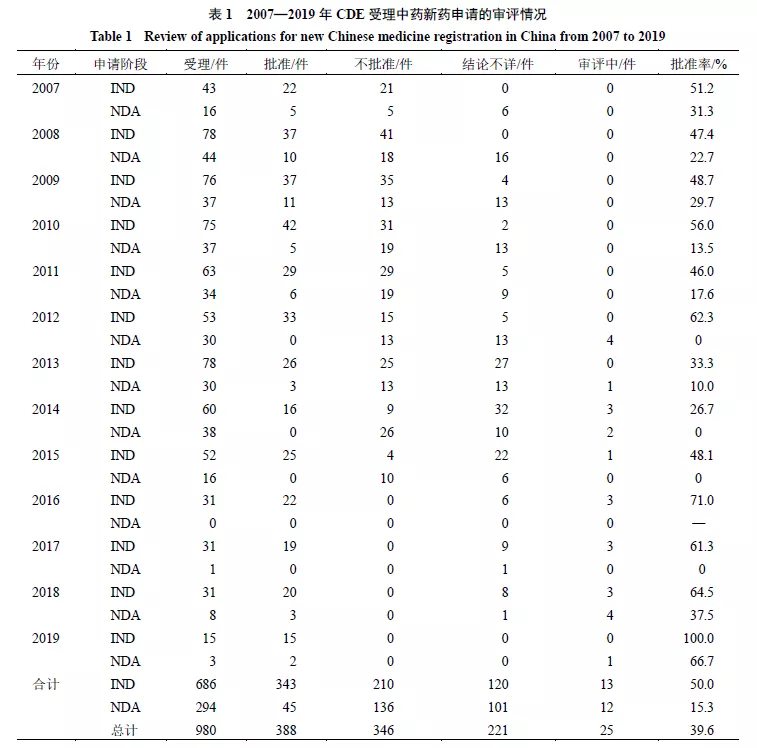
In addition, among the applications that have completed the review, there are346Cases are not approved, except for the application whose review conclusion is clearly "not approved"264(69Pieces), all of which are2015—2016Withdrawn inNDA. otherwise221The conclusion of the case is not clear, mainly because the enterprise is required to supplement technology or other data, or the review conclusion is missing.
2.2 Registration categories of new drugs of traditional Chinese Medicine
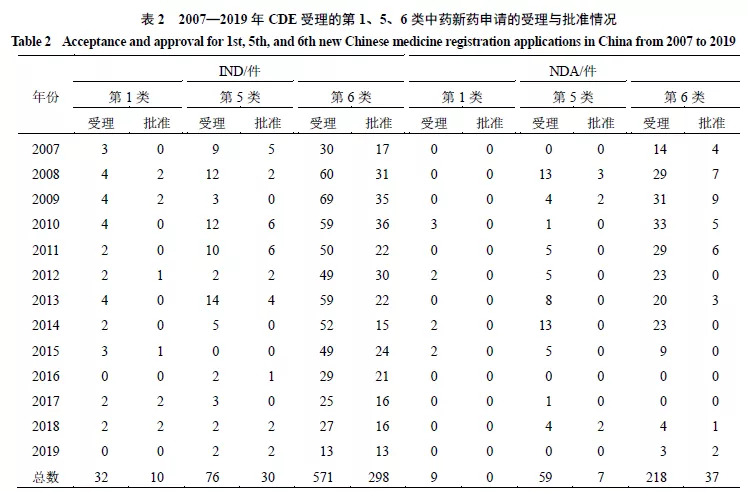
2007—2019yearCDEThe accepted application for new Chinese medicine is based on the number of6The largest number of traditional Chinese medicines, total789Pieces, accounting for80.5%; followed by No5、1Traditional Chinese medicine, respectively135、41Pieces, accounting for about13.8%、4.2%. page2、3、4Class applications are rare, and only accepted separately7、5、3. After verifying the variety information, it was found that in the2In the application of traditional Chinese medicine, only mangji persimmon and its capsule preparationINDto2009Approved in, andCDEThe information of "drug clinical trial registration and information publicity platform" is still inIIPhase I trial recruitment; stay5Piece No3Among the applications for traditional Chinese medicine, there are4This is the method2007Submitted beforeNDA, which is not the "new substitute of traditional Chinese medicine" stipulated by itProduct ", so actually only1pieceIND(artificial bear bile powder) was the first3Traditional Chinese medicine; Page4All kinds of traditional Chinese medicine areINDIt can be seen that as of the statistical time of this article,2007—2019Year ending2、3、4Acquisition of new drugs of traditional Chinese MedicineNDAApproved.
Further analysisCDEThe main registration categories accepted (para1、5、6,2007—2019This year3General of traditional Chinese MedicineINDThe number and rate of approval were significantly higher thanNDAHowever, according to the annual distribution of approved applications (table2), this3Traditional Chinese MedicineINDandNDAThe difference between the two is larger. In the approvedINDMiddle, P6; Page5Traditional Chinese medicine like2010—2011Most cases were accepted in2014Years later, there was a0The phenomenon of; Page1Traditional Chinese medicines are mainly distributed in the "measures"2007Early and recent implementation of the annual edition3Years. NDAAmong them, the6Traditional Chinese medicines are mainly used in2007—2011Applications accepted in, accounting for% of the total approved84%, while in2014—2017The number of consecutive approvals per year is0; P5Traditional Chinese medicine is only distributed in2008、2009and2018Years, respectively43%、38%、29%; P1Traditional Chinese medicine is0。
2.3 Therapeutic fields involved in the application of new drugs of traditional Chinese Medicine
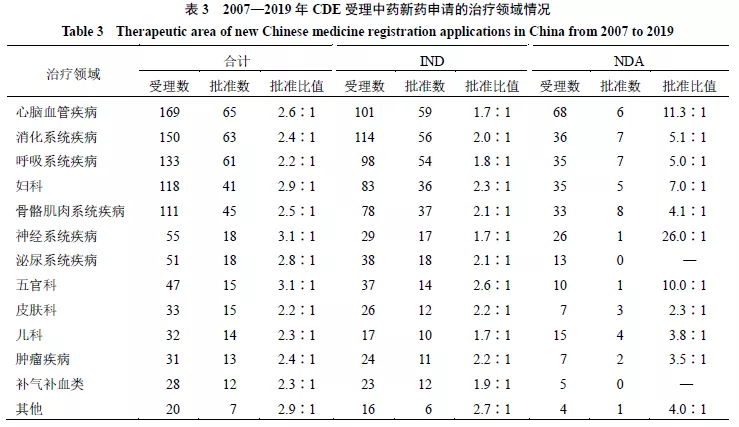
stay980pieceCDEAmong the applications accepted, there are2Applications failed to obtain relevant information in the field of treatment, so this part was included978Applications were analyzed, and the results showed that,2007—2019The therapeutic fields involved in the application for registration of new traditional Chinese medicine drugs in13Category. Regardless of the overall application or the breakdown intoIND、NDAAfter that, cardiovascular and cerebrovascular diseases, digestive system diseases, respiratory system diseases, gynecological drugs and skeletal muscle system diseases were the top applicants5Class, accounting for about70%. The ratio of the number of accepted applications to the number of approved applications (approval ratio) reflects the difficulty of obtaining approval in each treatment field (table3)YesIt was found that the approval ratio of each field was about2∶1~3∶1. Further subdivided intoINDandNDAAfter,INDThe approval ratio of each field in the stage is relatively close, about2∶1, while inNDAThe stage is quite different, and there are no drugs for urinary system diseases and Qi and blood replenishment yetNDAApproved inNDAAmong the other approved treatment fields, nervous system diseases are the most difficult to use drugs, and the approved ratio is about26∶1, followed by drugs for cardiovascular and cerebrovascular diseases, about11∶1, followed by the use of drugs in the Department of facial features and Gynecology, about10∶1、7∶1, dermatological drugs are the most easily approved, with a ratio of about2∶1。
2.4 Dosage forms involved in the application of new drugs of traditional Chinese Medicine
2007—2019yearCDEAmong the accepted applications for new drugs of traditional Chinese medicine, the applications involving preparations share897Pieces, mainly ordinary oral preparations(87%)(11%), injection(2%)This3Category, and subdivided intoINDandNDA. In terms of the composition of specific dosage forms (table4)In the application for ordinary oral preparations, the overall application and breakdown areINDandNDAAfter that, capsules, granules and tablets accounted for the majority of the proportion, with a total of about88%, and about10%It is oral liquid and pill, about2%. In the application for mucosal administration and topical preparations,INDandNDAIt shows different structural characteristics;INDThe most involved are topical plasters(33%)(14%), gelling agent(11%), suppository(11%), patches(10%), eye drops(7%), liniment(6%)Et al; andNDAPreparation application to patch(46%)It is most common, and the rest mainly involves external plasters(17%), gelling agent(13%), spray(8%)(8%)Et al. Injection involves22This kind of dosage form is from2011It has rarely been involved since3No application was made in.
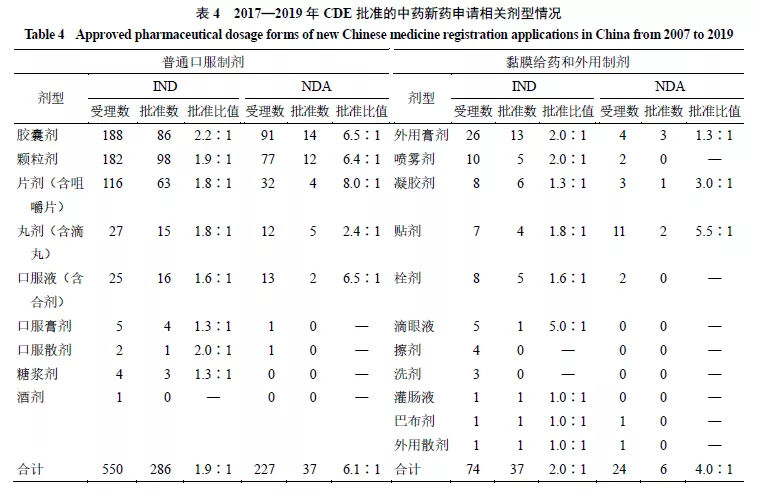
The approval ratio is also used to reflect the difficulty of approval of each dosage form, as shown in table4, in approved common oral preparations,INDPhase(286The approval difficulty of each dosage form is similar, but in theNDAPhase(37Pills are easier to be approved, and the approval ratio is2.4∶1, and the other dosage forms reach6.4∶1~8.0∶1, and no oral plasters, oral powders, syrups and alcoholic drinks have been approved. In approved mucosal administration and topical preparations,INDPhase(37Pieces) with eye drops(5.0∶1)The most difficult, the remaining dosage forms are about1∶1~2∶1;NDAPhase(6The approved dosage forms are only patches, gels and external plasters, with patches being the most difficult(5.5∶1)The remaining dosage forms applied for have not yet been approved.
3 discuss
3.1 The changing trend of registration application, evaluation and approval of new drugs of traditional Chinese medicine over the years
Since the measures2005The approval standard of the annual edition is relatively low, especially the provision that if there is no qualitative change in the dosage form of traditional Chinese medicine, the clinical research can be exempted,Traditional Chinese medicine generic drugs can be exempted from relevant research as long as they meet national standards[8],As a result, the enthusiasm of enterprises to develop new drugs is not strong, and the number of simply changing dosage forms and imitating traditional Chinese medicine has increased sharply. In response to this problem, the measures2007By raising the requirements for new drugs, the new drugs will no longer be managed according to the new drugs if the dosage form, route of administration or new indications of the marketed drugs are specified[9]And encourage the research and development of innovative drugs. From table1It can be seen that the application for new drugs of traditional Chinese medicine is listed in the measures2007After the implementation of the annual edition, it quickly returned to rationality, from2006In, thousands of pieces fell to ca100Pieces, suggesting that at that time2005The reform of the year edition has achieved good results. From the "measures"2007According to the change trend over the years of the acceptance of new drug applications for traditional Chinese medicine during the implementation of the annual version,INDandNDAThe number of pieces accepted is2015Years ago, they maintained relatively high levels, respectively52~78、34~44piece/Years, followed by a sharp decline, especiallyNDA, annual acceptance volume reduced to single digits, in2016Years even appeared0Acceptance. This paper analyzes that this may be related to2015The "opinions of the State Council on the reform of the review and approval system for drugs and medical devices" in and the subsequent issuance of a series of reform policy documents, especially the "announcement on carrying out the self inspection and verification of drug clinical trial data"[10], not only withNDAThe sharp decline in acceptance is directly related, and may also be the main reason for enterprises to voluntarily withdraw a large number of new drug registration applications. According to the statistics in this paper2015—2016Withdrawn by the enterprise in69Pieces of new Chinese MedicineNDA, which may all be the case. In the change trend of approval over the years, compared withNDA,INDThere was no significant decrease in the later period, and it remained at15~25piece/. Thus, althoughINDThe number of accepted pieces is the same asNDASimilarly, in2015After, it still fell sharply, but its annual approval rate increased significantly,2019Accepted annually15Applications were even approved in full. 2018year7monthNMPA"Announcement on adjusting the review and approval procedures for clinical trials of drugs" was issued[11]Propose the implied license system.2019year12Monthly2pieceIND(para6"Shenqi sherong pills" and "niter Gandan granules") are tacit licenses.
In general, in the measures2007In the late stage of the implementation of the annual edition, especially in recent years5In recent years, the application and approval status of new Chinese medicine registration in China is not ideal. Among them,INDAs an intermediate key link connecting new drug R & D and listing registration, its acceptance volume reflects the activity of new drug R & D. At present, the new drugs of traditional Chinese medicine in ChinaINDThe current situation of low acceptance indirectly reflects the potential problems or defects in the current R & D and technology evaluation system and regulatory policies that conform to the characteristics of traditional Chinese medicine, and also directly raises concerns about the future innovation and development of the traditional Chinese medicine industry. The traditional Chinese medicine industry, academia and competent departments should pay full attention to this problem. Although the implied licensing system has been written2020New version of the measures in[12]It has a direct role in promoting the development of innovative drugs, but for traditional Chinese medicine, the implementation of the policy should also be multi pronged, combined with the actual situation of different registration categories (such as the requirements of non clinical safety research, how to apply existing human evidence in product registration), and improve the subsequent relevant supporting documents.
3.2 Application for new drugs of various traditional Chinese medicines
Measures2007During the implementation of the annual version, the distribution of registration categories of new drug applications for traditional Chinese medicine was extremely uneven, mainly involving the third1、5、6Class to6(80.5%)2、3、4Class of traditional Chinese medicine approved for marketing. This is related to the actual research and development of new drugs of traditional Chinese medicine in China. On the one hand, the first2、3、4Traditional Chinese medicine, namely, newly discovered medicinal materials and their preparations, new substitutes of traditional Chinese medicine, new medicinal parts of medicinal materials and their preparations, lack of human use history, have greater difficulties and risks in development, and the enthusiasm of enterprises is not high; On the other hand, para1、5、6The development of traditional Chinese medicine is inspired by the clinical practice of traditional Chinese medicine to varying degrees, and the most applied for and approved is No6Traditional Chinese medicine is mainly derived from clinical practice and has a rich foundation for human use. In the process of new drug application, it can obtain relief from non clinical pharmacodynamic research and even clinical trials, and the enterprise is more motivated. However, medicinal resources are directly related to the healthy development of traditional Chinese medicine industry and environmental sustainable protection, and its importance is self-evident. As early as in China1999In, the new drug approval method has begun to pay attention to the problem of traditional Chinese medicine resources[13], to the measures2007In the new drug registration category of traditional Chinese medicine, the2、3、4. Although previous studies such as artificial musk(2004A few substitutes of traditional Chinese medicine, such as those approved in, were approved for listing, but the "measures"2007Implementation of the annual edition13Years, none1Above3Traditional Chinese medicine likeNDA.
2016(2016—2030Years)[14]It is clearly pointed out that the sustainable development of traditional Chinese medicine in China is faced with the problems of insufficient total resources, serious destruction of wild traditional Chinese medicine resources, and decline in the quality of some traditional Chinese medicine.2017Opinions on deepening the reform of the review and approval system and encouraging the innovation of drugs and medical devices13Article and2020The new version of the measures in also proposed that the sustainable utilization of resources should be promoted from the national and legal levels. It can be seen that the current strengthening of the2、3、4The importance of the development and registration of traditional Chinese medicine. from2020The supporting documents related to traditional Chinese medicine in the new version of the measures "requirements for registration classification and application materials of traditional Chinese medicine"[4]On "innovative traditional Chinese medicine"(1.1、1.2and1.3According to the specific content of the provisions, the actual situation is similar to that of the measures2007,1.1The content of class is basically included in the original6Among the traditional Chinese medicine and new drugs,1.2Class and1.3Category includes the "measures"2007In1、5Class and2、3、4Traditional Chinese medicine. 2007During the implementation of the annual edition, new medicinal materials, new substitutes of traditional Chinese medicine and other registration categoriesNDA 0In order to ensure the healthy and sustainable development of the traditional Chinese medicine industry from the source, the drug regulatory department should draw lessons from the historical experience and strengthen the policy incentives for this kind of new traditional Chinese medicine when formulating the corresponding guidance documents.
3.3 Therapeutic fields involved in the application of new drugs of traditional Chinese Medicine
Measures2007During the implementation of the year edition, the treatment fields of domestic application for new drugs of traditional Chinese medicine mainly focused on cardiovascular and cerebrovascular diseases, digestive system diseases, respiratory system diseases, gynecological drugs and skeletal muscle system diseases5. Judging from the degree of difficulty in obtaining approval, in theINDStage, each treatment field is similar; But inNDAAt this stage, the drugs for urinary system and invigorating qi and blood have not been approved, and the fields of nervous system diseases, cardiovascular and cerebrovascular diseases, and facial features are difficult to be approved, so they are accepted/The approved ratio exceeded10∶1, which may be related to the difficulty of clinical trial research in the above fields. 2007Years ago, the approval standard of new drugs was low, and a considerable number of sponsors did not pay enough attention to clinical trial research. In addition, the ability of clinical trial design was limited, and they failed to understand the clinical positioning of products, which not only led to the problems of broad positioning and unclear clinical value of many Chinese patent drugs approved for listing in early stage in China[15]And to a certain extent, some patients with unclear clinical positioning and too large range of functional indicationsNDAThe generation of the application is described in the measures2007After the approval standard was raised in the year edition, it became a possible reason for the difficulty of obtaining approval in the above fields.
since2015Since China started the reform of drug evaluation and approval in,CDEAccording to the general principles of clinical research of new Chinese medicines, new Chinese medicines have been used to treat primary osteoporosis, stroke, malignant tumor, influenza, irritable bowel syndrome, functional dyspepsia, cough variant asthma, rheumatoid arthritis, chronic heart failure, dementia10. proposalCDEIn the process of formulating more relevant guiding principles, we can further focus on the combination of the above-mentioned "measures"2007None during the implementation of the annual edition.The company has no such business as the company's management of the company's business and management of the company's business and management of the company's business and management of the company's business and management of the companyNDAApproval, as well as the treatment fields that are difficult to approve, select the representative diseases in the dominant fields of traditional Chinese medicine, play a better role in policy guidance and technical guidance, and meet the industry and clinical needs.
3.4 Dosage forms involved in the application of new drugs of traditional Chinese Medicine
Measures2007During the implementation of the annual version, capsules, granules, tablets and other common oral preparations wereCDEThe main dosage forms that accept applications for new Chinese medicine are closely related to the characteristics of drugs used in the treatment field, the difficulty of research and development, and the distribution characteristics of the registration categories of new Chinese medicine. At present, most of the new traditional Chinese medicine drugs applied for and approved are No6The daily dosage of compound preparations of traditional Chinese medicine is relatively large, so the dosage form with large drug loading should be selected. In addition, traditional Chinese medicine injections from2006After the Houttuynia cordata injection incident in, China paid special attention to the safety of traditional Chinese medicine injections. The drug administration department in2007In, the "basic technical requirements for traditional Chinese medicine and natural medicine injections" and the "work plan for re evaluation of the safety of traditional Chinese medicine injections" were promulgated,2009In, the "notice on carrying out the re evaluation of the safety of traditional Chinese medicine injections" was issued,2011In, the "basic technical requirements for safety re evaluation of traditional Chinese medicine injections" was issued, which put forward higher requirements for pharmaceutical and safety research. Therefore, almost no enterprises have applied for TCM injections in recent years, and the entire "measures"2007During the implementation of the annual edition, there was noINDandNDA.
2017In, the general office of the CPC Central Committee and the general office of the State Council issued the "opinions on deepening the reform of the review and approval system and encouraging the innovation of drugs and medical devices"13The article puts forward the principle of supporting the inheritance and innovation of traditional Chinese medicine, that the research of traditional Chinese medicine should "handle the relationship between maintaining the traditional advantages of traditional Chinese medicine and the requirements of modern drug research and development", and "encourage the use of modern science and technology to research and develop traditional Chinese patent medicine, and encourage the development of new Chinese medicine by giving full play to the advantages of traditional Chinese medicine dosage forms". From the above measures2007During the implementation of the annual editionCDEAccording to the distribution of relevant dosage forms for accepting and approving applications, the development of new dosage forms of traditional Chinese medicine is not enough in terms of inheritance and innovation. The concentration of dosage forms concerned by the applicant is high, the traditional dosage forms such as pills, powders, ointments and pills are lacking, the new dosage forms developed by modern preparation technology combined with the characteristics of traditional Chinese medicine are lacking, and only a few new Chinese medicine applications involve sprays, cataplasms, eye drops, etc., and there is no productNDA. ,2020The relevant supporting documents of the new version of the measures in shall also be considered accordingly.
Conflict of interest
References (omitted)
Come Source: quliping, Chen Yang, Xiao Zhu Wang, Wen Jun Zou, Liu ; [J] . Chinese herbal medicine, 2021, 52 (3): 894- 901
