State Key Laboratory of active components and pharmacodynamics of natural drugs, China Pharmaceutical UniversityLiping、Haohaiping、Yang HuaIt was found that dihydrotanshinone I (DT), an active component of Salvia miltiorrhiza, can exert myocardial ischemic preconditioning by inducing transient ROS production, glutathionylation modification of pkm2 and nuclear translocation. Relevant research results are published inActa Pharmaceutica Sinica B)Phase 1, 2023。LipingProfessorHaohaipingProfessorYang HuaProfessor is the corresponding author of the paper and a doctoral studentWuxunxunIs the first author.
Previous research findingsDihydrotanshinone IIt has significant myocardial protection and can induce transientROSGeneration of. In this paper, a rat model of myocardial infarction induced by isoproterenol was used to demonstrate that,Dihydrotanshinone IExerting myocardial ischemic preconditioning depends on transientROSRelease. Nuclear proteomics was used to screen outDihydrotanshinone ICan promote pyruvate kinaseM2(PKM2)ROSScavengers can almost offsetDT; At the same time, it was found that low dose ofROSInducers can also promotePKM2Into the nucleus. Further using site directed mutagenesis of amino acids, it was found thatPKM2Of423/424The glutathionylation modification and oligomerization change of cysteine at positionPKM2The key mechanism of nuclear entry. In the left anterior descending artery ligation induced myocardial infarction model, it was found that in theAAV9Cardiac specific knockdown andC423/424In the mutant mouse model,DTIts cardioprotective effect was almost lost. ROSAnd the molecular mechanism of glutathionylation modification exerting cardioprotective effect.
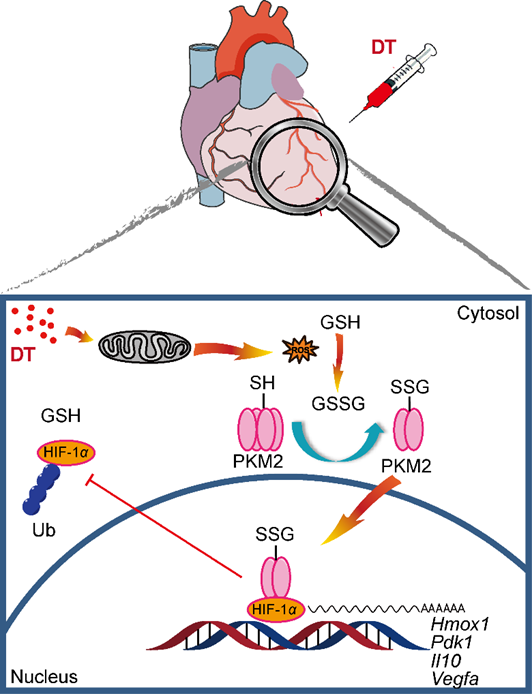
Dihydrotanshinone I preconditions myocardium against ischemic injury via PKM2 glutathionylation sensitive to ROS
Xunxun Wu, Lian Liu, Qiuling Zheng, Hui Ye, ... Ping Li
Acta Pharm Sin B 2023;13(1):113-127
