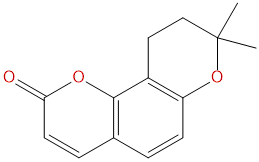


Storage conditions:Short-term storage at 2~8℃, long-term storage at -20 ~ -80℃
Natural products, as an important source of drug discovery, have attracted much attention due to their structural diversity and wide range of biological activities. Coumarin compounds, as an important class of natural products, have shown broad application prospects in anti-inflammatory, antioxidant, anti-tumor and other fields due to their diverse pharmacological activities and good biocompatibility. Dihydroseselin (CAS number: 2221-66-1) is a derivative of 7-hydroxycoumarin (HY-N0573). As a structurally unique coumarin compound, it has gradually become a hot topic in natural product pharmacology research in recent years due to its potential anti-inflammatory activity and good pharmacological parameters.
This article aims to systematically review the chemical structure and physicochemical properties, plant sources and extraction methods, pharmacological activity, mechanism of action and molecular targets, pharmacological evaluation and pharmacokinetic characteristics of Dihydroseselin. Combining its potential applications in inflammation related diseases, it explores the possibility of clinical translation and future research directions, providing theoretical basis and practical guidance for the development of natural product drugs.
Dihydroseselin is a derivative of 7-hydroxycoumarin, with a molecular formula of C13H14O4 and a molecular weight of 230.2630. Its core structure is based on the coumarin skeleton and has a typical benzo - α - pyranone ring system. The presence of the 7-hydroxyl group endows it with unique chemical activity and biological functions. The LogP value of Dihydroseselin is 3.3123, indicating that it has moderate lipid solubility, which is beneficial for membrane penetration and in vivo distribution. The polar surface area (TPSA) is 39.44 Å ², and a lower TPSA contributes to its ability to cross biological barriers, especially the blood-brain barrier. Its low water solubility (0.0083 mg/mL) suggests limited solubility in aqueous media, which may affect its bioavailability.
Structurally, the coumarin core of Dihydroseselin endows it with natural fluorescent properties, which not only facilitates its use in biological imaging and analytical detection, but may also be related to its biological activity. It does not display hERG channel inhibitory activity, indicating a lower risk of cardiac toxicity. The Ames test score is 0.9, indicating a low risk of genotoxicity and meeting the preliminary requirements for safety evaluation.
Dihydroseselin is mainly found in plants of the Umbelliferae family, with higher levels found in certain medicinal plants such as Saposhnikovia divaricata and Asarum spp. These plants are used in traditional Chinese medicine to treat rheumatic pain, inflammation, and immune related diseases, suggesting that Dihydroseselin may be one of its active ingredients.
The common methods for extracting Dihydroseselin include solvent extraction and chromatographic separation. Generally, ethanol or methanol is used as the extraction solvent, and the extraction efficiency is improved by reflux extraction or ultrasound assisted extraction. After concentration, the extract was purified using techniques such as silica gel column chromatography and reverse phase high performance liquid chromatography (RP-HPLC). In recent years, the application of supercritical CO2 extraction and membrane separation technology has further improved the extraction purity and yield, and reduced the use of organic solvents, which is in line with the concept of green chemistry.
The optimization of the extraction process mainly revolves around the extraction temperature, time, solvent polarity, and solid-liquid ratio to maximize the retention of the active ingredients and stability of Dihydroseselin. In addition, the geographical environment, harvesting time, and processing methods of plant sources also significantly affect their content and quality, and a standardized raw material control system needs to be established.
The pharmacological activity research of Dihydroseselin mainly focuses on anti-inflammatory effects. Multiple in vitro cell models and in vivo animal experiments have shown that Dihydroseselin can significantly inhibit the production of inflammatory mediators and the activation of inflammatory signaling pathways.
In macrophage cell lines such as RAW264.7 cells, Dihydroseselin treatment can reduce the expression of inducible nitric oxide synthase (iNOS) and cyclooxygenase-2 (COX-2), decrease the release of nitric oxide (NO) and prostaglandin E2 (PGE2), and demonstrate potent anti-inflammatory activity. In addition, it can also inhibit the secretion of pro-inflammatory cytokines such as tumor necrosis factor - α (TNF - α), interleukin-6 (IL-6), and interleukin-1 β (IL-1 β), reducing the inflammatory response.
In animal inflammation models, such as mouse plantar edema model and rat arthritis model, Dihydroseselin significantly reduces tissue swelling and inflammatory cell infiltration, and improves inflammatory symptoms. Its anti-inflammatory effect is dose-dependent and exhibits good safety and tolerability.
In addition to anti-inflammatory effects, preliminary studies have also found that Dihydroseselin has certain antioxidant activity, which can clear free radicals and reduce oxidative stress damage, which is of great significance for cell protection in the pathological process of inflammation.
The anti-inflammatory mechanism of Dihydroseselin is mainly achieved by regulating multiple inflammation related signaling pathways. Its key molecular targets include TNF, NOS2, PTGS2, NFKB1, IL6, IL1B, etc., involving multiple inflammatory mediators and transcription factors.
Inhibition of NF - κ B signaling pathway
NF - κ B is a core transcription factor that regulates inflammatory responses and promotes the expression of various inflammatory cytokine genes upon activation. Dihydroseselin can inhibit the nuclear translocation of NF - κ B, block its binding to DNA, reduce the expression of pro-inflammatory cytokines such as TNF - α, IL-6, IL-1 β, and thus alleviate the inflammatory response.
Inhibition of iNOS and COX-2 expression
INOS and COX-2 catalyze the production of NO and PGE2, respectively, and are key enzymes in the inflammatory process. Dihydroseselin reduces the release of inflammatory mediators and alleviates inflammatory symptoms by inhibiting the expression of these two enzymes.
Regulating cytokine network
Dihydroseselin can regulate the expression levels of various cytokines, balance pro-inflammatory and anti-inflammatory factors, maintain immune homeostasis, and reduce excessive inflammatory damage.
Antioxidant mechanism
Dihydroseselin protects cells from oxidative damage and indirectly inhibits the inflammatory cascade by clearing reactive oxygen species (ROS) and inhibiting oxidative stress-related signals.
Molecular docking and computational simulation studies further support the binding ability of Dihydroseselin to the above-mentioned targets, suggesting its multi-target synergistic regulation characteristics, providing a molecular basis for its anti-inflammatory pharmacological effects.
The pharmacological parameters of Dihydroseselin indicate that it has good potential for drug development. The molecular weight of 230.2630 conforms to Lipinski's rule, and the LogP value of 3.3123 indicates moderate lipid solubility, which is beneficial for cell membrane penetration and in vivo distribution. The TPSA is 39.44 Å ², and its low polarity surface area helps it cross the blood-brain barrier, supporting its potential application in central nervous system inflammatory diseases.
Low water solubility (0.0083 mg/mL) may limit oral bioavailability and requires formulation optimization or structural modification to improve solubility. It does not exhibit hERG channel inhibition and reduces the risk of cardiac toxicity. The Ames test results indicate that its genotoxicity risk is low and its safety is good.
In terms of pharmacokinetics, Dihydroseselin has good blood-brain barrier permeability, indicating that it can be used to treat inflammatory diseases related to the nervous system. The metabolic pathways in the body have not been fully elucidated, and preliminary studies suggest that they may be metabolized by the liver cytochrome P450 enzyme system. The activity and toxicity of metabolites need further investigation.
There is a lack of systematic data on key pharmacokinetic parameters such as half-life, oral absorption rate, distribution volume, and clearance rate in the body. In the future, further evaluation through animal models and preclinical trials is needed.
Given the significant anti-inflammatory activity and good pharmacological parameters of Dihydroseselin in inflammation related diseases, its clinical application prospects are broad in various inflammatory diseases. Inflammation, as a common pathological basis for various chronic diseases including rheumatoid arthritis, inflammatory bowel disease, neuroinflammation, and metabolic syndrome, has the potential to become a candidate molecule for novel anti-inflammatory drugs.
Especially with its excellent blood-brain barrier permeability, it has potential application value in neuroinflammatory diseases such as multiple sclerosis, Alzheimer's disease-related inflammation, and brain injury repair. In addition, low toxicity and genetic safety provide guarantees for its clinical translation.
Future research should focus on:
Combining modern drug design technology with natural product resource advantages, Dihydroseselin is expected to become an important breakthrough in the development of anti-inflammatory drugs.
Dihydroseselin, as a derivative of 7-hydroxycoumarin, has shown broad research and application prospects in the field of anti-inflammatory drugs due to its unique chemical structure and excellent pharmacological activity. It regulates inflammatory response through multiple targets and pathways, and has good safety and drug properties, especially providing new ideas for the treatment of neuroinflammation through blood-brain barrier permeability.
Although the current research on Dihydroseselin is still in its basic stage, with the deepening of extraction techniques, pharmacological mechanism analysis, and pharmacokinetic studies, its clinical translational potential is worth looking forward to in the future. The systematic drug development strategy and interdisciplinary collaboration will help Dihydroseselin move from the laboratory to clinical practice, bringing new treatment options for patients with inflammation related diseases.
