Introduction/Overview
Toralactone (CAS number: 41743-74-2) is a natural product isolated from the traditional Chinese medicine Cassia obtusifolia, belonging to the family of organic heterocyclic compounds. As a plant metabolite with multiple biological activities, quercetin has gradually received attention in pharmacological research in recent years, especially in the fields of liver protection and lipid-lowering, showing significant potential. It exerts liver protection by activating Nrf2 dependent antioxidant mechanisms and exhibits good activity in regulating lipid metabolism related targets, providing a theoretical basis for its development as a new natural medicine. This article provides a systematic review of the chemical structure and physicochemical properties, plant sources and extraction methods, pharmacological activity and mechanism of action, pharmacological evaluation, and clinical application prospects of cassia lactone, aiming to provide reference for subsequent basic research and drug development.
Chemical structure and physicochemical properties
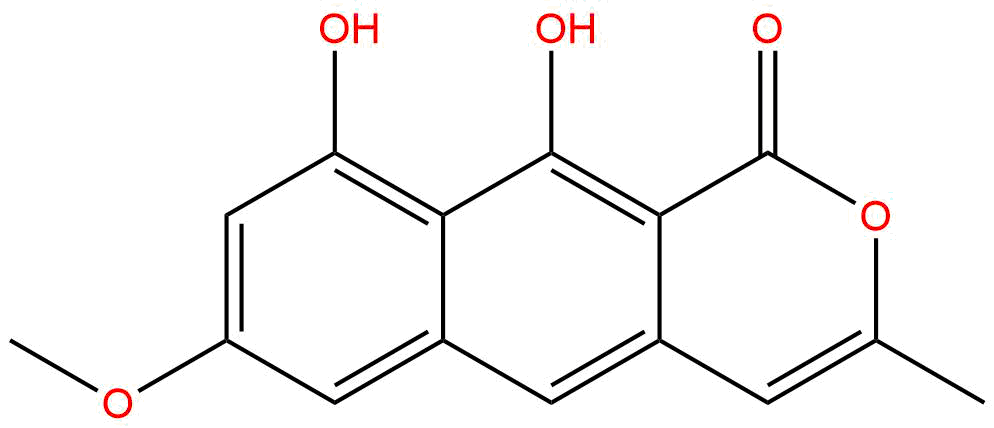
The chemical name of cassia lactone is 9,10-dihydroxy-1H-benzo [g] isochromene-1-one, with a molecular formula of C15H12O5 and a molecular weight of 272.2560. Its structural features include a naphtho - α - pyranone skeleton, a lactone ring structure, and methyl and methoxy substituents at positions 3 and 7, respectively. It belongs to aromatic ethers and phenolic compounds with multiple hydroxyl substituents. This structure endows it with strong polarity and a certain degree of aromaticity, and due to the presence of the lactone ring, the molecule exhibits a relatively rigid tricyclic configuration.
In terms of physical and chemical properties, the LogP value of cassia lactone is 2.7352, indicating its moderate lipophilicity, which is conducive to the penetration of cell membranes; The polar surface area (TPSA) is 79.9 Å ², indicating that it has a certain polarity and is conducive to binding with biomolecules. Low water solubility (0.0780 mg/mL) suggests limited solubility in aqueous phase, which may affect its bioavailability. The low permeability of the blood-brain barrier suggests that it mainly acts on peripheral tissues, reducing the risk of central nervous system side effects. The negative result of hERG channel inhibition experiment indicates a low risk of cardiac toxicity. The Ames mutagenicity test score is 1.2, indicating a low risk of genotoxicity.
Plant sources and extraction methods
Cassinolactone is mainly isolated from Cassia obtusifolia L. Cassia seed is a seed of the legume plant Cassia genus, widely distributed in tropical and subtropical regions of Asia. As a traditional Chinese medicinal herb, it has a long history of application and has the effects of clearing the liver, improving vision, moistening the intestines, and promoting bowel movements.
The common methods for extracting quercetin include:
-
Solvent extraction method Using ethanol or methanol as solvents, reflux extraction or ultrasound assisted extraction can effectively dissolve cassia lactone and other flavonoids and anthraquinone components.
-
Liquid liquid distribution and column chromatography separation After concentration, the extraction solution is separated into liquid and liquid phases using solvents of different polarities, and then purified using techniques such as silica gel column chromatography and reverse phase high performance liquid chromatography (RP-HPLC).
-
Modern Separation Technology Including supercritical fluid extraction, molecular imprinting technology, etc., to further improve extraction efficiency and purity.
The purified cassia lactone can be structurally identified and purity confirmed by mass spectrometry (MS), nuclear magnetic resonance (NMR) and other methods.
Pharmacological activity research
Liver protective effect
Numerous in vitro and in vivo studies have shown that cassia lactone has significant liver protective effects. It activates the nuclear factor E2 related factor 2 (Nrf2) signaling pathway, enhances the expression of intracellular antioxidant enzyme systems such as glutathione peroxidase and superoxide dismutase, and reduces oxidative stress-induced liver cell damage. In animal models, quercetin can effectively reduce the levels of lipid peroxidation products in the liver, inhibit the release of inflammatory factors, and alleviate liver tissue fibrosis and necrosis.
Hypolipidemic effect
Cassinolactone exhibits potential pharmacological activity in regulating lipid metabolism. It targets a variety of key proteins, including cholesterol ester transfer protein (CETP), 3-hydroxy-3-methylglutaryl-CoA reductase (HMGCR), low-density lipoprotein receptor (LDLR), apolipoprotein B (APOB), proprotein converting enzyme subtilisin 9 (PCSK9), apolipoprotein E (APOE), and peroxisome proliferator activated receptor alpha (PPARA). By regulating these targets, cassia lactone can reduce the levels of plasma total cholesterol and low-density lipoprotein cholesterol (LDL-C), promote the balance of lipid metabolism, and reduce the risk of atherosclerosis.
Anti inflammatory and antioxidant properties
In addition to liver protection and lipid-lowering, cassia lactone also exhibits good anti-inflammatory and antioxidant activities. It can inhibit the nuclear factor kappa B (NF - κ B) signaling pathway, reduce the release of pro-inflammatory cytokines (such as TNF - α, IL-6), and alleviate chronic inflammation. The antioxidant effect is mainly achieved by clearing free radicals and enhancing endogenous antioxidant enzyme activity.
Mechanism of action and molecular targets
The biological activity of quercetin mainly depends on its regulation of intracellular signaling pathways and key proteins:
-
Nrf2 dependent antioxidant mechanism
Cassinolactone promotes the translocation of Nrf2 from the cytoplasm to the nucleus, enhances gene expression mediated by antioxidant response elements (ARE), increases the activity of antioxidant enzymes such as glutathione peroxidase and superoxide dismutase, reduces oxidative stress damage, and protects liver cell function.
-
Regulating blood lipid metabolism related targets
- CETP Regulating cholesterol transfer between high-density lipoprotein (HDL) and low-density lipoprotein (LDL), affecting plasma lipid composition.
- HMGCR As a rate limiting enzyme in cholesterol synthesis, quercetin reduces endogenous cholesterol synthesis by inhibiting its activity.
- LDLR Promote LDL receptor expression and enhance LDL cholesterol clearance.
- PCSK9 Inhibiting PCSK9 expression, reducing LDLR degradation, indirectly increasing LDL-C clearance rate.
-
PPARA Activate PPARA, promote fatty acid beta oxidation, and improve lipid metabolism disorders.
-
Anti inflammatory mechanism
By inhibiting the NF - κ B signaling pathway, reducing the release of pro-inflammatory cytokines, alleviating inflammatory reactions, and protecting tissues from inflammatory damage.
-
Other potential mechanisms
The structure of quercetin lactone is similar to that of demethylated lactone, and it may share some biological activity mechanisms, but the specific differences still need to be further studied.
Evaluation of drug properties and pharmacokinetics
The pharmacological parameters of Cassinolactone indicate that it has good potential for drug development:
- Molecular weight (272.2560)Complies with Lipinski's rules and is beneficial for oral absorption.
- LogP(2.7352)Moderate, with both lipid solubility and water solubility, it is beneficial for cell membrane penetration and in vivo distribution.
- TPSA(79.9 Ų)Indicating that its polarity is moderate and helpful for binding to target proteins.
- Water solubility (0.0780 mg/mL)Low, indicating the need to optimize the formulation to improve bioavailability.
- Low blood-brain barrier permeability Reduce the risk of central nervous system side effects.
- HERG inhibition negative Low risk of cardiac toxicity.
- Ames test score 1.2 The risk of genotoxicity is relatively low and the safety is good.
In terms of pharmacokinetics, there is currently limited data on the in vivo absorption, distribution, metabolism, and excretion (ADME) of quercetin. It is preliminarily speculated that it has good oral absorption, but due to its low water solubility, there may be a first pass effect. Its metabolic pathway may involve the liver cytochrome P450 enzyme system, and the activity and toxicity of metabolites need further evaluation. In the future, systematic pharmacokinetic studies are needed to guide clinical applications.
Clinical application prospects and prospects
Cassinolactone, as a natural product with multiple pharmacological activities, has broad clinical application prospects:
-
Prevention and treatment of liver diseases
It can effectively alleviate liver damage through Nrf2 mediated antioxidant mechanism and is suitable for adjuvant therapy of hepatitis, fatty liver, and drug-induced liver injury.
-
Prevention and control of cardiovascular diseases
By regulating lipid metabolism related targets, cassia lactone is expected to become a new candidate for lipid-lowering drugs to prevent atherosclerosis and related cardiovascular events.
-
Anti inflammatory and antioxidant properties
Its anti-inflammatory and antioxidant effects provide possibilities for the treatment of chronic inflammatory diseases, such as metabolic syndrome, diabetes and neurodegenerative diseases.
-
Drug development and formulation optimization
Given its low water solubility, modern formulation technologies such as nanocarriers and solid dispersions are needed to enhance its bioavailability in the future. Meanwhile, structural modification to enhance targeting and drug efficacy is also an important direction.
-
Safety and clinical trials
The existing toxicology data preliminarily shows good safety, but lacks systematic preclinical and clinical studies. In the future, animal toxicity, pharmacokinetics, and clinical trials need to be conducted to verify its efficacy and safety.
Conclusion
Cassia lactone, as a natural organic heterocyclic compound derived from traditional Chinese medicine Cassia seed, exhibits significant liver protection and lipid-lowering effects due to its unique chemical structure and multi-target pharmacological activity. It exerts a wide range of biological effects by activating the Nrf2 antioxidant pathway and regulating various lipid metabolism targets, and has good pharmacological characteristics and safety potential. Although the current research on its pharmacokinetics and clinical applications is still relatively preliminary, it is worth further exploring as an emerging candidate molecule for natural drug development. In the future, through systematic pharmacological mechanism research, structural optimization, and clinical validation, it is expected to promote the clinical translation of quercetin in the prevention and treatment of liver and cardiovascular diseases, benefiting a large number of patients.