Introduction/Overview
Hepatocellular carcinoma (HCC) is one of the malignant tumors with the highest incidence rate and mortality worldwide, among which hepatocellular carcinoma (HCC) accounts for the vast majority of primary liver cancer. Despite the continuous development of surgical resection, local ablation, and targeted therapy, the overall prognosis of liver cancer patients is still not ideal, especially for advanced patients, where drug resistance and treatment-related toxic side effects are major challenges in clinical practice. Therefore, exploring highly efficient and low toxicity anti liver cancer lead compounds from natural products has always been an important direction for drug development. Scutebarbatine A (CAS: 176520-13-1), as a diterpenoid alkaloid isolated from traditional medicinal plants, has attracted much attention in recent years due to its significant anti liver cancer activity. Research has shown that Scutellaria baicalensis alkaloid A can effectively inhibit the proliferation of liver cancer cells and trigger their apoptosis by activating the mitogen activated protein kinase (MAPK) signaling pathway, inducing endoplasmic reticulum stress. This article aims to systematically review the chemical structure, plant origin, pharmacological activity, mechanism of action, medicinal properties, and clinical application prospects of Scutellaria baicalensis alkaloid A, in order to provide comprehensive scientific references for the in-depth research and development of this compound.
Chemical structure and physicochemical properties
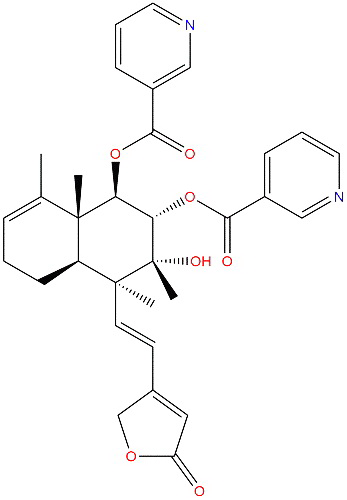
Half branch lotus alkaloid A is a structurally complex diterpenoid alkaloid with a molecular formula of C ∝₂ H ₄₂ N ₂ O ₆ and a molecular weight of 558.6310. Its core structure is based on a diterpene skeleton with four or five rings, and incorporates nitrogen-containing heterocycles, which gives it unique biological activity. From the analysis of physical and chemical properties, the lipid water partition coefficient (LogP) of the compound is 3.5819, indicating that it has moderate lipophilicity, which is conducive to its penetration of the cell membrane and interaction with intracellular targets. Its topological polar surface area (TPSA) is 124.9100 Å ², which is relatively high, indicating the presence of multiple hydrogen bond donor and acceptor sites in the molecule, which is related to its potential protein binding ability. The water solubility parameter is 0.0138, indicating that it has low solubility in water and belongs to insoluble compounds. This may be one of the key issues that need to be addressed in the development of its formulation. Based on its molecular weight, LogP, and TPSA parameters, Scutellaria baicalensis A basically conforms to the Rule of Five and has the preliminary structural basis to become a candidate molecule for oral medication.
Plant sources and extraction methods
Half branch lotus alkaloid A mainly comes from the Lamiaceae plant, Half branch lotus(Scutellaria barbata D. Don)。 Half branch lotus, as a traditional Chinese medicine, has the effects of clearing heat, detoxifying, removing blood stasis, and diuresis. It is commonly used in clinical practice to treat abscesses, sores, venomous snake bites, and various tumors. The extraction of active ingredients is usually carried out using organic solvent extraction method. The classic process is as follows: Crush the dried whole plant of Scutellaria barbata, and first degrease it with petroleum ether or n-hexane to remove weak polar impurities such as chlorophyll and oil. Subsequently, use solvents with moderate polarity, such as chloroform, ethyl acetate, or methanol, for repeated leaching or reflux extraction. The crude extract obtained is initially separated by silica gel column chromatography, often using gradient elution systems such as chloroform methanol or petroleum ether ethyl acetate for elution. The fraction containing Scutellaria baicalensis A was further purified by preparative high-performance liquid chromatography (HPLC) using a reverse phase C18 column with methanol water or acetonitrile water (usually containing a small amount of buffer salts such as trifluoroacetic acid) as the mobile phase to obtain high-purity Scutellaria baicalensis A monomer. Modern technologies such as high-speed countercurrent chromatography (HSCCC) have also been applied for the separation and purification of such alkaloids due to their high recovery rate and avoidance of irreversible adsorption.
Pharmacological activity research
The core pharmacological activity of Scutellaria baicalensis alkaloid A is characterized by broad-spectrum and highly effective anti-tumor effects, especially in liver cancer models, which have been extensively studied.
1. Anti proliferative activity In vitro cell experiments have shown that Scutellaria baicalensis alkaloid A exhibits significant proliferation inhibitory activity on various human liver cancer cell lines (such as HepG2, Huh-7, SMMC-7721), with a half maximal inhibitory concentration (IC ₅₀) typically at the micromolar or even sub micromolar level, and the inhibitory effect is time-dependent and dose-dependent. Compared to some normal liver cells, its toxicity selectivity towards cancer cells is higher, indicating that it has a certain safety window.
2. Inducing cell apoptosis Flow cytometry, Hoechst/PI staining, and Western blot analysis confirmed that treatment with Scutellaria baicalensis alkaloid A significantly increased the apoptosis rate of liver cancer cells. Its features include: phosphatidylserine eversion, nuclear condensation fragmentation, and activation of apoptosis executing proteins Caspase-3 and Caspase-9.
3. Inhibit cell migration and invasion Through scratch healing experiments and Transwell chamber experiments, it was found that Scutellaria baicalensis A can effectively inhibit the migration and invasion ability of liver cancer cells, which is closely related to its regulation of matrix metalloproteinases (such as MMP2).
4. In vivo anti-tumor effect In the nude mouse liver cancer transplant tumor model, intraperitoneal injection or gavage of hemiphylline A can significantly inhibit tumor growth, and the tumor weight and volume are significantly smaller than the control group. Pathological examination showed a large number of apoptotic cells in the tumor tissue of the treatment group, while no significant toxic damage was observed in the main organs, preliminarily confirming its in vivo effectiveness and low acute toxicity.
Mechanism of action and molecular targets
The anti liver cancer effect of Scutellaria baicalensis A involves synergistic regulation of multiple targets and pathways, with its core mechanism revolving around activating the MAPK pathway and inducing endoplasmic reticulum stress.
1. Activate MAPK signaling pathway The MAPK pathway is a key signaling network that regulates cell proliferation, stress, and apoptosis. Research has shown that Scutellaria baicalensis alkaloid A can rapidly and continuously phosphorylate and activate extracellular signal regulated kinase (ERK, MAPK1), c-Jun N-terminal kinase (JNK), and p38 MAPK. This activation does not promote survival signals, but rather shifts towards promoting apoptosis. For example, activated JNK and p38 can phosphorylate and inhibit the anti apoptotic protein Bcl-2, while promoting the expression and activation of the pro apoptotic protein Bim, thereby inducing apoptosis in the mitochondrial pathway.
2. Inducing endoplasmic reticulum stress Half branch lotus alkaloid A can cause the accumulation of unfolded/misfolded proteins in the endoplasmic reticulum, triggering the unfolded protein response (UPR). Specifically, it manifests as upregulation of endoplasmic reticulum stress marker molecule GRP78/BiP, as well as significant activation of key effector proteins such as CHOP (C/EBP homologous protein). Upregulation of CHOP can further inhibit the expression of anti apoptotic proteins MCL1 and BCL2, promote the generation of reactive oxygen species (ROS), and ultimately synergize with the MAPK pathway to push cells towards apoptosis.
3. Regulating key apoptosis related targets:
* BCL2 family Directly or indirectly downregulate the expression of anti apoptotic members MCL1 and BCL2, disrupting the balance of pro apoptotic/anti apoptotic proteins.
* STAT3 Inhibiting the phosphorylation and activation of signal transduction and transcription activator 3 (STAT3), thereby downregulating downstream target genes related to proliferation (such as Cyclin D1) and survival (such as Survivors).
* HIF1A In hypoxic microenvironment, it can inhibit the stability and activity of hypoxia inducible factor 1 alpha (HIF1A), interfere with tumor adaptation and angiogenesis.
* Topoisomerase May cause DNA damage by interfering with the functions of topoisomerases I (TOP1) and II α (TOP2A).
* Other targets Inhibition of matrix metalloproteinase MMP2 is the molecular basis for its resistance to invasion and metastasis; The potential role of estrogen receptor (ESR1) and aromatase (CYP19A1) suggests their potential application value in hormone related cancers.
Evaluation of drug properties and pharmacokinetics
Based on the provided pharmacological parameters and existing research, a preliminary evaluation of the pharmacological properties of Scutellaria baicalensis alkaloid A is conducted
1. drug-likeness The molecular weight of 558.6 is slightly higher than 500, but the LogP (3.58) and hydrogen bond donor acceptor number (implied in the structure and TPSA) basically meet the common oral drug standards. A higher TPSA (124.9) may affect its membrane permeability, but moderate LogP can partially compensate.
2. Absorption, distribution, metabolism, excretion (ADME) prediction:
* absorb Moderate LogP and high TPSA suggest that its oral bioavailability may be moderate or low, and formulation techniques (such as nanocrystals, liposomes, solid dispersions) may be needed to improve solubility and permeability.
* distribution Predict its blood-brain barrier (BBB) penetration as' high ', which means it may be easy to enter the central nervous system. This is a potential advantage for treating brain tumors or metastases, but attention should also be paid to its potential risk of side effects on the central nervous system.
* Metabolism As an alkaloid, it may be a substrate or inhibitor of cytochrome P450 (CYP) enzymes, and the specific metabolic pathways and metabolites need to be clarified through liver microsomal experiments. The association with CYP19A1 (aromatase) also suggests that it may affect endogenous hormone metabolism.
* excretion There is currently no clear data available, further research is needed.
3. Preliminary Safety Assessment:
* cardiotoxicity The result of the hERG potassium channel inhibition experiment is' no ', which is a very positive signal indicating a low risk of inducing QT interval prolongation and apical torsion ventricular tachycardia in the heart.
* Genotoxicity The Ames test result is 0.0, indicating that there is no direct genetic mutation induction. However, a complete genetic toxicity evaluation still requires chromosome aberration and micronucleus tests.
* acute toxicity There have been no reports of significant acute toxicity in existing in vivo experiments, but systematic acute and long-term toxicity experiments still need to be conducted.
At present, there is still a lack of pharmacokinetic studies on the half branch lotus alkaloid A system, such as absolute bioavailability, plasma protein binding rate, tissue distribution, major metabolic pathways, and excretion modes. This is a key data gap that must be filled to advance its preclinical development.
Clinical application prospects and prospects
Half branch lotus alkaloid A has shown promising prospects for anti liver cancer applications, but its clinical application still faces a series of opportunities and challenges.
prospect:
1. New candidate drugs for liver cancer treatment Its unique mechanism of action (simultaneously activating the MAPK pro apoptotic axis and inducing endoplasmic reticulum stress) is different from existing targeted drugs such as sorafenib and lenvatinib, and is expected to provide new treatment options for liver cancer patients who are resistant or not suitable for existing therapies.
2. Combination therapy sensitizer Given its ability to downregulate anti apoptotic proteins such as MCL1 and BCL2, the combination of Scutellaria baicalensis A with conventional chemotherapy drugs or other targeted drugs (such as BCL-2 inhibitors) may produce a synergistic effect and reverse tumor resistance.
3. Development of formulations to enhance drug efficacy To address the issue of poor water solubility, new nano drug delivery systems (such as polymer nanoparticles and albumin nanoparticles) can be developed to improve their stability, targeting, and bioavailability.
Challenges and Prospects:
1. In depth mechanism research Further clarification is needed on its direct interaction with targets such as STAT3, TOP1/2, ESR1, etc., and potential new targets should be discovered using proteomics, chemical proteomics, and other techniques.
2. System preclinical evaluation Comprehensive pharmacological (more tumor types, drug resistance models), pharmacokinetic (ADME full parameters), and toxicological (long-term toxicity, reproductive toxicity, etc.) evaluations that comply with the guidelines for preclinical research of new drugs must be completed.
3. structural optimization On the basis of clarifying its pharmacophore, reasonable structural modifications can be made to enhance its activity, improve its water solubility and pharmacokinetic properties, while reducing potential toxicity.
4. Exploring biosynthetic pathways Analyzing its biosynthetic pathway in Scutellaria barbata is expected to achieve sustainable and efficient green production through synthetic biology strategies, solving the bottleneck of limited natural sources.
Conclusion
Banzhilian alkaloid A is a diterpenoid alkaloid with significant anti liver cancer activity discovered from the traditional Chinese medicine Banzhilian. It effectively inhibits the proliferation, invasion, and induces apoptosis of liver cancer cells by synergistically activating the MAPK pathway and inducing endoplasmic reticulum stress, regulating multiple key targets such as MCL1, BCL2, STAT3, MMP2, etc. Preliminary pharmacological parameters indicate that it has a low risk of hERG inhibition and genetic toxicity, but poor water solubility is an urgent drawback that needs to be overcome. Although there are still challenges in the in-depth elucidation of the mechanism of action, systematic pharmacokinetic studies, and formulation development, Scutellaria baicalensis A is undoubtedly a highly promising lead compound for anti liver cancer. Future research should focus on the systematic work of its preclinical development, and actively explore its combination therapy strategy and structural optimization, in order to push it from laboratory research to clinical application as soon as possible, bringing new hope to liver cancer patients.