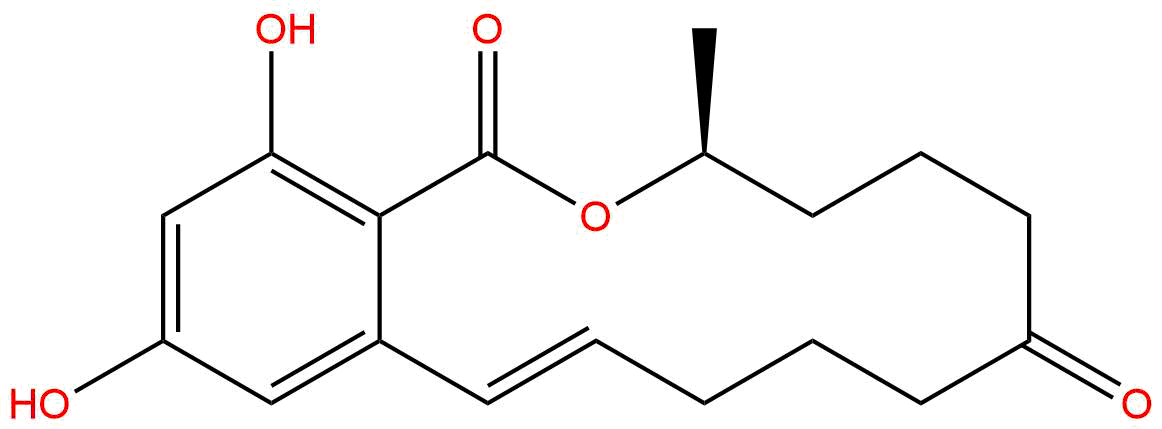


Product name: Zearalenone
Synonym name: Mycotoxin F 2; Toxin F2; Zenone; trans-Zearalenone
Catalogue No.: BP4368
Cas No.: 17924-92-4
Formula: C18H22O5
Mol Weight: 318.369
Botanical Source:
Type of Compound:
Purity: 95%~99%
Analysis Method: HPLC-DAD or/and HPLC-ELSD
Identification Method: Mass, NMR
Packing: Brown vial or HDPE plastic bottle
Storage: Store in a well closed container, protected from air and light. Put into refrigerate or freeze for long term storage.
Whenever possible, you should prepare and use solutions on the same day. However, if you need to make up stock solutions in advance, we recommend that you store the solution as aliquots in tightly sealed vials at -20℃. Generally, these will be useable for up to two weeks.
The product could be supplied from milligrams to grams
Inquire for bulk scale.
For Reference Standard and R&D, Not for Human Use Directly.
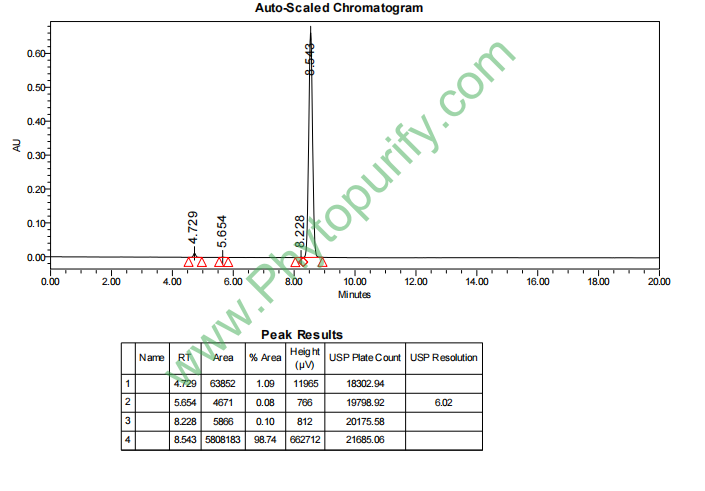
HPLC of Zearalenone
Storage conditions:Short-term storage at 2~8℃, long-term storage at -20 ~ -80℃
83.8300
3.1655
3.0629
.2178
3.4413
5.3102
High
90.4647
3.7053
No
Yes
No
No
Yes
Yes
0.0
Yes
No
Yes
Yes
Zearalenone (ZEN), also known as F-2 toxin, is a non steroidal fungal toxin produced by Fusarium fungi, with a CAS number of 17924-92-4. Since its first isolation and identification in the 1960s, ZEN has become a global focus for food safety and animal husbandry due to its widespread contamination of grains (such as corn, wheat, barley) and their derivatives. As a fungal toxin, ZEN has relatively low acute toxicity, but its most notable feature is its strong estrogenic activity. When animals (especially pigs highly sensitive to estrogen) consume contaminated feed, ZEN and its metabolites bind to endogenous estrogen receptors, disrupting normal reproductive endocrine function and causing a series of estrogen excess syndromes such as redness and swelling of the external genitalia, premature breast development, false pregnancy, miscarriage, and decreased litter size in young sows, resulting in huge economic losses. In terms of human health, long-term intake of low-dose ZEN through diet is also considered to pose potential risks, which are associated with the occurrence and development of endocrine disorders, reproductive disorders, and even certain hormone dependent tumors. Therefore, research on zearalenone spans across multiple fields such as toxicology, veterinary medicine, food science, and pharmacology. This article aims to systematically review the chemical properties, sources, pharmacological (toxicological) activities, molecular mechanisms of action, and pharmacological characteristics of zearalenone from the perspective of natural product pharmacology, and explore its potential translational medical value.
The chemical name of zearalenone is 6- (10-hydroxy-6-oxo-trans-1-undecene) - β - clavulanic acid lactone, with a molecular formula of C18H22O5 and a molecular weight of 318.3690. Its core structure is a condensed dihydrobenzo - α - pyranone (also known as clavulanic acid lactone) ring system, which has a similar spatial conformation to steroid estrogens (such as 17 β - estradiol) in mammals. This is the structural basis for its ability to simulate estrogenic effects.
In terms of physical and chemical properties, zearalenone is a white crystalline solid at room temperature. Its lipophilicity is strong, with a calculated LogP value of approximately 3.1655, indicating that it is easy to penetrate biofilms and accumulate in adipose tissue. Its topological polar surface area (TPSA) is 83.83 Å ², with poor water solubility of approximately 0.2178 mg/mL, which explains its relatively stable nature in the environment and difficulty in removal by water washing. Corn ketone can emit characteristic fluorescence under ultraviolet light (λ max=236, 274, 316 nm) and blue-green light (λ max=450 nm) irradiation, which is commonly used for its analysis and detection. This compound is thermally stable and cannot be completely destroyed by conventional food processing temperatures such as baking and steaming. Stable in acidic and neutral environments, but under alkaline conditions, its lactone ring can be opened to generate cornenone salts with reduced toxicity but still biological activity.
Zeosenone is mainly metabolized by the liver in organisms, including reduction reactions to produce alpha zearalanol and beta zearalanol. Among them, the affinity between alpha isomer and estrogen receptor is 3-4 times that of ZEN itself, indicating stronger estrogenic activity; However, the activity of β - isomer is much weaker. This metabolic transformation is a key link in amplifying or regulating the estrogenic effect in its body.
Corn ketone is not a natural product synthesized by plants themselves, but a secondary metabolite produced by various Fusarium species during the process of infecting grains. The main toxin producing strains include Fusarium graminearum, F. culmorum, and F. tricintum. These fungi are commonly found in temperate and subtropical regions, preferring cool and humid climate conditions. Grains such as corn, wheat, barley, oats, sorghum, etc. are highly susceptible to fungal infections and ZEN production during field growth, harvesting, or storage if the temperature and humidity are suitable (usually 24-27 ° C, relative humidity>30%). Therefore, ZEN's pollution has obvious seasonal and regional characteristics.
Extracting and purifying zearalenone from contaminated substrates is a prerequisite for conducting toxicological and pharmacological research, as well as developing detection methods. The classic extraction methods are mainly based on their lipid solubility and chemical stability:
1. Solvent extraction method The most commonly used method. Usually, polar organic solvents such as acetonitrile water mixture, methanol water mixture, or chloroform are used to extract ZEN from ground grains or cultures through shaking, homogenization, or Soxhlet extraction.
2. Immunoaffinity column purification method This is currently the mainstream pre-treatment technology used for food and feed testing. When the extract passes through an immunoaffinity column containing ZEN specific antibodies, ZEN is selectively adsorbed, impurities are washed away, and then a small amount of methanol or other solvents are used to wash off ZEN. This method has high selectivity and good purification effect, and is suitable for accurate quantitative analysis of trace ZEN in complex matrices.
3. Solid phase extraction method SPE columns filled with C18, silica gel, or Florisil are often used as an alternative or supplementary solution to immunoaffinity columns for purification and enrichment.
The extracted and purified samples are usually analyzed qualitatively and quantitatively using high-performance liquid chromatography fluorescence detection (HPLC-FLD) or liquid chromatography tandem mass spectrometry (LC-MS/MS), the latter of which has higher sensitivity and specificity.
The pharmacological activity research of zearalenone mainly focuses on its estrogen like effects and related effects, which is essentially a research paradigm of "toxic pharmacology".
Reproductive and endocrine activity This is the core biological activity of ZEN. Its estrogenic effect on pigs is most significant, and low doses (1-5 ppm feed) can cause redness and swelling of the external genitalia, vaginal prolapse, and breast hyperplasia in young sows; Long term intake can lead to ovarian atrophy, corpus luteum dissolution, embryo implantation failure, miscarriage, and weak offspring. Ruminant animals have lower sensitivity because rumen microorganisms can convert most of them into metabolites with lower activity. Effects such as uterine weight gain and dysregulation of the estrous cycle have also been observed in poultry and rodents. In vitro, ZEN can stimulate the proliferation of estrogen dependent cells (such as human breast cancer MCF-7 cells).
Immune regulatory activity ZEN has a dual regulatory effect on the immune system. Research has shown that ZEN can inhibit lymphocyte proliferation, reduce antibody production, and affect the function of macrophages and natural killer cells, which may impair the body's immune defense ability and increase susceptibility to infection. However, under certain experimental conditions, it has also been observed to have immunostimulatory effects, which may be related to dosage, exposure time, and species.
Hepatotoxicity Although acute liver toxicity is not strong, long-term exposure to ZEN can cause an increase in liver weight, hepatic cell steatosis, necrosis, and elevated liver function indicators (such as ALT and AST) in experimental animals, indicating a potential risk of liver damage.
Genotoxicity and Carcinogenicity The Ames test result of ZEN is negative (0.0), indicating that it has no direct genetic mutation effect. But its metabolites, especially the free radical intermediates generated by cytochrome P450 enzyme system metabolism, may cause DNA oxidative damage and adduct formation. Long term high-dose intake of ZEN can induce pituitary tumors and liver cancer in mice. The International Agency for Research on Cancer (IARC) classifies it as Group 3 (carcinogenicity in humans cannot be classified yet), but its estrogen driven oncogenic effects are worthy of caution.
Impact on other systems There are also research reports that ZEN may cause hematological changes, kidney damage, and oxidative stress reactions.
The estrogenic effect of zearalenone is its main mechanism of action, and its molecular target network is complex, not limited to classical nuclear estrogen receptors.
Classical genomic pathway (nuclear receptor pathway)This is the core mechanism by which ZEN functions. ZEN and its highly active metabolite alpha zearalenone, as agonists of estrogen receptors, have high binding affinity with estrogen receptors alpha (ESR1) and beta (ESR2). After binding, the receptor undergoes dimerization and is transported to the nucleus, where it binds to the estrogen response element (ERE) in the promoter region of the target gene, recruiting co activators to initiate or inhibit the transcription of specific genes, such as progesterone receptor (PGR), pS2, etc., thereby simulating the biological effects of estradiol and regulating cell proliferation, differentiation, and function.
Non genomic pathway (membrane receptor pathway)ZEN can also rapidly activate downstream signaling pathways such as MAPK/ERK and PI3K/Akt pathways by activating the G protein coupled estrogen receptor (GPER, also known as GPR30) located on the cell membrane, producing cellular effects within minutes to hours and participating in regulating cell migration, survival, and metabolism.
Interactions with other nuclear receptors:
Oxidative stress and cell apoptosis The reactive oxygen species (ROS) generated during ZEN metabolism can cause oxidative damage to lipids, proteins, and DNA. Meanwhile, ZEN can induce apoptosis in various cells by affecting the Bcl-2/Bax ratio and activating mitochondrial pathways such as the Caspase cascade reaction.
In summary, zearalenone exerts its biological effects through a multi-target network, with ESR1 mediated estrogen signaling as the core, and the cross dialogue of receptors such as AR, AHR, and PPAR γ jointly shaping its complex and diverse pharmacological (toxicological) spectrum.
From the perspective of drug development, the pharmacological parameters of zearalenone exhibit contradictory characteristics: on the one hand, it has good drug like molecular properties, and on the other hand, its strong endogenous hormone interference activity constitutes a major safety risk.
Analysis of drug properties parameters:
* Molecular weight (318.37)Meets the criteria for small molecule drugs (<500 Da).
* Fat solubility (LogP ≈ 3.17)Moderate lipid solubility is beneficial for its penetration through the cell membrane, but excessive solubility may also lead to tissue accumulation.
* Polar surface area (TPSA ≈ 83.83 Å ²)A moderate value indicates good membrane permeability.
* Water solubility (0.22 mg/mL)Poor, may affect its oral bioavailability, and needs to be improved through pharmaceutical methods.
* Blood-brain barrier permeability A prediction of 'high' indicates its ability to enter the central nervous system, which may be related to the reported potential risk of neurotoxicity.
* HERG inhibition A prediction of 'no' indicates a lower risk of causing QT interval prolongation in the heart, which is a favorable safety indicator.
* Mutability (Ames test negative)No direct genetic toxicity, reducing its primary risk as a carcinogen.
Pharmacokinetic characteristics:
The pharmacokinetic process of zearalenone in animals is well studied.
* absorb After oral administration, it is rapidly and completely absorbed in the small intestine, with high bioavailability.
* distribution Due to its lipophilicity, it is widely distributed in various tissues throughout the body, with high concentrations in fat, liver, kidneys, and reproductive organs. Its high blood-brain barrier permeability also allows it to enter brain tissue.
* Metabolism Mainly through the reduction metabolism of 3 α - and 3 β - hydroxysteroid dehydrogenase in the liver, producing α - and β - zearalenone. In addition, reactions such as hydroxylation and demethylation mediated by cytochrome P450 enzyme systems (such as CYP1A2, CYP3A4) are also involved in its metabolism. UDP glucuronosyltransferase (UGT) is responsible for its II binding metabolism, generating glucuronides and promoting excretion. There are significant metabolic differences between species, such as pigs producing a high proportion of highly active alpha zearalenone, making them the most sensitive.
* excretion Metabolites are mainly excreted through bile and urine, and there is also enterohepatic circulation, which prolongs their retention time in the body.
Overall, zearalenone possesses the basic physicochemical properties of small molecule drugs, but its core estrogenic activity is the fundamental obstacle to its development as a therapeutic drug. Any drug design based on its structure must first address its endocrine disrupting toxicity, significantly reducing or eliminating its excitatory activity towards ESR1/2 through structural modification, while retaining or enhancing its regulatory effect on other potential therapeutic targets, such as AHR or PPAR γ in specific disease states.
Although zearalenone poses significant harm as a fungal toxin, its unique biological activity also provides a special molecular template and inspiration for translational medicine research. Its clinical application prospects are not directly as a drug, but are reflected in the following aspects:
As a tool molecule and probe ZEN is a classic tool for studying the estrogen receptor signaling pathway, the mechanism of action of endocrine disruptors, and reproductive toxicology. The clear structure activity relationship, such as the difference in activity between α/β - zearalenone, provides a reference for designing selective estrogen receptor modulators (SERMs).
Structural optimization and new drug development Reasonably design and modify the chemical structure of zearalenone, aiming to "remove its toxicity and extract its activity". For example:
Reverse application in veterinary medicine - detoxification and prevention and control Developing efficient detoxifiers or adsorbents to address the hazards of ZEN pollution is currently a more urgent "application". For example, developing enzyme preparations that can specifically degrade ZEN, modifying montmorillonite and other feed additives that can firmly adsorb ZEN, and cultivating crop varieties resistant to Fusarium or low accumulation ZEN through biotechnology are the main directions for preventing and controlling ZEN hazards from source to end.
As a disease model inducer In scientific research, low-dose ZEN can be used to establish research models for animal estrogenic disorders, reproductive endocrine disorders, or hormone dependent tumor promotion, for screening and evaluating protective drugs or treatment methods.
Looking ahead to the future, research on zearalenone should continue to deepen
* Refinement of mechanism research Using omics technology and gene editing animal models, systematically elucidate the integrated mechanism of adverse health outcomes caused by a multi-target network under low-dose long-term exposure.
* Systematic structural modification Combining computer-aided drug design and synthetic chemistry, a ZEN derivative library was systematically synthesized to comprehensively evaluate its activity spectrum against targets such as ESR1/2, AHR, PPAR γ, AR, etc., and to search for lead compounds with novel pharmacological activities.
* Precision of risk assessment Establish a more accurate population dietary exposure assessment model, combining biomarkers and effector markers, to scientifically evaluate the long-term risks of ZEN to human health, especially sensitive populations such as children and pregnant women.
As a natural fungal toxin produced by Fusarium, the research process of zearalenone perfectly illustrates the duality of "the line between toxin and drug". On the one hand, it is a global food pollutant and agricultural toxin, posing a sustained threat to animal husbandry and public health due to its strong estrogenic activity. Its mechanism of action involves a complex signal network composed of multiple targets such as ESR1, AHR, PPAR γ, etc. On the other hand, its clear chemical structure, unique receptor interaction mode, and excellent drug like molecular properties make it a valuable pharmacological tool and potential source of lead compounds. The focus of future research is to deepen the understanding of its multi-target toxicity mechanism to enhance risk prevention and control, while exploring the therapeutic potential of its derivatives in selectively regulating nuclear receptors (such as AHR, PPAR γ) through rational structural modification, thereby turning "toxicity" into "use" and promoting the discovery of related innovative drugs. The continuous exploration of zearalenone is not only related to food safety, but also provides a unique scientific perspective for us to understand endocrine disruption and develop new receptor modulators.
