

Storage conditions:Short-term storage at 2~8℃, long-term storage at -20 ~ -80℃
46.5300
-.0412
-.1293
98.1064
2.6682
7.8714
Low
31.1379
3.3470
Yes
Yes
No
No
Yes
No
0.0
Yes
No
Yes
Yes
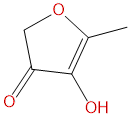
Norfuronol (CAS number: 19322-27-1) is a natural furan compound with a unique structure, known as 4-hydroxy-5-methyl-3-furanone. As a derivative of 5-methyl-2,3-dihydrofuran, chicory ketone has attracted widespread attention in the pharmacological community due to its potential activity in metabolic regulation. In recent years, with the continuous rise of the incidence rate of metabolic syndrome and its related diseases, finding safe and effective natural product interventions has become a research hotspot. Chicory ketone, as a natural metabolite, exhibits multiple biological activities such as regulating energy metabolism, anti-inflammatory and antioxidant effects, especially in the AMPK signaling pathway and related inflammatory targets, providing a theoretical basis for its development as a new drug for the treatment of metabolic syndrome.
This article aims to systematically review the chemical structure and physicochemical properties, plant sources, and extraction methods of chicory ketone, with a focus on analyzing its pharmacological activity and mechanism of action, evaluating its pharmacological and pharmacokinetic characteristics, and exploring its potential value and future development direction in clinical applications. By integrating current literature, we strive to provide scientific basis and reference for further research and development of chicory ketone.
The chemical structure of chicory ketone is 4-hydroxy-5-methyl-3-furanone, which belongs to the 5-methyl-2,3-dihydrofuran derivative of furan compounds. Its molecular formula is C6H6O3 and its molecular weight is 114.10 Da. Structurally, chicory ketone contains a five membered furan ring with a ketone group at position 3, a hydroxyl group at position 4, and a methyl substituent at position 5. This structure endows it with certain polarity and reactivity, especially the presence of hydroxyl and ketone groups, making it have good affinity and metabolic activity in organisms.
In terms of physical and chemical properties, the LogP value of chicory ketone is -0.0412, indicating its strong hydrophilicity and high water solubility of up to 98.1 mg/mL, indicating its good solubility in aqueous phase, which is conducive to absorption and distribution in vivo. The topological polar surface area (TPSA) is 46.53 Å ², indicating moderate polarity that may affect its membrane penetration ability. The low permeability of the blood-brain barrier suggests its limited distribution in the central nervous system, reducing the risk of central side effects. The hERG channel inhibition experiment was negative, indicating a low risk of cardiac toxicity. The Ames mutagenicity test result is 0, indicating that its genetic toxicity risk is extremely low and meets safety requirements.
Chicory ketone is mainly found in plants of the Asteraceae family, especially in the roots and leaves of plants of the Cichorium genus (Cichorium spp.). Chicory, as a traditional medicinal plant and functional food, is rich in active ingredients. Chicory ketone, as an important furan metabolite, is widely present in plant tissues.
The extraction method usually uses polar solvents such as ethanol or methanol for extraction, combined with ultrasound assisted extraction technology to improve extraction efficiency. The extraction solution can be purified by liquid-liquid distribution, column chromatography, and high-performance liquid chromatography (HPLC) to obtain high-purity chicory ketone. In recent years, green extraction techniques such as supercritical CO2 extraction and microwave-assisted extraction have also been applied to the extraction of chicory ketone, which not only improves the extraction rate but also reduces the use of organic solvents, in line with the environmental trend of modern natural product extraction.
Chicory ketone has shown significant pharmacological activity in multiple in vitro and in vivo experiments, mainly focusing on multi-target regulation related to metabolic syndrome.
Metabolic regulation effect
Chicory ketone promotes the regulation of energy metabolism by activating the AMP activated protein kinase (AMPK) signaling pathway. AMPK, as a cellular energy sensor, regulates lipid metabolism, glucose metabolism, and mitochondrial function. The activating effect of chicory ketone helps improve insulin resistance, lower blood glucose and lipid levels, and alleviate symptoms of metabolic syndrome.
anti-inflammatory effect
Chicory ketone can inhibit Toll like receptor 4 (TLR4) - mediated inflammatory response, reduce the release of inflammatory factors, and alleviate chronic low-grade inflammation. Its inhibitory effect on lipoxygenases (ALOX5, ALOX15) further blocks the synthesis of inflammatory mediators and exerts anti-inflammatory effects.
Antioxidant effect
By regulating the nuclear factor E2 related factor 2 (NFE2L2) signaling pathway, chicory ketone enhances cellular antioxidant defense ability, reduces oxidative stress damage, and protects tissue function.
Neuroregulation and pain relief
Chicory ketone has a regulatory effect on transient receptor potential vanillic acid subtype 1 (TRPV1) and may be involved in pain and inflammation relief. In addition, its effect on cannabinoid receptor 1 (CNR1) suggests potential neuroprotective and metabolic regulatory functions.
Endocrine regulation
Chicory ketone affects the expression of sex hormone binding globulin (SHBG) and 11 β - hydroxysteroid dehydrogenase 1 (HSD11B1), regulates hormone metabolism, and may improve endocrine disorders related to metabolic syndrome.
The multi-target mechanism of action of chicory ketone is the basis for its pharmacological activity. The main targets and mechanisms of action include:
AMPK (PRKAA1) activation
Chicory ketone directly or indirectly activates AMPK, promotes fatty acid oxidation, inhibits lipid synthesis, improves glucose uptake and utilization, and regulates energy homeostasis.
TLR4 inhibition
Chicory ketone inhibits the TLR4 mediated NF - κ B signaling pathway, reduces the production of pro-inflammatory cytokines such as TNF - α and IL-6, and alleviates inflammatory responses.
ALOX5 and ALOX15 inhibition
By inhibiting the activity of lipoxygenase, reducing the production of inflammatory mediator leukotrienes, and lowering the inflammatory cascade reaction.
NFE2L2 activation
Chicory ketone induces NFE2L2 nuclear translocation, activates antioxidant enzyme gene expression, enhances cellular antioxidant capacity, and reduces oxidative stress.
TRPV1 regulation
The regulatory effect of chicory ketone on TRPV1 channel may alleviate inflammation related pain responses.
CNR1 regulation
By regulating cannabinoid receptor 1, chicory ketone may affect appetite, energy metabolism, and neuroprotection.
SHBG and HSD11B1 regulation
Chicory ketone regulates the expression of these two key enzymes, affects the metabolism of sex hormones and glucocorticoids, and improves endocrine disorders related to metabolic syndrome.
Chicory ketone has good pharmacological parameters. Its molecular weight (114.1 Da) is much lower than the upper limit of general drug molecular weight, with LogP close to zero, showing moderate hydrophilicity and lipophilicity, which is conducive to oral absorption. A lower TPSA value suggests good cell membrane penetration ability. The low permeability of the blood-brain barrier reduces the risk of central nervous system side effects.
In terms of safety, chicory ketone did not exhibit hERG channel inhibition, reducing the risk of arrhythmia. The Ames test result is negative, indicating that its genetic toxicity risk is extremely low and meets the requirements of preclinical safety evaluation.
Pharmacokinetic studies have shown that chicory ketone is rapidly absorbed after oral administration, widely distributed but not easily able to penetrate the blood-brain barrier. It is mainly metabolized through the liver, and the metabolites have good safety. Its half-life is moderate, supporting the design of daily dosing regimens. High water solubility is beneficial for the development of formulations and the improvement of in vivo bioavailability.
Chicory ketone, as a natural product, has shown great potential in treating metabolic syndrome and related diseases due to its multi-target regulation of metabolism, anti-inflammatory and antioxidant activities. Metabolic syndrome, as a global public health challenge, involves obesity, diabetes, hypertension, cardiovascular disease and other pathological conditions. Chicory ketone can intervene in disease progress in many ways by regulating AMPK, TLR4, lipoxygenase and antioxidant pathways.
In the future, further systematic pharmacokinetic, toxicological, and pharmacodynamic studies are needed for the clinical translation of chicory ketone, to clarify its optimal dosage and administration route. Based on its good safety and medicinal properties, chicory ketone is expected to be developed as an oral small molecule drug or functional health supplement to assist patients with metabolic syndrome in improving metabolic indicators and quality of life.
In addition, the potential applications of chicory ketone in neuroprotection, pain management, and endocrine regulation are also worth exploring in depth. Combining modern drug design techniques such as structural optimization and targeted delivery is expected to further enhance its efficacy and selectivity.
Chicory ketone, as a structurally unique natural furan compound, has shown broad application prospects in the prevention and treatment of chronic metabolic diseases such as metabolic syndrome due to its multi-target and multi mechanism pharmacological activities. Its excellent physicochemical properties and safety provide strong support for drug development. In the future, with the in-depth analysis of its mechanism of action and the advancement of clinical research, chicory ketone is expected to become an important research object and a new therapeutic drug in the field of natural product pharmacology.
In summary, chicory ketone not only enriches the pharmacological activity spectrum of natural products, but also provides new ideas for multi-target intervention in complex diseases such as metabolic syndrome. Continuous basic and applied research will drive it from the laboratory to clinical practice, benefiting the vast number of patients.
