Introduction/Overview
Inflammation is a complex defense response of the body in response to infection, injury, or stress, and its precise regulation is crucial for maintaining internal environmental stability. However, persistent or excessive inflammatory reaction is the common pathological basis of many chronic diseases, such as rheumatoid arthritis, atherosclerosis, neurodegenerative diseases and metabolic syndrome. Non steroidal anti-inflammatory drugs (NSAIDs) and glucocorticoids widely used in clinical practice have significant therapeutic effects, but long-term use often accompanies serious side effects such as gastrointestinal injury, cardiovascular risk, and immune suppression. Therefore, exploring efficient and low toxicity novel anti-inflammatory lead compounds from natural products has always been an important direction in the field of drug development.
N-trans-Snapoylthyramine, as a phenylacetamide alkaloid, has attracted much attention in recent years due to its significant activity in various inflammatory models. This compound was originally derived from plants of the genus Piper Lindera glauca Sieb Zucc It was isolated from the cow tendon tree, and its structure cleverly combines the molecular characteristics of Sinapic acid and Tyramine. Preliminary pharmacological studies have revealed that sinapyr can exert multi-target anti-inflammatory effects by intervening in key inflammatory signaling pathways including nuclear factor kappa B (NF - κ B), signal transduction and transcriptional activation factor 3 (STAT3), and regulating the expression of various inflammatory mediators such as interleukin-6 (IL-6), tumor necrosis factor - α (TNF - α), inducible nitric oxide synthase (NOS2), and cyclooxygenase (COX). This article aims to provide a systematic review of the chemical properties, plant sources, pharmacological activities, molecular mechanisms of action, and pharmacological potential of sinapyr, in order to provide comprehensive scientific references for the in-depth research and future development of this natural product.
Chemical structure and physicochemical properties
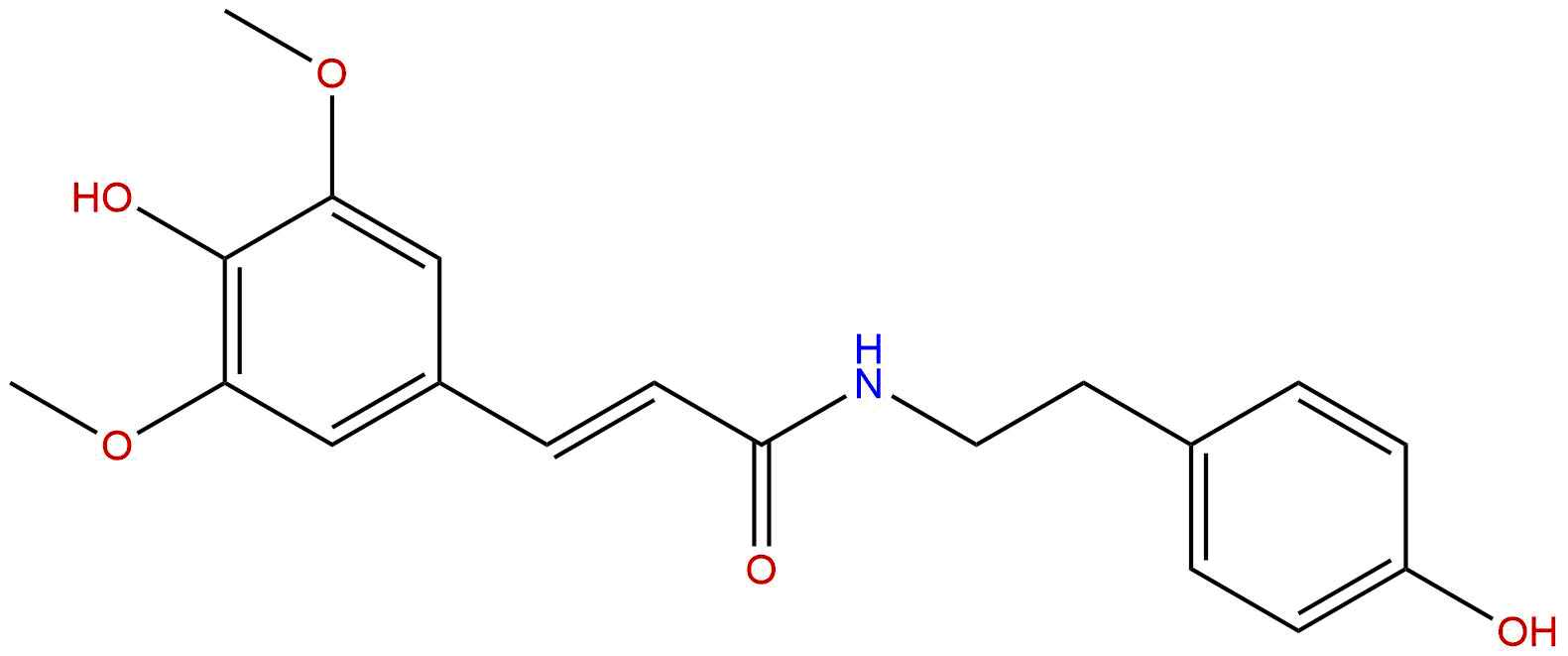
The chemical name of mustard casein (CAS number: 200125-11-7) is N - [(E) -3- (4-hydroxy-3,5-dimethoxyphenyl) acryloyl] -4-hydroxyphenylethylamine, with a molecular formula of C20H23NO5 and a molecular weight of 343.3790. Its structural core is composed of two parts connected by amide bonds: one end is 3,5-dimethoxy-4-hydroxycinnamoyl (sinapyryl) derived from sinapine, and the other end is 4-hydroxyphenylethylamine derived from tyramine. Its double bond configuration is usually trans, which is an important conformational basis for its biological activity.
From the analysis of physical and chemical properties, this compound exhibits typical phenolic amide characteristics. The calculated lipid water partition coefficient (LogP) is 2.4493, indicating that it has moderate lipophilicity, which is beneficial for transmembrane transport, but does not significantly increase the risk of accumulation in the body due to high lipid solubility. Its topological polar surface area (TPSA) is 88.0200 Å ², reflecting the presence of multiple polar groups (hydroxyl, methoxy, amide bonds) in the molecule. The predicted value of water solubility is about 0.1951 mg/mL, which belongs to the category of slightly soluble to poorly soluble. This suggests that solubilization strategies may need to be considered in formulation development, such as making salt forms, cyclodextrin inclusion complexes, or nano formulations.
The phenolic hydroxyl groups in the molecule endow it with potential antioxidant activity and the ability to scavenge free radicals, while the sinapyryl conjugated system is the structural basis for its interactions with certain biomolecules, such as hydrophobic interactions and π - π stacking. These physical and chemical properties collectively determine its absorption, distribution, metabolism, and excretion behavior in organisms, as well as its potential to interact with multiple protein targets.
Plant sources and extraction methods
Mustard casein is mainly found in plants of the Lindera genus in the Lauraceae family. The source of its first report is Lindera glauca(Niujinshu), a plant commonly used in traditional medicine in East Asia (especially in China, Japan, and South Korea) to treat rheumatic pain, traumatic injuries, and inflammation related diseases, indirectly confirms its potential value in anti-inflammatory activity from the perspective of ethnic pharmacology. In addition, subsequent studies have also found this component in the root bark of other plants such as Lycium in the Solanaceae family, indicating its possible distribution in the plant kingdom.
The extraction and separation of sinapyr from plant materials usually follow the conventional process of natural product chemistry. Firstly, medium polarity organic solvents such as methanol, ethanol, or acetone are used to extract or reflux the dried and crushed plant tissues (such as roots and stem bark) to fully extract the phenolic amide components. After vacuum concentration, the crude extract obtained was preliminarily enriched using solvent partitioning method (such as ethyl acetate water partitioning), and sinapyr was mainly concentrated in the ethyl acetate layer.
Further purification relies on various chromatographic techniques. Silica gel column chromatography is commonly used for separation using gradient elution systems such as chloroform methanol or petroleum ether ethyl acetate. Subsequently, fine purification is carried out by combining reverse phase medium pressure or high pressure liquid chromatography (such as C18 column, methanol water or acetonitrile water as mobile phase) to obtain high-purity monomer compounds. The structural identification is confirmed by comprehensive use of ultraviolet spectroscopy (UV, with characteristic absorption of cinnamoyl structure at~330 nm), mass spectrometry (MS, providing molecular weight and fragment ion information), and nuclear magnetic resonance spectroscopy (NMR, especially 1H NMR and 13C NMR), ultimately determining its planar structure and stereoconfiguration. The application of modern and efficient separation and identification techniques ensures that the compound can be effectively obtained from complex plant matrices, providing material support for its subsequent pharmacological research.
Pharmacological activity research
Numerous in vitro and in vivo pharmacological experiments have confirmed that the core biological activity of sinapyr is concentrated in the anti-inflammatory field, and its effects are extensive, involving multiple inflammatory models.
1. In vitro anti-inflammatory activity:
At the cellular level, sinapyr exhibits potent inhibitory effects on the inflammatory response of macrophages (such as RAW 264.7 cells and BV2 microglia) induced by stimuli such as lipopolysaccharides (LPS). It can dose dependently reduce key pro-inflammatory cytokines, such as TNF-αand IL-6 MRNA expression and protein secretion. At the same time, it can significantly inhibit the expression of inducible nitric oxide synthase (NOS2) and cyclooxygenase-2 (COX-2), thereby reducing the excessive production of inflammatory mediators nitric oxide (NO) and prostaglandin E2 (PGE2). These effects can be observed within the micromolar concentration range, indicating its high in vitro activity.
2. In vivo anti-inflammatory activity:
In animal models, sinapyr also exhibits good anti-inflammatory effects. For example, in mouse ear xylene or TPA induced acute inflammation models, local or systemic administration can significantly reduce ear swelling. In the rat paw swelling model induced by carrageenan or formalin, it can effectively inhibit the formation of edema and pain response. More importantly, in chronic inflammation models such as dextran sulfate sodium (DSS) induced mouse experimental colitis, sinapyr intervention can improve colon shortening, histopathological damage, and reduce the levels of cytokines such as IL-6 and TNF - α in colon tissue, indicating its protective effect on intestinal inflammation.
3. Other related activities:
In addition to its direct anti-inflammatory effect, sinapyr also exhibits other activities closely related to inflammation. The phenolic hydroxyl groups in its structure endow it with certain antioxidant Ability to eliminate DPPH free radicals and enhance cellular antioxidant defense. In addition, by acting on members of the transient receptor potential (TRP) channel family, such as TRPV1 and TRPA1 Both are important pain and inflammation receptors, and they may be involved in regulating pain signal transduction, which is consistent with their effectiveness in analgesic models. There are also preliminary studies suggesting that its anti-inflammatory mechanism may involve key executive proteins involved in pyroptosis Caspase-1 Regulation.
Mechanism of action and molecular targets
The anti-inflammatory effect of sinapyr is not achieved through a single target, but is characterized by synergistic intervention of multiple targets and pathways. The core mechanism network is as follows:
1. Inhibition of NF - κ B signaling pathway:
Nuclear factor kappa B (NF - κ B) is a pivotal transcription factor that regulates the expression of inflammatory genes. Research has shown that sinapyr can effectively inhibit LPS induced degradation of I κ B α protein and nuclear translocation of NF - κ B p65 subunit. This prevents the binding of NF - κ B to DNA, thereby extensively downregulating the expression of its downstream target genes at the transcriptional level, including TNF-α、IL-6、NOS2、COX-2 Wait. This is the main molecular basis for its broad-spectrum anti-inflammatory effect.
2. Regulating the JAK/STAT signaling pathway:
especially STAT3 The signaling pathway plays a crucial role in chronic inflammation and immune regulation. Mustard casein has been shown to inhibit the tyrosine phosphorylation activation of STAT3, block its dimerization and nuclear metastasis, and thereby affect the expression of a series of genes related to cell proliferation, survival, and inflammation. The inhibition of STAT3 pathway and NF - κ B pathway often have a synergistic effect, jointly suppressing the inflammatory cascade reaction.
3. Regulating inflammation related enzymes and mediators:
* Cyclooxygenase (COX)Mustard casein COX-2 The expression of inducible type has a selective inhibitory effect, while on COX-1 The structural type has a relatively small impact, and this characteristic is similar to selective COX-2 inhibitors, which may help reduce the risk of gastrointestinal side effects of traditional NSAIDs.
* Inducible nitric oxide synthase (NOS2)By inhibiting the expression of NOS2, excessive NO production is reduced, thereby alleviating NO mediated vasodilation, tissue damage, and inflammatory amplification effects.
* Caspase-1 By affecting the activity of Caspase-1, it may intervene in the activation of NLRP3 inflammasomes and the mature release of IL-1 β, IL-18, etc., thereby regulating the process of cell pyroptosis, which is a programmed cell death associated with various inflammatory diseases.
4. Acting on ion channels and receptors:
Mustard casein TRPV1 and TRPA1 The regulatory effect of channels provides another explanation for their anti-inflammatory and analgesic activities. These channels are expressed on peripheral sensory neurons and can be activated by various inflammatory mediators, mediating pain sensation and neurogenic inflammation. Mustard casein may act as a regulator to affect the function of these channels, thereby blocking pain signals and related local inflammatory responses.
In summary, sinapyr forms a three-dimensional anti-inflammatory network by interweaving with multiple key targets and pathways, which may be the reason why it can exert good effects in different inflammation models and is also in line with the trend of modern multi-target drug development.
Evaluation of drug properties and pharmacokinetics
Based on the provided calculation parameters and existing research, a preliminary evaluation of the pharmacological properties of sinapyr is conducted
1. Preliminary analysis of drug properties:
The molecular weight (343.4) falls within the range of the "Five Rules" for generic drugs. The LogP value (~2.45) is within the ideal range (1-3), indicating good membrane permeability. The TPSA value (88 Å ²) is moderate and usually corresponds to a certain oral absorption potential. However, its predicted water solubility is poor (0.195 mg/mL), which may be the main limiting factor affecting its oral bioavailability. The predicted permeability of the blood-brain barrier (BBB) is "low", which is consistent with its equal polarity and molecular weight, suggesting that it may mainly act on the peripheral system. The treatment of central nervous system related diseases may require formulation optimization or consideration of peripheral mechanisms of action.
2. Preliminary safety warning:
Key security warning indicators display positive signals:HERG inhibition A prediction of 'no' indicates a low risk of potential cardiac toxicity (QT interval prolongation), which is an important drug safety advantage.Ames test The predicted value is 0.0, indicating that it may not have a direct genetic toxicity risk. These computational predictions provide an optimistic starting point for subsequent preclinical safety evaluations, but still require experimental validation.
3. Pharmacokinetic (PK) considerations:
At present, there is limited publicly available data on the pharmacokinetics of the sinapyr system. Based on its structure, it can be inferred that its possible PK behavior: after oral administration, its amide bond may resist gastrointestinal hydrolysis to some extent, but the presence of phenolic hydroxyl and amide bonds may make it a substrate for II binding metabolism (such as glucuronidation and sulfation), leading to first pass effects and affecting bioavailability. Its distribution in the body may be limited by plasma protein binding rate (expected to be moderate) and tissue permeability. The excretion pathway may involve the kidneys (prototype or metabolites) and bile. A comprehensive study of ADME (absorption, distribution, metabolism, excretion), including the identification and activity of its metabolites, is an indispensable part of future development.
Clinical application prospects and prospects
As a multi-target natural anti-inflammatory lead compound, sinapyr exhibits translational medicine potential worthy of further exploration.
1. Potential therapeutic areas:
* Chronic inflammatory diseases For diseases such as rheumatoid arthritis and inflammatory bowel disease (Crohn's disease, ulcerative colitis), their multi pathway inhibitory properties may have advantages over single target drugs.
* Neuroinflammatory related diseases Although BBB penetration is low, it may have practical value for peripheral inflammatory components in diseases such as Alzheimer's and Parkinson's, or for improving brain entry efficiency through the development of prodrugs and nano delivery systems. Its inhibitory effect on the activation of microglia has been preliminarily confirmed.
* pain management Especially for inflammatory pain and neuropathic pain, their dual mechanisms of acting on TRPV1/TRPA1 channels and inhibiting central/peripheral inflammatory mediators may provide new analgesic strategies.
* Metabolic diseases Low degree chronic inflammation is the core pathological link of obesity, type 2 diabetes and nonalcoholic fatty liver. The anti-inflammatory properties of myrosin tyramine may provide new ideas for the intervention of these diseases.
2. Future research directions and challenges:
* In depth mechanism elucidation It is necessary to use techniques such as gene knockout and eutectic structure analysis to accurately elucidate the direct interaction patterns and sites with key targets such as STAT3 and TRP channels.
* Preclinical development of the system Including optimizing synthesis or semi synthesis processes to obtain sufficient samples; Conduct comprehensive ADME and toxicology studies (acute toxicity, chronic toxicity, reproductive toxicity, etc.); Conduct efficacy validation studies on specific disease models.
* Pharmaceutical optimization To address the issue of poor water solubility, new drug delivery systems such as solid dispersions, liposomes, polymer micelles, etc. have been developed to improve their oral bioavailability or achieve targeted delivery.
* Structural modification and structure-activity relationship Using it as the parent nucleus, systematic structural modifications are carried out to enhance activity, improve PK properties, reduce potential toxicity, and discover better candidate drugs.
Conclusion
Mustard casein is derived from traditional medicinal plants Lindera glauca A phenylacetamide alkaloid with clear multi-target anti-inflammatory activity was discovered. It exhibits significant therapeutic effects in various inflammatory models by synergistically inhibiting key inflammatory signaling pathways such as NF - κ B and STAT3, downregulating the expression of multiple inflammatory mediators such as COX-2, NOS2, TNF - α, IL-6, and possibly regulating TRP channel function. Preliminary pharmacological analysis suggests that it has good drug like properties and low risks of cardiac toxicity and genetic toxicity, although water solubility and BBB penetration are properties that need to be optimized.
In summary, sinapyr not only provides modern scientific basis for understanding the traditional pharmacological effects of Piper species, but more importantly, as a novel and diverse lead compound, it provides a valuable molecular template for the development of new drugs for the treatment of chronic inflammatory diseases, pain, and other conditions. Future research should focus on its in-depth mechanism of action, systematic preclinical efficacy and safety evaluation, as well as overcoming its physicochemical limitations through medicinal chemistry and pharmacology methods, ultimately promoting its transformation from a natural product to a potential therapeutic drug, providing new possibilities for addressing the growing global burden of inflammation related diseases.