Introduction/Overview
Natural products have long been an important source of innovative drug discovery, among which phenanthrene compounds have attracted much attention due to their diverse chemical structures and extensive biological activities. Confusarin, as a phenanthrene compound isolated from traditional medicinal plants, has entered the field of pharmacological researchers since its discovery due to its potential anti-tumor activity. This compound was originally derived from the family Hamamelidaceae plant, the tassel Hamamelis(Fothergilla fimbriata)The unique chemical skeleton and preliminary biological activity screening results of the intermediate separation and identification indicate that it may have important research value in the field of tumor therapy. With the development of modern molecular biology and pharmacology techniques, research on Mao Lanfei has gradually progressed from initial isolation and identification to exploring its multi-target and multi pathway mechanisms of action. This article aims to systematically review the chemical properties, plant sources, pharmacological activities, molecular mechanisms of action, pharmacological evaluation, and clinical application prospects of Maolanfei, in order to provide comprehensive academic references for the in-depth research and potential drug development of this natural product.
Chemical structure and physicochemical properties
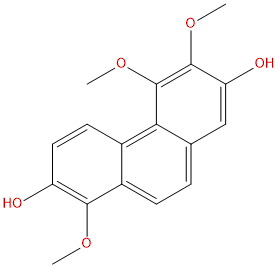
The chemical name of Confusarin is based on its phenanthrene parent nucleus structure, with CAS accession number 108909-02-0. Its molecular formula is C ₁₉ H ₁₆ O ₄, and its molecular weight is 300.3100 g/mol. Structurally speaking, Maolanfei belongs to the derivatives of phenanthrene, usually having a planar polycyclic aromatic system composed of three benzene rings (A, B, C) fused together, and connected with specific oxygen-containing substituents (such as methoxy, hydroxyl, etc.). The type and position of these substituents have a decisive impact on its biological activity and physicochemical properties.
The key physicochemical property parameters are as follows:
* Lipid water partition coefficient (LogP)The calculated value is approximately 3.0189. This value indicates that Maolanfei has moderate to high lipophilicity, which is beneficial for its penetration of cell membranes, but may also affect its water solubility and in vivo distribution.
* Topological Polarity Surface Area (TPSA): 68.1500 Å ². This value reflects the surface area of polar atoms (mainly oxygen atoms) in the molecule, which is at a moderate level, indicating that it has a certain polarity and may affect its membrane permeability and bioavailability.
* Water solubility The predicted value is relatively low, about 0.0164 mg/mL, which belongs to insoluble compounds. This is a common challenge faced by many natural active products, which needs to be improved through salt form, eutectic, nano formulation, or prodrug strategies in formulation development.
* Blood-brain barrier permeability Prediction shows that it has high blood-brain barrier permeability potential. This is mainly attributed to its suitable molecular weight, moderate LogP and TPSA values. This characteristic suggests that Maolanfei may have potential therapeutic value for central nervous system related tumors or diseases.
* HERG inhibition risk The prediction result is negative ("no"), indicating a low potential risk of causing QT interval prolongation in the heart, which is a favorable pharmacological feature.
* Genotoxicity screening (Ames test)The predicted value is 1.2, and it is generally believed that a value less than 1.5 indicates no mutagenic tendency, suggesting a low risk of genetic toxicity. However, further confirmation through experiments is needed.
These physical and chemical properties together constitute the preliminary pharmacological profile of Maolanfei, providing basic data for its subsequent pharmacokinetic studies and formulation design.
Plant sources and extraction methods
Mao Lanfei's first report was from the family Hamamelidaceae, a plant of the genus Hamamelidaceae(Fothergilla fimbriata)Separated from the middle. Hamameliaceae plants are commonly used in traditional medicine, and their various components have been reported to have anti-inflammatory, antioxidant, and anti-tumor activities. In addition to the initial source, subsequent research may also discover structural analogues or isomers in other plants, especially Orchidaceae or Thymelaeaceae plants containing phenanthrene components, but the tassel witch hazel remains its iconic source.
The extraction of wolfberry from plant materials usually follows the conventional process of natural product chemistry:
1. Extract Dried and crushed plant materials (such as stems, leaves, or roots) are first extracted or refluxed using polar organic solvents (such as methanol, ethanol, or acetone), sometimes using mixed solvent systems to improve extraction efficiency.
2. Rough classification After vacuum concentration, the crude extract obtained was subjected to liquid-liquid extraction using solvents such as petroleum ether, ethyl acetate, and n-butanol in sequence. Based on the solubility (moderate LogP) of lanobis, it may be mainly enriched in the ethyl acetate fraction.
3. Separation and Purification The ethyl acetate fraction was further separated and purified using various chromatographic techniques. Silica gel column chromatography is commonly used for preliminary separation, using solvent systems of different polarities (such as petroleum ether ethyl acetate gradient elution) for elution. Then, fine purification was carried out in combination with reversed-phase silica gel column chromatography (such as C18 column, eluted with methanol water system), gel column chromatography (such as Sephadex LH-20), and high performance liquid chromatography (HPLC) to finally obtain high-purity Maolanfei monomer compound.
4. appraisal The purified compound was structurally identified by spectroscopic techniques such as nuclear magnetic resonance (NMR, including ¹ H-NMR, ¹ ³ C-NMR, 2D-NMR), mass spectrometry (MS), infrared spectroscopy (IR), and ultraviolet spectroscopy (UV), and confirmed by comparison with literature data or standard samples.
Modern extraction and separation techniques, such as high-speed countercurrent chromatography (HSCCC) and preparative supercritical fluid chromatography (SFC), may also be applied to improve separation efficiency and yield.
Pharmacological activity research
The most notable pharmacological activity of Maolanfei is its extensive anti-tumor effect. A large number of in vitro cell experiments show that Maolanfei has significant proliferation inhibitory activity on a variety of human tumor cell lines, including but not limited to breast cancer, lung cancer, liver cancer, colon cancer and leukemia cells. Its anti-tumor activity is mainly achieved through inducing cell cycle arrest, triggering cell apoptosis, inhibiting cell migration and invasion, and other pathways.
In addition to its direct cytotoxic effects, the study also suggests that Maolanfei may have other auxiliary pharmacological activities. For example, phenanthrene compounds with similar structures are often reported to have anti-inflammatory, antioxidant, and antibacterial activities. Although there is relatively little specialized research on Maolanfei, its core phenanthrene ring structure and phenolic hydroxyl groups suggest that it may have the potential to scavenge free radicals and inhibit the production of pro-inflammatory factors. These characteristics may complement its microenvironmental regulatory role in anti-tumor effects. However, further experimental evidence is needed to support these potential activities.
Mechanism of action and molecular targets
The anti-tumor effect of Maolanfei is not achieved through a single target, but involves a complex network of multiple targets and pathways. Existing research (based on provided target information) has revealed key aspects of its mechanism of action:
- Regulating the apoptotic pathway Maolanfei can target survival promoting proteins MCL1 and BCL2 By inhibiting the function of these anti apoptotic proteins, it disrupts the integrity of the mitochondrial outer membrane, promotes the release of cytochrome C, activates the caspase cascade reaction, and ultimately induces intrinsic pathway apoptosis in tumor cells.
- Interference signal transduction:STAT3 It is an important oncogenic transcription factor. Mao Lanfei can inhibit the phosphorylation activation of STAT3, block its nuclear translocation and the transcription of downstream target genes (such as Bcl-2, Cyclin D1, MMPs), thereby inhibiting cell proliferation, survival, and metastasis.
- Inhibit invasion and metastasis Maolanfei can downregulate matrix metalloproteinases MMP2 Expression and activity. MMP2 is a key enzyme that degrades the extracellular matrix (ECM) and basement membrane. Inhibiting its activity can effectively reduce the invasion and metastasis ability of tumor cells.
- Affects DNA metabolism Mao Lanfei is predicted to TOP1 and TOP2A Interaction. Topoisomerase is a key enzyme in DNA replication and transcription. Inhibiting its activity can lead to DNA damage and replication fork arrest, thereby triggering cell death.
- Regulating hypoxia adaptation and angiogenesis: By acting on HIF1A(Hypoxia inducible factor 1 alpha), Maolanfei may interfere with the adaptive ability of tumor cells in hypoxic microenvironment and inhibit the expression of angiogenic factors such as vascular endothelial growth factor (VEGF) mediated by it, thereby inhibiting tumor angiogenesis.
- Intervention of key kinases and hormone pathways: Yes MAPK1 Inhibition of ERK2 may affect cell proliferation and differentiation signaling. Meanwhile, with ESR1(Estrogen receptor alpha) and CYP19A1 The potential interaction of (aromatase) suggests that Maolanfei may play an important role in hormone dependent tumors (such as breast cancer), and may play a therapeutic role by antagonizing estrogen receptor or inhibiting estrogen synthesis.
In summary, Maolanfei has formed a synergistic anti-tumor network by simultaneously acting on multiple key nodes such as apoptosis regulation, signal transduction, extracellular matrix degradation, DNA metabolism, hypoxia response, and hormone signaling, which helps overcome the problem of drug resistance easily caused by single target drugs.
Evaluation of drug properties and pharmacokinetics
Based on computational predictions and preliminary in vitro data, the pharmacological characteristics of Maolanfei present both advantages and challenges.
Advantage aspects:
* Security potential The prediction of no hERG inhibition and Ames mutagenicity provides preliminary positive signals for its safety.
* Good membrane permeability Moderate LogP and TPSA, as well as high blood-brain barrier penetration prediction, indicate its excellent ability to penetrate cell membranes and biological barriers.
* Clear activity and multi-target mechanism The strong in vitro anti-tumor activity and clear multi-target mechanism of action are the core foundations for its development.
Challenge aspect:
* Poor water solubility The extremely low water solubility is the primary obstacle to the development of oral absorption and intravenous administration formulations.
* Potential metabolic and stability issues As a phenanthrene compound, it may be easily metabolized by cytochrome P450 enzyme system, leading to strong first pass effect or short half-life in vivo. The phenolic hydroxyl groups in its structure may also undergo II phase binding reactions (such as glucuronidation and sulfation) in the body, accelerating clearance.
* Lack of systematic pharmacokinetic data in vivo Currently, there is very limited publicly available research on the absorption, distribution, metabolism, and excretion (ADME) of Mao Lanfei in animal bodies. Future research is needed to clarify its oral bioavailability, tissue distribution characteristics (especially tumor tissue accumulation capacity), major metabolites, and elimination pathways.
* Urgent demand for formulation development To improve solubility and bioavailability, it may be necessary to develop advanced drug delivery systems such as nanocrystals, liposomes, polymer micelles, or cyclodextrin inclusion complexes.
Clinical application prospects and prospects
As a natural lead compound with multi-target anti-tumor activity, Maolanfei has broad clinical application prospects, but the road ahead is long. Future research and development may focus on the following directions:
- Research on Structural Optimization and Structure Performance Relationship Based on the parent nucleus structure of Maolanfei, systematic chemical modification is carried out to improve its activity, selectivity, water solubility, and metabolic stability. By synthesizing a series of derivatives or analogues and establishing a structure-activity relationship model, it is expected to discover candidate drugs with better drug properties.
- Overcoming drug resistance Its multi-target mechanism of action gives it potential advantages in overcoming tumor drug resistance caused by abnormal activation of a single pathway or target mutations. Studying its efficacy in tumor models resistant to traditional chemotherapy drugs (such as topoisomerase inhibitors) or targeted drugs is an important direction.
- Combination therapy strategy Exploring the combination application of Maolanfei with existing clinical anti-tumor drugs (such as chemotherapy drugs, immune checkpoint inhibitors, and other targeted drugs) may produce synergistic effects, reduce toxic side effects, or reverse drug resistance.
- Expand disease spectrum research In addition to the types of cancer that have been studied, their targets (such as STAT3, HIF1A) are also involved in inflammation, autoimmune diseases, and ischemic diseases. Therefore, it is necessary to explore the therapeutic potential of Maolanfei in non tumor fields.
- In depth preclinical development It is urgent to conduct comprehensive in vivo pharmacological evaluations (on different human tumor xenograft models or humanized models), as well as complete preclinical pharmacokinetic and toxicological studies, to provide solid data for its application for clinical trials.
- Development of a new delivery system Actively utilizing new formulation methods such as nanotechnology to develop an intelligent delivery system for Ranfei, in order to improve its targeting, reduce systemic toxicity, and enhance pharmacokinetic behavior.
Conclusion
Maolanfei, as a natural product of phenanthrene extracted from traditional medicinal plants, has become a valuable lead compound in the field of natural product anti-tumor research due to its unique chemical structure and multi-target anti-tumor pharmacological activity. From chemical structure identification to preliminary elucidation of multi pathway mechanisms, research has revealed its enormous potential in intervening in key stages of tumor occurrence and development. However, its inherent physicochemical property defects (such as poor water solubility) and incomplete in vivo pharmacokinetics and safety evaluation are the core scientific issues that must be faced and solved in the process of pushing it from an "active compound" to a "candidate drug". In the future, through interdisciplinary collaboration and systematic research combining medicinal chemistry, pharmacy, pharmacology, and toxicology, Maolanfei is expected to be optimized and developed into a new, efficient, multi-target anti-tumor drug, or provide new strategies and tool molecules for the treatment of related diseases.