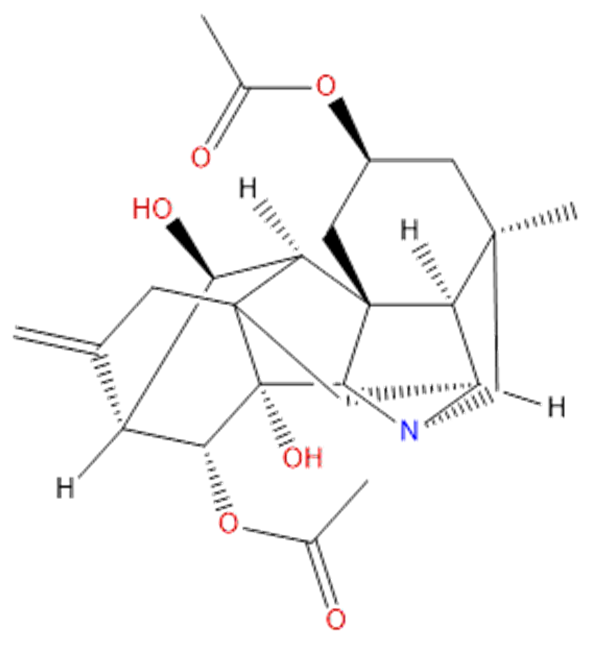


Product name: Acehytisine
Synonym name: Guan-fu base A
Catalogue No.: BP4602
Cas No.: 1394-48-5
Formula: C24H31NO6
Mol Weight: 429.513
Botanical Source:
Type of Compound:
Purity: 95%~99%
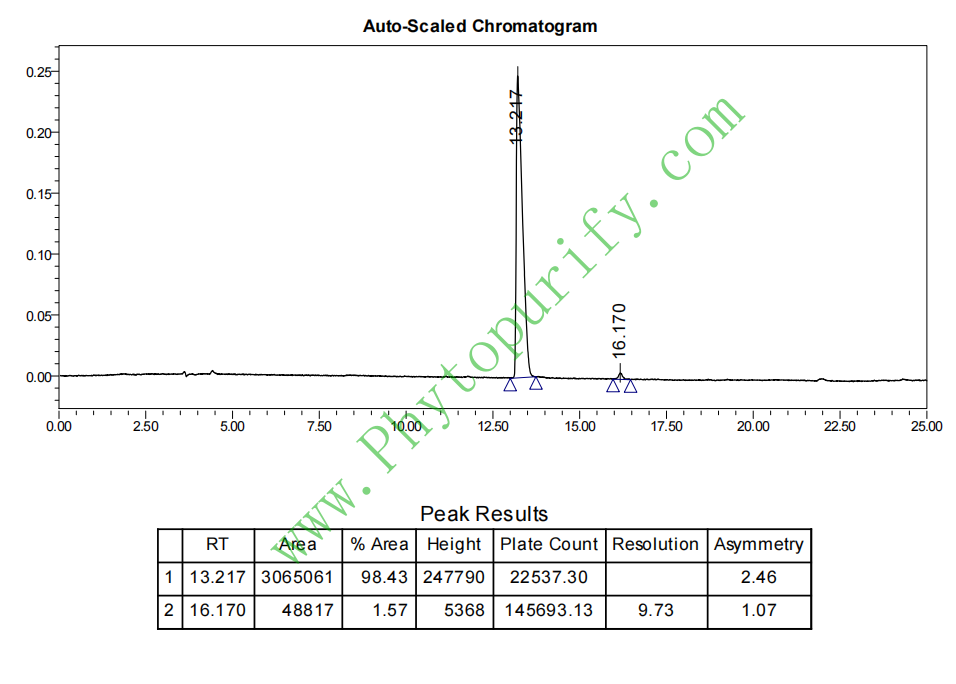
Analysis Method: HPLC-DAD or/and HPLC-ELSD
Identification Method: Mass, NMR
Packing: Brown vial or HDPE plastic bottle
Storage: Store in a well closed container, protected from air and light. Put into refrigerate or freeze for long term storage.
Whenever possible, you should prepare and use solutions on the same day. However, if you need to make up stock solutions in advance, we recommend that you store the solution as aliquots in tightly sealed vials at -20℃. Generally, these will be useable for up to two weeks.
The product could be supplied from milligrams to grams
Inquire for bulk scale.
For Reference Standard and R&D, Not for Human Use Directly.
HPLC of Acehytisine
Storage conditions:Short-term storage at 2~8℃, long-term storage at -20 ~ -80℃
96.3000
1.0328
.9399
.2002
1.7775
1.3272
High
46.9059
7.8083
No
No
No
No
Yes
No
0.6
Yes
No
Yes
No
Arrhythmia is a common and dangerous pathological state in cardiovascular diseases, with a complex mechanism involving multiple aspects such as abnormal ion channel function of myocardial cells, imbalance of autonomic nervous system regulation, and cardiac structural remodeling. Although various synthetic drugs have been applied in clinical practice, there are common side effects such as narrow treatment window and arrhythmia, and there is an urgent need to develop new highly efficient and low toxicity antiarrhythmic drugs. In this context, exploring natural products with clear pharmacological activities from traditional medicinal plants has become one of the important approaches for new drug development. Acehytisine (CAS number: 1394-48-5) is a C20 diterpenoid alkaloid isolated from the root tubers (traditional Chinese medicine "Guanbaifu") of Aconitum coreanum (L é vl.) Rapiacs, a plant in the Aconitum genus of the Ranunculaceae family. It is one of the main active ingredients in the anti arrhythmic effect of Guanbaifu. Since its discovery, numerous studies have confirmed its significant antiarrhythmic activity and preliminarily revealed its multi-target mechanism of action, making it a highly promising natural candidate drug for development. This article aims to systematically review the chemical structure, plant origin, pharmacological activity, mechanism of action, medicinal properties, and clinical application prospects of Guanfu Jia Su, in order to provide comprehensive academic references for the in-depth research and development of this compound.
Guanfu A belongs to the C20 diterpenoid alkaloids, with a molecular formula of C25H39NO5 and a molecular weight of 429.5130. Its basic skeleton is of the hetisine type, containing multiple oxygen-containing functional groups, including hydroxyl and ester bonds, which have a significant impact on its solubility and biological activity. From the perspective of pharmacological parameters, its lipid water partition coefficient (LogP) is 1.0328, indicating moderate lipophilicity; The topological polar surface area (TPSA) is 96.3000 Å ², reflecting the proportion of polar atoms in the molecule; The water solubility value is 0.2002 mg/mL, which is slightly soluble. It is worth noting that its blood-brain barrier permeability is predicted to be "high", indicating that the compound may easily enter the central nervous system, which requires assessment of its potential central effects or neurotoxicity. However, the key hERG channel inhibition prediction is' no ', which is a positive signal because hERG channel inhibition is the main mechanism by which many drugs cause acquired long QT syndrome and fatal arrhythmias (apical torsion ventricular tachycardia), and there is no risk of this prediction for Guan Fu A, providing preliminary theoretical support for its cardiac safety. The Ames test result is 0.6, indicating a low risk of mutagenicity. These physicochemical and preliminary toxicological parameters together outline a molecular profile with great potential for development.
Guanfu Jia is mainly derived from the dried tubers of Aconitum coreanum, a plant in the Aconitum genus of the Ranunculaceae family. This medicinal herb is called "Guanbai Fu" in traditional Chinese medicine and has the effects of dispelling wind and phlegm, calming epilepsy, detoxifying and dispersing nodules. It is traditionally used to treat symptoms such as stroke induced phlegm obstruction, mouth and eye deviation, epilepsy, and abnormal headache. Aconitum plants generally contain a variety of diterpenoid alkaloids, many of which have strong neurotoxicity and cardiotoxicity (such as aconitine). However, the chemical form in which aconitine is located is relatively unique, and its parent nucleus structure determines its low toxicity and significant cardiac pharmacological activity.
The modern process of solvent extraction combined with chromatographic separation is commonly used for the extraction of Guanfu Jia Su. The general process is as follows: after drying and crushing the medicinal material of Guanbai Fu, reflux extraction or percolation extraction is carried out using a suitable polar organic solvent (such as ethanol, methanol or acid water). After concentration, the extract is dissolved in acidic water, alkalized, and extracted with organic solvents such as chloroform or dichloromethane to enrich total alkaloids. Subsequently, various chromatographic techniques such as silica gel column chromatography, alumina column chromatography, and preparative high-performance liquid chromatography (HPLC) were used for repeated separation and purification, ultimately obtaining high-purity Guan Fu A monomer. Process optimization usually focuses on improving extraction efficiency, reducing residual toxic alkaloids, and lowering production costs, laying the material foundation for subsequent pharmacological research and formulation development.
The core pharmacological activity of Guanfu A is anti arrhythmic, which has been fully validated in various experimental models.
1. in vivo experiments In animal models of arrhythmia induced by various drugs (such as aconitine, barium chloride, adrenaline, chloroform, etc.) or electrical stimulation (such as electrically induced ventricular fibrillation), intravenous injection or gavage of Guan Fu A can significantly reduce the incidence of arrhythmia, shorten its duration, and increase the fibrillation threshold. For example, in a rat model of arrhythmia induced by aconitine, guanfu A can dose dependently delay the onset time of arrhythmia and alleviate its severity.
2. in vitro experiment In vitro hearts (such as Langendorff perfused hearts) and isolated individual myocardial cells, guanosine A exhibits a broad regulatory effect on myocardial electrophysiological properties. It can prolong action potential duration (APD), effective refractory period (ERP), and slow down conduction velocity. These effects help interrupt reentry excitation, inhibit ectopic pacing, and thus combat various types of arrhythmias.
3. Other activities In addition to antiarrhythmic effects, some studies suggest that Guanfu A may have sedative, anti-inflammatory, and neuroprotective effects, but further research is needed to clarify these activities and their association with cardiac effects.
The antiarrhythmic effect of Guan Fu Jia Su is not achieved through a single "ion channel blocker" mode, but is manifested as a multi-target, comprehensive regulation, which may be an important reason for its significant therapeutic effect and low potential risk of arrhythmia. The main targets of its action involve the following key cardiac ion channels and receptors:
1. potassium ion channel:
* KCNH2 (hERG, encoding fast delayed rectifier potassium current I2 Kr)The inhibition prediction of hERG channel by Guan Fu A is negative, which is different from classical class III antiarrhythmic drugs such as sotalol and dofetide, and avoids the risk of apical torsion ventricular tachycardia caused by excessive prolongation of ventricular repolarization (QT interval). But it may work by regulating other potassium currents.
* KCNQ1/KCNE1 (encoding slow delay rectifier potassium current I2 Ks)Research has shown that Guan Fu Jia Su can inhibit the current of I2 Ks, which helps to effectively prolong the duration of action potential and refractory period even when heart rate increases, enhancing its anti arrhythmic efficacy.
* Other potassium channel subunits (such as KCNE2)It may also participate in regulation, affecting background potassium current or other repolarization reserve currents.
2. Sodium ion channel:
* SCN5A (encoding cardiac voltage-gated sodium channel Nav1.5, responsible for fast sodium current I2 Na)Guanfu Jia Su has a use dependent blocking effect on sodium channels, which is stronger when the heart rate is high (channel opening frequency is high). It can inhibit the peak value of I-Na, slow down the maximum rate of action potential rise in phase 0 (V_max), thereby slowing down the conduction velocity of the heart, which helps to terminate reentrant arrhythmia, similar to the effect of class I antiarrhythmic drugs, but the intensity may be moderate.
3. Calcium ion channel:
* CACNA1C (encoding L-type voltage-gated calcium channel Cav1.2, responsible for L-type calcium current I2 Ca-L)Guanfu Jia Su can inhibit I-Ca-L and reduce calcium ion influx. On the one hand, this can reduce the cytoplasmic calcium concentration of myocardial cells, weaken myocardial contractility (negative inotropic effect), and on the other hand, it can help prolong the action potential plateau period and may inhibit the occurrence of afterdepolarization (especially early afterdepolarization, EADs).
* RYR2 (encoding sarcoplasmic reticulum receptor 2, RyR2)Lanine receptors are key channels that regulate the release of calcium from the sarcoplasmic reticulum. Some studies suggest that Guanfu A may stabilize RyR2, reduce diastolic calcium leakage, and inhibit calcium mediated delayed depolarization (DADs) and its triggered ventricular arrhythmias. This is a potential unique mechanism that distinguishes it from many traditional antiarrhythmic drugs.
Comprehensive mechanism In summary, Guan Fu Jia Su forms a multi-target synergistic network by simultaneously and moderately inhibiting sodium current (slowing down conduction), L-type calcium current (prolonging plateau phase, inhibiting EADs, negative muscle strength), and slow delayed rectifier potassium current (prolonging repolarization) in cardiomyocytes, and possibly stabilizing sarcoplasmic reticulum calcium release (inhibiting DADs). This "broad-spectrum" but "mild" regulatory mode enables it to intervene more comprehensively in multiple electrophysiological processes involved in the occurrence of arrhythmia (autonomic abnormalities, triggering activity, reentry), while potentially reducing the risk of inducing new fatal arrhythmias due to its minimal impact on hERG channels and balanced blocking of various currents.
Based on its physicochemical parameters and preliminary pharmacological and toxicological data, Guanfu Jia Su has shown certain potential as a drug.
* Absorption, distribution, metabolism, excretion (ADME)There are relatively limited reports on pharmacokinetic studies of the Guan Fu Jia Su system. Its moderate LogP value and high blood-brain barrier permeability prediction suggest that it may have some absorption after oral administration and can be distributed to multiple tissues including the heart and central nervous system. As an alkaloid, its metabolism in the body may mainly be through oxidation, hydrolysis and other reactions by the liver cytochrome P450 enzyme system, and the metabolites and their activities need to be clarified. The excretion pathway may involve the kidneys and bile. In the future, in-depth animal and human pharmacokinetic studies are needed to clarify their absolute bioavailability, half-life, tissue distribution characteristics, major metabolic pathways, and excretion kinetics.
* safety evaluation A negative Ames test indicates a low risk of genetic toxicity. The negative prediction of hERG inhibition, a key cardiac safety indicator, is a significant advantage over many synthetic antiarrhythmic drugs. However, as compounds derived from the Aconitum genus, their potential neurotoxicity, acute toxicity, and long-term chronic toxicity still need to be rigorously evaluated through comprehensive GLP toxicology studies (such as acute toxicity, long-term toxicity, reproductive toxicity, carcinogenicity tests). Its high blood-brain barrier permeability also requires attention to its potential impact on the central nervous system.
* Formulation development Due to its poor water solubility, developing formulations suitable for intravenous or oral administration is a major challenge. It may be necessary to use solubilization techniques (such as cyclodextrin inclusion, nanocrystals, liposomes, micelles, etc.) or structural modifications (to prepare water-soluble prodrugs) to improve their bioavailability and ease of administration.
As a natural active molecule derived from traditional Chinese medicine, Guan Fu Jia Su's multi-target anti arrhythmic properties provide unique opportunities for its clinical translation, but also face many challenges.
prospect:
1. New multi-target antiarrhythmic drug candidates In the context of precision medicine and network pharmacology, multi-target drug strategies for complex diseases such as arrhythmia are increasingly being emphasized. The natural multi ion channel regulatory effect of Guan Fu Jia Su may be particularly suitable for treating complex arrhythmias involving multiple electrophysiological mechanisms, where traditional single target drugs have poor efficacy or significant side effects.
2. Potential security advantages Its characteristic of not inhibiting hERG channels may make it have a lower risk of QT interval prolongation and apical torsion ventricular tachycardia, which is particularly important for patients who require long-term medication.
3. Examples of Modernization and Internationalization of Traditional Chinese Medicine The in-depth study of Guan Fu Jia Su is a successful example of identifying active ingredients from traditional Chinese medicine, clarifying scientific connotations, and ultimately developing modern innovative drugs, which helps to promote the modernization and international recognition of traditional Chinese medicine.
Challenges and Prospects:
1. In depth mechanism research At present, there is still a need to deepen our understanding of the targets of Guan Fu A, especially its direct effects on intracellular targets such as RyR2, the weight of each target's contribution, and the changes in its effects under pathological conditions such as heart failure and myocardial ischemia.
2. Optimization of drug properties in the system Comprehensive preclinical pharmacokinetic and toxicological studies must be completed. A systematic pharmaceutical research is needed to address the issue of poor water solubility. When necessary, reasonable structural modifications can be considered to optimize its solubility, metabolic stability, or target selectivity while retaining the core pharmacophore.
3. Clinical study design If clinical research is to be conducted in the future, it is necessary to carefully design the trial protocol, clarify the most suitable type of arrhythmia (such as atrial fibrillation, premature ventricular contractions, specific types of ventricular tachycardia, etc.), explore its potential for combination therapy with existing drugs, and strictly monitor its long-term safety and efficacy.
4. Source quality control To ensure the stable and sustainable supply of raw materials for Aconitum carmichaelii, it is necessary to establish standardized planting (GAP) standards for Aconitum carmichaelii and standardized production processes (GMP) for its extraction and purification.
Guanfu Jia, as a natural diterpenoid alkaloid discovered from the traditional Chinese medicine Guanbai Fu, has become a remarkable candidate molecule in the field of natural product drug development due to its clear anti arrhythmic activity and unique multi-target mechanism of action. It exhibits a broad-spectrum and relatively balanced antiarrhythmic effect by synergistically regulating multiple ion channels such as sodium, potassium, and calcium, and may act on intracellular calcium processing proteins. Its non inhibitory property on hERG channels further suggests potential good cardiac safety. Although there are still a series of scientific problems and technical challenges that need to be solved in comprehensively elucidating its molecular mechanism, optimizing drug properties, and promoting clinical translation, the research on Guan Fu A undoubtedly provides important lead compounds and new ideas for the development of a new generation of highly efficient and low toxicity antiarrhythmic drugs. With the continuous deepening of interdisciplinary research, Guanfu Jia Su is expected to emerge from the treasure trove of traditional Chinese medicine and ultimately develop into a modern innovative drug that benefits arrhythmia patients worldwide.
