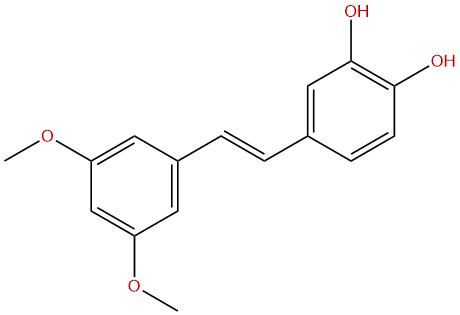


Storage conditions:Short-term storage at 2~8℃, long-term storage at -20 ~ -80℃
3 '- Hydroxypterostilbene (CAS number: 475231-21-1) is a naturally occurring hydroxylated derivative and an important isomer of pterostilbene compounds. Purple sandalwood and its derivatives have received widespread attention in the field of natural product pharmacology in recent years due to their diverse biological activities and good medicinal properties. 3 '- Hydroxy Pterostilbene, as a hydroxylated derivative of Pterostilbene, exhibits unique biological functions, particularly in antioxidant, anti-inflammatory, anti-tumor, and neuroprotective aspects, demonstrating potential medicinal value. This article will provide a systematic review of the chemical structure, physicochemical properties, plant sources, and extraction methods of 3 '- hydroxypterostilbene. Combining its pharmacological activity and mechanism of action, we will delve into its pharmacological parameters and pharmacokinetic characteristics. Finally, we will look forward to its clinical application potential and future research directions.
3 '- Hydroxypterostilbene is a natural product of stilbene, with a chemical formula of C16H16O4 and a molecular weight of 272.30. Its structural feature is the substitution of hydroxyl groups at the 3 'position on the rosewood skeleton, which significantly affects its polarity and biological activity. According to the physical and chemical properties data, the LogP value of 3 '- hydroxypterostilbene is 3.3119, indicating that it has moderate lipid solubility and is beneficial for cell membrane penetration. The topological polar surface area (TPSA) is 58.92 Å ², indicating its good potential in membrane permeability and binding to biological targets. The low water solubility (0.0409 mg/mL) to some extent limits its oral bioavailability, but the high lipid solubility facilitates its crossing of the blood-brain barrier (BBB), which is further confirmed by its high BBB penetration. In addition, 3 '- hydroxypterostilbene does not possess hERG channel inhibitory activity, indicating a low risk of cardiac toxicity. The Ames test value is 1.2, indicating a low risk of genetic toxicity and meeting safety requirements.
3 '- Hydroxy Pterocarpus mainly exists in various Pterocarpus plants, especially in the roots, stem bark, and leaves of Pterocarpus and related plants. Its natural content is relatively low, and it is usually detected as a hydroxyl derivative of rosewood. Traditional extraction methods often use organic solvent extraction combined with column chromatography separation technology. The specific steps include:
In recent years, with the development of green extraction technology, new technologies such as supercritical CO2 extraction and microwave-assisted extraction have gradually been applied to the extraction of 3 '- hydroxyrosewood, improving extraction efficiency and purity while reducing the use of organic solvents.
The pharmacological activity research of 3 '- hydroxypterostilbene mainly focuses on its antioxidant, anti-inflammatory, anti-tumor, and neuroprotective aspects, and related studies often use in vitro cell models and in vivo animal models.
3 '- Hydroxypterostilbene exerts significant antioxidant effects by scavenging free radicals and regulating antioxidant enzyme systems such as superoxide dismutase (SOD) and glutathione peroxidase (GPx). Its hydroxyl structure contributes to the enhancement of electron donor ability, promotes the capture of free radicals, and reduces oxidative stress damage to cells.
Multiple studies have shown that 3 '- hydroxyrosewood can inhibit the production of inflammatory mediators such as tumor necrosis factor alpha (TNF - α), interleukin-6 (IL-6), and nitric oxide (NO), and downregulate the nuclear factor kappa B (NF - κ B) signaling pathway, thereby reducing inflammatory response. Its anti-inflammatory effect has shown good therapeutic potential in inflammatory disease models.
3 '- Hydroxypterostilbene exhibits inhibitory effects on cell proliferation and induces apoptosis in various tumor cell lines. The mechanism involves cell cycle arrest, activation of mitochondrial pathways, and regulation of the expression of apoptosis related proteins such as Bax and Bcl-2. In addition, 3 '- hydroxyrosewood can also inhibit the migration and invasion of tumor cells, indicating its potential in tumor metastasis inhibition.
Due to its excellent blood-brain barrier penetration, 3 '- hydroxypterostilbene exhibits neuroprotective effects in neurodegenerative disease models. By reducing oxidative stress, inhibiting neuroinflammation, and regulating neurotransmitter balance, 3 '- hydroxyrosewood is expected to be used as an adjuvant therapy for diseases such as Alzheimer's disease and Parkinson's disease.
The multi-target mechanism of action of 3 '- hydroxypterostilbene mainly includes the following aspects:
The synergistic effect of these molecular mechanisms endows 3 '- hydroxypterostilbene with a broad biological activity basis.
The pharmacological parameters of 3 '- hydroxypterostilbene indicate that it has good potential for drug development. The molecular weight is 272.3, which conforms to Lipinski's rule. The LogP value is moderate at 3.31, indicating that it has good lipid solubility and is conducive to cell membrane penetration. The TPSA is 58.92 Å ², below the threshold of 90 Å ², which is favorable for oral absorption and blood-brain barrier penetration. Low water solubility (0.0409 mg/mL) suggests limited solubility, which may affect oral bioavailability, but can be improved through formulation technology.
The high penetration of the blood-brain barrier is its advantage in the treatment of neurological diseases. The hERG channel has no inhibitory effect and reduces the risk of cardiac toxicity. Ames test results show that the genetic toxicity risk is low and the safety is good.
In terms of pharmacokinetics, preliminary in vivo studies have shown that 3 '- hydroxypterostilbene has good oral absorption, moderate plasma half-life, wide distribution, and particularly high concentration in brain tissue. Its metabolism is mainly carried out through the liver enzyme system, and the metabolites need further identification. The main excretion pathways are the kidneys and bile. Further systematic research on its pharmacokinetic parameters and metabolic characteristics is needed in the future to guide clinical dose design.
Given the significant activities and good pharmacological properties of 3 '- hydroxypterostilbene in antioxidant, anti-inflammatory, anti-tumor, and neuroprotective aspects, its clinical development prospects are broad. Specific application directions include:
Future research should focus on preclinical safety evaluation, pharmacokinetic optimization, and formulation development of 3 '- hydroxypterostilbene, while conducting systematic clinical trials to verify its efficacy and safety. In addition, structural optimization and derivative design based on molecular targets will also promote it as a new type of therapeutic drug.
3 '- Hydroxypterostilbene, as an important derivative of natural pterostilbene products, exhibits diverse pharmacological activities and good medicinal properties due to its unique chemical structure and excellent physicochemical properties. Its potential in antioxidant, anti-inflammatory, anti-tumor, and neuroprotective fields provides new ideas and directions for the development of natural product drugs. In the future, through in-depth mechanism research, pharmacokinetic optimization, and clinical validation, 3 '- hydroxypterostilbene is expected to become an effective candidate drug for the treatment of various diseases, promoting the development and application of natural product pharmacology.
