Introduction/Overview
Neurodegenerative diseases such as Alzheimer's disease (AD) and Parkinson's disease (PD) have become major global public health challenges. The common pathological features of these diseases include oxidative stress, mitochondrial dysfunction, protein misfolding and aggregation, and neuronal apoptosis. At present, clinical treatment drugs mainly focus on symptom relief, making it difficult to effectively delay or reverse the disease progression, and often accompanied by side effects. Therefore, searching for lead compounds with multi-target, high efficiency and low toxicity neuroprotective activity from natural products is one of the important directions in current drug development. Tetrahydroperoxide lignin alcohol (THDCA), as a lignan compound isolated from various medicinal plants, has attracted much attention in recent years due to its significant neuroprotective activity in various in vitro and in vivo models. Its unique chemical structure enables it to act on multiple key targets closely related to neurodegenerative diseases, including regulating apoptosis, clearing reactive oxygen species, inhibiting β - amyloid protein production, and enhancing autophagy. This article aims to provide a systematic review of the chemical properties, plant sources, pharmacological activities, mechanisms of action, and pharmacological properties of THDCA, and to explore its potential as a lead compound for neuroprotective drugs.
Chemical structure and physicochemical properties
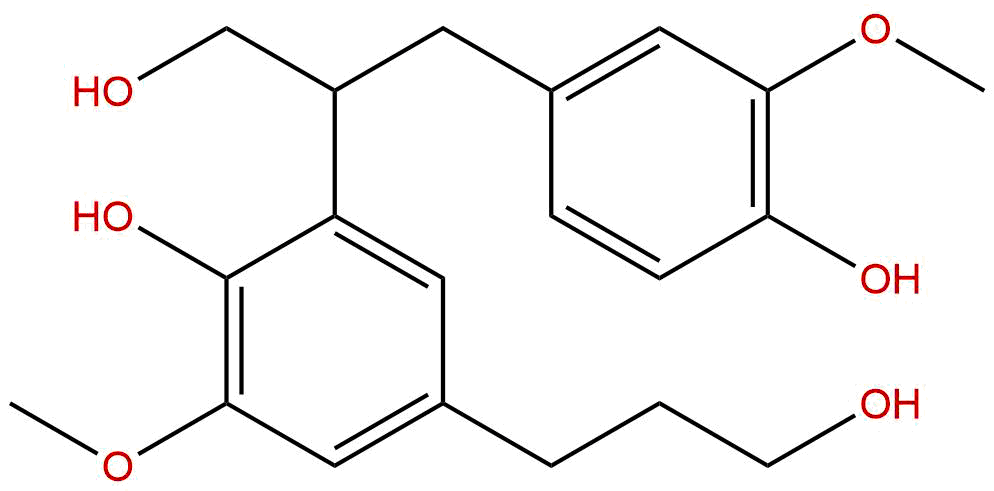
Tetrahydrodihydrodihydrodihydrodihydrodihydrodihydrodihydrodihydroxylenol (CAS number: 5234-70-8), molecular formula C20H26O6, molecular weight 362.4220. Its chemical structure belongs to the diphenyl butyrolactone type lignan in the lignan class of compounds. The basic skeleton is formed by connecting two phenylpropanoid units (C6-C3) through an 8-8 'carbon carbon bond, and further cyclizing to form a lactone ring (butyrolactone structure). At the same time, specific positions on its side chains (usually at C-7 and C-7') are reduced (tetrahydrogenated) and carry hydroxyl (alcohol) substituents. This structure endows THDCA with a certain degree of rigidity and chiral center, and its stereochemical configuration may have a significant impact on its biological activity.
From the perspective of pharmacological parameters, the lipid water partition coefficient of THDCA (calculated LogP value of approximately 2.26) indicates that it has moderate lipophilicity, which facilitates its penetration of cell membranes and binding to hydrophobic targets. Its topological polar surface area (TPSA) is 99.38 Å ², which is relatively high and mainly attributed to multiple hydroxyl and ether oxygen atoms in the molecule. This suggests that it has a strong ability to form hydrogen bonds, but may also affect its transmembrane permeability. The water solubility parameter (approximately 0.27 mg/mL) shows that it is slightly soluble to insoluble in water. It is worth noting that preliminary computer prediction models suggest low blood-brain barrier (BBB) permeability, which may be one of the key bottlenecks that need to be overcome in its development as a central nervous system drug. In the preliminary safety screening, THDCA did not show potential hERG channel inhibitory activity (low risk of arrhythmia), and the Ames test predicted a negative result (no mutagenicity), providing preliminary evidence for its relatively good safety.
Plant sources and extraction methods
THDCA is widely present in various plant families and genera, especially abundant in traditional medicinal plants. Its main plant sources include:
1. Pinaceae plants Resin, heartwood, or bark of various species of pine plants.
2. Asteraceae plants For example, it has been found in the rhizomes of plants such as Inula helenium.
3. Other medicinal plants There have also been isolated reports in some ethnic medicinal plants used for anti-inflammatory, antioxidant, or neuroprotective purposes, such as certain Eucommia ulmoides Related species of Eucommia ulmoides.
The extraction and separation of THDCA usually follow the conventional process of natural product chemistry. Firstly, dry plant materials such as roots, stem bark, or resin are crushed and subjected to cold soaking or heating reflux extraction using polar solvents such as methanol, ethanol, or acetone. After vacuum concentration, the crude extract obtained was subjected to liquid-liquid extraction using solvents such as petroleum ether, ethyl acetate, and n-butanol. THDCA was mainly enriched in the ethyl acetate fraction. Further purification relies on various chromatographic techniques, including silica gel column chromatography (using chloroform methanol or petroleum ether ethyl acetate gradient elution), reverse phase silica gel (such as ODS) column chromatography, and high-performance liquid chromatography (HPLC) preparation. Its structural identification is mainly completed through modern spectroscopic techniques, including nuclear magnetic resonance (1H NMR, 13C NMR, 2D NMR such as HSQC, HMBC), mass spectrometry (ESI-MS, HR-ESI-MS), and optical rotation determination.
Pharmacological activity research
Numerous studies have confirmed that the core pharmacological activity of THDDA is concentrated in neuroprotection The field has demonstrated potential in various experimental models.
-
Cellular level neuroprotection:
- anti-oxidative stress In PC12 cells (rat pheochromocytoma cells), SH-SY5Y cells (human neuroblastoma cells) or primary cortical neuron injury models induced by hydrogen peroxide (H2O2), glutamate or β - amyloid protein (A β), THDCA pretreatment can significantly improve cell survival rate and reduce lactate dehydrogenase (LDH) leakage rate. The mechanism is closely related to reducing intracellular reactive oxygen species (ROS) accumulation, restoring mitochondrial membrane potential, and enhancing endogenous antioxidant enzyme activities such as superoxide dismutase (SOD) and glutathione peroxidase (GSH Px).
- anti-apoptotic THDCA can inhibit neuronal apoptosis induced by neurotoxins, manifested by reducing the proportion of apoptotic cells (Annexin V/PI double staining), decreasing mitochondrial cytochrome c release, and downregulating pro apoptotic proteins (such as Bax) and upregulating the expression of anti apoptotic proteins (such as Bcl-2).
- anti-inflammatory effect In the activation model of microglia (such as BV2 cells), THDCA can inhibit the excessive production of nitric oxide (NO), prostaglandin E2 (PGE2), and pro-inflammatory cytokines (such as TNF - α, IL-1 β, IL-6) induced by lipopolysaccharide (LPS), suggesting that it may indirectly protect neurons by regulating neuroinflammation.
-
Animal model research:
- Alzheimer's disease model In the AD mouse model induced by lateral ventricular injection of A β 1-42, intraperitoneal injection or gavage of THDCA significantly improved the spatial learning and memory abilities of mice (Morris water maze test), reduced neuronal loss in the hippocampus, and lowered the burden of A β plaques in the brain. Similar learning and memory improvement effects were also observed in APP/PS1 transgenic AD model mice.
- Parkinson's disease model In MPTP (1-methyl-4-phenyl-1,2,3,6-tetrahydropyridine) or 6-OHDA (6-hydroxydopamine) induced PD mouse or rat models, THDCA treatment can protect dopaminergic neurons in the substantia nigra pars compacta, reduce the loss of tyrosine hydroxylase positive cells, and improve animal motor coordination ability (rotating rod, open field experiments).
- Cerebral ischemia/reperfusion injury model In the middle cerebral artery occlusion (MCAO) model rats, THDCA pretreatment or post-treatment can reduce cerebral infarction volume, alleviate brain edema, and improve neurological deficit scores.
Mechanism of action and molecular targets
The neuroprotective effect of THDCA is not achieved through a single pathway, but involves a complex multi-target regulatory network, which is consistent with its characteristics as a natural product. The potential molecular targets and pathways revealed by existing research include:
-
Regulating cell apoptosis and survival pathways:
- Bcl-2/Bax pathway THDCA can upregulate the expression of anti apoptotic protein Bcl-2 and downregulate the expression of pro apoptotic protein Bax, thereby inhibiting cell apoptosis through the mitochondrial pathway.
- Caspase cascade reaction It can inhibit the activation of apoptosis executor Caspase-3.
- MAPK/ERK pathway Promote cell survival and proliferation signals by activating extracellular signal regulated kinases (MAPK1/ERK).
-
Combat oxidative stress:
- Nrf2/ARE pathway THDCA is an effective activator of nuclear factor E2 related factor 2 (NFE2L2/Nrf2). It can promote the translocation of Nrf2 from the cytoplasm to the nucleus, bind to antioxidant response elements (ARE), and upregulate the expression of phase II detoxifying enzymes such as heme oxygenase-1 (HO-1), NAD (P) H quinone oxidoreductase 1 (NQO1), and antioxidant proteins, which is its core antioxidant mechanism.
-
Intervention in key pathological processes of Alzheimer's disease:
- Starch like protein pathway THDCA has been reported to downregulate the expression of amyloid precursor protein (APP) and inhibit the activity of β - secretase 1 (BACE1), thereby reducing the production of A β.
- Tau protein phosphorylation It may indirectly reduce the abnormal hyperphosphorylation of microtubule associated protein tau (MAPT) by regulating the related kinase/phosphatase system.
- Acetylcholinesterase inhibition Some studies have shown that it has acetylcholinesterase (ACHE) inhibitory activity, which may help improve cholinergic neurotransmission defects.
-
Regulating protein homeostasis and cellular autophagy:
- SIRT1 activation THDCA can activate the deacetylase SIRT1. The activation of SIRT1 is not only related to energy metabolism and antioxidant stress, but also regulates autophagy related proteins (such as Atg5, Atg7, LC3) through deacetylation, promoting autophagic flow and clearing misfolded protein aggregates (such as A β, α - synuclein (SNCA)).
- Alpha synuclein clearance In PD related models, its protective effect may be related to promoting the clearance of abnormal alpha synuclein.
-
Anti neuroinflammation By inhibiting the excessive activation of microglia and downstream inflammatory signaling pathways such as NF - κ B, the damage to neurons caused by neuroinflammation can be alleviated.
Evaluation of drug properties and pharmacokinetics
Although THDCA exhibits excellent pharmacological activity, its potential as a drug candidate molecule still requires comprehensive evaluation.
- Absorption, distribution, metabolism, excretion (ADME)Currently, there are relatively limited reports on pharmacokinetic studies of the THDCA system. Based on its physicochemical properties (moderate LogP, high TPSA), it is predicted that its oral bioavailability may be moderately low. Its blood-brain barrier permeability is predicted to be "low", which is a major obstacle to the development of central nervous system drugs, and may need to be improved through structural modifications (such as prodrug preparation, nano formulations) or the combined use of delivery technologies. In the body, lignans typically undergo extensive phase I (such as oxidation by cytochrome P450 enzymes) and phase II (glucuronidation and sulfation) metabolism. Clarifying its main metabolites, metabolic enzymes, and excretion pathways is crucial for evaluating its drug efficacy persistence and potential drug interactions.
- safety Preliminary computer predictions (hERG inhibition negative, Ames test negative) suggest a good starting point. However, a complete preclinical safety evaluation is still needed, including acute toxicity, subchronic toxicity, genetic toxicity, reproductive toxicity, and other experiments, to determine its safe dosage range.
- Formulation development Due to its poor water solubility, developing suitable drug delivery formulations is another challenge. Explorable dosage forms include cyclodextrin inclusion complexes, solid dispersions, liposomes, nanoemulsions, or polymer nanoparticles to enhance their solubility, stability, and bioavailability.
Clinical application prospects and prospects
THDCA, as a multi-target neuroprotective agent, has broad application prospects in the treatment of neurodegenerative diseases such as Alzheimer's disease, Parkinson's disease, post-stroke nerve damage, and even amyotrophic lateral sclerosis (ALS). Its advantage lies in the ability to intervene in multiple key pathological processes (oxidative stress, apoptosis, protein misfolding, inflammation) simultaneously, which may produce synergistic effects and more effectively delay disease progression.
Future research directions should focus on:
1. In depth mechanism research Using chemical biology methods such as affinity fishing, molecular docking, and kinetic simulations to more accurately identify its direct target and elucidate the network relationships of its multi-target interactions.
2. Optimization of drug properties of the system Based on the structure-activity relationship (SAR) study, the rational structural modification of THDCA aims to improve its blood-brain barrier permeability, metabolic stability, efficacy, and selectivity. For example, esterification or etherification of its phenolic hydroxyl group, or modification of the lactone ring.
3. Advanced delivery system development Actively developing brain targeted delivery systems, such as nanocarriers loaded with THDCA (with surface modifications to promote BBB penetration), or coupling them with penetrating peptides.
4. Complete preclinical development chain Validate its long-term efficacy in animal models closer to human diseases, such as humanized genetically modified animal models, and complete comprehensive GLP toxicology studies to lay the foundation for its application for clinical trials (IND).
5. Explore combination therapy Consider combining THDCA with existing standard therapeutic drugs such as donepezil and levodopa, which may have a synergistic effect and reduce side effects.
Conclusion
THDCA, a highly promising neuroprotective lead compound, has been discovered from natural plant resources. It exhibits clear protective effects against neurodegenerative diseases in cellular and animal models by activating the Nrf2/ARE antioxidant pathway, regulating the balance of Bcl-2/Bax apoptosis, inhibiting BACE1 to reduce A β production, activating SIRT1 to promote autophagy, and other multiple mechanisms. Despite facing challenges in blood-brain barrier permeability and pharmacokinetics, its multi-target nature and good preliminary safety prediction make it of significant development value. By optimizing and modifying it through modern medicinal chemistry, pharmacy, and pharmacology methods, THDCA is expected to derive a new generation of innovative drugs for the prevention and treatment of neurodegenerative diseases, bringing new hope to the growing number of neurological disease patients worldwide.