Introduction/Overview
Natural products have long been an important source of innovative drug discovery, and their structural diversity and wide range of biological activities provide unique molecular frameworks for addressing various disease challenges. Among numerous natural compounds with potential, Tectol (CAS number: 24449-39-6) has gradually entered the field of pharmacological researchers. Wunanphenol is a medicinal plant derived from Lippia sidoides Terpenoids isolated from (commonly known as "Brazilian mint" or "alecrim pimata"). Early studies have revealed its significant in vitro anti leukemia activity, which can effectively inhibit the growth of human leukemia cell lines HL60 and CEM. Subsequent mechanistic studies have shown that naringenin is an effective Farnesyltransferase (FTase) inhibitors It exhibits micromolar level inhibitory activity against FTases derived from both humans and parasites (such as Trypanosoma brucei) with IC50 values of 2.09 μ M and 1.73 μ M, respectively. In addition, its inhibitory effect on drug-resistant Plasmodium falciparum strain (FcB1) (IC50 of 3.44 μ M) and potential broad-spectrum antibacterial activity further broaden its application prospects as a lead compound, covering multiple therapeutic fields such as tumors, parasitic diseases, and bacterial infections. The purpose of this article is to systematically review the chemical properties, plant sources, pharmacological activities, mechanisms of action, pharmacological evaluation, and clinical application potential of Wunanfen, in order to provide comprehensive scientific references for the in-depth research and development of this compound.
Chemical structure and physicochemical properties
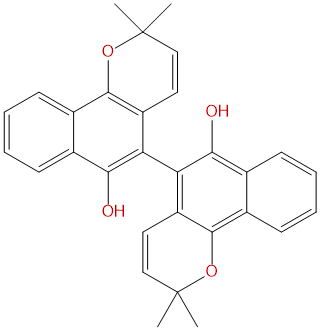
Wunanphenol is a type of Sesquiterpenes Natural organic compounds. Its molecular formula is C30H50O2, with a molecular weight of 450.5340 g/mol. Structurally, naringenin has a complex polycyclic system, and its characteristic structural units are similar to known farnesyltransferase inhibitors (such as certain terpenoids), providing a structural basis for its biological activity.
The key physicochemical property parameters are as follows:
* Lipid water partition coefficient (LogP): 7.3837. This value is significantly greater than 5, indicating that wunanphenol has extremely strong Lipophilic nature A high LogP value typically indicates high solubility of compounds in non-polar solvents or biofilms, but this also directly leads to poor water solubility.
* Water solubility Approximately 0.0003 mg/mL, belonging to the category of almost insoluble in water. This characteristic is one of the main challenges it faces in formulation development and in vivo administration.
* Topological Polarity Surface Area (TPSA)58.9200 Å ². The relatively small TPSA is consistent with its high LogP value, further confirming its low molecular polarity.
* Blood-brain barrier permeability Predicted as' low '. Although its high lipophilicity is usually advantageous for penetrating biological membranes, its excessively high molecular weight (>450) and possible other molecular properties may limit its ability to freely pass through the blood-brain barrier.
* HERG inhibition Predicted as' no '. This is a positive signal that suggests that wunanfen may not significantly inhibit the cardiac potassium channel hERG at therapeutic concentrations, thereby reducing the risk of cardiac toxicity induced by acquired long QT syndrome and apical torsion ventricular tachycardia.
* Ames test (prediction)The value is 0.9. The Ames test is commonly used to predict the mutagenic potential of compounds. This value is close to 1, indicating that according to its chemical structure prediction, wunanphenol Low risk of mutagenicity But it still needs to be verified through experiments.
In summary, Wunanfen is a medium molecular weight sesquiterpene with high lipophilicity and low water solubility in chemistry. The favorable hERG and Ames prediction results provide preliminary safety clues for subsequent development, but the extremely poor water solubility and potential absorption, distribution, metabolism, and excretion (ADME) issues will be the core of its pharmacological optimization.
Plant sources and extraction methods
Wunan phenol is mainly derived from Lamiaceae plants Lippia sidoides Separated from Cham. This plant is widely distributed in South America, especially in the northeastern region of Brazil. It is often used in traditional medicine to treat skin infections, respiratory diseases, and as an insect repellent. Its essential oil is known for being rich in thymol and carvacrol, and has strong antibacterial properties.
The extraction and separation of naringenin from plant materials usually follow the conventional process of natural product chemistry:
1. Raw material preparation and drying: Collection L. sidoides The above ground parts (stems, leaves) are washed, dried in a cool place, and crushed into coarse powder to increase extraction efficiency.
2. Preliminary extraction The most commonly used method is Organic solvent extraction method Due to the high lipophilicity of naringenin, medium polarity solvents such as dichloromethane, ethyl acetate, or mixed solvent systems (such as methanol dichloromethane) are often used for cold soaking or heating reflux extraction of plant powders. Supercritical CO2 extraction, as a green technology, may also be suitable for efficient extraction of such lipophilic components and can reduce the degradation of thermosensitive components.
3. Enrichment of crude extract After the crude extract is concentrated under reduced pressure, it is usually first processed Liquid-liquid distribution extraction By utilizing the high solubility of wunanphenol in non-polar solvents such as n-hexane and petroleum ether, it can be separated from the aqueous phase to preliminarily enrich the target components.
4. Separation and Purification The enriched portion needs to be separated and purified through a series of chromatographic techniques. Commonly used silica gel column chromatography Use gradient elution systems with different ratios of petroleum ether ethyl acetate or n-hexane ethyl acetate. Subsequently, further use may be necessary Prepared Thin Layer Chromatography (PTLC) or High performance liquid chromatography (HPLC, commonly using a reverse phase C18 column with methanol water or acetonitrile water as the mobile phase) To obtain high-purity monomeric compounds of wunanphenol. Structural identification is accomplished through spectroscopic techniques such as nuclear magnetic resonance (NMR, including 1H, 13C, and 2D NMR), mass spectrometry (MS), and infrared spectroscopy (IR).
At present, the content of wunanphenol in plants is relatively low, and the yield of its extraction and separation process is a factor limiting its large-scale research and application. In the future, the source problem may be solved through plant cell culture, synthetic biology, or total chemical synthesis.
Pharmacological activity research
Wunanfen exhibits diverse in vitro pharmacological activities, mainly focused on anti-tumor, antiparasitic, and antibacterial fields.
-
Antitumor activity:
- Anti-leukemia Wunanfen was originally used for its effects on Human acute myeloid leukemia cell line HL60 and CEM of human acute T-cell leukemia cells Significant cytotoxicity was discovered. Research has shown that at micromolar concentrations, wunanfen can effectively inhibit the proliferation of these cancer cells and induce their apoptosis. This suggests its potential value in the treatment of hematological malignancies.
-
Antiparasitic activity:
- Anti trypanosomal infection Wunanfen is effective against Trypanosoma brucei FTase, the pathogen that causes African trypanosomiasis, also known as sleeping sickness, exhibits potent inhibitory activity (IC50=1.73 μ M). FTase is crucial for the survival of Trypanosoma cruzi, therefore naringenin can be used as a lead compound for the development of novel anti Trypanosoma drugs.
- against malaria Of particular note is that wunanfen has an effect on Drug resistant malignant malaria parasite strain (FcB1) It has inhibitory activity with an IC50 of 3.44 μ M. The spread of malaria parasite drug resistance is a major threat to global public health, and the effectiveness of naringenin against drug-resistant strains provides hope for its use as a novel antimalarial drug.
-
Antibacterial activity:
Although the direct antibacterial experimental data of Wunanfen itself is not as abundant as that of anti-tumor and antiparasitic drugs in existing public materials, based on its related target information, it can be inferred that it has a potential broad-spectrum antibacterial mechanism. Its function may involve multiple key bacterial targets:
- DNA replication: Acting on GYRA (DNA gyrase A subunit) and PENA (Penicillin Binding Protein 2)Interference with DNA supercoiling and cell wall synthesis.
- protein synthesis Possible targeting GYPB(It is speculated to be a ribosome related target, and the original GYPB may be a typographical error or specific abbreviation. Typically, antibacterial targets involve ribosomes.).
- cell division: Inhibition FTSZ(Bacterial microtubule protein homolog), which prevents bacterial division.
- metabolic pathway: Inhibition FABI(Acyl carrier protein reductase, involved in fatty acid synthesis) and DHFR Dihydrofolate reductase, involved in nucleotide synthesis.
- Drug resistance related targets: May affect MECA(Methicillin resistance associated protein) and other resistance mechanisms.
In addition, its targets also extend to fungi ERG11/CYP51A1(lanosterol 14 α - demethylase, a key enzyme in ergosterol synthesis) and CDR1 The efflux pump protein suggests that it may have antifungal potential, especially against azole resistant fungi.
Mechanism of action and molecular targets
The core mechanism of action of wunanfen has been identified as Inhibition of farnesyltransferase (FTase)。
-
Inhibition of farnesyltransferase (FTase)FTase is an isoprene transferase responsible for covalently linking the farnesyl group to the CAAX box sequence at the C-terminus of certain key signaling proteins (such as Ras, Rho, Lamins, etc.). This post-translational modification (farnesylation) is crucial for these proteins to localize on the cell membrane and exert their functions. Mutation and sustained activation of Ras protein are common driving factors in human cancers. Wunanfen inhibits FTase competitively or through other means (with an IC50 of 2.09 μ M for human FTase), blocking the farnesylation of proteins such as Ras, preventing them from being localized on the membrane and activating downstream survival and proliferation signaling pathways such as MAPK and PI3K/Akt, ultimately leading to tumor cell cycle arrest and apoptosis. In both Trypanosoma brucei and Plasmodium falciparum, the farnesylation pathway is also essential for the growth, development, and survival of parasites. Therefore, the FTase inhibitory activity of naringenin is the main molecular basis for its antiparasitic effect.
-
Hypothesis of multi-target antibacterial activity As mentioned earlier, the antibacterial potential of naringenin may stem from its inhibition of multiple essential targets of bacteria and fungi. This Multi target mode of action It has unique advantages in overcoming bacterial single target resistance. For example, simultaneous interference with FTSZ (division), FABI (metabolism), and cell wall synthesis (PENA) may result in a synergistic bactericidal effect and make it difficult for bacteria to develop drug resistance through a single mutation. However, further biochemical experiments (such as enzyme activity inhibition experiments, thermal shift analysis, co crystallization, etc.) are needed to confirm the direct interaction and inhibitory strength between these targets and wunanfen.
-
Inducing cell apoptosis In anti leukemia research, HL60 and CEM cells treated with wunanphenol exhibited typical apoptotic characteristics, such as phosphatidylserine eversion, caspase enzyme activation, and mitochondrial membrane potential decline. This may be due to its inhibition of FTase, leading to activation of non farnesylation pro apoptotic proteins (such as certain Rho family proteins), or by affecting other unclear signaling pathways.
Evaluation of drug properties and pharmacokinetics
Based on its physical and chemical properties and existing data, a preliminary evaluation of the pharmacological properties of Wunanfen is conducted
Clinical application prospects and prospects
Wunanfen, as a FTase inhibitor with multi-target potential, has broad clinical application prospects but is also full of challenges.
Conclusion
Tectol is a natural sesquiterpene compound with multiple biological activities discovered from the traditional medicinal plant Lippia sidoides. Its clear mechanism as a farnesyltransferase inhibitor, as well as its inhibitory potential against drug-resistant malaria parasites and potential multidrug-resistant pathogens, have earned it a place in the research and development of anti-tumor, antiparasitic, and antibacterial drugs. However, its extremely poor water solubility and incompletely elucidated pharmacokinetic properties are currently the main bottlenecks restricting its development. Future research should focus on fundamentally optimizing drug properties through rational drug design and advanced delivery technologies, supplemented by systematic preclinical efficacy and safety evaluations. Only in this way can Wunanfen be transformed from a potential natural lead compound into an innovative drug that can benefit patients and provide new weapons for addressing global health challenges such as cancer and drug-resistant infections.