Introduction/Overview
Natural products have always been an important source of innovative drug discovery, among which terpenoids have attracted much attention for their structural diversity and wide range of biological activities. Teucvidin, as a diterpenoid isolated from plants of the Teucrium genus, has gradually entered the field of researchers due to its unique chemical structure and potential pharmacological activity since its discovery. Especially in recent years, with the increasingly severe threat of new and recurrent viral diseases worldwide, finding efficient and low toxicity new antiviral drugs has become a top priority. The potential demonstrated by Shanhuoxiangding in antiviral activity screening makes it a candidate molecule worthy of further investigation. This article aims to systematically review the chemical characteristics, plant sources, pharmacological activities, especially its antiviral effect and multi-target mechanism of action, of Shanhuoxiangding, and explore its pharmacological properties and future development prospects, in order to provide comprehensive scientific references for the deep development of this compound.
Chemical structure and physicochemical properties
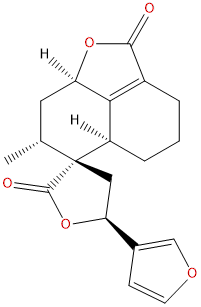
The chemical name of Teucvidin is (1R, 2R, 4aS, 8aS) -1,2,4a, 5,6,7,8,8a-octahydro-1,2,4a-trimethyl-1,2-naphthalenedioic anhydride, and its CAS number is 53625-15-3. Structurally, it is a typical tetracyclic diterpenoid compound with a highly saturated hydrogenated phenanthrene skeleton and a lactone ring structure. This rigid multi ring skeleton and specific functional groups are the structural basis of its biological activity.
Its molecular formula is C20H28O3 and its molecular weight is 328.3640 g/mol. The calculated lipid water partition coefficient (LogP) is 2.4623, indicating that the compound has moderate lipophilicity, which is beneficial for its penetration of cell membranes, but may also affect its water solubility. Its topological polar surface area (TPSA) is 65.74 Å ², which is relatively low, further confirming its good membrane permeation potential. The theoretically calculated water solubility value is relatively low (about 0.0242 mg/mL), indicating that it may need to be improved through formulation methods (such as making salts, using solubilizers or nano formulations) during the development process. Preliminary pharmacological predictions indicate that Shanhuoxiangding has a high blood-brain barrier penetration ability, which provides a possibility for its potential treatment of central nervous system viral infections. In addition, preliminary toxicity predictions indicate a negative risk of hERG inhibition, and the Ames test (prediction) result is 0.0, suggesting that it may have a lower risk of mutagenicity and cardiac toxicity, but further experimental validation is needed.
Plant sources and extraction methods
Shanhuo Xiangding mainly comes from various plants in the Lamiaceae family, Teucrium genus. This genus of plants is widely distributed worldwide and is often used in traditional medicine to treat fever, inflammation, digestive system diseases, and infections. Species such as Teucrium polium and Teucrium chamaedrys are common sources of isolated mountain hawthorn.
Its extraction and separation usually follow the conventional process of natural product chemistry. Firstly, the dried aboveground parts of the plants are crushed and subjected to cold soaking or hot reflux extraction using moderately polar organic solvents such as methanol, ethanol, or acetone to maximize the extraction of diterpenoid components. After vacuum concentration, the crude extract obtained was subjected to liquid-liquid distribution extraction using solvents such as petroleum ether and ethyl acetate. Shanhuoxiangding was mainly enriched in the ethyl acetate fraction. Further purification relies on column chromatography technology, often using silica gel as the stationary phase, with different ratios of petroleum ether ethyl acetate or chloroform methanol gradient elution. According to its polarity characteristics, Shan Huo Xiang Ding usually appears in the medium polarity elution segment. High performance liquid chromatography (HPLC), especially preparative HPLC, is the ultimate key step in obtaining high-purity monomers. Structural identification involves the comprehensive use of techniques such as nuclear magnetic resonance (NMR, including 1H-NMR, 13C-NMR, 2D-NMR), mass spectrometry (MS), and infrared spectroscopy (IR) to confirm by comparing with literature data or known standards.
Pharmacological activity research
The pharmacological activity research of Shanhuoxiangding is currently mainly focused on the field of antiviral, showing broad-spectrum antiviral potential.
1. Antiherpesvirus activity Research has shown that Shanhuoxiangding has significant inhibitory activity against herpes simplex virus (HSV). Its function is not only reflected in inhibiting virus replication, but may also interfere with virus adsorption and entry processes. The targets involved in the study include virus DNA polymerase helper protein UL42, major DNA polymerase UL54, as well as immediate early regulatory proteins ICP27 and thymidine kinase (TK), suggesting that they may inhibit the lifecycle of HSV through multiple pathways. In addition, potential interference with viral envelope glycoprotein D (gD) may affect the initial binding between the virus and host cells.
2. Anti human immunodeficiency virus (HIV) activity Shanhuoxiangding has also shown promising prospects in anti HIV research. Its mechanism of action may involve multiple targets. On the one hand, it may act as a lead compound for HIV entry inhibitors, blocking virus cell fusion by acting on the co receptors CCR5 and/or CXCR4 on the surface of host cells. On the other hand, computational simulations and preliminary biochemical experiments suggest that it may have a certain inhibitory ability on key enzymes of HIV, such as HIV-1 protease (HIV1-PR) and integrase (INT), thereby interfering with virus maturation and genome integration.
3. Other antiviral activities In addition to HSV and HIV, the antiviral spectrum of Shanhuoxiangding may be broader. Its structural characteristics suggest that it may also have inhibitory effects on other enveloped viruses or viruses that rely on specific host factors. For example, myeloperoxidase (MPO) is a key enzyme for neutrophils to produce hypochlorous acid in inflammation and anti infection. Some viruses may utilize the inflammatory environment for replication and transmission. The potential regulatory effect of berberine on MPO may indirectly affect the pathological process of viral infection, but further research is needed to confirm this.
4. Other potential activities As a diterpenoid compound, Shan Huo Xiang Ding may also possess other common biological activities in this family, such as anti-inflammatory and antioxidant effects. These activities may synergize with their antiviral effects, such as improving disease prognosis by reducing the excessive inflammatory response caused by the virus (cytokine storm). However, experimental data in these areas is currently relatively limited and is a direction worth exploring in the future.
Mechanism of action and molecular targets
The antiviral effect of Shanhuoxiangding exhibits multi-target and multi link characteristics, which may be its advantage in efficiently inhibiting viruses and not easily developing drug resistance.
Direct intervention for virus lifecycle:
* Entering the Stage The first line of defense against infection is to block the fusion of viral particles with the host cell membrane by interfering with HSV's gD glycoprotein or competitively binding to HIV's co receptors CCR5/CXCR4.
* Copy and gene expression stage For HSV, virus DNA synthesis may be directly terminated by inhibiting the activity of UL42/UL54 complex (viral DNA polymerase complex); Meanwhile, inhibition of the immediate early protein ICP27 can disrupt the temporal expression regulation of viral genes. For HIV, the potential HIV1-PR and INT inhibitory activities target the two key steps of viral precursor protein cleavage maturation and viral cDNA integration into the host genome, respectively.
* Nucleotide metabolism The potential impact on HSV TK may interfere with the virus's unique nucleotide salvage synthesis pathway, thereby selectively inhibiting virus DNA replication.
Regulation of host targets and microenvironment:
* Host factor utilization Viruses rely on host cytokines to complete replication. The antagonistic effect of Shanhuoxiangding on CCR5/CXCR4 is a typical strategy of using host targets for antiviral treatment.
* Immune and inflammatory regulation The potential inhibitory effect on MPO activity deserves attention. MPO plays an important role in antimicrobial defense, but its excessive production of reactive oxygen species can also lead to tissue damage and chronic inflammation. In certain viral infections, MPO may exacerbate pathology. If Shanhuoxiangding can moderately regulate MPO activity at the site of infection, it may help control virus related inflammatory damage and create a microenvironment that is unfavorable for virus replication. But this belongs to the indirect mechanism of action and needs to be distinguished from the direct antiviral effect.
The multi-target mode of action that combines direct antiviral and indirect immune regulation makes Shanhuoxiangding have the potential to be developed as a novel broad-spectrum or synergistic antiviral drug.
Evaluation of drug properties and pharmacokinetics
Based on computational predictions and limited preliminary research, a preliminary evaluation of the pharmacological properties of Shanhuoxiangding can be conducted.
Advantage:
1. Suitable drug like properties The molecular weight is moderate (~328), and the LogP value is around the ideal range (2-3), indicating that it has good membrane permeability and oral absorption potential.
2. Central nervous system permeability The predicted high blood-brain barrier penetration rate is its outstanding advantage, providing the possibility for the treatment of herpes virus encephalitis, HIV related central nervous system infections, and so on.
3. Preliminary Safety Tips The prediction of no hERG inhibition and Ames mutagenicity provides preliminary positive signals for its safety assessment.
challenge:
1. Poor water solubility Low water solubility is its main physical and chemical defect, which may seriously affect its oral bioavailability and the development of intravenous drug formulations. This needs to be overcome through prodrug design (such as making phosphate or amino acid esters), eutectic technology, or advanced drug delivery systems (such as liposomes, nanoparticles, cyclodextrin inclusion complexes).
2. Lack of pharmacokinetic data At present, there is almost no systematic pharmacokinetic research on Shanhuoxiangding. Its absorption, distribution, metabolism, and excretion (ADME) characteristics, especially its metabolic stability in vivo (diterpenoid lactone structures may be susceptible to esterase hydrolysis or cytochrome P450 enzyme metabolism), major metabolites, half-life, tissue distribution characteristics, etc., are key issues that must be clarified in preclinical development.
3. Potential toxicity Although the calculation prediction is good, it must be validated through comprehensive in vitro and in vivo toxicology experiments. Some Teucrium plants are known to have hepatotoxicity, although the toxicity may originate from other components such as furan diterpenes. However, as one of its extracts, kaempferol still requires detailed liver cell toxicity, genetic toxicity, and long-term toxicity assessments.
Clinical application prospects and prospects
Shanhuoxiangding, as a natural diterpene with multi-target antiviral activity, has broad clinical application prospects, but the road ahead is long.
Potential application directions:
1. Local antiviral agents: For skin and mucous membrane infections caused by HSV (such as herpes labialis and genital herpes), local topical preparations (cream, gel) can be developed preferentially. This can bypass the challenges of its systemic pharmacokinetics and directly act on the infected site, exerting therapeutic effects.
2. Systemic antiviral drugs On the basis of addressing solubility and pharmacokinetics issues, oral or injectable forms can be explored for the treatment of severe systemic HSV infections, herpes virus infections resistant to existing drugs, and as a supplementary or alternative component to HIV combined antiretroviral therapy (cART), especially for viral reservoirs or central nervous system infections.
3. combination therapy Its multi-target properties make it an ideal partner for combination therapy. Combined use with nucleoside analogues such as acyclovir may produce synergistic effects, reducing their respective dosages and resistance risks; Combining with existing HIV entry inhibitors or integrase inhibitors may provide new treatment combinations.
Future research focus:
1. In depth mechanism verification Currently, many target associations are based on calculations or preliminary experiments, and require confirmation of their direct interactions and functional outcomes with various targets through biophysical and cellular biology methods such as surface plasmon resonance (SPR), isothermal titration calorimetry (ITC), co crystallization, and reporter gene systems.
2. Comprehensive preclinical development Conduct ADME and toxicology research in the system, establish stable in vivo pharmacological models (such as HSV mouse infection model and humanized mouse HIV model), evaluate their in vivo efficacy, safety, and therapeutic window.
3. Structural Optimization and Medicinal Chemistry Using it as the parent nucleus, conduct systematic structural modification and structure-activity relationship research. By introducing or altering functional groups, the aim is to improve its water solubility, metabolic stability, target selectivity, and potency, while reducing potential toxicity and obtaining better candidate drugs.
4. Explore new indications Based on its chemical structure, explore its activity in other fields such as anti-inflammatory and anti-tumor (especially virus related tumors).
Conclusion
Teucvidin is a diterpenoid compound with significant antiviral potential derived from the Teucrium genus of plants. Its unique chemical structure endows it with the ability to intervene in the virus lifecycle through multiple targets, covering multiple stages from virus entry, replication to maturation, and may also have the function of regulating the host immune microenvironment. Despite facing challenges such as poor water solubility and lack of pharmacokinetic information in terms of drug properties, its good drug like parameters, predicted central permeability, and preliminary safety implications have laid a positive foundation for its further development. Future research needs to focus on confirming its molecular mechanism of action, systematically evaluating its pharmacokinetic and toxicity characteristics, and optimizing it through medicinal chemistry methods. The research on Shanhuoxiangding not only has the potential to add a new candidate to the antiviral drug library, but also provides a valuable example for exploring multi-target treatment modes of natural products. With the deepening of research, this ancient natural molecule is expected to be revitalized with the help of modern pharmaceutical science, contributing to the challenges of viral diseases.